

You must have an order with a minimum of $1,000.00 to place your order, your current order total is $0.00.
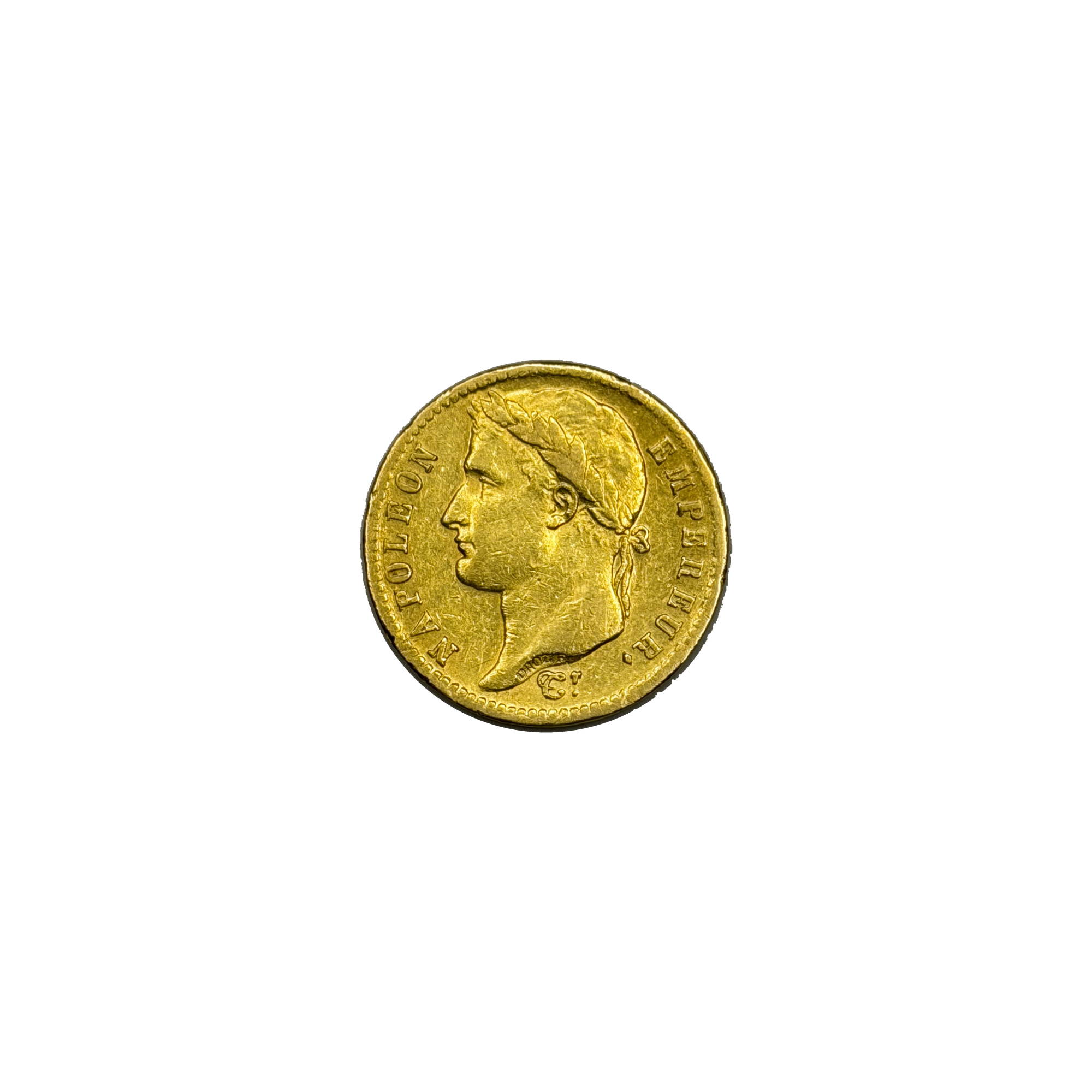
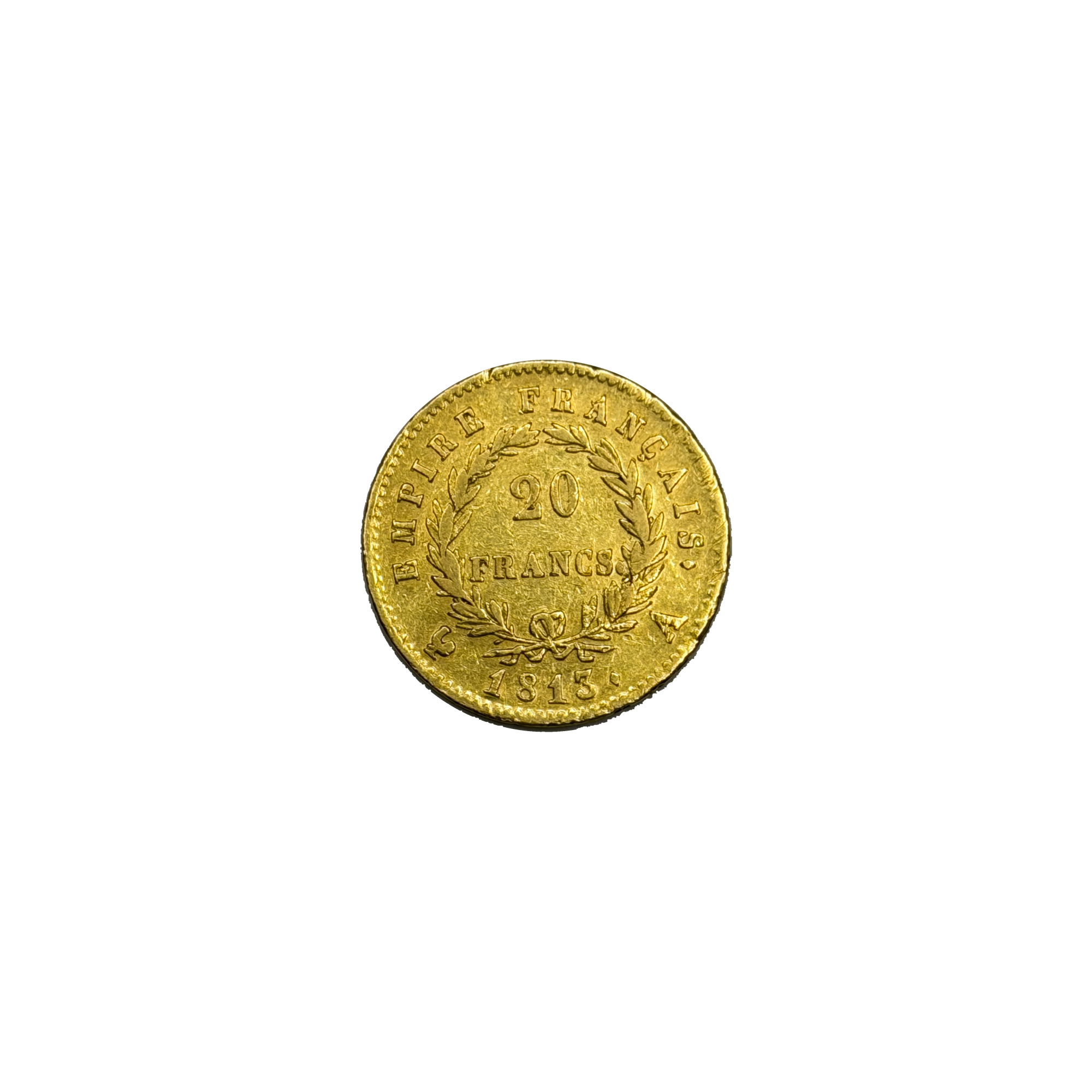
Every French 20 franc gold coin — the Napoleon III, the Ceres, the Angel, the Rooster — descends from this one. The 20 franc gold piece was created under Napoleon Bonaparte’s monetary reform of 1803, which established the gold standard France would maintain for the next 111 years, and the coins offered here were struck between 1802 and 1815 — under the Consulate and the First Empire, while Napoleon himself ruled France. Collectors and investors alike refer to all French 20 franc gold generically as “Napoleons.” These are the coins to which the name actually belongs.
More than two centuries old, these coins carry a premium above the common later French issues, as coins of this age and significance should. The argument is comparative: total production across the entire 1802–1815 series was approximately 19.7 million pieces, a small fraction of the hundreds of millions of French 20 francs struck in the decades that followed, and two centuries of wars, melts, and attrition have reduced the survivors far below what even that figure suggests. At roughly one-fifth of a troy ounce, the coin also offers divisible negotiability: affording its owner the flexibility to liquidate positions incrementally, in amounts proportionate to the specific needs of the moment and across a variety of circumstances. For investors whose priorities are a highly coveted coin steeped in historical significance, comparative scarcity two centuries in the making, and a standardized and widely recognized gold content, the Napoleon Bonaparte 20 franc is the deepest entry into French gold the market makes available — and one that surfaces only irregularly, in small quantities.
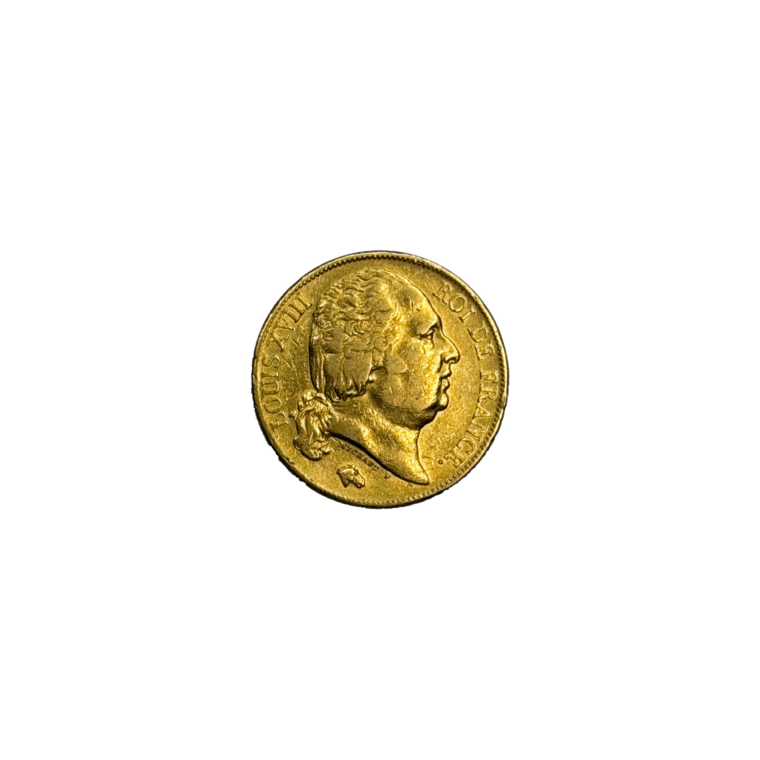
The obverse bears the portrait of Napoleon Bonaparte engraved by Pierre-Joseph Tiolier of the Paris Mint — a bare head on the earlier issues, a laureate head crowned with the victor’s wreath on the later ones. The reverse carries the denomination within a wreath, and its inscription records the arc of Napoleon’s rule: RÉPUBLIQUE FRANÇAISE on the early strikes, EMPIRE FRANÇAIS after the Republic gave way formally to the Empire. The earliest issues are dated in the French Revolutionary calendar — AN XI, AN 12 — a detail found on no other gold coin in the historic fractional market.
At 21mm in diameter and 6.45 grams total weight, each coin is struck from .900 fine gold and contains 0.1867 troy ounces of actual gold content — the specification Napoleon’s 1803 reform established, and the same standard later adopted by the Swiss 20 Franc Helvetia, the Italian 20 Lira, and the Latin Monetary Union issues, all of which remain interchangeable with it at the gold content level. Minted 1802–1815. Grade range: VF.
Napoleon Bonaparte bestrides European history like a colossus — arguably the most famous individual in the continent’s long record. A military tactician of genius, statesman, and lawgiver, he conquered most of Europe, and in one of history’s most audacious gestures crowned himself Emperor in 1804, deliberately following in the footsteps of Charlemagne, the first French emperor. The coins in this series were struck across the full arc of that career: the Consulate, the coronation, Austerlitz, the Empire at its height, the retreat from Moscow, and the Hundred Days of 1815 that ended at Waterloo.
What most investors do not know is that Napoleon was also, by conviction and practice, a hard-money man. He founded the Bank of France in 1800 and rebuilt French finance on gold after the assignat inflation of the Revolution had — in the words of historian Andrew Dickson White — “ended in the complete financial, moral and political prostration of France, a prostration from which only a Napoleon could raise it.” Asked at his first cabinet council what he intended to do, Bonaparte replied: “I will pay cash or pay nothing.” Years later, pressed financially by war and urged to print, he wrote to his minister: “I will never resort to irredeemable paper money.” He never did — and France, under that determination, commanded all the gold she needed. The 20 franc coin was the instrument of that policy. Few coins in the world let an investor hold the monetary philosophy of its issuer in such literal form.
Napoleon’s monetary reform of 1803 — the “franc germinal,” named for its date on the Revolutionary calendar — defined the franc as a fixed weight of gold and established the 20 franc coin as its standard-bearer. That standard proved so durable that France maintained it until 1914, and when France, Belgium, Italy, and Switzerland formed the Latin Monetary Union in 1865, it was Napoleon’s specification — 6.45 grams, .900 fine, 0.1867 ounces of gold — that they adopted. Tens of millions of European gold coins struck across a dozen countries over the following half-century conform to the standard this coin introduced.
The 1802–1815 issues are therefore not simply old French gold; they are the founding instrument of the European gold coin system from which USAGOLD’s entire historic fractional category descends. The final strikes of 1815 — roughly 463,000 pieces — belong to the Hundred Days, Napoleon’s brief return from Elba that ended at Waterloo in June of that year. A coin from this series has been in existence since before there were railroads, telegraphs, or a Bank of England gold standard as the world came to know it.
Total production of the Napoleon Bonaparte 20 franc across all fourteen years — 1802 through 1815 — was approximately 19.7 million pieces. For comparison, France went on to strike hundreds of millions of 20 franc coins across the Napoleon III, Ceres, Angel, and Rooster series; single years of later production approached what the entire Napoleon I series accomplished in fourteen. And the original mintage overstates what survives: these coins circulated as working money through the Napoleonic Wars and for generations afterward, passed through melts and recoinages, and endured two additional centuries of attrition that the later series never faced.
The scarcity argument is therefore comparative and structural: the oldest coin in the French 20 franc family, from the smallest production base, with the longest attrition history — routinely trading at a premium that reflects only a fraction of that difference. The supply is fixed in the strictest sense. No demand event can enlarge it.
The coins USAGOLD offers grade Very Fine (VF) — and on a coin struck between 1802 and 1815, that grade tells a story worth understanding. VF on a two-century-old coin means substantial, honest wear from real circulation: these pieces were money, carried and counted and spent through the Napoleonic era and the decades that followed, and the smoothing on the high points of Tiolier’s portrait is the physical record of that service. The wear is the provenance. A Napoleon Bonaparte 20 franc in VF remains fully identifiable — the portrait clear, the legends and date legible, the coin unmistakably itself — while documenting, on its own surfaces, that it actually passed through the era whose name it carries.
For the investor, the practical points are two. First, VF is the grade in which coins of this age are genuinely encountered; heavy survival in high grade was never realistic for working gold of the early nineteenth century, and the VF population is what the market actually trades. Second, the grade keeps the entry cost of the series’ scarcest dimension — its age — as low as the market allows: the same 1802–1815 supply base and the same pre-1933 standing, at the most accessible price the type offers.
“Napoleon” is the universal shorthand for French 20 franc gold — the most widely traded family of fractional gold coins in Europe for more than a century, recognized by dealers across Europe and North America on sight. The Napoleon Bonaparte issues share the family’s specifications exactly, and trade within one of the deepest and most liquid markets in historic gold. The type also enjoys a second channel of demand: collectors of Napoleonic material and early French coinage compete for these pieces alongside gold investors, a demand layer the later, more common French issues do not enjoy.
In 1933, FDR issued Executive Order 6102, requiring Americans to surrender their gold coin and bullion to the Treasury — but the order and the regulations that followed it exempted gold coins of recognized special value to collectors of rare and unusual coins. Subsequent clarifications by the Treasury identified pre-1933 gold coins — a classification within which the Napoleon Bonaparte 20 franc, struck 1802–1815, stands among the oldest members — as falling within that collector classification as historical items.
Under current constitutional law, a government intervention in the gold market would be executed through the power of eminent domain — the government’s right to take private property for public use provided it pays the owner just compensation. Historic coins complicate the government’s ability to broadly establish “just compensation” or “fair value,” which was precisely the reasoning behind the original “recognized special value” exemption in 1933. That complexity, and the precedent surrounding pre-1933 gold coins, creates a notable impediment to the government’s ability to restrict them broadly — particularly compared to modern bullion, which can be valued easily and consistently at a single price. In essence, it is a bureaucratic question of whether the government would undertake the enormous task of valuing the diversity and complexity of the historic-coin genre — every coin, every date, every condition, every personal holding — and that difficulty is what insulates the owner’s legal liquidity rights in the event of capital controls. A two-century-old coin bearing the portrait of Napoleon himself sits about as far from uniformly-priced bullion as the gold market allows.
Whether a future government intervention in private gold markets is a risk an investor assigns significant weight to is a personal judgment. The factual point is narrower: the pre-1933 status represents a layer of portfolio differentiation that this coin carries along with a measure of insulation for the legal liquidity rights of its owner.
For a more in-depth study, we invite you to read our comprehensive memorandum on this subject: Preparing for a Potential Gold Confiscation
The French 20 Franc Napoleon Bonaparte is the original Napoleon — the founding coin of the European gold standard, struck while its namesake ruled France, its Very Fine surfaces carrying the honest wear of actual Napoleonic-era circulation. It offers comparative scarcity the later French series cannot approach, the deepest historical significance in the fractional gold market, and a standardized and widely recognized gold content — and because survivors surface in small numbers, offerings are irregular and quickly subscribed. No other gold coin available to investors combines this degree of age and historical consequence in a single heirloom-quality instrument.
| Year | Mintage |
|---|---|
| 1802 | 58,262 |
| 1803 | 1,416,387 |
| 1804 | 519,645 |
| 1805 | 154,235 |
| 1806 | 996,367 |
| 1807 | 838,514 |
| 1808 | 1,481,571 |
| 1809 | 719,173 |
| 1810 | 2,184,676 |
| 1811 | 4,067,275 |
| 1812 | 3,468,474 |
| 1813 | 3,034,078 |
| 1814 | 346,910 |
| 1815 | 463,124 |
| Total | 19,748,691 |
Each coin contains 0.1867 troy ounces of gold, struck in .900 fine gold at 6.45 grams total weight and 21mm in diameter - the specification established by Napoleon's monetary reform of 1803 and later adopted by the Latin Monetary Union.
From 1802 to 1815, under the Consulate and the First Empire, while Napoleon himself ruled France. Total production across the fourteen-year series was approximately 18.3 million pieces.
The obverse bears Pierre-Joseph Tiolier's portrait of Napoleon - a bare head on the earlier issues, a laureate head on the later ones. The reverse carries the denomination within a wreath, inscribed REPUBLIQUE FRANCAISE on early strikes and EMPIRE FRANCAIS after the Republic gave way to the Empire. The earliest issues are dated in the French Revolutionary calendar - AN XI, AN 12.
Total 1802-1815 production of approximately 18.3 million pieces is a small fraction of the hundreds of millions of French 20 francs struck in the later series, and two centuries of wars, melts, and attrition have reduced the survivors well below the original mintage.
The grade range is VF (Very Fine) - substantial, honest wear from real circulation, with the portrait clear and the legends and date fully legible.
Yes. Struck 1802-1815, it stands among the oldest members of the pre-1933 classification that Treasury clarifications following Executive Order 6102 identified as historical items of recognized special value to collectors.
VF
1802-1815
.1867 troy ounce
France
| Quantity | Wire | Card |
|---|---|---|
| 1–25 | $949.18 | $988.73 |
| 26–50 | $939.69 | $978.84 |
| 51+ | $930.20 | $968.96 |
Quantity tiers reflect the historic & fractional gold order discount (1% at $25,000+ · 2% at $50,000+ in qualifying coins). Any mix of qualifying historic coins counts toward the same order total.
Prices shown under Wire include a 4% cash discount. Card prices are the full list price. ACH bank transfer is available to established clients only. First-time orders can be paid by wire transfer or card.
Interested in gold but struggling to find the right firm?

AU, UNC
1853-1870
.1867 troy ounce
France
XF, AU
1849-1851
.1867 troy ounce
France
UNC, BU
1848/49, 1871 – 1898
.1867 troy ounce
France
VF, XF
1825-1830
.1867 troy ounce
France
VF, XF
1830-1848
.1867 troy ounce
France
VF, XF
1814-1815
.1867 troy ounce
France
VF, XF
1814-1824
.1867 troy ounce
France


