

You must have an order with a minimum of $1,000.00 to place your order, your current order total is $0.00.
Charles X reigned for six years, and his mints struck fewer 20 franc gold pieces in all of them combined — 1,688,437 — than most French types produced in a single ordinary year. Napoleon III’s mints alone turned out nearly 14 times the entire Charles X series in the one year of 1854. Within a coin family defined by production in the tens and hundreds of millions, the Charles X issues of 1825–1830 stand apart as the smallest production run of any major French 20 franc type — the gold of the last king of the senior Bourbon line, ended abruptly by the July Revolution of 1830.
The investor argument follows directly from those numbers. The Charles X 20 franc shares its specifications, its recognizability, and its market with the most liquid fractional gold coins in Europe, yet its supply is a rounding error beside theirs — and supply of that kind is fixed in the strictest sense, incapable of being enlarged by any demand event. The coin carries the historic (pre-1933) designation and the associated insulation against the possibility of future government intervention, and at roughly one-fifth of a troy ounce it offers divisible negotiability: affording its owner the flexibility to liquidate positions incrementally, in amounts proportionate to the specific needs of the moment and across a variety of circumstances. For investors whose priorities are a highly coveted coin, notable scarcity from the smallest production base in the French 20 franc family, and a standardized and widely recognized gold content, the Charles X 20 franc is the rarest air the French gold market offers — a coin rarely available in quantity, and quickly subscribed when offerings appear.
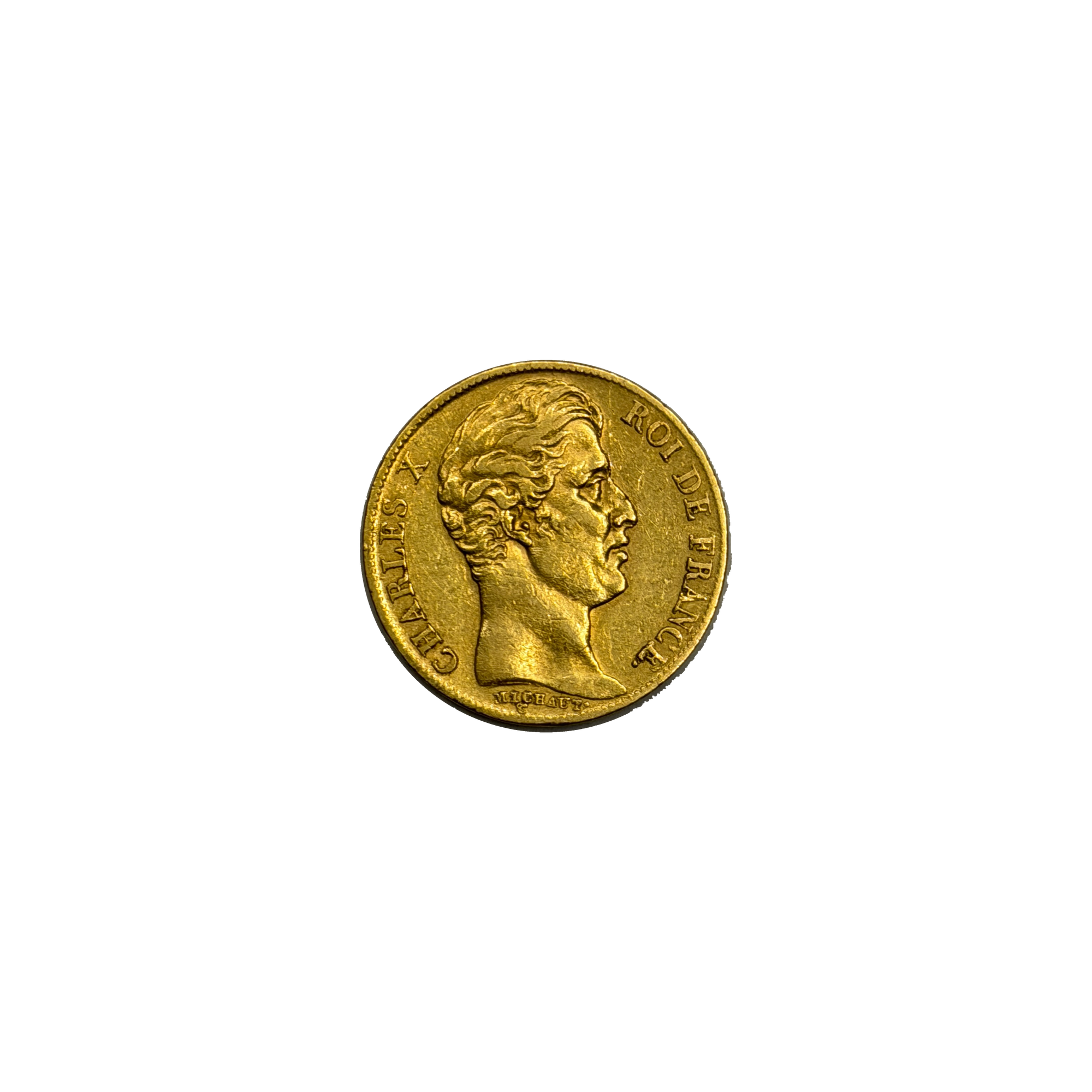
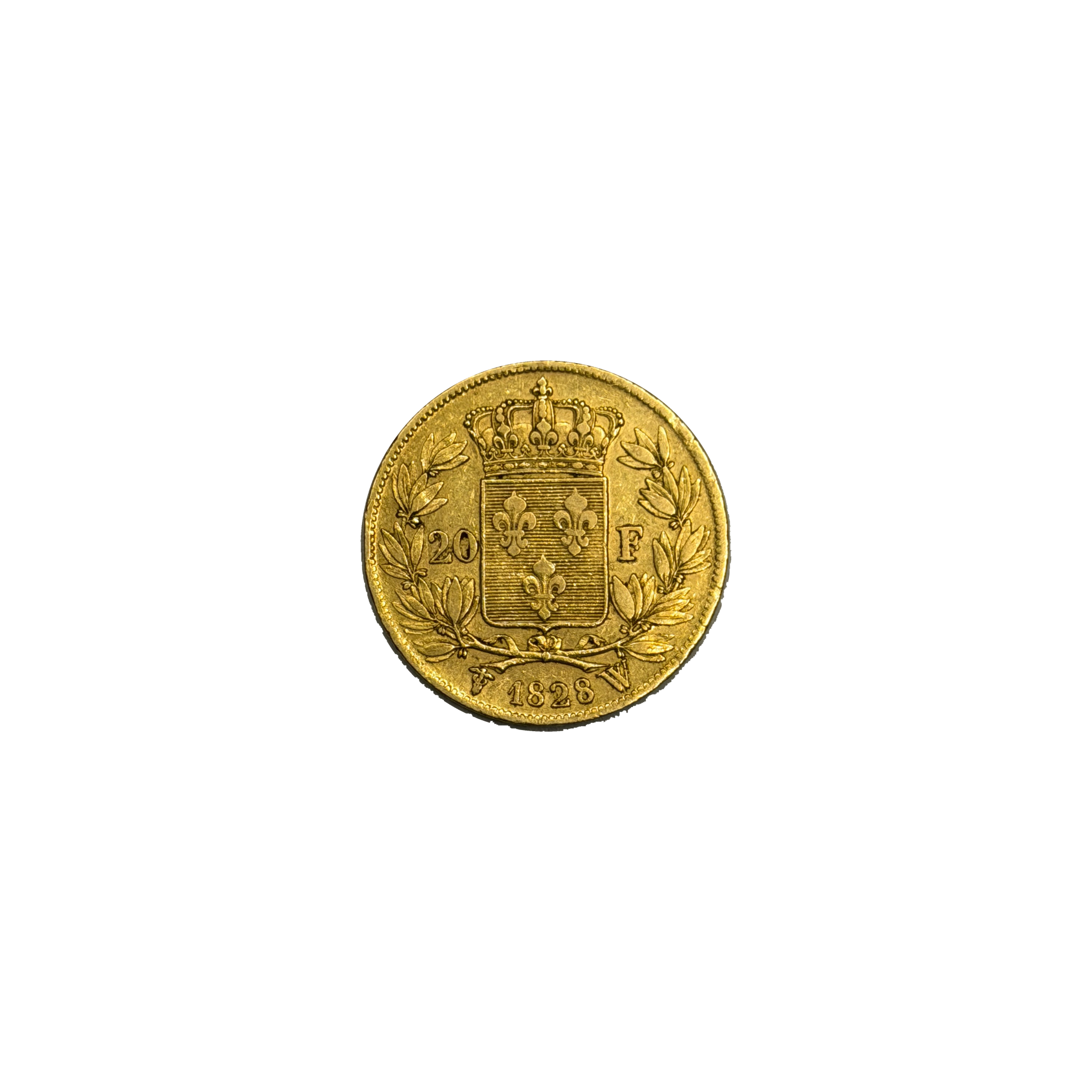
The obverse bears a bare-head portrait of the king facing right, his hair thick and curled in the Bourbon manner, inscribed CHARLES X ROI DE FRANCE and signed MICHAUT below the truncation. The reverse presents the crowned arms of France — the shield of three fleurs-de-lis beneath the royal crown — framed by branches, with the denomination split 20 F to either side and the date below, accompanied by the mint mark (the Paris Mint’s A predominates; branch mints such as Lille’s W also appear).
At 21mm in diameter and 6.45 grams total weight, each coin is struck from .900 fine gold and contains 0.1867 troy ounces of actual gold content — the germinal franc standard maintained without change from Napoleon’s 1803 reform. Grade range: VF/XF. Minted 1825–1830.
Charles X was the youngest of the three brothers who ruled France’s final Bourbon century — after Louis XVI, who died on the guillotine, and Louis XVIII, whom he succeeded in 1824. Crowned at Reims Cathedral in 1825 in the last coronation any French monarch would receive, he set out to restore as much of the old order as the nineteenth century would tolerate. It tolerated less than he believed. In July 1830 his ordinances dissolving the newly elected chamber and muzzling the press ignited three days of revolution in the streets of Paris — les Trois Glorieuses — and by early August he had abdicated and departed for exile. With him went the senior Bourbon line’s claim to the French throne. His 20 francs, struck in modest numbers across all six years of the reign, are that ending rendered in gold.
The Charles X series documents the last stand of France’s ancien régime — the final gold coins to pair the fleur-de-lis shield of the senior Bourbons with the title ROI DE FRANCE, King of France, a formula reaching back to the medieval monarchy. The revolution that removed him replaced both the king and the idea: his successor would style himself King of the French, a monarch of the people rather than of the territory. Numbers tell the same story of a regime running out of confidence — the series’ low point of 13,645 pieces in 1829, on the eve of the revolution, is among the smallest single-date figures recorded in USAGOLD’s mintage studies of the French 20 franc family.
Comparative context is the entire argument, so it is worth stating plainly. The Charles X series total of 1.69 million compares with 19.7 million Napoleon Bonaparte pieces, 18.4 million Louis XVIII, 16.7 million Ceres, 89 million Angels, and 233 million Napoleon IIIs. Every other major type in the family out-produced Charles X by a factor of nearly ten or more; Napoleon III out-produced him by a factor of more than one hundred. Two centuries of circulation, melts, and attrition have further reduced what survives. Scarcity of this order within an otherwise abundant, actively traded family is not fully expressed in the coin’s cost of acquisition — the family is priced off its most abundant members — and that is the value: the scarcity, in large measure, comes with the coin.
Because the Charles X 20 franc matches the French family’s universal specifications exactly, it trades within the same deep European and North American dealer network as the common Napoleons — recognized on sight, documented in every reference, and convertible to cash wherever gold trades. The investor gives up nothing in liquidity to hold the family’s scarcest member: the coin rides the same rails as the most common French gold while carrying a supply profile the common issues cannot approach.
In 1933, FDR issued Executive Order 6102, requiring Americans to surrender their gold coin and bullion to the Treasury — but the order and the regulations that followed it exempted gold coins of recognized special value to collectors of rare and unusual coins. Subsequent clarifications by the Treasury identified pre-1933 gold coins — a classification that includes the Charles X 20 franc, struck between 1825 and 1830 — as falling within that collector classification as historical items.
Under current constitutional law, a government intervention in the gold market would be executed through the power of eminent domain — the government’s right to take private property for public use provided it pays the owner just compensation. Historic coins complicate the government’s ability to broadly establish “just compensation” or “fair value,” which was precisely the reasoning behind the original “recognized special value” exemption in 1933. That complexity, and the precedent surrounding pre-1933 gold coins, creates a notable impediment to the government’s ability to restrict them broadly — particularly compared to modern bullion, which can be valued easily and consistently at a single price. In essence, it is a bureaucratic question of whether the government would undertake the enormous task of valuing the diversity and complexity of the historic-coin genre — every coin, every date, every condition, every personal holding — and that difficulty is what insulates the owner’s legal liquidity rights in the event of capital controls.
Whether a future government intervention in private gold markets is a risk an investor assigns significant weight to is a personal judgment. The factual point is narrower: the pre-1933 status represents a layer of portfolio differentiation that this coin carries at minimal added per-ounce cost over comparable modern bullion, along with a measure of insulation for the legal liquidity rights of its owner.
For a more in-depth study, we invite you to read our comprehensive memorandum on this subject: Preparing for a Potential Gold Confiscation
The French 20 Franc Charles X is the scarcest member of Europe’s most liquid historic gold family — 1.69 million coins from the six-year reign that ended the senior Bourbon line’s rule, set against siblings struck by the hundred million. It pairs a genuinely small, permanently fixed supply with the standardized and widely recognized gold content the whole family shares — a highly coveted combination, and one rarely available in quantity. No other French 20 franc offers gold investors comparative scarcity of this magnitude inside a market this deep.
| Year | Mintage |
|---|---|
| 1825 | 726,944 |
| 1826 | 46,153 |
| 1827 | 157,835 |
| 1828 | 297,259 |
| 1829 | 13,729 |
| 1830 | 446,517 |
| Total | 1,688,437 |
VF, XF
1825-1830
.1867 troy ounce
France
Prices shown under Wire include a 4% cash discount. Card prices are the full list price. ACH bank transfer is available to established clients only. First-time orders can be paid by wire transfer or card.
Call our team for availability. Monday to Friday, 8 AM to 6 PM Mountain Time.
Want to be notified when this product is back in stock?
Interested in gold but struggling to find the right firm?

XF, AU
1849-1851
.1867 troy ounce
France
AU, UNC
1853-1870
.1867 troy ounce
France
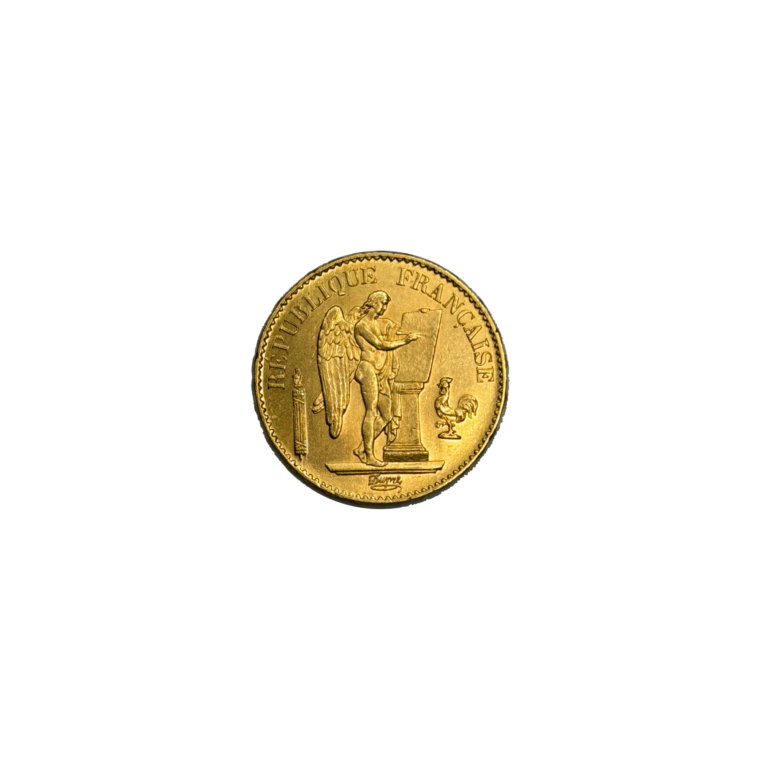
UNC, BU
1848/49, 1871 – 1898
.1867 troy ounce
France
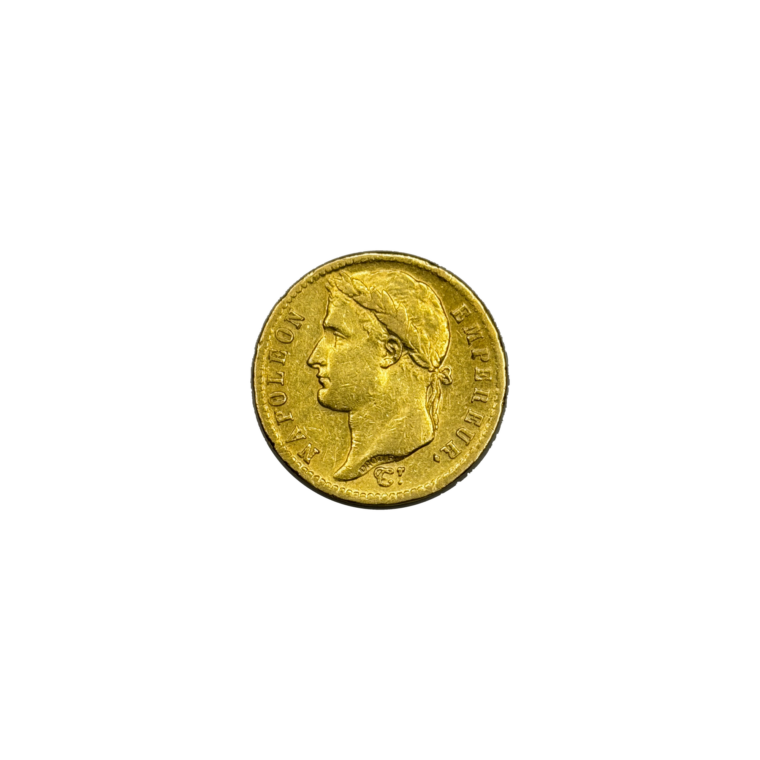
VF
1802-1815
.1867 troy ounce
France
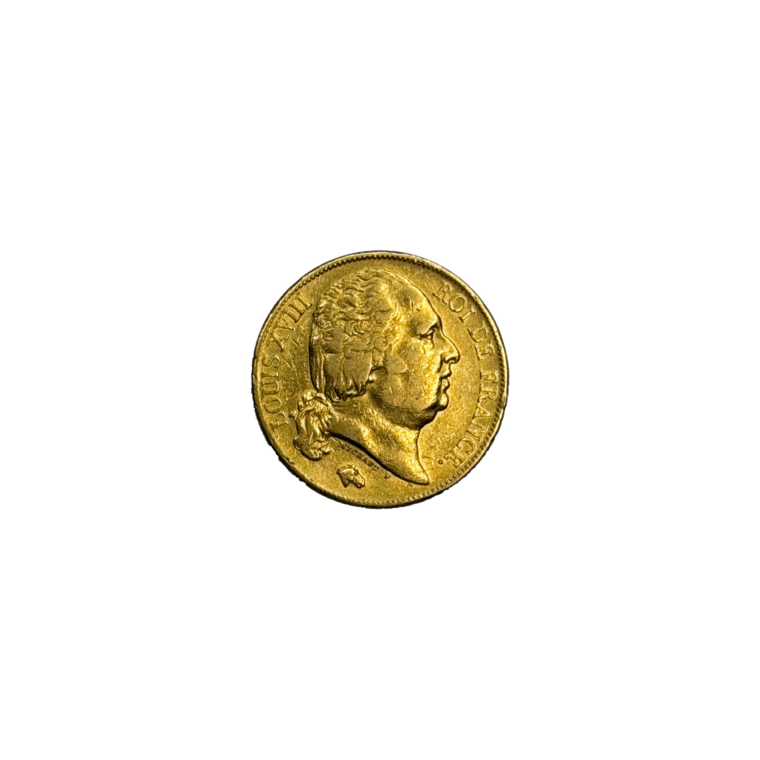
VF, XF
1814-1824
.1867 troy ounce
France
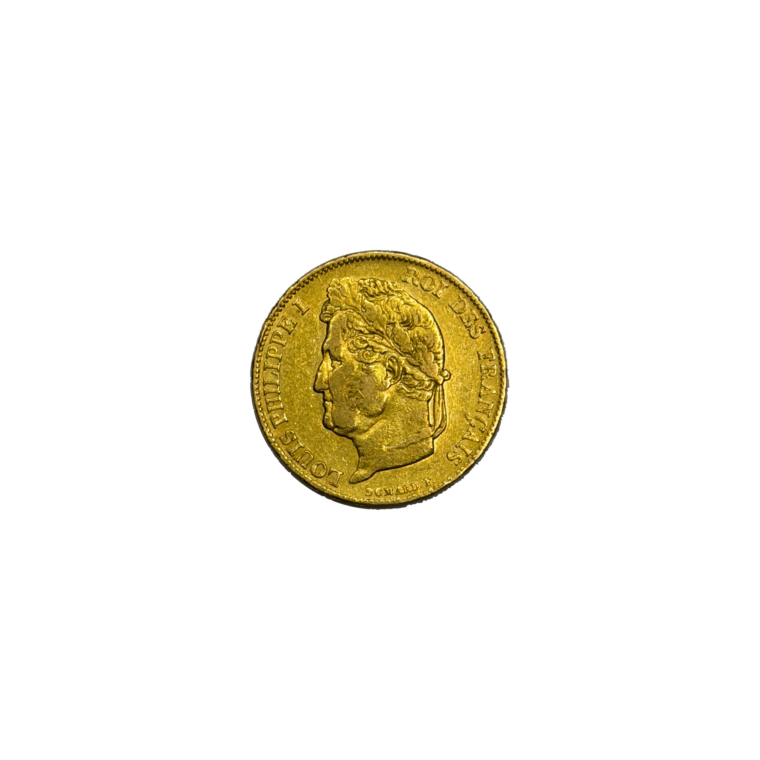
VF, XF
1830-1848
.1867 troy ounce
France


