

You must have an order with a minimum of $1,000.00 to place your order, your current order total is $0.00.
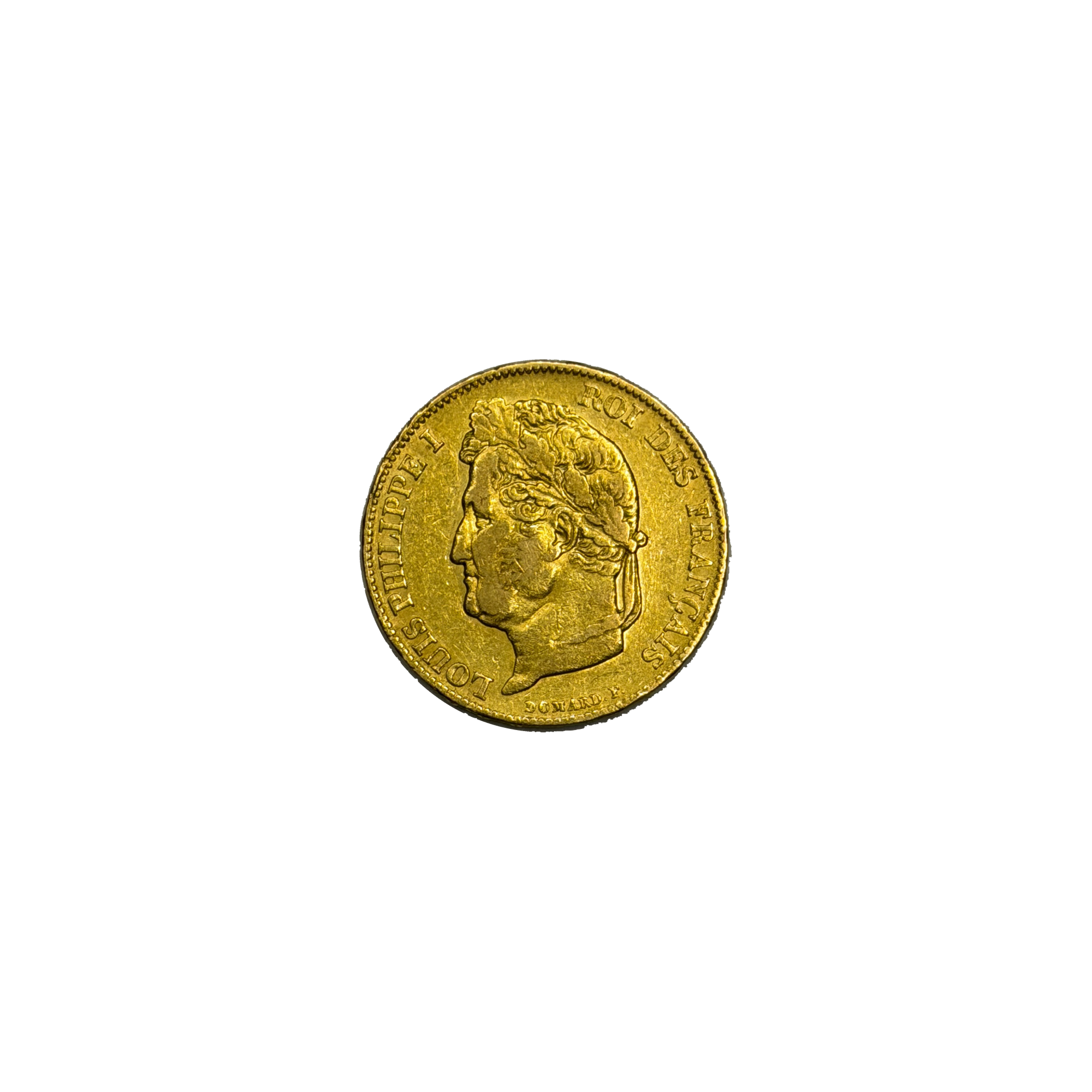
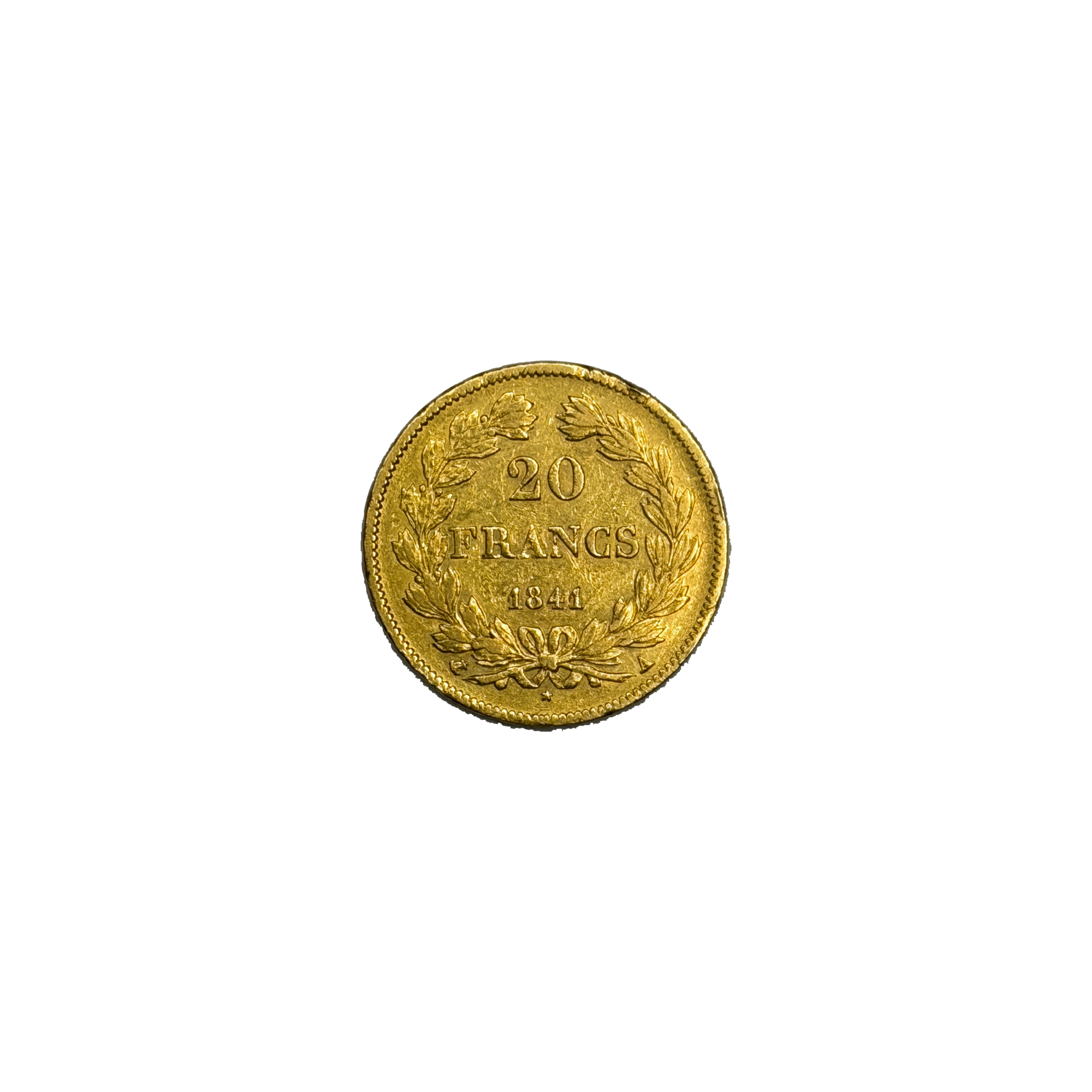
Louis Philippe came to the throne by revolution and left it the same way. Raised up by the July Revolution of 1830 and deposed by the Revolution of 1848, the “Citizen King” was the last man to reign as a king over France — and his 20 franc gold pieces are the final French gold coins ever struck in a king’s name. Across all 19 years of his reign, his mints produced just 9,133,079 of them, an average of fewer than 500,000 a year. Napoleon III, who followed, averaged nearly 13 million a year.
That combination — a terminal place in French royal history and a production base among the smallest in the family — frames the investor case. The Louis Philippe 20 franc trades within the deepest and most recognized fractional gold market in Europe, at the same specifications as every other French 20 franc, while offering pre-1848 comparative scarcity the abundant later series cannot. It carries the historic (pre-1933) designation and the associated insulation against the possibility of future government intervention, and at roughly one-fifth of a troy ounce it offers divisible negotiability: affording its owner the flexibility to liquidate positions incrementally, in amounts proportionate to the specific needs of the moment and across a variety of circumstances. For investors whose priorities are recognizability, liquidity, and pre-1848 comparative scarcity in France’s last royal gold coin—all for near-bullion pricing—the Louis Philippe 20 franc holds a place no other coin in the French series can duplicate: the closing chapter of French royal gold.
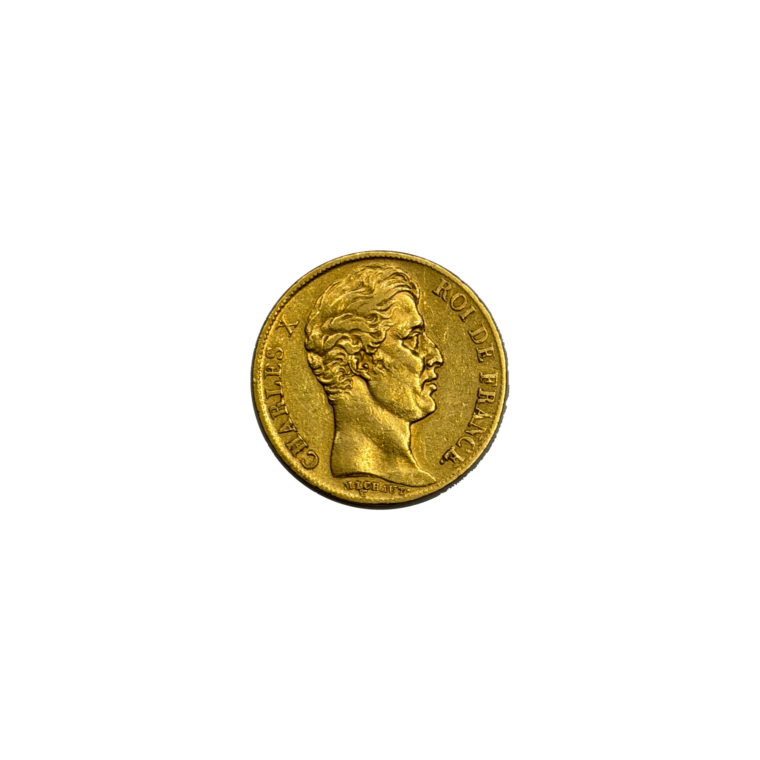
The obverse pictured bears the laureate head of the king facing left — a laurel wreath tied at the nape, the work of engraver Domard, whose signature appears below the truncation — inscribed LOUIS PHILIPPE I ROI DES FRANÇAIS. The inscription itself is a piece of constitutional history: not King of France, the old territorial formula carried by his Bourbon predecessors, but King of the French, a monarch answerable to the people. The reverse places the denomination and date within a wreath of laurel branches, with the mint mark below. The earliest issues of the reign (1830–1831) carry a bare-head portrait; the laureate head shown here served from 1832 to the reign’s end. USAGOLD does not specify portrait type on this offering — delivered coins may bear either design.
At 21mm in diameter and 6.45 grams total weight, each coin is struck from .900 fine gold and contains 0.1867 troy ounces of actual gold content — the germinal franc standard carried unchanged through every French regime since 1803. Grade range: VF/XF. Minted 1830–1848.
Louis Philippe of the House of Orléans had lived the whole revolutionary drama before he ever wore the crown — a young officer in the Revolutionary armies, then an exile who taught school under an assumed name and toured the early United States. When the July Revolution of 1830 swept out Charles X, the propertied classes turned to this famously unpretentious duke who walked the streets of Paris carrying his own umbrella. His July Monarchy presided over France’s early industrialization — railways, banking, an expanding middle class — while the franchise stayed narrow and the gap between the country’s new wealth and its workers widened. In February 1848 Paris rose again, the king abdicated and slipped away to England, and the monarchy in France was finished for good. No French king would ever again strike a gold coin.
French kings had issued gold more or less continuously since the Middle Ages — écus, louis d’or, and finally the 20 franc pieces of the Restoration. The Louis Philippe series is where that line ends. Every French 20 franc struck afterward carries an emperor or an allegory of the Republic; the laureate portrait of the Citizen King is royal French gold’s final appearance. The series also spans one of history’s hinge decades — the years that ended in the continent-wide revolutions of 1848 — and its production numbers reflect the era’s turbulence, swinging from 2.4 million pieces in 1831 to as few as 5,921 in 1845, one of the smallest single-date figures in the entire French 20 franc family.
The great mass of French 20 franc gold available today was struck after 1848 — the Ceres, Napoleon III, Angel, and Rooster series together account for hundreds of millions of pieces. Everything before 1848 is comparatively thin: the Louis Philippe series’ 9.1 million ranks it among the smallest totals in the family, roughly half the size of the Louis XVIII or Napoleon Bonaparte series and about one twenty-fifth of Napoleon III’s output alone. Two things follow. First, the supply is permanently fixed — no demand event can enlarge a series that ended with a revolution. Second, because the coin trades inside a family priced off its most abundant members, the scarcity is not fully expressed in its cost of acquisition — the client acquires a pre-1848 supply profile at what is essentially post-1848 pricing, one of the quieter values in French gold.
The Louis Philippe 20 franc is a “Napoleon” in every market sense — identical specifications, the same universal dealer recognition across Europe and North America, the same documented standard, and the same deep trading network that makes the French 20 franc family the benchmark for fractional gold liquidity. An investor holding the family’s last royal issue sacrifices nothing in the ability to convert the position to cash quickly, at tight spreads, wherever gold trades.
In 1933, FDR issued Executive Order 6102, requiring Americans to surrender their gold coin and bullion to the Treasury — but the order and the regulations that followed it exempted gold coins of recognized special value to collectors of rare and unusual coins. Subsequent clarifications by the Treasury identified pre-1933 gold coins — a classification that includes the Louis Philippe 20 franc, struck between 1830 and 1848 — as falling within that collector classification as historical items.
Under current constitutional law, a government intervention in the gold market would be executed through the power of eminent domain — the government’s right to take private property for public use provided it pays the owner just compensation. Historic coins complicate the government’s ability to broadly establish “just compensation” or “fair value,” which was precisely the reasoning behind the original “recognized special value” exemption in 1933. That complexity, and the precedent surrounding pre-1933 gold coins, creates a notable impediment to the government’s ability to restrict them broadly — particularly compared to modern bullion, which can be valued easily and consistently at a single price. In essence, it is a bureaucratic question of whether the government would undertake the enormous task of valuing the diversity and complexity of the historic-coin genre — every coin, every date, every condition, every personal holding — and that difficulty is what insulates the owner’s legal liquidity rights in the event of capital controls.
Whether a future government intervention in private gold markets is a risk an investor assigns significant weight to is a personal judgment. The factual point is narrower: the pre-1933 status represents a layer of portfolio differentiation that this coin carries at minimal added per-ounce cost over comparable modern bullion, along with a measure of insulation for the legal liquidity rights of its owner.
For a more in-depth study, we invite you to read our comprehensive memorandum on this subject: Preparing for a Potential Gold Confiscation
The French 20 Franc Louis Philippe closes a chapter that had run since the Middle Ages: it is the last gold coin of a French king, struck in numbers a fraction of the imperial and republican series that followed, on the same universally recognized standard that keeps it as liquid as the most common gold in Europe. Add the fixed pre-1848 supply, and the coin’s standing is easy to state directly — no other gold coin lets an investor hold the final act of French royal coinage at a cost this near the metal itself.
| Year | Mintage |
|---|---|
| 1830 | 18,355 |
| 1831 | 2,354,355 |
| 1832 | 48,379 |
| 1833 | 393,785 |
| 1834 | 882,593 |
| 1835 | 152,298 |
| 1836 | 149,082 |
| 1837 | 44,721 |
| 1838 | 185,677 |
| 1839 | 1,032,203 |
| 1840 | 2,048,244 |
| 1841 | 617,823 |
| 1842 | 92,266 |
| 1843 | 140,982 |
| 1844 | 136,723 |
| 1845 | 5,921 |
| 1846 | 104,063 |
| 1847 | 284,497 |
| 1848 | 441,112 |
| Total | 9,133,079 |
VF, XF
1830-1848
.1867 troy ounce
France
| Quantity | Wire | Card |
|---|---|---|
| 1–26 | $899.82 | $937.31 |
| 27–53 | $890.82 | $927.94 |
| 54+ | $881.82 | $918.56 |
Quantity tiers reflect the historic & fractional gold order discount (1% at $25,000+ · 2% at $50,000+ in qualifying coins). Any mix of qualifying historic coins counts toward the same order total.
Prices shown under Wire include a 4% cash discount. Card prices are the full list price. ACH bank transfer is available to established clients only. First-time orders can be paid by wire transfer or card.
Interested in gold but struggling to find the right firm?

VF, XF
1814-1824
.1867 troy ounce
France
XF, AU
1849-1851
.1867 troy ounce
France
UNC, BU
1848/49, 1871 – 1898
.1867 troy ounce
France
AU, UNC
1853-1870
.1867 troy ounce
France
VF, XF
1814-1815
.1867 troy ounce
France
VF
1802-1815
.1867 troy ounce
France
VF, XF
1825-1830
.1867 troy ounce
France


