

You must have an order with a minimum of $1,000.00 to place your order, your current order total is $0.00.
Switzerland has not been at war since 1815. Its currency has maintained purchasing power through every monetary crisis the twentieth century produced: the hyperinflations of Weimar Germany and post-war France, the suspension of the gold standard, the collapse of Bretton Woods, the oil shocks, the financial crises. The Swiss 20 Franc Helvetia, produced from 1897 to 1949 at the Swiss Federal Mint in Bern, is the physical expression of that monetary tradition.
At 0.1867 troy ounces of .900 fine gold, the Helvetia trades at among the lowest premiums over spot of any fractional historical gold coin in the market, tracking directly with the gold price over time. Total production of 58.6 million pieces ensures wide availability; the Swiss Federal Mint’s reputation ensures consistent quality. One distinction matters: a substantial portion of that mintage was struck 1945–1947, well after the pre-war gold era. USAGOLD specifies all Swiss 20 Franc Helvetia coins as pre-1933 dated — an added layer of historical authenticity, and the government-intervention insulation that accompanies it, at no additional cost to the buyer. At roughly one-fifth of a troy ounce, the coin also offers divisible negotiability: affording its owner the flexibility to liquidate positions incrementally, in amounts proportionate to the specific needs of the moment and across a variety of circumstances. For investors whose priorities are safety, on-sight recognizability, deep two-way liquidity, and divisible negotiability—all at near-bullion pricing—the Helvetia is among the most efficient, readily available, and lowest cost per ounce instruments in the fractional gold market today.
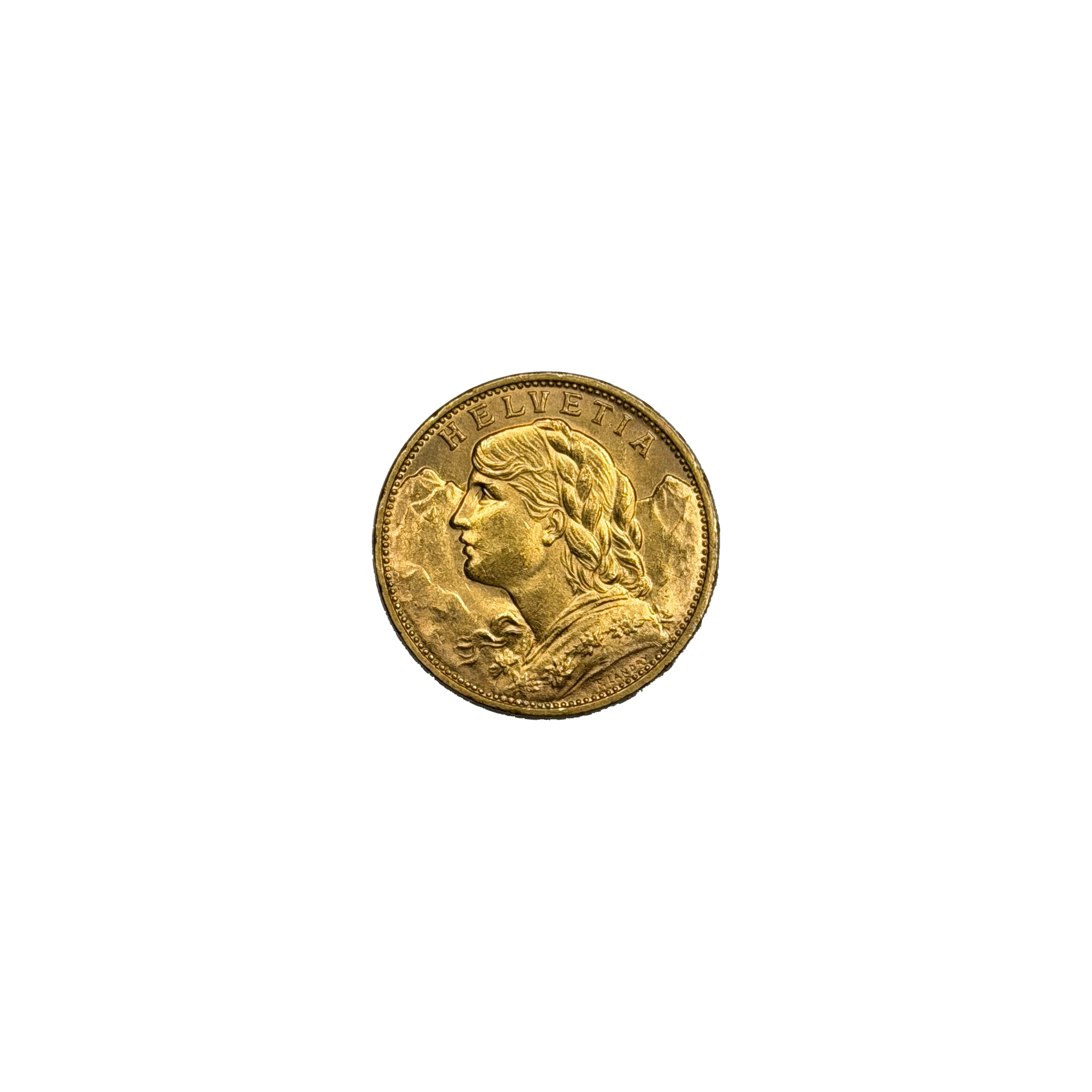
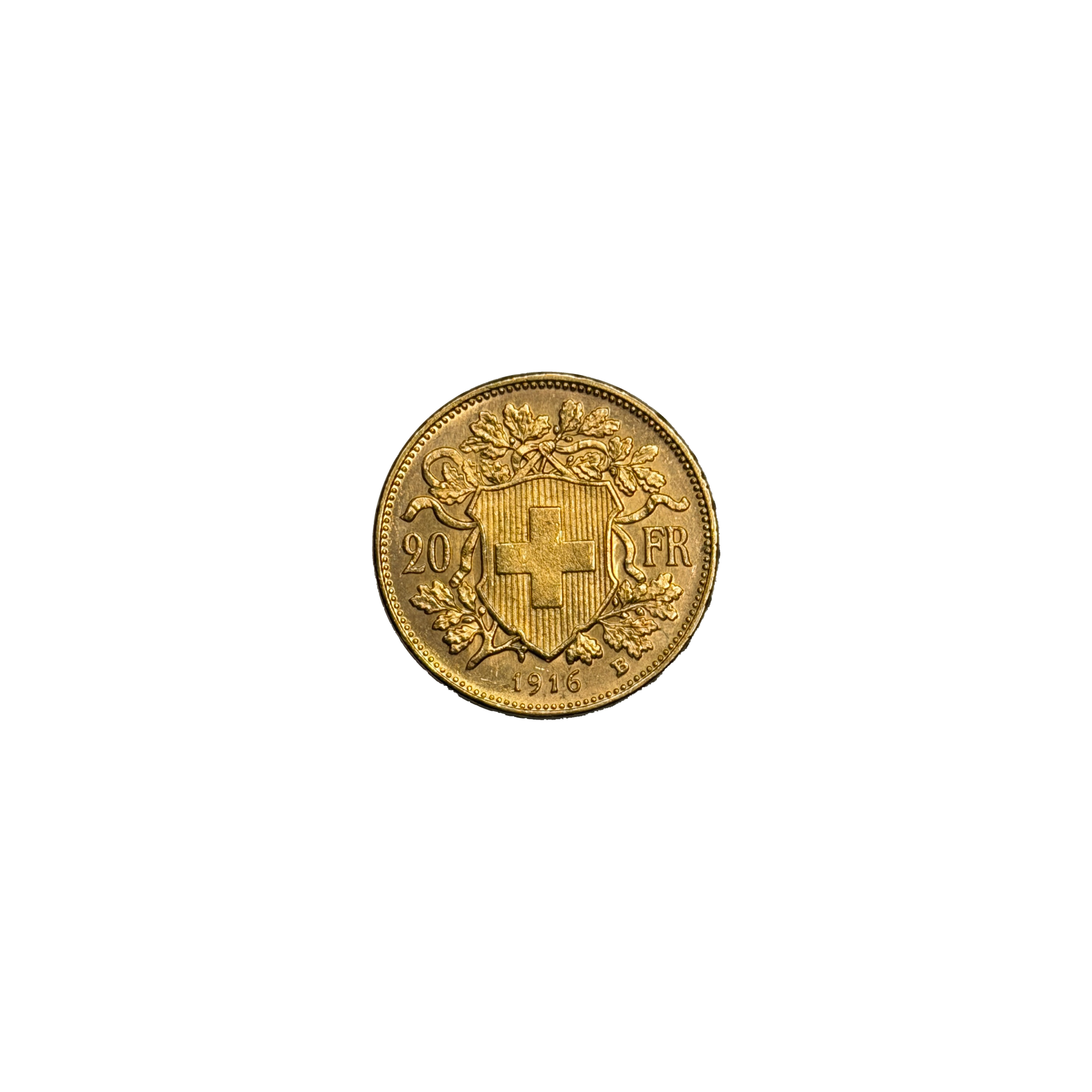
The obverse bears Fritz Landry’s allegorical portrait of Helvetia — the personification of Switzerland since the Roman era — her hair loosely braided, the peaks of the Swiss Alps visible behind her. The reverse carries the Swiss shield with its bold white cross, surrounded by an oak wreath, with the denomination 20 FR and the date. The Bern mint mark “B” appears as the sole mint identifier.
At 21mm in diameter and 6.45 grams total weight, each coin contains 0.1867 troy ounces of pure gold in a .900 fine alloy — the same standard as the French 20 Franc, the Italian 20 Lira, and the other Latin Monetary Union issues, and interchangeable with all of them at the gold content level. Grade range: BU/UNC. Minted 1897–1930.
Switzerland joined the Latin Monetary Union in 1865 as a pragmatic decision: French francs, Belgian francs, and Italian lire circulated freely across Swiss borders, and adopting the same monetary standard eliminated friction in trade. The Swiss approach was characteristically arms-length — participating in the monetary architecture while maintaining the political neutrality that has defined Swiss policy since the early sixteenth century. That neutrality is the reason the Swiss franc survived the twentieth century’s monetary dislocations without the interruptions that ended German, Austrian, Italian, and French gold coinage.
The Helvetia series spans 1897 to 1949 — fifty-two years that include both world wars. Through each crisis, Switzerland remained outside the conflict and its monetary system remained intact. The Swiss franc did not collapse under Weimar-style inflation. It was not devalued like the French franc. It was not suspended, frozen, or called in. The Helvetia gold coin is the most direct physical expression of that continuity available in the fractional gold market today.
Fritz Landry designed the Helvetia portrait in 1897 at the request of the Swiss Federal Council, which wanted a distinctly Swiss image to replace the earlier head-of-liberty design. His allegory was based not on a specific historical figure but on the composite ideal of the Swiss woman — practical, self-possessed, neither triumphant nor martial, with the Alps behind her as a statement that Switzerland is defined by its geography as much as its institutions.
The design ran virtually without modification from 1897 to 1949. Compare this to the French 20 Franc, which cycled through multiple design variants, or the British sovereign, which changed portraits with each monarch. The Helvetia’s fifty-two-year visual stability is itself an institutional statement: a coin whose design was considered finished when it was made.
The Swiss Federal Mint in Bern is among the oldest continuously operating mints in the world, and Helvetia coins in uncirculated condition display a quality of strike and surface that reflects that institutional standard — die preparation, metal composition, and striking pressure each controlled to a standard that shows in the finished coin.
The pre-1933 specification at USAGOLD is a meaningful differentiator that buyers should understand clearly. The 1935 L-B issue (struck 1945–1947 but dated 1935) and the 1947 and 1949 issues were struck after the Second World War, well outside the pre-1933 era. Competitors who offer Swiss 20 Franc Helvetia coins at “dates of our choice” deliver post-1933 pieces in the overwhelming majority of transactions, because post-1933 supply is cheaper and more abundant. USAGOLD’s pre-1933 specification ensures that every coin delivered carries a date from the original, pre-war era of production — a real distinction, not a technical one, with legal implications detailed below.
Alongside the British sovereign, the Swiss 20 Franc Helvetia is the benchmark for liquid fractional historical European gold in both American and European markets. Dealers on both continents recognize it immediately, its gold content is standardized and universally documented, and its trading history is deep enough that bid-ask spreads remain consistently tight. For investors who need to convert a gold holding to cash quickly, the Helvetia performs that function reliably across virtually every market condition and every geography where gold trades.
One market behavior deserves mention in passing. The Helvetia prices at essentially the same cost per ounce as same-size modern bullion, yet it carries a characteristic bullion never shows: in flight-to-safety episodes, the historic genre’s inherently limited supply produces modest premium rises across the board. In 2008, premiums rose on all European historic gold coins — common and rare alike — simply on the limitation of supplies. When two instruments cost essentially the same, that behavior is simply another advantage of the historic coin.
The combination of near-bullion premiums, Swiss Federal Mint quality, pre-1933 specification, and global market recognition makes the Helvetia the most practically efficient fractional historical gold coin available to investors who want maximum gold per premium dollar without sacrificing liquidity or historical provenance.
In 1933, FDR issued Executive Order 6102, requiring Americans to surrender their gold coin and bullion to the Treasury — but the order and the regulations that followed it exempted gold coins of recognized special value to collectors of rare and unusual coins. Subsequent clarifications by the Treasury identified pre-1933 gold coins as falling within that collector classification as historical items. The Swiss 20 Franc Helvetia, as specified by USAGOLD in its pre-1933 dated form, falls within that classification — unlike the post-1933 dated coins routinely delivered by competitors, whose post-1933 issues fall outside it entirely.
Under current constitutional law, a government intervention in the gold market would be executed through the power of eminent domain — the government’s right to take private property for public use provided it pays the owner just compensation. Historic coins complicate the government’s ability to broadly establish “just compensation” or “fair value,” which was precisely the reasoning behind the original “recognized special value” exemption in 1933. That complexity, and the precedent surrounding pre-1933 gold coins, creates a notable impediment to the government’s ability to restrict them broadly — particularly compared to modern bullion, which can be valued easily and consistently at a single price. In essence, it is a bureaucratic question of whether the government would undertake the enormous task of valuing the diversity and complexity of the historic-coin genre — every coin, every date, every condition, every personal holding — and that difficulty is what insulates the owner’s legal liquidity rights in the event of capital controls.
Whether a future government intervention in private gold markets is a risk an investor assigns significant weight to is a personal judgment. The factual point is narrower: the pre-1933 status represents a layer of portfolio differentiation that this coin carries at minimal added per-ounce cost over comparable modern bullion, along with a measure of insulation for the legal liquidity rights of its owner.
For a more in-depth study, we invite you to read our comprehensive memorandum on this subject: Preparing for a Potential Gold Confiscation
The Swiss 20 Franc Helvetia is the gold coin of the country that maintained monetary discipline while every neighbor abandoned it — struck at a mint whose precision is a matter of national identity and designed by an artist whose work required no revision for fifty-two years. It is the genre’s liquidity benchmark: readily available, recognized on sight wherever gold trades, and priced at near-bullion acquisition costs. No other fractional gold coin delivers more gold per premium dollar with less compromise on liquidity or quality.
Pre-1933 issues (1897–1930)
| Year | Mintage |
|---|---|
| 1897 | 400,000 |
| 1898 | 400,000 |
| 1899 | 300,000 |
| 1900 | 400,000 |
| 1901 | 500,000 |
| 1902 | 600,000 |
| 1903 | 200,000 |
| 1904 | 100,000 |
| 1905 | 100,000 |
| 1906 | 100,000 |
| 1907 | 150,000 |
| 1908 | 355,000 |
| 1909 | 400,000 |
| 1910 | 375,000 |
| 1911 | 350,000 |
| 1912 | 450,000 |
| 1913 | 700,000 |
| 1914 | 700,000 |
| 1915 | 750,000 |
| 1916 | 300,000 |
| 1922 | 2,784,000 |
| 1925 | 400,000 |
| 1926 | 50,000 |
| 1927 | 5,015,000 |
| 1930 | 3,372,000 |
| Pre-1933 total | 19,251,000 |
Post-1933 issues
| Year | Mintage |
|---|---|
| 1935 B | 175,000 |
| 1935 L-B (struck 1945–1947) | 20,009,000 |
| 1947 | 9,200,000 |
| 1949 | 10,000,000 |
| Post-1933 total | 39,384,000 |
Mintage figures per USAGOLD records. Pre-1933 and post-1933 issues are totaled separately: only pre-1933-dated pieces carry the classification described in the Pre-1933 Advantage section — and the totals make the point plainly, with post-1933 production roughly double the entire original era. USAGOLD’s pre-1933 date specification is what separates the two.
UNC, BU
1897 – 1930
.1867 troy ounce
Switzerland
| Quantity | Wire | Card |
|---|---|---|
| 1–27 | $868.46 | $904.65 |
| 28–55 | $859.78 | $895.60 |
| 56+ | $851.09 | $886.56 |
Quantity tiers reflect the historic & fractional gold order discount (1% at $25,000+ · 2% at $50,000+ in qualifying coins). Any mix of qualifying historic coins counts toward the same order total.
Prices shown under Wire include a 4% cash discount. Card prices are the full list price. ACH bank transfer is available to established clients only. First-time orders can be paid by wire transfer or card.
Interested in gold but struggling to find the right firm?


