

You must have an order with a minimum of $1,000.00 to place your order, your current order total is $0.00.
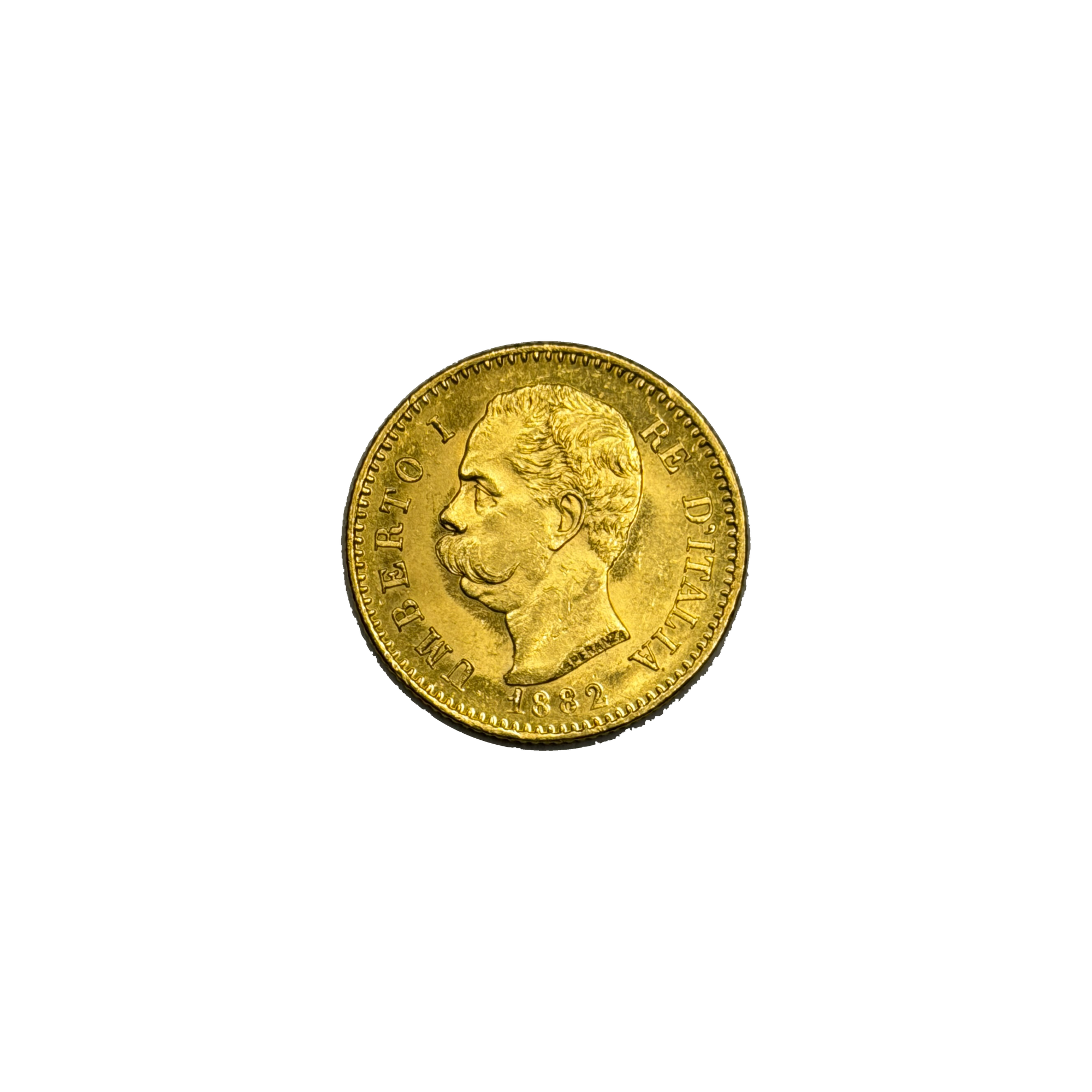
Italy did not exist as a unified nation until 1861. The Risorgimento — the decades-long movement of nationalist unification that brought together a peninsula fragmented among the Austrian Empire, the Papal States, the Kingdom of the Two Sicilies, and a dozen smaller principalities — concluded with the proclamation of the Kingdom of Italy under Vittorio Emanuele II. His son Umberto I inherited a nation barely a generation old, and the 20 Lira gold coins struck in his name from 1879 to 1897 are, in a precise sense, the currency of Italy’s first full generation of national existence.
These coins present in beautiful UNC/BU/PL condition — proof-like surfaces exceptional for a pre-1900 coin — and trade at per ounce acquisition costs comparable to modern bullion, tracking directly with the spot price of gold over time. The Italian 20 Lira is a Latin Monetary Union coin, interchangeable at the gold content level with the French 20 Franc and Swiss 20 Franc Helvetia — yet it is far scarcer in the market than its French counterpart while trading at a comparable premium. The client acquires that scarcity at no added cost — which is what makes this coin one of the strongest values in the historic fractional gold market. At roughly one-fifth of a troy ounce, the coin also offers divisible negotiability: affording its owner the flexibility to liquidate positions incrementally, in amounts proportionate to the specific needs of the moment and across a variety of circumstances. For investors whose priorities are comparative scarcity, UNC/BU/PL condition that stands as a benchmark for the genre, and a standardized and widely recognized gold content—all for near-bullion pricing—the Umberto I 20 Lira is one of the most underpriced instruments in the historic gold market today.
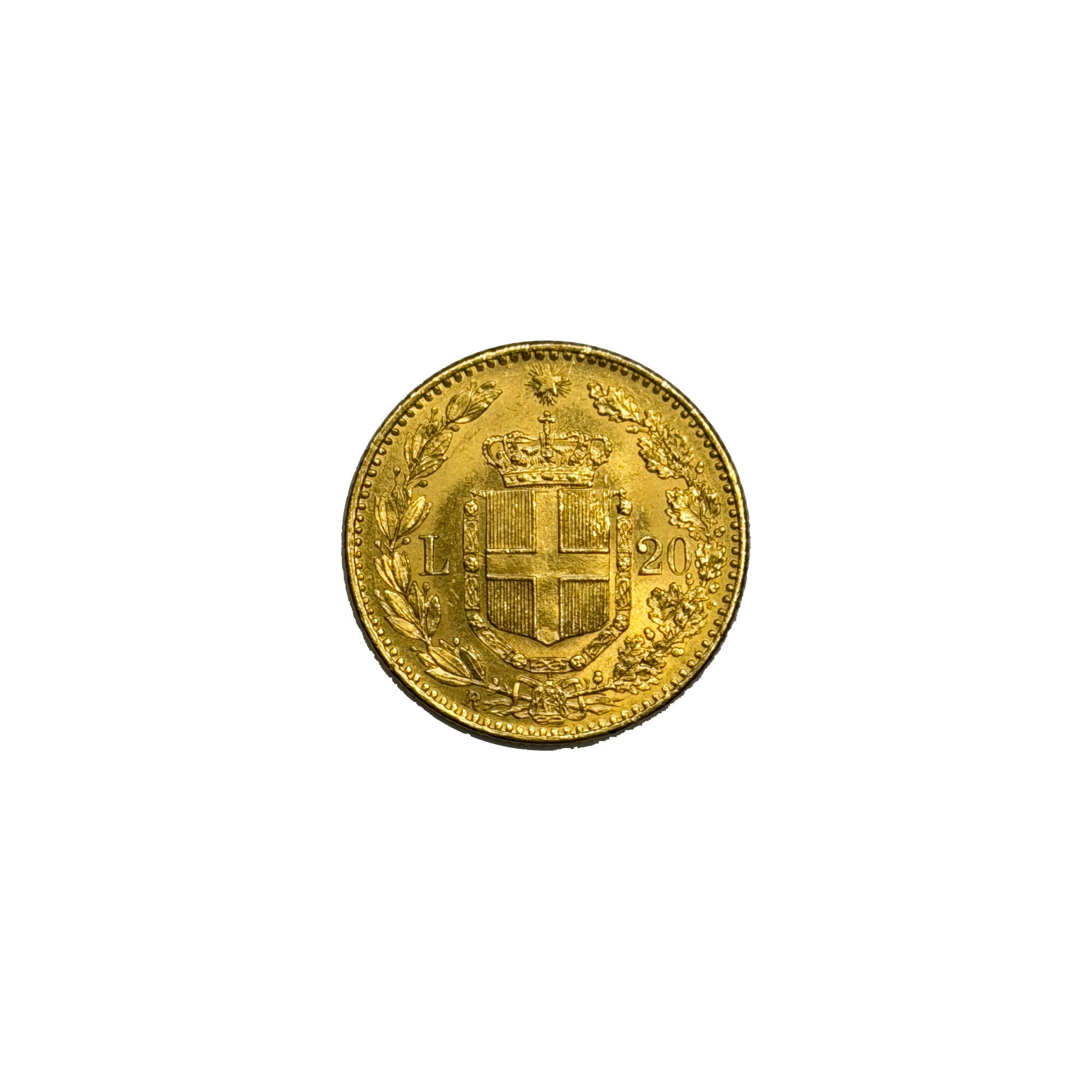
The obverse bears a confident left-facing portrait of King Umberto I, his expression carrying the gravity appropriate to the ruler of a newly unified nation. The reverse displays the Italian Crowned Coat of Arms — the Savoia shield decorated with the Collare dell’Annunziata, flanked by the denomination L. 20, with the Savoy star above the crowned shield.
At 21mm in diameter and 6.45 grams total weight, each coin is struck from .900 fine gold and contains 0.1867 troy ounces of actual gold content. Issued under the Latin Monetary Union of 1865, the coin meets the same specifications as the French 20 Franc, the Swiss 20 Franc Helvetia, and the Belgian 20 Franc.
France minted hundreds of millions of 20 Franc pieces across its various Napoleon and Rooster series. Italy’s economy was smaller, its monetary system younger, and its gold production correspondingly limited. Total mintage of the Umberto I 20 Lira across the full 1879–1897 series is a small fraction of French 20 Franc production — yet the two coins trade at comparable premiums to spot, as though the scarcity differential does not exist.
Within the series, date variation matters. The 1882 issue, with a mintage of approximately seven million pieces, is the most common date. The 1884 issue, with fewer than ten thousand pieces struck, is among the scarcest dates collectible without specialized numismatic searching. Common dates trade at or near bullion; even the scarcest dates carry premiums modest for their mintages. For investors who want genuine scarcity at near-bullion acquisition costs — supply that is fixed and demonstrably thinner than comparable coins — the Italian 20 Lira delivers an unusual combination at common-coin pricing: the scarcity comes with the coin rather than on the invoice. And like the rest of the genre, it carries an advantage same-priced bullion does not: in flight-to-safety episodes such as 2008 and the early-2010s European banking crisis, overall supplies of historic European gold are taxed and premiums rise modestly across the whole family, rare and common coins alike.
Umberto I came to the throne in 1878, barely a decade after formal unification was complete. His father, Vittorio Emanuele II, had been the first king of unified Italy; Umberto’s task was to make the new nation function — building institutions from scratch, managing tensions between the secular state and the Vatican, and navigating a European diplomatic landscape in which Italy was the newest major power.
His reign coincided with Italian industrial expansion, the beginnings of African colonial ambition, and a period of intense social conflict. On July 29, 1900, he was assassinated by Gaetano Bresci — an Italian-American anarchist who had returned from Paterson, New Jersey, specifically to carry out the act. Umberto I remains the only king of modern unified Italy to die by assassination. The 20 Lira coins struck during his reign, from 1879 to 1897, were minted in the years before that end.
The Italian 20 Lira exists because of the Latin Monetary Union of 1865 — the multinational currency agreement in which France, Belgium, Italy, Switzerland, and Greece established a common bimetallic standard. For Italy, the Union was an act of monetary self-definition: a newly unified nation, barely four years old at the time of signing, declaring its place in the architecture of European finance by adopting the same monetary standard as France and Belgium. The coins struck under Umberto I circulated through a nation in its first full generation after unification — a nation that no longer exists in the form it took during those years.
The obverse portrait of Umberto I is among the more distinctive royal images in European gold coinage of the period — his bearing upright, his profile conveying the self-possession of a king who understood the new Italian state was being judged by older European powers. The reverse heraldry is deliberately elaborate: the Savoia shield at center, the Collare dell’Annunziata surrounding it, the crowned coat of arms above — chosen to assert, in the visual language of heraldry, that the Kingdom of Italy belonged among the established monarchies of Europe.
The UNC/BU/PL condition of the coins USAGOLD carries amplifies this visual quality significantly. Most pre-1900 European gold arrives in the market in circulated grades — worn by actual use. A proof-like Umberto I 20 Lira shows the coin as it was meant to be seen: the portrait crisp, the heraldic detail fully resolved, the fields carrying the luster of a fresh strike.
The standard assumption in the pre-1900 European gold market is wear. Coins struck before 1900 circulated actively in an era when gold was actual transactional currency. Finding a pre-1900 European gold coin in genuine uncirculated or proof-like condition is genuinely uncommon. Finding one at near-bullion acquisition costs is more uncommon still.
The coins USAGOLD carries in the Umberto I 20 Lira series present in beautiful UNC/BU/PL condition — a preservation state that reflects careful storage across more than a century, not typical circulation history. The combination of below-market pricing, genuine scarcity, and exceptional grade creates a set of circumstances that does not arise often in the historic gold market.
In 1933, FDR issued Executive Order 6102, requiring Americans to surrender their gold coin and bullion to the Treasury — but the order and the regulations that followed it exempted gold coins of recognized special value to collectors of rare and unusual coins. Subsequent clarifications by the Treasury identified pre-1933 gold coins — a classification that includes the Italian 20 Lira Umberto I, struck between 1879 and 1897 — as falling within that collector classification as historical items.
Under current constitutional law, a government intervention in the gold market would be executed through the power of eminent domain — the government’s right to take private property for public use provided it pays the owner just compensation. Historic coins complicate the government’s ability to broadly establish “just compensation” or “fair value,” which was precisely the reasoning behind the original “recognized special value” exemption in 1933. That complexity, and the precedent surrounding pre-1933 gold coins, creates a notable impediment to the government’s ability to restrict them broadly — particularly compared to modern bullion, which can be valued easily and consistently at a single price. In essence, it is a bureaucratic question of whether the government would undertake the enormous task of valuing the diversity and complexity of the historic-coin genre — every coin, every date, every condition, every personal holding — and that difficulty is what insulates the owner’s legal liquidity rights in the event of capital controls.
Whether a future government intervention in private gold markets is a risk an investor assigns significant weight to is a personal judgment. The factual point is narrower: the pre-1933 status represents a layer of portfolio differentiation that this coin carries at minimal added per-ounce cost over comparable modern bullion, along with a measure of insulation for the legal liquidity rights of its owner.
For a more in-depth study, we invite you to read our comprehensive memorandum on this subject: Preparing for a Potential Gold Confiscation
The Italian 20 Lira Umberto I is a genuinely scarce fractional gold coin from the first generation of a unified Italy — available in UNC/BU/PL condition that is exceptional for a pre-1900 piece, priced near bullion, and undervalued relative to its French Latin Monetary Union counterpart, of which hundreds of millions were minted. Coins in this state of preservation surface only in limited numbers, and offerings are quickly subscribed. No comparable European gold coin offers this much scarcity, condition, and history at so low a cost per ounce.
Each coin contains 0.1867 troy ounces of gold in .900 fine alloy, at 21mm diameter and 6.45 grams total weight — the same Latin Monetary Union specification as the French 20 Franc, Swiss 20 Franc Helvetia, and Belgian 20 Franc.
The Umberto I 20 Lira was struck from 1879 to 1897 — the currency of Italy's first full generation as a unified nation following the Risorgimento.
Total mintage of the Umberto I series is a small fraction of French 20 Franc production. Within the series, the 1882 issue (about seven million pieces) is the most common date; the 1884 issue, with fewer than ten thousand struck, is among the scarcest.
They present in UNC/BU/PL condition — proof-like surfaces that are exceptional for a pre-1900 coin.
The obverse bears a right-facing portrait of King Umberto I. The reverse displays the crowned Savoia coat of arms decorated with the Collare dell'Annunziata, flanked by the denomination 20 L, with the Savoy star above.
UNC, BU, PL
1879-1897
.1867 troy ounce
Italy
| Quantity | Wire | Card |
|---|---|---|
| 1–27 | $868.18 | $904.35 |
| 28–55 | $859.50 | $895.31 |
| 56+ | $850.82 | $886.26 |
Quantity tiers reflect the historic & fractional gold order discount (1% at $25,000+ · 2% at $50,000+ in qualifying coins). Any mix of qualifying historic coins counts toward the same order total.
Prices shown under Wire include a 4% cash discount. Card prices are the full list price. ACH bank transfer is available to established clients only. First-time orders can be paid by wire transfer or card.
Interested in gold but struggling to find the right firm?

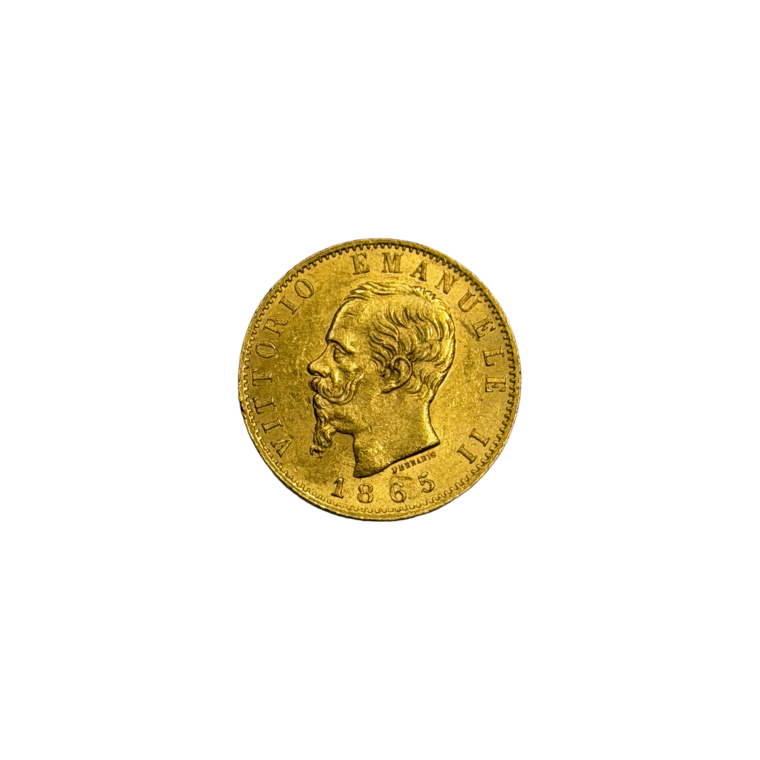
XF, AU
1861-1878
.1867 troy ounce
Italy
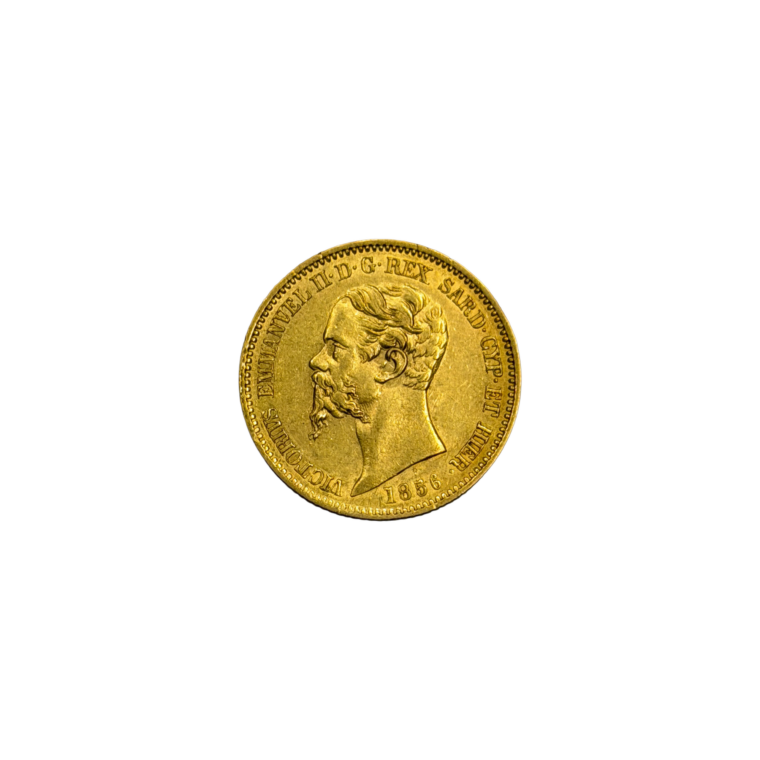
XF, AU
1850-1861
.1867 troy ounce
Italy


