

You must have an order with a minimum of $1,000.00 to place your order, your current order total is $0.00.
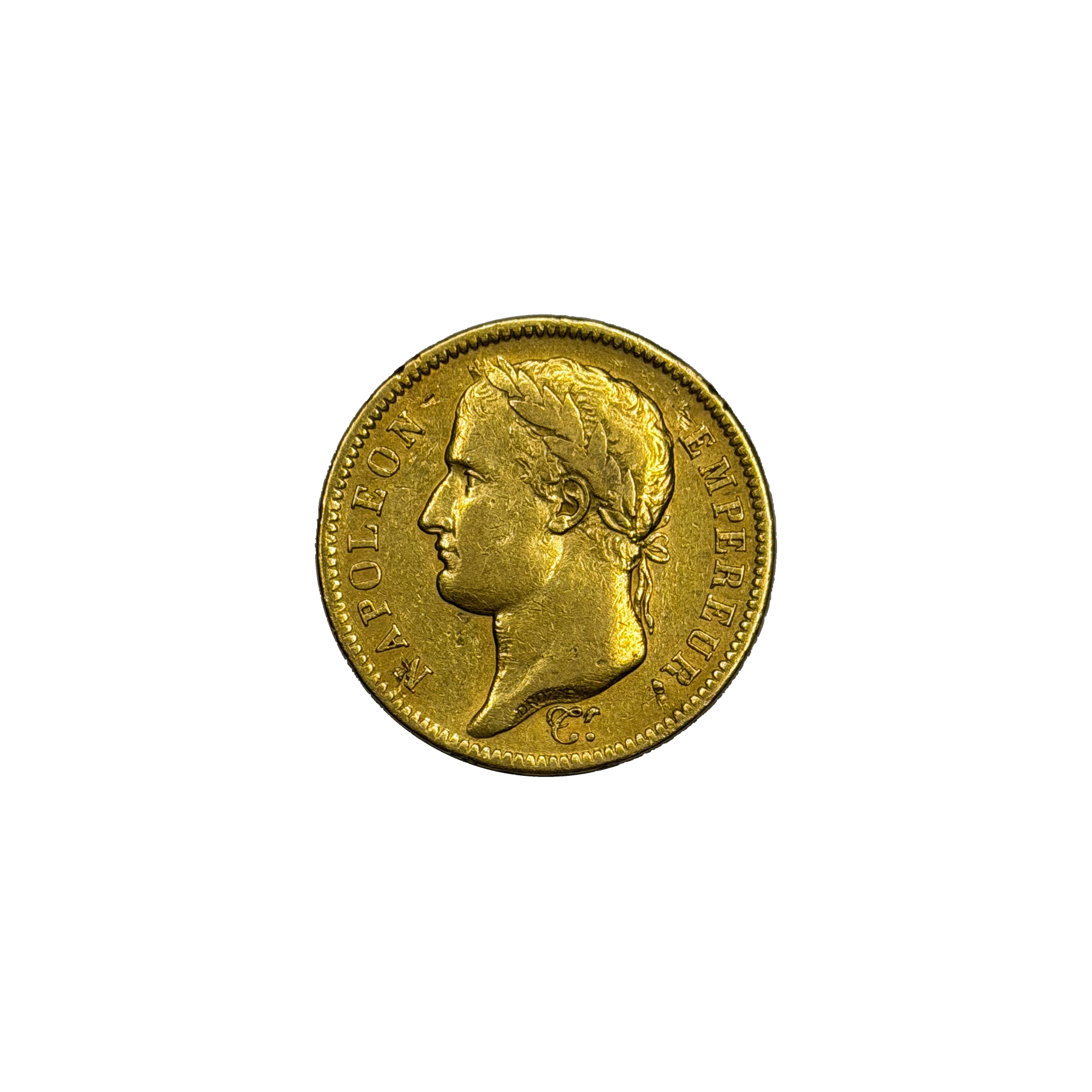
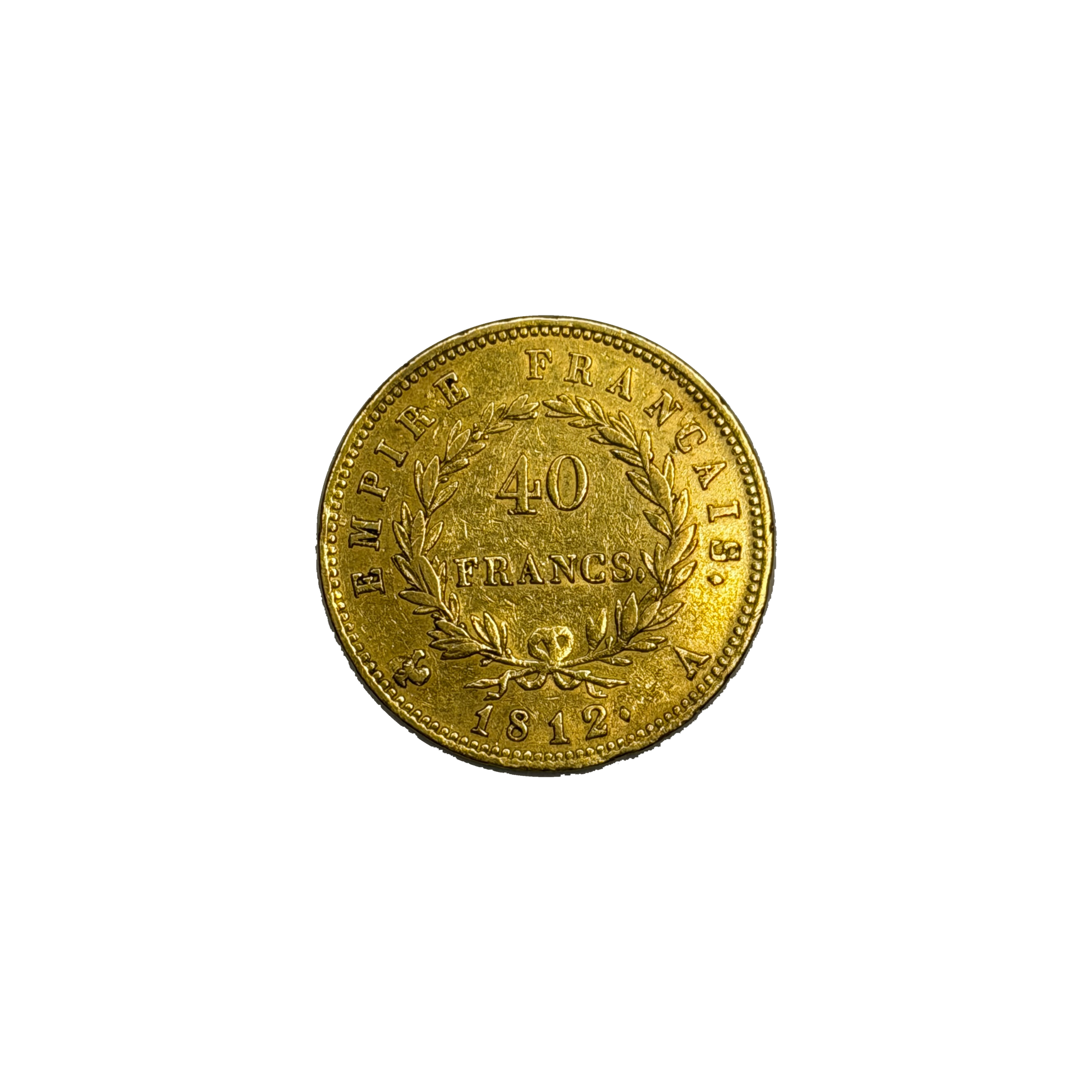
The French 40 franc was the largest gold coin of Napoleon Bonaparte‘s monetary system — the senior denomination of the 1803 reform that put France on the gold standard it would keep for the next 111 years. The coins offered here were struck between 1803 and 1812, while Napoleon himself ruled France as First Consul and then Emperor, and most carry his portrait crowned in laurel (the earliest issues, 1803–1806, show him bare-headed).
The investor argument begins with production. Gold coins of the era were working money, and a 40 franc piece represented too much value for everyday commerce — so France struck far fewer of them. Total production of the Napoleon I 40 franc across all dates was approximately 2.8 million pieces, against roughly 15.8 million of the companion 20 franc struck over the same period — about one-sixth the supply, for the coin twice the size. Two additional centuries of circulation, melts, and attrition have thinned the survivors well below what even that figure suggests. For investors whose priorities are a highly coveted coin steeped in the history of the First Empire, notable scarcity from a 2.8 million-piece production base, and a standardized and widely recognized gold content, the Napoleon I 40 franc occupies a position none of the later, more common French issues can approach: the Emperor’s own large gold, from the founding years of European gold coinage.
The obverse bears the laureate portrait of Napoleon facing left — crowned with the victor’s wreath, the inscription reading NAPOLEON EMPEREUR — with the engraver’s signature at the truncation of the neck. The reverse carries the denomination, 40 FRANCS, within a laurel wreath, encircled by EMPIRE FRANÇAIS, with the date and mint mark below. Earlier strikes in the series document the arc of Napoleon’s rise, from the Consulate of the young Republic through the proclamation of the Empire.
At approximately 26mm in diameter and 12.90 grams total weight, each coin is struck from .900 fine gold and contains 0.3734 troy ounces of actual gold content — exactly twice the 20 franc standard upon which France, and later the Latin Monetary Union countries, built their gold coinage. Grade range: Very Fine/Extra Fine — fully struck coins with moderate, even wear consistent with their two centuries of age, the portrait and legends complete and unmistakable. Minted 1803–1812.
Napoleon Bonaparte bestrides European history like a colossus — arguably the most famous individual in the continent’s long record. A military tactician of genius, statesman, and lawgiver, he conquered most of Europe and, in one of history’s most audacious gestures, crowned himself Emperor in 1804, deliberately following in the footsteps of Charlemagne, the first French emperor.
Less known is that Napoleon was, by conviction and practice, a hard-money man. He founded the Bank of France in 1800 and rebuilt French finance on gold after the assignat inflation of the Revolution had — in the words of historian Andrew Dickson White — “ended in the complete financial, moral and political prostration of France, a prostration from which only a Napoleon could raise it.” Asked at his first cabinet council what he intended to do, Bonaparte replied: “I will pay cash or pay nothing.” Pressed years later by the costs of war and urged to print, he wrote to his minister: “I will never resort to irredeemable paper money.” He never did — and France, under that determination, commanded all the gold she needed. The 40 franc was the largest instrument of that policy, and holding one is holding the monetary philosophy of its issuer in literal form.
Napoleon’s monetary reform of 1803 — the franc germinal — defined the franc as a fixed weight of gold and created two gold coins to carry it: the 20 franc and the 40 franc. The specification proved so durable that France maintained it until 1914, and the Latin Monetary Union adopted it across a half-dozen countries in 1865. The 20 franc became the everyday coin, struck by the hundreds of millions across the Napoleon III, Ceres, Angel, and Rooster series. The 40 franc remained what it was designed to be — the large-value settlement coin — and was produced accordingly, in numbers that never approached its smaller sibling.
The comparative record from the mintage ledgers makes the argument directly. Napoleon I 20 franc production, 1802–1815: approximately 19.7 million pieces. Napoleon I 40 franc production, 1803–1812: approximately 2.8 million pieces. Single years of the smaller coin — 4.1 million in 1811 alone — exceeded the 40 franc’s entire ten-year output. And these coins were spent, not saved: they circulated through the Napoleonic Wars and for generations afterward, passed through recoinages and melts, and endured attrition the later French series never faced. The supply is fixed in the strictest sense — no demand event can enlarge a mintage that ended when Napoleon’s empire did.
“Napoleon” is the universal shorthand for French gold — the most widely traded family of historic gold coins in Europe for more than a century, recognized on sight by dealers across Europe and North America. The 40 franc trades within that established market at specifications every dealer can document, and its status as the original large Napoleon adds a second channel of demand: collectors of Napoleonic material and early French coinage compete for these pieces alongside gold investors, a demand layer the common later issues do not enjoy.
In 1933, FDR issued Executive Order 6102, requiring Americans to surrender their gold coin and bullion to the Treasury — but the order and the regulations that followed it exempted gold coins of recognized special value to collectors of rare and unusual coins. Subsequent clarifications by the Treasury identified pre-1933 gold coins — a classification within which the Napoleon I 40 franc, struck between 1803 and 1812, stands among the oldest members — as falling within that collector classification as historical items.
Under current constitutional law, a government intervention in the gold market would be executed through the power of eminent domain — the government’s right to take private property for public use provided it pays the owner just compensation. Historic coins complicate the government’s ability to broadly establish “just compensation” or “fair value,” which was precisely the reasoning behind the original “recognized special value” exemption in 1933. That complexity, and the precedent surrounding pre-1933 gold coins, creates a notable impediment to the government’s ability to restrict them broadly — particularly compared to modern bullion, which can be valued easily and consistently at a single price. In essence, it is a bureaucratic question of whether the government would undertake the enormous task of valuing the diversity and complexity of the historic-coin genre — every coin, every date, every condition, every personal holding — and that difficulty is what insulates the owner’s legal liquidity rights in the event of capital controls.
Whether a future government intervention in private gold markets is a risk an investor assigns significant weight to is a personal judgment. The factual point is narrower: the pre-1933 status represents a layer of portfolio differentiation that this coin carries along with a measure of insulation for the legal liquidity rights of its owner.
For a more in-depth study, we invite you to read our comprehensive memorandum on this subject: Preparing for a Potential Gold Confiscation
The French 40 Franc Napoleon I is the large gold coin of the man who put Europe on the gold standard — struck while he ruled, bearing his portrait, from a production base one-sixth the size of his famous 20 franc. It combines the deepest monarch significance in European coinage, genuine comparative scarcity, and a standardized and widely recognized gold content — a highly coveted profile that surfaces irregularly, rarely in quantity, and better suited to heirloom positions than to rapid accumulation. No other large gold coin available to investors carries the founding era of European gold coinage — and the Emperor himself — in a single instrument.
| Year | Mintage |
|---|---|
| 1803 | 253,406 |
| 1804 | 251,191 |
| 1805 | 121,121 |
| 1806 | 265,876 |
| 1807 | 30,608 |
| 1808 | 66,156 |
| 1809 | 20,052 |
| 1810 | 58,268 |
| 1811 | 1,267,627 |
| 1812 | 696,286 |
| Total | 3,030,591 |
Per-date figures per USAGOLD mintage records for the 1803–1812 issues offered; USAGOLD source records state the series total as just under 2.8 million pieces, which is the figure used above. A final 44,895 pieces were struck at Paris in 1813, outside the range offered.
VF, XF
1803-1812
.3734 troy ounce
France
Prices shown under Wire include a 4% cash discount. Card prices are the full list price. ACH bank transfer is available to established clients only. First-time orders can be paid by wire transfer or card.
Call our team for availability. Monday to Friday, 8 AM to 6 PM Mountain Time.
Want to be notified when this product is back in stock?
Interested in gold but struggling to find the right firm?

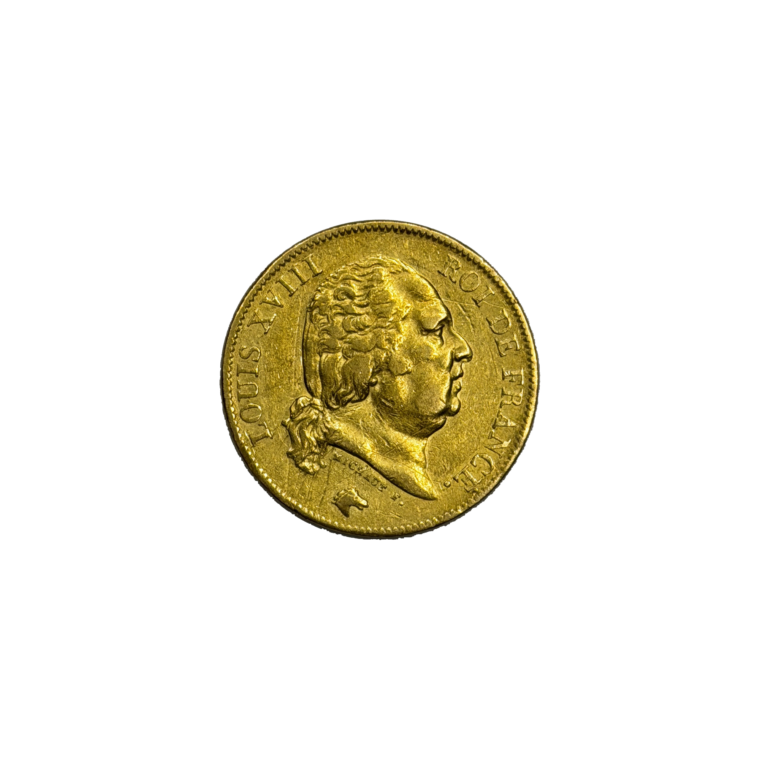
VF, XF
1816-1824
.3734 troy ounce
France
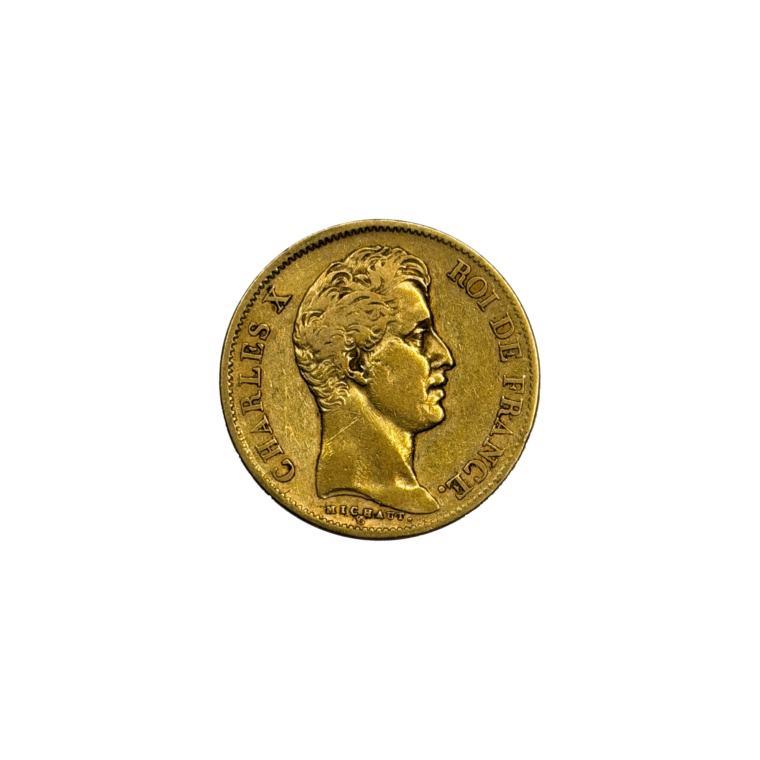
VF, XF
1824-1830
.3734 troy ounce
France
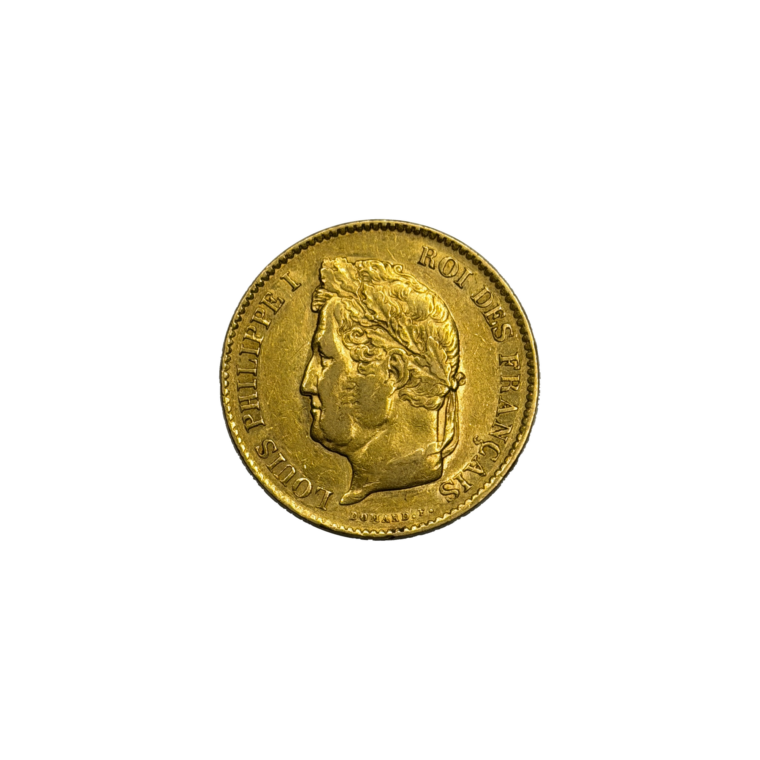
VF, XF
1831-1839
.3734 troy ounce
France


