

You must have an order with a minimum of $1,000.00 to place your order, your current order total is $0.00.
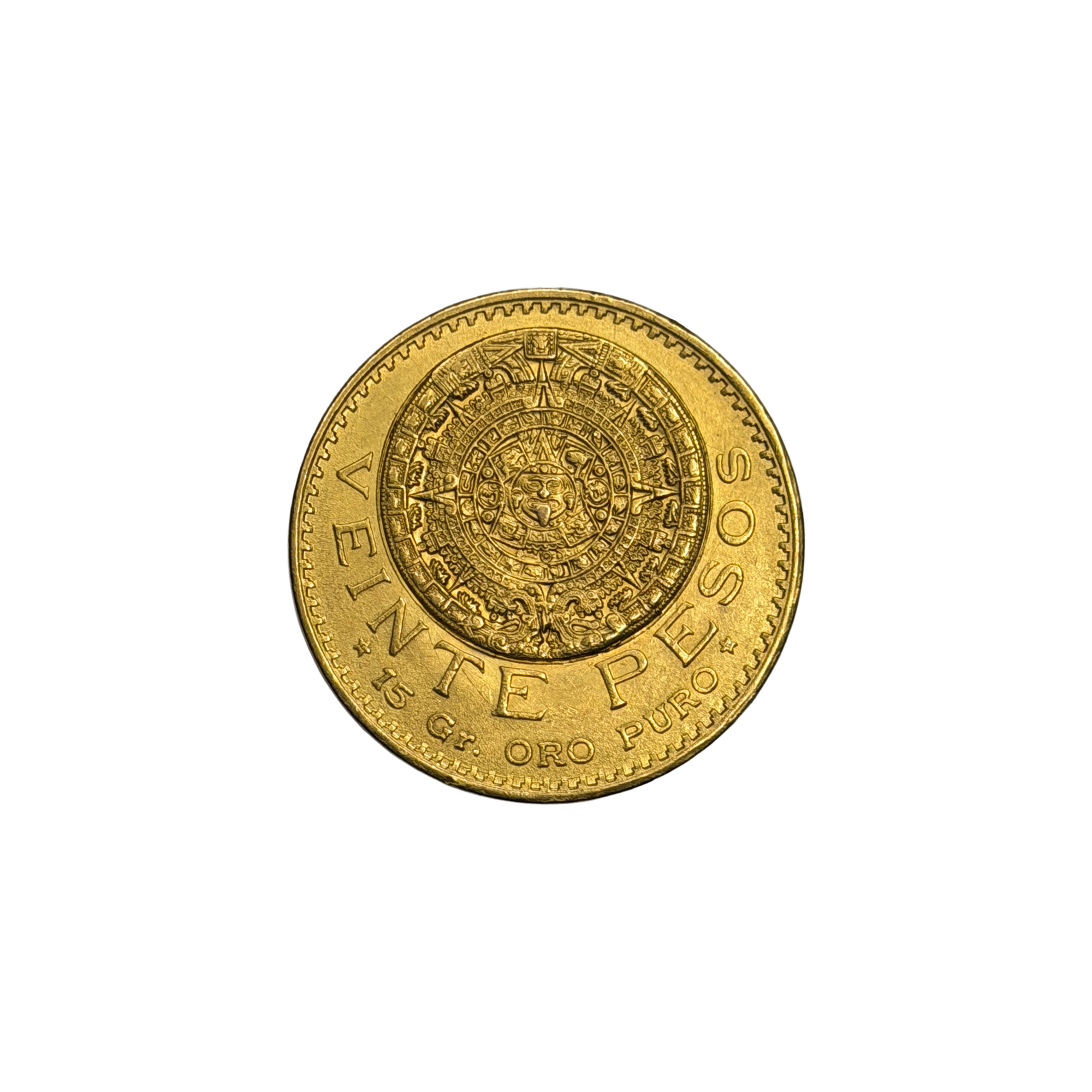
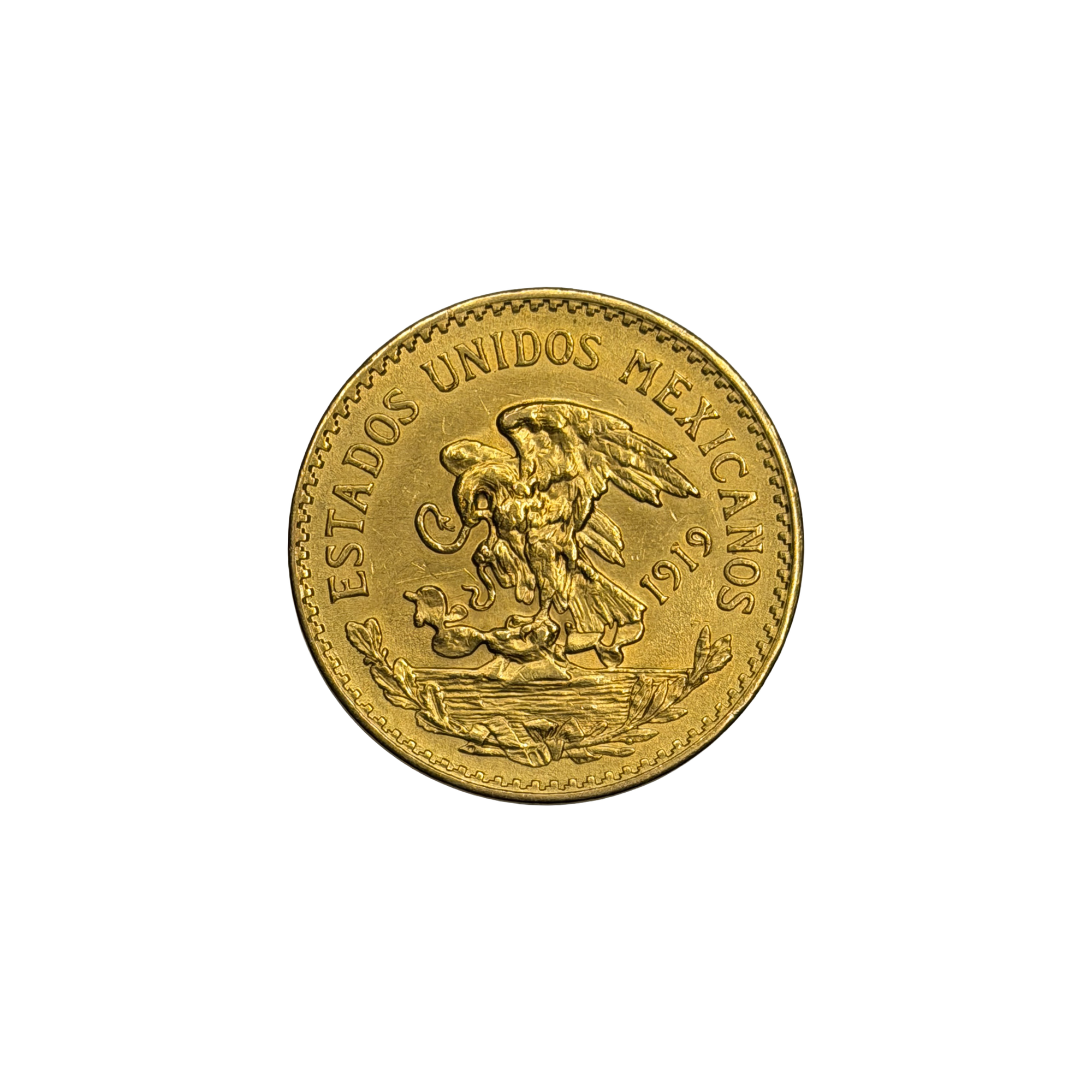
The Mexico 20 Pesos is widely considered one of the most beautiful coins of the gold-standard era — its reverse an intricate strike of the Aztec Calendar, the great Sun Stone of Tenochtitlan — and it occupies a position in the market that few investors know exists. At 0.4823 troy ounces of .900 fine gold, it is one of the few coins of the entire historical era struck to roughly half an ounce. It trades at per ounce acquisition costs comparable to modern half-ounce American Eagles. And by total mintage it is substantially scarcer than the U.S. $10 gold pieces it is most naturally compared against — coins that routinely command far higher premiums in similar condition.
Brilliant Uncirculated examples are rarely seen. USAGOLD has been able to offer them only in small lots over the years, and they are always quickly subscribed. For investors whose priorities are a highly coveted design, comparative scarcity, a high state of preservation, and the reassurance of a gold content stamped directly on the coin itself (15 Gr. ORO PURO — fifteen grams of pure gold)—all for near-bullion pricing—the Mexico 20 Pesos is, when available, one of the best values in the historic gold market.
The reverse bears the Aztec Calendar Stone — the Sun Stone — rendered in remarkable detail: the face of the sun god at center, ringed by the day-signs and cosmological bands of the original monolith, which was carved around 1479 and rediscovered beneath Mexico City’s central plaza in 1790. The obverse carries the Mexican national arms — the eagle on a cactus devouring a serpent, the emblem drawn from the Aztec foundation legend of Tenochtitlan — with the legend ESTADOS UNIDOS MEXICANOS. No other coin of the gold-standard era carries pre-Columbian imagery of this ambition.
Each coin contains 0.4823 troy ounces of pure gold in a .900 fine alloy — and, uniquely, states its gold weight directly on the coin: 15 GRAMOS ORO PURO. Grade: Brilliant Uncirculated. Minted 1917–1921 (a smaller restrike issue followed in 1959; USAGOLD’s offering is limited to the original pre-1933 era).
The 20 Pesos was introduced in 1917 — the year Mexico’s revolutionary decade culminated in the Constitution of 1917, which still governs the country today. The new gold coinage, crowned by the Sun Stone design, was a deliberate statement of national identity: a modern republic reaching past the colonial era to the Aztec civilization for its monetary imagery. The coins circulated through the reconstruction years that followed the Revolution, and their five-year original run (1917–1921) ended as Mexico, like much of the world, moved away from circulating gold.
The Sun Stone itself is among the most recognizable artifacts in the hemisphere — the single most famous object of Aztec civilization. The 20 Pesos places it in gold, at half-ounce scale, with a level of die detail that has made the coin a favorite of collectors and investors for a century.
Larger historic coins are generally scarcer than smaller ones — gold coins of the era were working money, and larger denominations were simply too valuable for practical daily use. The half-ounce class of the historical era is essentially three coins — the French 50 Franc, the U.S. $10 gold piece, and the Mexico 20 Pesos — joined only by Cuba’s brief two-year 10 Pesos, struck to the American standard. Among them, the Mexican coin is the standout value.
The comparison with the $10 gold pieces makes the point. As direct contemporaries, roughly half as many Mexico 20 Pesos (6.2 million, 1917–1921) were minted as $10 Indians (13.9 million). Include the Indian’s predecessor, the $10 Liberty, and total $10 gold piece production exceeds 56 million coins — roughly ten times the Mexican coin’s original supply. Yet uncirculated $10 gold pieces normally carry premiums around 25%, while the Mexico 20 Pesos trades near modern bullion pricing. That gap between comparative scarcity and premium is the value: the client acquires a coin one-tenth as plentiful, in the same size class, at a fraction of the premium — the comparative scarcity, in effect, comes at no added cost.
The Sun Stone strike is the coin’s signature: a design of genuine intricacy, fully appreciated only in high grade, where the concentric rings and glyphs of the calendar remain sharp and the fields carry original mint luster. Brilliant Uncirculated examples show the design as the Mexico City Mint intended it — and they are genuinely scarce in the market. These coins surface in small lots, irregularly, and the combination of beauty, scarcity, and low premium has meant that every offering USAGOLD has made over the years has been quickly subscribed.
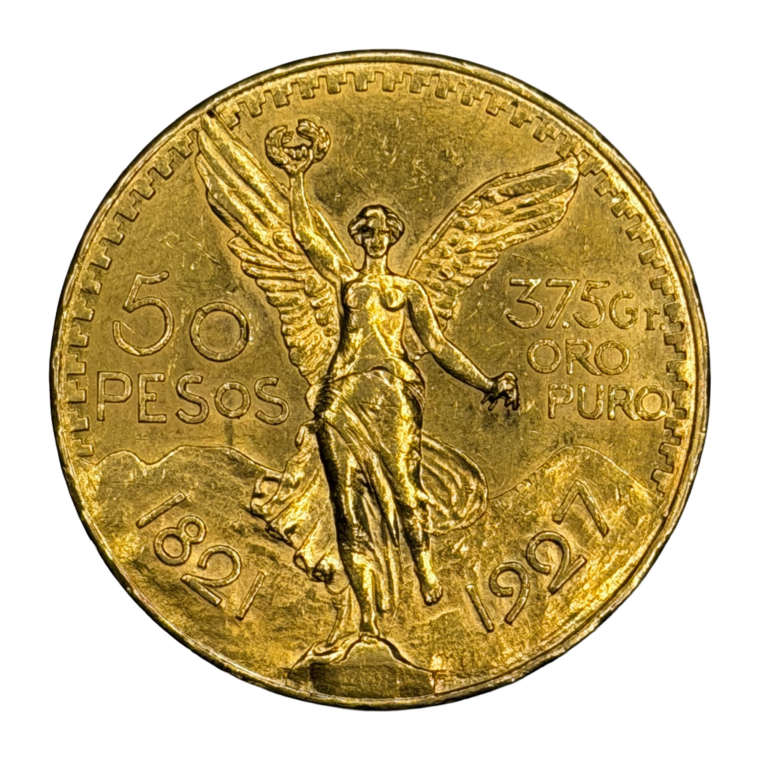
The Mexico 20 Pesos carries a practical liquidity feature almost no other historic coin shares: its pure gold weight — 15 grams — is stated on the coin itself. That inscription makes the coin self-documenting anywhere gold is traded, in any language, to any dealer. Mexican gold has been a fixture of the North American trade for a century — anchored by the 50 Pesos Centenario — and the 20 Pesos trades within that established market. For asset-preservation-minded buyers seeking broad-based recognition and liquidity in a mid-sized coin, it is a perennial favorite.
In 1933, FDR issued Executive Order 6102, requiring Americans to surrender their gold coin and bullion to the Treasury — but the order and the regulations that followed it exempted gold coins of recognized special value to collectors of rare and unusual coins. Subsequent clarifications by the Treasury identified pre-1933 gold coins — a classification that includes the original-era Mexico 20 Pesos, struck 1917–1921 — as falling within that collector classification as historical items.
Under current constitutional law, a government intervention in the gold market would be executed through the power of eminent domain — the government’s right to take private property for public use provided it pays the owner just compensation. Historic coins complicate the government’s ability to broadly establish “just compensation” or “fair value,” which was precisely the reasoning behind the original “recognized special value” exemption in 1933. That complexity, and the precedent surrounding pre-1933 gold coins, creates a notable impediment to the government’s ability to restrict them broadly — particularly compared to modern bullion, which can be valued easily and consistently at a single price. In essence, it is a bureaucratic question of whether the government would undertake the enormous task of valuing the diversity and complexity of the historic-coin genre — every coin, every date, every condition, every personal holding — and that difficulty is what insulates the owner’s legal liquidity rights in the event of capital controls.
Whether a future government intervention in private gold markets is a risk an investor assigns significant weight to is a personal judgment. The factual point is narrower: the pre-1933 status represents a layer of portfolio differentiation that this coin carries at minimal added per-ounce cost over comparable modern bullion, along with a measure of insulation for the legal liquidity rights of its owner.
For a more in-depth study, we invite you to read our comprehensive memorandum on this subject: Preparing for a Potential Gold Confiscation
The Mexico 20 Pesos is the rare coin that wins on every axis it competes on: one of the three half-ounce coins of the historical era, one-tenth as plentiful as its American counterparts yet priced near modern bullion, bearing perhaps the most striking design of the gold-standard age, with its gold weight stamped on its face for instant recognition anywhere in the world. Brilliant Uncirculated examples are rarely seen, highly coveted, and quickly subscribed — for good reason. No other mid-sized historic gold coin combines this much beauty, comparative scarcity, and liquidity at so low a premium.
| Year | Mintage |
|---|---|
| 1917 | 852,000 |
| 1918 | 2,831,000 |
| 1919 | 1,094,000 |
| 1920 | 462,000 |
| 1921 | 922,000 |
| Pre-1933 total | 6,161,000 |
(A separate restrike issue of 1,249,414 pieces was produced in 1959.)
BU
1917-1921
.4823 troy ounce
Mexico
| Quantity | Wire | Card |
|---|---|---|
| 1–10 | $2,306.67 | $2,402.78 |
| 11–20 | $2,283.60 | $2,378.75 |
| 21+ | $2,260.54 | $2,354.72 |
Quantity tiers reflect the historic & fractional gold order discount (1% at $25,000+ · 2% at $50,000+ in qualifying coins). Any mix of qualifying historic coins counts toward the same order total.
Prices shown under Wire include a 4% cash discount. Card prices are the full list price. ACH bank transfer is available to established clients only. First-time orders can be paid by wire transfer or card.
Interested in gold but struggling to find the right firm?

UNC, BU
1921-1931
1.2057 troy ounce
Mexico
AU, UNC
1905-1959
.2411 troy ounce
Mexico
AU, UNC
1905-1955
.1206 troy ounce
Mexico


