

You must have an order with a minimum of $1,000.00 to place your order, your current order total is $0.00.
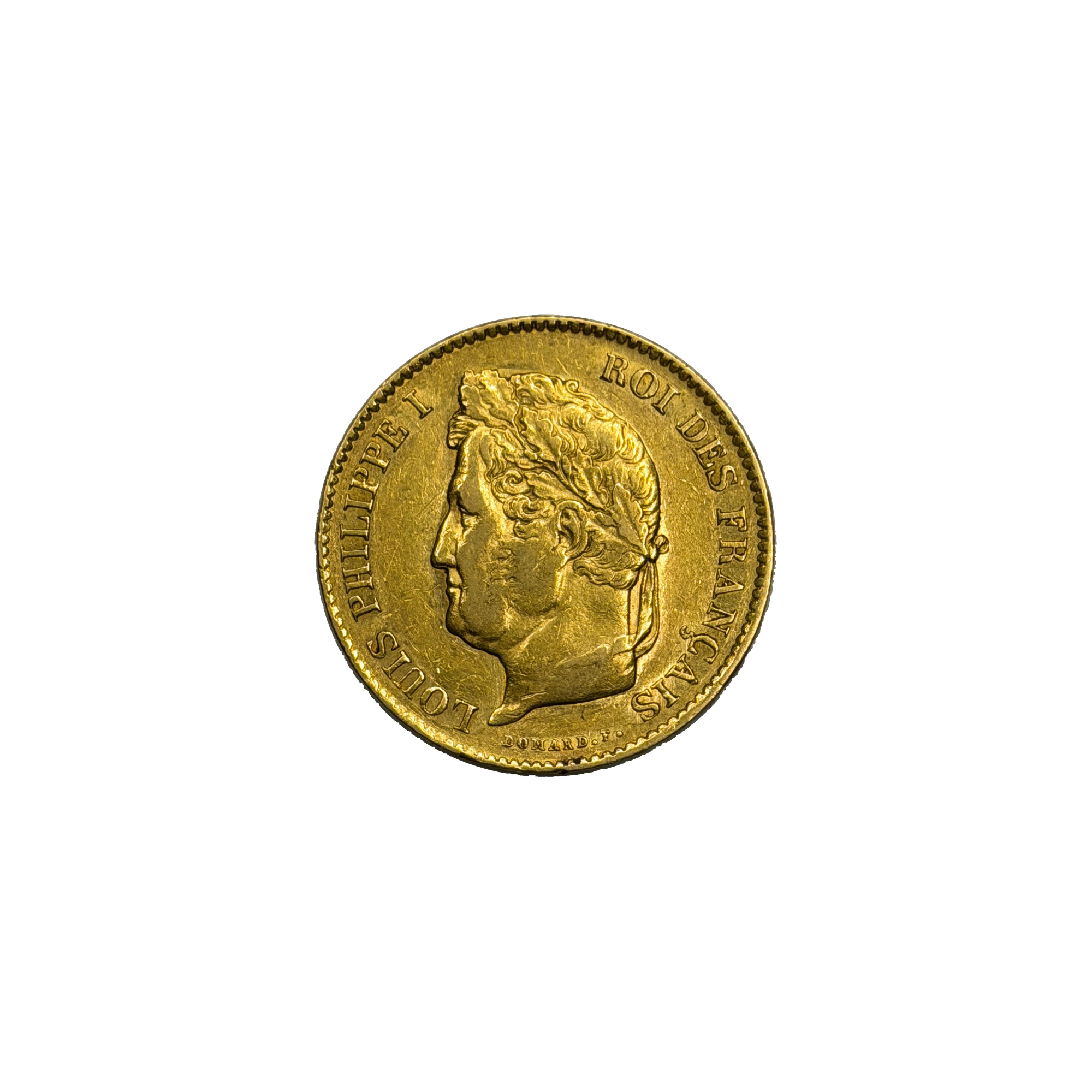
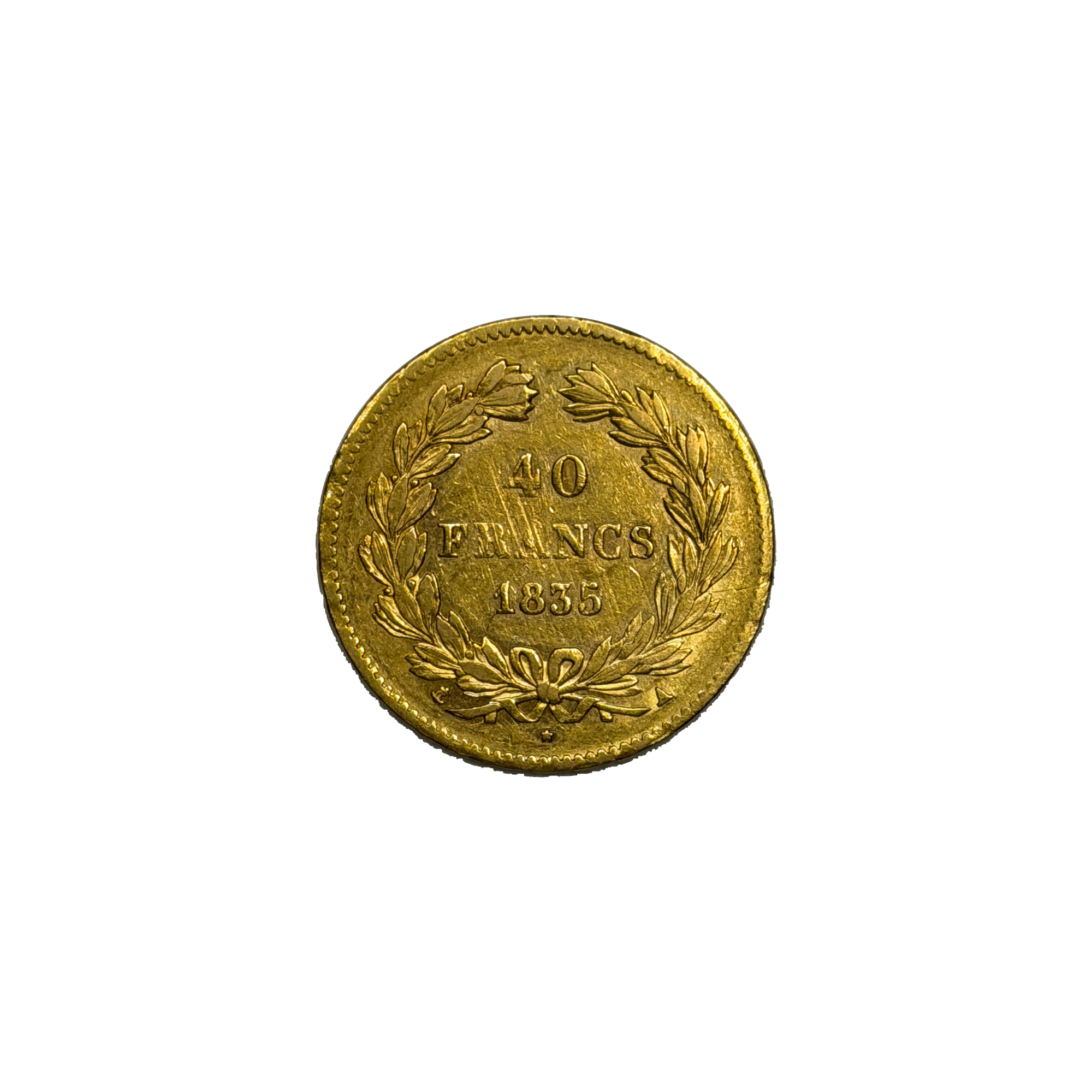
The 40 franc gold pieces of Louis Philippe are the last of their kind. Struck between 1831 and 1839 under the Citizen King who came to power in the July Revolution of 1830, they closed a denomination that had begun under Napoleon in 1802 — after 1839, France never struck a 40 franc gold coin again, and the country’s next large gold coins would wait until Napoleon III introduced the 50 and 100 franc pieces in 1855.
The production record makes the investor argument. Louis Philippe’s mints struck approximately 9.1 million 20 franc gold coins across his reign — and just 775,336 of the 40 franc, less than one-tenth the supply, in a coin carrying twice the gold. The denomination was simply too valuable for the daily commerce of the 1830s, and output dwindled accordingly until the final year’s striking of 17 pieces ended the series outright. For investors whose priorities are notable scarcity from a supply fixed since 1839, the historical significance of a denomination’s closing chapter, and a standardized and widely recognized gold content, the Louis Philippe 40 franc is a highly coveted position within French large gold — and one rarely available in quantity.
The obverse bears the laureate portrait of Louis Philippe facing left, engraved by Joseph-François Domard — the king’s head crowned with oak-and-laurel, the inscription reading LOUIS PHILIPPE I ROI DES FRANÇAIS, the engraver’s signature beneath the truncation. That title — King of the French, rather than King of France — was itself a constitutional statement, defining a monarch who ruled by the consent of the nation rather than by right over its territory. The reverse abandons the Bourbon arms of the two preceding reigns for a plainer republican-flavored design: the denomination and date, 40 FRANCS, within a closed laurel wreath, with the mint mark below.
At approximately 26mm in diameter and 12.90 grams total weight, each coin is struck from .900 fine gold and contains 0.3734 troy ounces of actual gold content — twice the 20 franc standard later carried across Europe by the Latin Monetary Union. Grade range: VF/XF. Minted 1831–1839.
Louis Philippe d’Orléans took the throne in 1830, after the July Revolution swept away Charles X and the senior Bourbon line. He was a king unlike any France had known — a man who had fought in the Revolutionary armies at Valmy and Jemappes, lived in exile in Switzerland, Scandinavia, and the United States, and taught school under an assumed name. As king he cultivated the image of a bourgeois monarch: he walked the streets of Paris with an umbrella, sent his sons to public schools, and governed in alliance with the banking and commercial classes who were industrializing France.
His eighteen-year reign — the July Monarchy — was the France of Balzac and early railroads, of expanding credit and rising industry. It ended as it began, in revolution: the upheaval of 1848 sent Louis Philippe into English exile and brought in the Second Republic, whose president, Louis-Napoleon Bonaparte, would shortly make himself Emperor Napoleon III. The 40 francs struck under Louis Philippe are the working large gold of that transitional France — the last French monarchy’s contribution to a denomination Napoleon had created.
The mintage ledger records a denomination winding down. Production was meaningful in only two years — 223,605 pieces in 1833 and 314,322 in 1834 — and never again exceeded 63,000. The final entry, 1839, records 17 pieces, and with them the French 40 franc ended permanently. The series total of 775,336 stands against 9.1 million Louis Philippe 20 francs, 18.4 million Louis XVIII 20 francs, and 232.9 million Napoleon III 20 francs — and unlike a paused series, this one is closed by history: France never returned to the denomination. Two centuries of circulation, melts, and attrition have further thinned what was already a small supply at the outset.
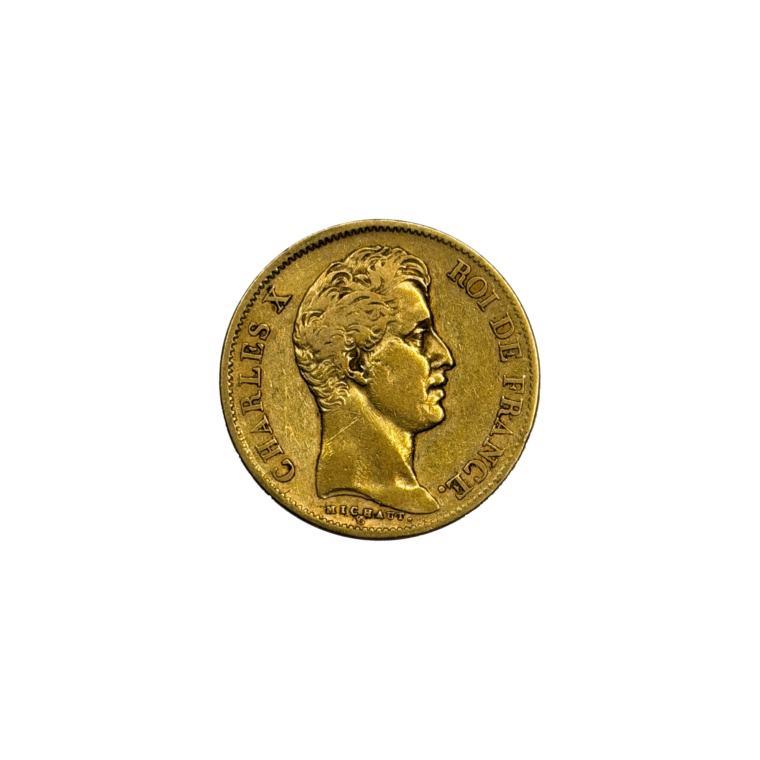
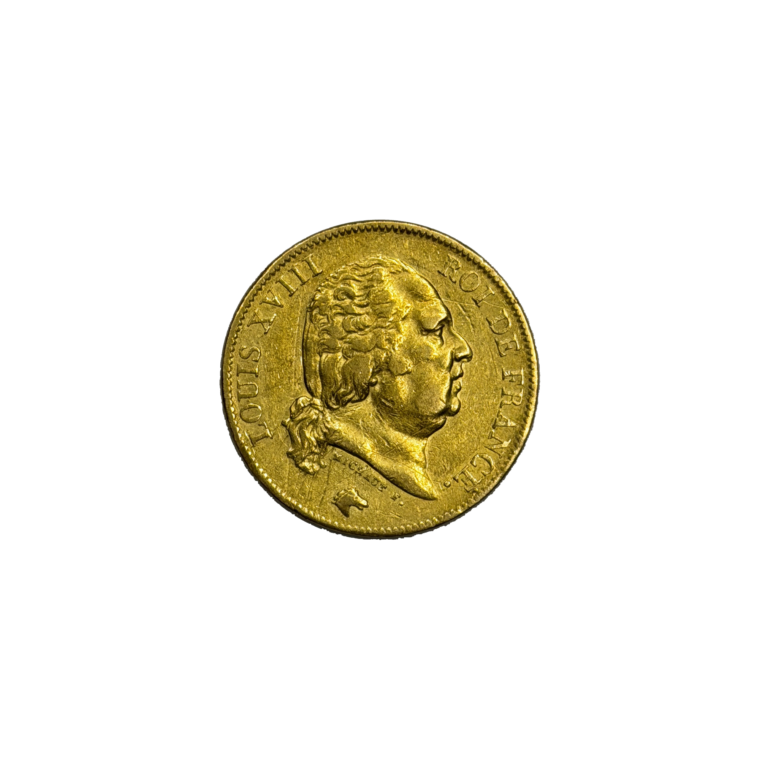
The Louis Philippe 40 franc trades within the French gold family — the most widely traded historic gold coinage in Europe, recognized on sight by dealers across Europe and North America. Its specifications are universally documented, and its gold content prices immediately off the 20 franc standard quoted daily wherever French gold changes hands. As the final issue of the denomination, it also draws demand from collectors assembling the four-reign 40 franc series — Napoleon I, Louis XVIII, Charles X, Louis Philippe — a demand layer that common French gold does not enjoy.
In 1933, FDR issued Executive Order 6102, requiring Americans to surrender their gold coin and bullion to the Treasury — but the order and the regulations that followed it exempted gold coins of recognized special value to collectors of rare and unusual coins. Subsequent clarifications by the Treasury identified pre-1933 gold coins — a classification that includes the Louis Philippe 40 franc, struck between 1831 and 1839 — as falling within that collector classification as historical items.
Under current constitutional law, a government intervention in the gold market would be executed through the power of eminent domain — the government’s right to take private property for public use provided it pays the owner just compensation. Historic coins complicate the government’s ability to broadly establish “just compensation” or “fair value,” which was precisely the reasoning behind the original “recognized special value” exemption in 1933. That complexity, and the precedent surrounding pre-1933 gold coins, creates a notable impediment to the government’s ability to restrict them broadly — particularly compared to modern bullion, which can be valued easily and consistently at a single price. In essence, it is a bureaucratic question of whether the government would undertake the enormous task of valuing the diversity and complexity of the historic-coin genre — every coin, every date, every condition, every personal holding — and that difficulty is what insulates the owner’s legal liquidity rights in the event of capital controls.
Whether a future government intervention in private gold markets is a risk an investor assigns significant weight to is a personal judgment. The factual point is narrower: the pre-1933 status represents a layer of portfolio differentiation that this coin carries along with a measure of insulation for the legal liquidity rights of its owner.
For a more in-depth study, we invite you to read our comprehensive memorandum on this subject: Preparing for a Potential Gold Confiscation
The French 40 Franc Louis Philippe is the last coin of a denomination that began with Napoleon — struck under France’s final monarchy-by-revolution, from a supply less than one-tenth that of its 20 franc companion, and closed forever by the 17 pieces of 1839. It combines a permanently fixed small supply, the historical significance of a denomination’s ending, and a standardized and widely recognized gold content — the kind of coin acquired for heirloom positions, and one that reaches the market only irregularly, in small quantities. No other coin lets an investor hold the final chapter of France’s original large gold denomination.
| Year | Mintage |
|---|---|
| 1831 | 62,323 |
| 1832 | 26,248 |
| 1833 | 223,605 |
| 1834 | 314,322 |
| 1835 | 37,204 |
| 1836 | 52,576 |
| 1837 | 28,140 |
| 1838 | 30,901 |
| 1839 | 17 |
| Total | 775,336 |
VF, XF
1831-1839
.3734 troy ounce
France
| Quantity | Wire | Card |
|---|---|---|
| 1–11 | $2,021.69 | $2,105.93 |
| 12–23 | $2,001.47 | $2,084.87 |
| 24+ | $1,981.26 | $2,063.81 |
Quantity tiers reflect the historic & fractional gold order discount (1% at $25,000+ · 2% at $50,000+ in qualifying coins). Any mix of qualifying historic coins counts toward the same order total.
Prices shown under Wire include a 4% cash discount. Card prices are the full list price. ACH bank transfer is available to established clients only. First-time orders can be paid by wire transfer or card.
Interested in gold but struggling to find the right firm?

VF, XF
1824-1830
.3734 troy ounce
France
VF, XF
1816-1824
.3734 troy ounce
France
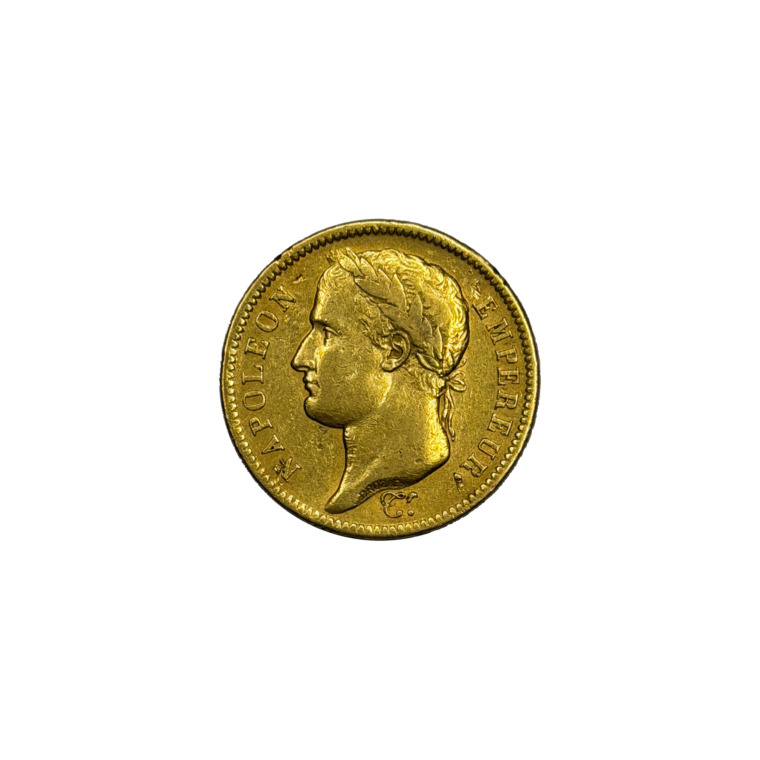
VF, XF
1803-1812
.3734 troy ounce
France


