

You must have an order with a minimum of $1,000.00 to place your order, your current order total is $0.00.
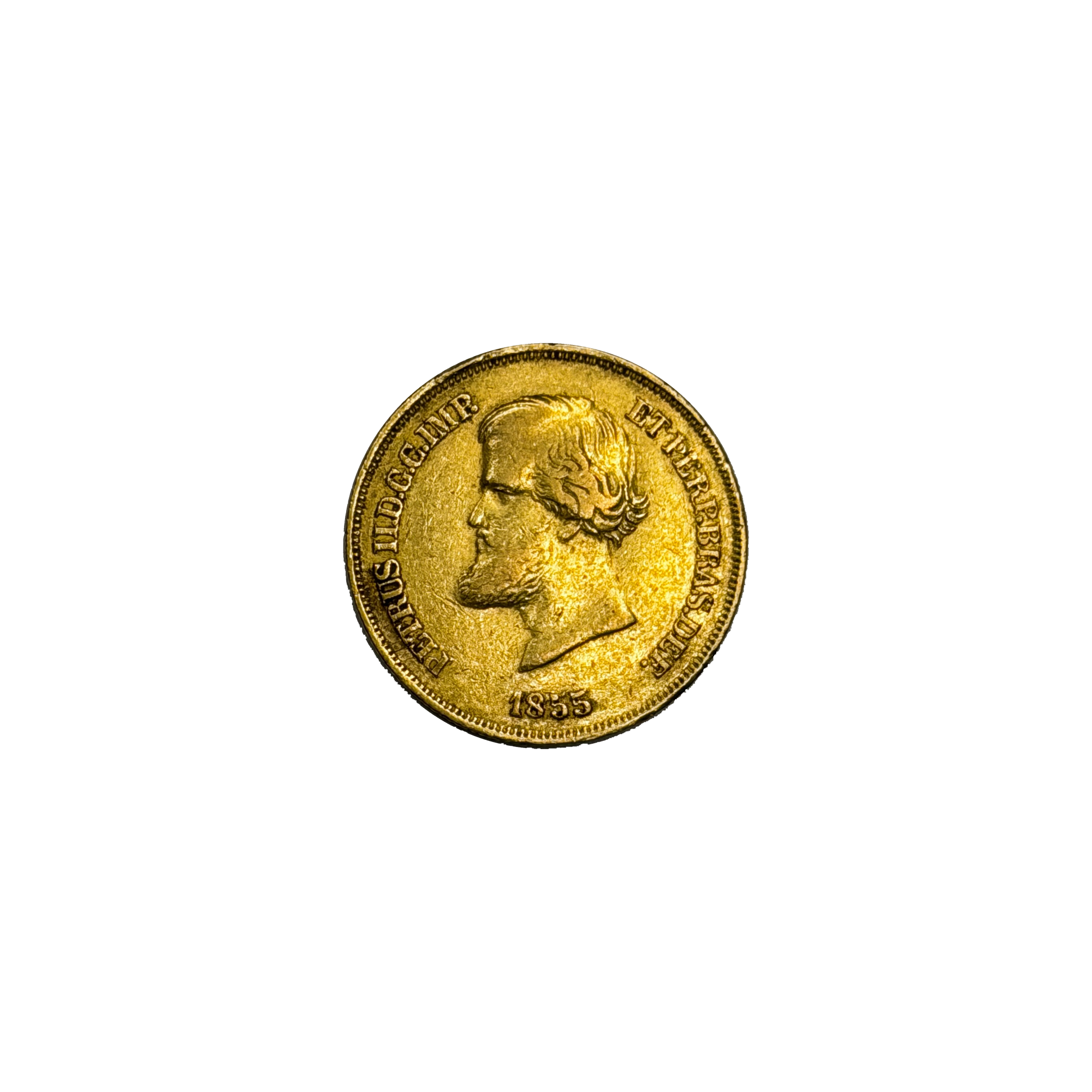
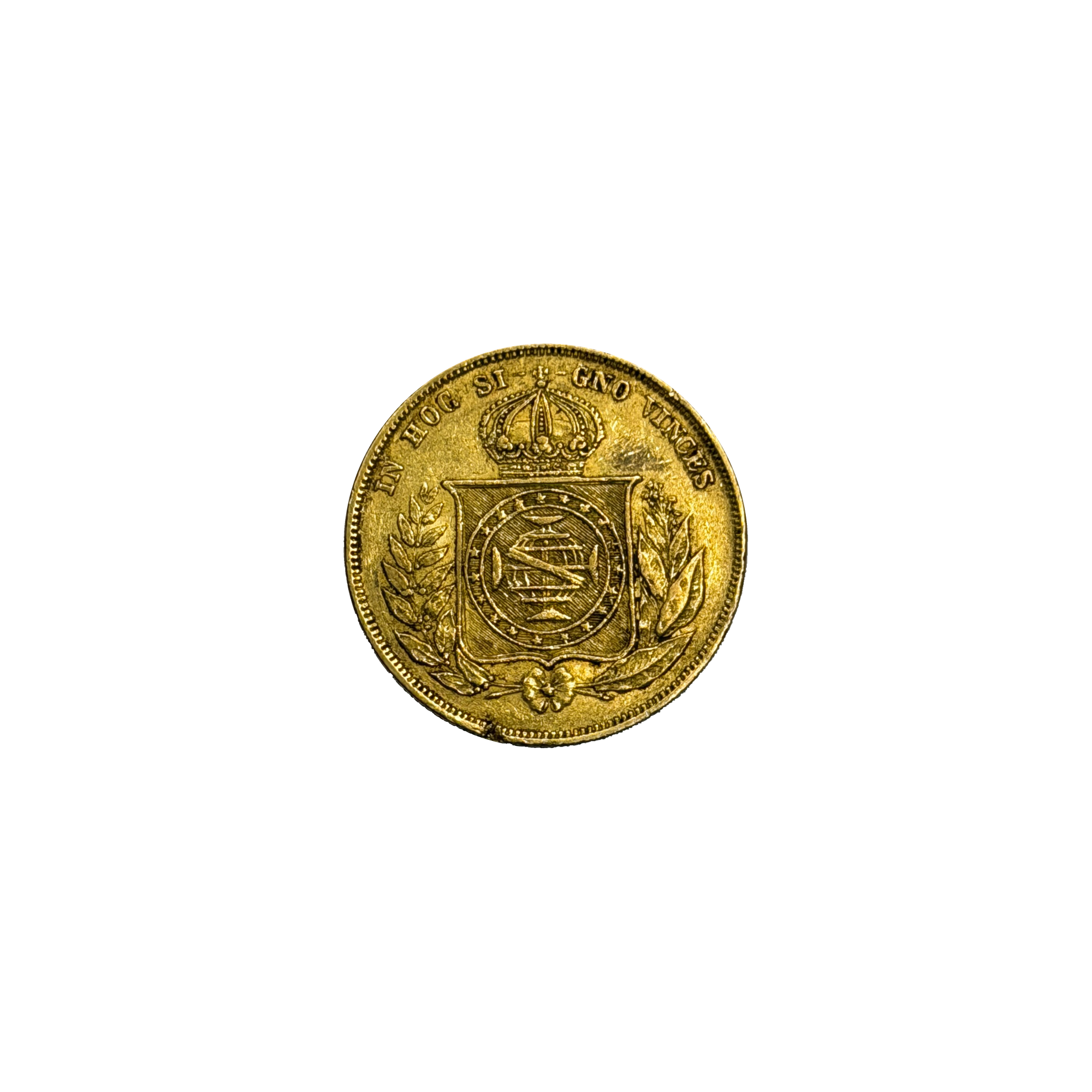
The Western Hemisphere has had exactly one enduring monarchy, and this is its coin. The Brazil 10,000 Reis carries the portrait of Dom Pedro II, who reigned for nearly half a century — the only long-reigning emperor in the history of the Americas — over a Brazil that grew, industrialized, and remained politically stable while most of its neighbors cycled through coups and caudillos. Struck at Rio de Janeiro across the heart of his reign, the coin is a genuine mid-nineteenth-century imperial artifact, more than a century and a half old.
For investors, its standing rests on an unusual combination: age and scarcity ordinarily priced at collector multiples, offered at pricing comparable to common historic bullion. The recorded mintages total 714,771 coins across the dates for which figures survive — a total smaller than many single-year issues of the mass-market European gold coins — and it trades at per ounce acquisition costs comparable to modern bullion while tracking the spot price of gold over time. It carries the historic (pre-1933) designation and the associated insulation against the possibility of future government intervention, and at 0.2643 troy ounces of gold it sits usefully above the quarter-ounce class. For investors whose priorities are a coin steeped in imperial history, notable scarcity from a fixed series of barely 700,000 pieces, and a standardized and fully documented gold content—all for near-bullion pricing—the 10,000 Reis is among the most substantive values in the historic world gold series.
The obverse presents the left-facing portrait of Pedro II with the Latin legend PETRUS II D.G.C. IMP. ET PERP. BRAS. DEF. — “Peter II, by the Grace of God Constitutional Emperor and Perpetual Defender of Brazil” — with the date below. The reverse displays the crowned arms of the Brazilian Empire, the imperial shield ringed by stars of the provinces, framed by branches of coffee and tobacco, Brazil’s twin engines of empire, under the legend IN HOC SIGNO VINCES — “In this sign you will conquer.”
Each coin contains 0.2643 troy ounces of pure gold, struck in .917 fine gold at approximately 8.96 grams gross weight. The series was minted from 1853 to 1889. USAGOLD offers the coin in XF/AU condition — extremely fine to about uncirculated, with the principal design elements sharp and much of the original detail preserved on a coin that circulated as working money in the 1800s.
Pedro II was born in Rio de Janeiro on December 2, 1825, and ascended the throne at the age of six upon the abdication of his father in 1831, ruling in his own right from his coronation a decade later. What followed was 49 years of domestic stability, prosperity, and progress — a record no other government in the hemisphere’s nineteenth century approached. During his reign Brazil built the Union and Industry road, its first paved highway; ran its first steam engine; instituted the postal stamp; laid the submarine telegraph cable; and inaugurated the telephone — Pedro II himself is believed to have been the first Brazilian to speak on one. A scholar-monarch who corresponded with Darwin, Pasteur, and Victor Hugo, he was deposed bloodlessly in 1889 by a military coup that ended the empire — and mourned by much of the nation that exiled him. The coins bearing his portrait were the hard currency of that entire national project.
The comparative numbers are documented. The 10,000 Reis dates with recorded mintages total 714,771 pieces between 1853 and 1888, with several later dates through 1889 struck without surviving figures — against more than 30 million sovereigns from the British mint system in a single peak year. The later dates are strikingly small: 3,411 pieces in 1877, 1,180 in 1887, 3,782 in 1886. Production ended with the empire itself, so the population is fixed, and 150-plus years of circulation, melting, and attrition have only reduced it. This is scarce-but-not-numismatically-rare territory: the coin trades on its gold content first and its history and finite supply second, which is exactly the value for patient holders — imperial-era scarcity and a century and a half of history acquired at little more than the price of the metal.
The 10,000 Reis is standardized, documented, and easy to authenticate — an imperial portrait coin with catalog specifications any professional can verify. Investors should understand the trade-off plainly: it trades on scarcity and character rather than the high-volume dealer flow that moves sovereigns and 20 franc coins. It is a coin acquired for differentiation within a diversified holding, not as a primary liquidity instrument — and demand has historically absorbed the modest quantities that surface. Clients seeking maximum on-sight liquidity should anchor with the high-volume fractionals and add the Brazilian imperials for age, scarcity, and character.
In 1933, FDR issued Executive Order 6102, requiring Americans to surrender their gold coin and bullion to the Treasury — but the order and the regulations that followed it exempted gold coins of recognized special value to collectors of rare and unusual coins. Subsequent clarifications by the Treasury identified pre-1933 gold coins — a classification that includes the Brazil 10,000 Reis, struck between 1853 and 1889 — as falling within that collector classification as historical items. A nineteenth-century imperial coin is, if anything, the archetype of the historical-item classification the exemption described.
Under current constitutional law, a government intervention in the gold market would be executed through the power of eminent domain — the government’s right to take private property for public use provided it pays the owner just compensation. Historic coins complicate the government’s ability to broadly establish “just compensation” or “fair value,” which was precisely the reasoning behind the original “recognized special value” exemption in 1933. That complexity, and the precedent surrounding pre-1933 gold coins, creates a notable impediment to the government’s ability to restrict them broadly — particularly compared to modern bullion, which can be valued easily and consistently at a single price. In essence, it is a bureaucratic question of whether the government would undertake the enormous task of valuing the diversity and complexity of the historic-coin genre — every coin, every date, every condition, every personal holding — and that difficulty is what insulates the owner’s legal liquidity rights in the event of capital controls.
Whether a future government intervention in private gold markets is a risk an investor assigns significant weight to is a personal judgment. The factual point is narrower: the pre-1933 status represents a layer of portfolio differentiation that this coin carries at minimal added per-ounce cost over comparable modern bullion, along with a measure of insulation for the legal liquidity rights of its owner.
For a more in-depth study, we invite you to read our comprehensive memorandum on this subject: Preparing for a Potential Gold Confiscation
The Brazil 10,000 Reis is a working gold coin from the hemisphere’s only enduring empire — the portrait of a monarch who gave Brazil 49 years of stability and progress, on 0.2643 ounces of gold from a fixed series of barely 700,000 pieces, finished before 1889 and untouched since. That a coin of this age and documented scarcity can still be acquired at pricing comparable to common historic bullion is the entire argument — though it is a value that presents itself irregularly, in the small quantities the market yields. No other South American gold coin combines imperial history, 150-year age, and near-bullion accessibility so completely for gold investors.
| Year | Mintage |
|---|---|
| 1853 | 40,399 |
| 1854 | 163,043 |
| 1855 | 41,401 |
| 1856 | 207,760 |
| 1857 | 97,997 |
| 1858 | 55,263 |
| 1859 | 15,684 |
| 1876 | 19,602 |
| 1877 | 3,411 |
| 1878 | 10,311 |
| 1879 | 6,431 |
| 1880 | 9,806 |
| 1882 | 4,671 |
| 1883 | 10,024 |
| 1884 | 10,692 |
| 1885 | 7,955 |
| 1886 | 3,782 |
| 1887 | 1,180 |
| 1888 | 5,359 |
| Total (recorded dates) | 714,771 |
XF, AU
1853-1889
.2643 troy ounce
Brazil
| Quantity | Wire | Card |
|---|---|---|
| 1–18 | $1,293.60 | $1,347.50 |
| 19–37 | $1,280.66 | $1,334.03 |
| 38+ | $1,267.73 | $1,320.55 |
Quantity tiers reflect the historic & fractional gold order discount (1% at $25,000+ · 2% at $50,000+ in qualifying coins). Any mix of qualifying historic coins counts toward the same order total.
Prices shown under Wire include a 4% cash discount. Card prices are the full list price. ACH bank transfer is available to established clients only. First-time orders can be paid by wire transfer or card.
Interested in gold but struggling to find the right firm?


