

You must have an order with a minimum of $1,000.00 to place your order, your current order total is $0.00.
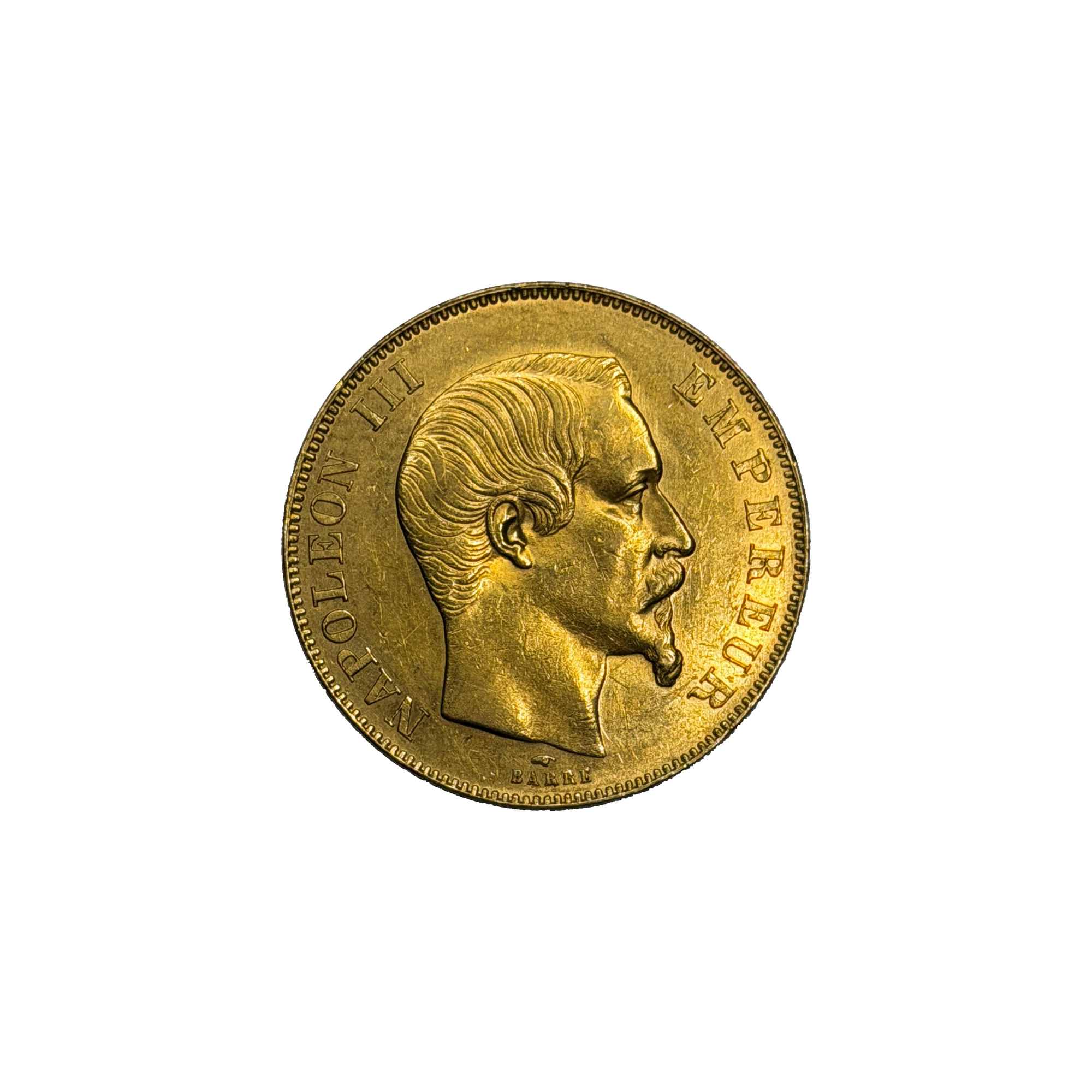
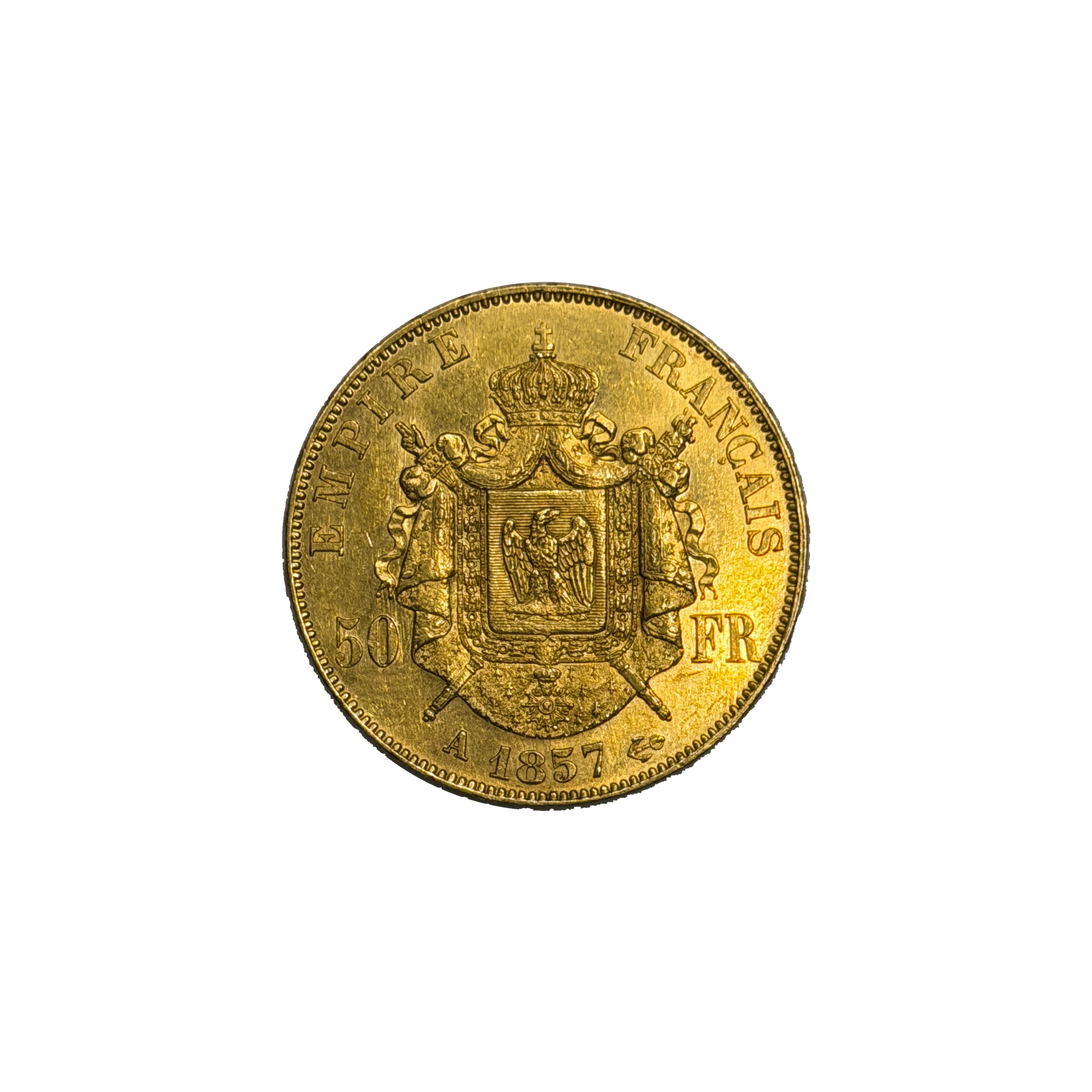
Larger historic gold coins are scarcer than smaller ones as a rule — gold was working money, and big denominations were too valuable for daily use — but the half-ounce size class is a special case. The half-ounce class of the entire historical era is essentially three coins — the U.S. $10 gold piece, the Mexico 20 Pesos, and the French 50 Franc — joined only by Cuba’s brief two-year 10 Pesos, struck to the American standard. Within that class, the French coin is by a wide margin the scarcest. Total production of the bare-head 50 Franc Napoleon III, struck 1855–1860, was 796,765 pieces — against approximately 6.2 million Mexico 20 Pesos and more than 56 million U.S. $10 gold pieces across the Liberty and Indian series combined.
The 50 franc was a new denomination when it appeared: France had struck nothing larger than the 40 franc since Napoleon’s 1803 reform, and it was his nephew, Napoleon III, who introduced the 50 and 100 franc pieces in 1855 as the gold of the Second Empire. For investors whose priorities are a highly coveted mid-sized gold coin, notable scarcity within a class of only three, and a standardized and widely recognized gold content, the French 50 Franc is the thinnest supply line in the half-ounce class — one-sixth the mintage of the Mexican coin, roughly one-sixtieth of its American counterparts, and rarely available in quantity.
The obverse bears the portrait of Napoleon III facing right — the bare-head type by Jean-Jacques Barre, chief engraver of the Paris Mint, with the emperor’s hair swept back and the pointed imperial beard and mustache rendered in fine detail — encircled by NAPOLEON III EMPEREUR, the engraver’s signature below. The reverse carries the full arms of the Second Empire: the imperial eagle on a draped, ermine-lined mantle beneath the crown, flanked by scepters, encircled by EMPIRE FRANÇAIS with the denomination 50 FR and the date and mint mark below.
At 28mm in diameter and 16.13 grams total weight, each coin is struck from .900 fine gold and contains 0.4667 troy ounces of actual gold content — two and a half times the 20 franc standard, in the same .900 fine alloy that the Latin Monetary Union carried across Europe. Grade range: AU/VF/XF. Minted 1855–1860.
Napoleon III was the nephew of Napoleon Bonaparte and emperor of France from 1852 to 1870. Elected president of the Second Republic in 1848, he faced a parliament determined to block his re-election — so in December 1851 he organized a coup, seized power, rewrote the constitution, and declared himself emperor. In a historical detail worth noting, he claimed the throne of the Second Empire on December 2, 1852 — 48 years to the day after his uncle’s coronation as Napoleon I.
His reign transformed French money as thoroughly as it transformed Paris. The gold strikes of California and Australia were pouring metal into the world economy, and France recoined on a massive scale — including, for the first time, denominations above 40 francs. The 50 franc of 1855 was part of that expansion, the Second Empire’s statement coin alongside the 100 franc. The empire itself ended at Sedan in 1870, when defeat in the Franco-Prussian War brought a new revolution; Napoleon III died in English exile in 1873. The coins remain — the only French half-ounce-class gold ever struck.
The comparison that matters is within the size class, and it is documented coin by coin. As its direct contemporaries, the U.S. $10 Liberty was struck by the tens of millions from 1838 to 1907, and the later $10 Indian added 13.9 million more — over 56 million U.S. half-ounce-class coins in all. The Mexico 20 Pesos of 1917–1921 totaled roughly 6.2 million. The bare-head French 50 Franc totals 796,765 — with production concentrated in 1855–1859 and only 29,000 pieces struck in its final year, 1860. (A separate laureate-head type followed from 1862 to 1868.) A century and a half of melts and attrition apply on top. Within the smallest size class in historic gold, the French coin is the smallest supply — fixed since 1860, a decade before the empire that struck it disappeared.
French gold is the most widely traded historic gold coinage in Europe, and the Napoleon III types are its most recognized portraits — dealers across Europe and North America identify them on sight, and the .900 fine Latin Monetary Union standard prices immediately in any market where gold trades. The 50 Franc shares that family recognition at a mid-sized scale investors actively seek. Its scarcity operates within one of the deepest coin markets in the world rather than in a specialist corner — the combination that historically serves liquidity best.
In 1933, FDR issued Executive Order 6102, requiring Americans to surrender their gold coin and bullion to the Treasury — but the order and the regulations that followed it exempted gold coins of recognized special value to collectors of rare and unusual coins. Subsequent clarifications by the Treasury identified pre-1933 gold coins — a classification that includes the French 50 Franc Napoleon III, struck between 1855 and 1860 — as falling within that collector classification as historical items.
Under current constitutional law, a government intervention in the gold market would be executed through the power of eminent domain — the government’s right to take private property for public use provided it pays the owner just compensation. Historic coins complicate the government’s ability to broadly establish “just compensation” or “fair value,” which was precisely the reasoning behind the original “recognized special value” exemption in 1933. That complexity, and the precedent surrounding pre-1933 gold coins, creates a notable impediment to the government’s ability to restrict them broadly — particularly compared to modern bullion, which can be valued easily and consistently at a single price. In essence, it is a bureaucratic question of whether the government would undertake the enormous task of valuing the diversity and complexity of the historic-coin genre — every coin, every date, every condition, every personal holding — and that difficulty is what insulates the owner’s legal liquidity rights in the event of capital controls.
Whether a future government intervention in private gold markets is a risk an investor assigns significant weight to is a personal judgment. The factual point is narrower: the pre-1933 status represents a layer of portfolio differentiation that this coin carries along with a measure of insulation for the legal liquidity rights of its owner.
For a more in-depth study, we invite you to read our comprehensive memorandum on this subject: Preparing for a Potential Gold Confiscation
The French 50 Franc Napoleon III occupies a category of three — the only half-ounce-class gold coins the historical era produced — and holds the smallest supply within it: under a million pieces against six million Mexican and fifty-six million American counterparts. It adds the history of the Second Empire and a standardized and widely recognized gold content — a combination quickly subscribed on the occasions the market makes it available. No other half-ounce historic gold coin offers gold investors comparative scarcity of this degree.
| Year | Mintage |
|---|---|
| 1855 | 158,512 |
| 1856 | 100,315 |
| 1857 | 319,320 |
| 1858 | 94,222 |
| 1859 | 95,396 |
| 1860 | 29,000 |
| Total | 796,765 |
VF, XF, AU
1855-1860
.4667 troy ounce
France
| Quantity | Wire | Card |
|---|---|---|
| 1–10 | $2,264.38 | $2,358.73 |
| 11–21 | $2,241.74 | $2,335.14 |
| 22+ | $2,219.09 | $2,311.56 |
Quantity tiers reflect the historic & fractional gold order discount (1% at $25,000+ · 2% at $50,000+ in qualifying coins). Any mix of qualifying historic coins counts toward the same order total.
Prices shown under Wire include a 4% cash discount. Card prices are the full list price. ACH bank transfer is available to established clients only. First-time orders can be paid by wire transfer or card.
Interested in gold but struggling to find the right firm?


