

You must have an order with a minimum of $1,000.00 to place your order, your current order total is $0.00.
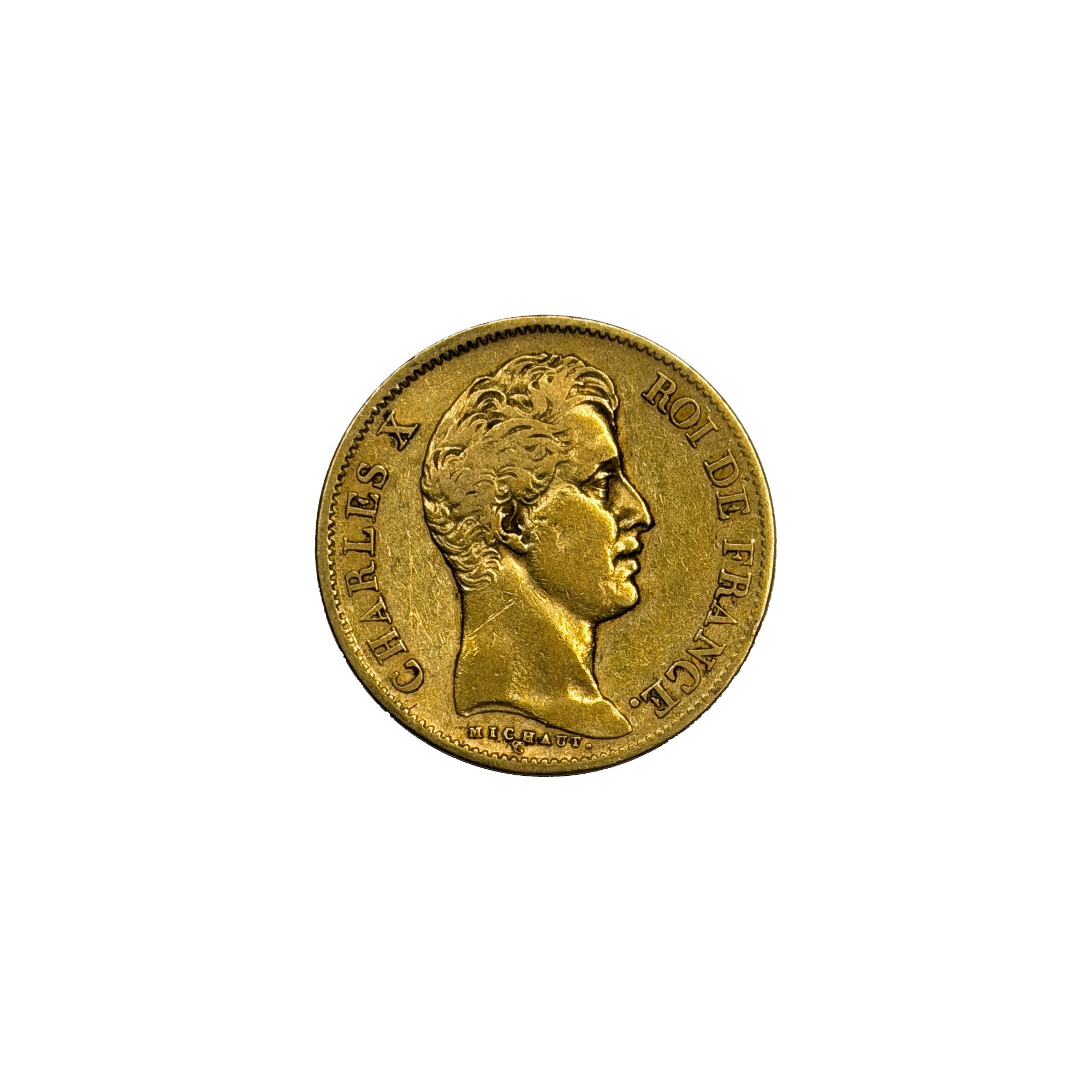
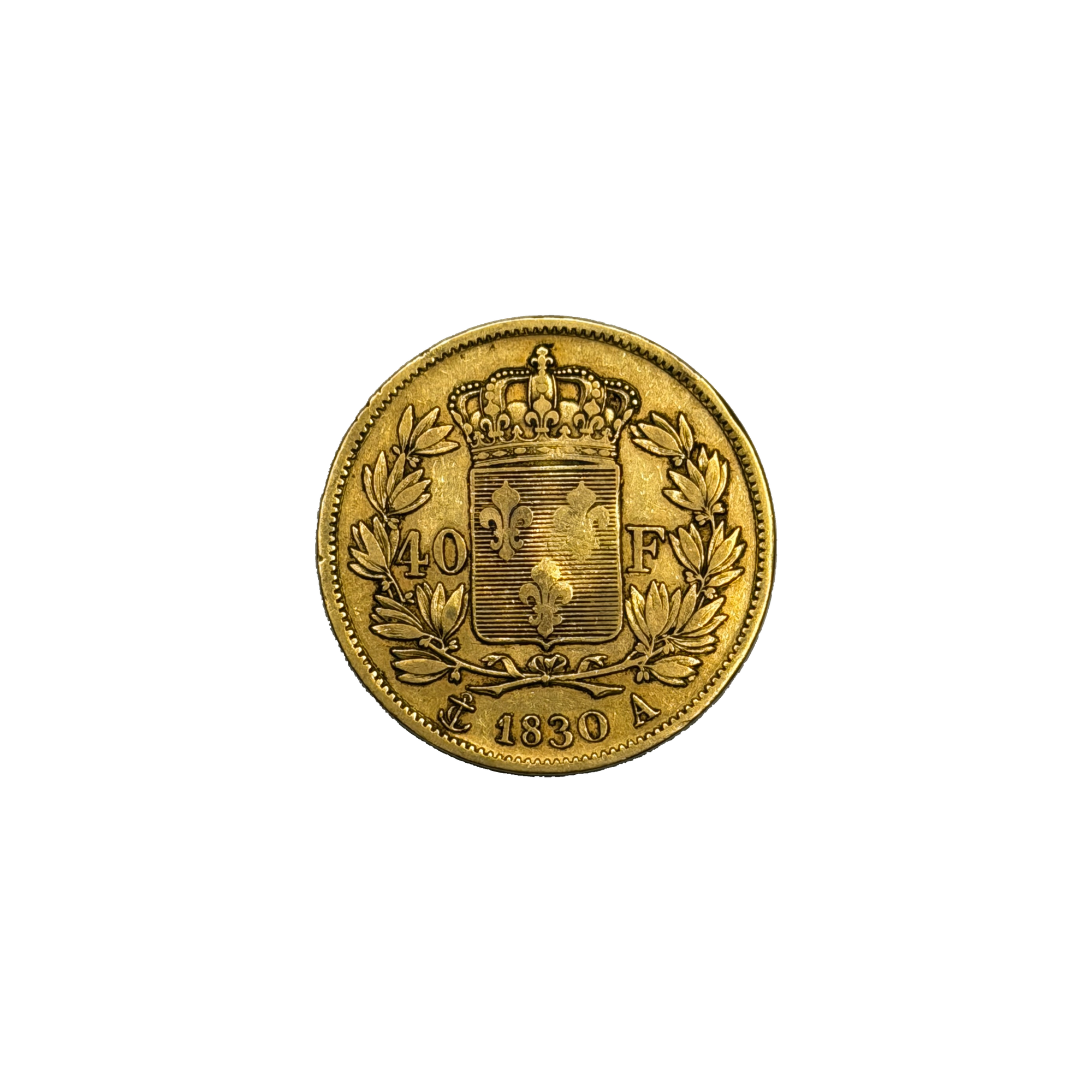
Charles X was the final king of France’s senior Bourbon line — the last monarch crowned at Reims Cathedral in the thousand-year tradition of French kings, and the ruler whose fall in the July Revolution of 1830 ended the dynasty that had produced Louis XIV. The 40 franc gold pieces bearing his portrait were struck between 1824 and 1830, and they are the smallest production run in the entire French 40 franc family.
The numbers frame the value. Total Charles X 40 franc production was 505,946 pieces — under two-thirds the Louis Philippe series, roughly half the Louis XVIII series, and less than one-sixth the Napoleon I series. Even his own 20 franc coinage, itself among the scarcer French types at 1.35 million pieces, was struck at nearly three times the rate. Large denominations were simply too valuable for daily commerce in the 1820s, and the mint acted accordingly. For investors whose priorities are a highly coveted coin steeped in the final act of Bourbon France, notable scarcity from a 505,946-piece production run, and a standardized and widely recognized gold content, the Charles X 40 franc is the thinnest supply line in the French large-gold series — a coin whose entire production, across seven years and a fallen dynasty, would not match a single ordinary month of modern bullion coin output.
The obverse bears the portrait of Charles X facing right, engraved by Auguste-François Michaut — a bare head with short curled hair, the inscription reading CHARLES X ROI DE FRANCE, the engraver’s signature beneath the truncation of the neck. The reverse carries the crowned shield of the Bourbons with its three fleurs-de-lis, flanked by branches, with the denomination 40 F divided beside the shield and the date and mint mark below — the final appearance of the royal arms of old France on a large gold coin struck for circulation.
At approximately 26mm in diameter and 12.90 grams total weight, each coin is struck from .900 fine gold and contains 0.3734 troy ounces of actual gold content — twice the 20 franc standard that the Latin Monetary Union would later carry across Europe. Grade range: VF/XF. Minted 1824–1830.
Charles X came to the throne in 1824 on the death of his brother Louis XVIII, having spent the revolutionary years in exile as the comte d’Artois. Where his brother had governed by compromise, Charles governed by conviction — he revived the full coronation rite at Reims, aligned the crown with the old aristocracy and the Church, and pressed steadily against the constitutional Charter. In July 1830 he issued ordinances dissolving the chamber and muzzling the press; Paris rose within days, and the last Bourbon king abdicated and returned to exile. The three days of revolution that ended his reign — les Trois Glorieuses — closed a monarchy that traced its line back eight centuries.
His coinage documents that ending with a curious precision: the heaviest year of 40 franc production, 382,956 pieces, came in 1830 itself — the dynasty’s final year — while mid-reign years saw the denomination all but cease, with 56 pieces struck in 1826 and 100 in 1827.
Every 40 franc series is scarce relative to its 20 franc counterpart; the Charles X series is scarce even among the 40 francs. Its 505,946 total stands against 775,336 for Louis Philippe, 907,109 for Louis XVIII, and 3,304,569 for Napoleon I. Against the broader French family the comparison becomes stark — France struck 232.9 million 20 francs under Napoleon III alone, more than 400 times the entire Charles X 40 franc production. These coins then served as working money and passed through nearly two centuries of melts and attrition. The supply is fixed, small, and — because the dynasty itself ended in 1830 — historically incapable of extension.
The Charles X 40 franc trades within the French gold family, the most widely traded historic gold coinage in Europe — recognized on sight by dealers across Europe and North America, with universally documented specifications and a gold content exactly double the 20 franc standard priced daily in every market where French gold changes hands. The royal Bourbon types add a second channel of demand: collectors of French royal coinage and of the Restoration era compete for these pieces alongside gold investors, a demand layer the common later French issues do not enjoy.
In 1933, FDR issued Executive Order 6102, requiring Americans to surrender their gold coin and bullion to the Treasury — but the order and the regulations that followed it exempted gold coins of recognized special value to collectors of rare and unusual coins. Subsequent clarifications by the Treasury identified pre-1933 gold coins — a classification that includes the Charles X 40 franc, struck between 1824 and 1830 — as falling within that collector classification as historical items.
Under current constitutional law, a government intervention in the gold market would be executed through the power of eminent domain — the government’s right to take private property for public use provided it pays the owner just compensation. Historic coins complicate the government’s ability to broadly establish “just compensation” or “fair value,” which was precisely the reasoning behind the original “recognized special value” exemption in 1933. That complexity, and the precedent surrounding pre-1933 gold coins, creates a notable impediment to the government’s ability to restrict them broadly — particularly compared to modern bullion, which can be valued easily and consistently at a single price. In essence, it is a bureaucratic question of whether the government would undertake the enormous task of valuing the diversity and complexity of the historic-coin genre — every coin, every date, every condition, every personal holding — and that difficulty is what insulates the owner’s legal liquidity rights in the event of capital controls.
Whether a future government intervention in private gold markets is a risk an investor assigns significant weight to is a personal judgment. The factual point is narrower: the pre-1933 status represents a layer of portfolio differentiation that this coin carries along with a measure of insulation for the legal liquidity rights of its owner.
For a more in-depth study, we invite you to read our comprehensive memorandum on this subject: Preparing for a Potential Gold Confiscation
The French 40 Franc Charles X is the gold of a dynasty’s final act — the last large gold coin of the senior Bourbon line, bearing the fleur-de-lis arms of old France, from the smallest production base in the entire 40 franc family. It combines the thinnest comparative supply in French large gold, the historical weight of a monarchy’s ending, and a standardized and widely recognized gold content — an offering rarely available in quantity and quickly subscribed when small groups can be assembled. No other French gold coin pairs so small a fixed supply with so consequential a place in the story of France.
| Year | Mintage |
|---|---|
| 1824 | 50,000 |
| 1826 | 56 |
| 1827 | 100 |
| 1828 | 51,840 |
| 1829 | 20,994 |
| 1830 | 382,956 |
| Total | 505,946 |
VF, XF
1824-1830
.3734 troy ounce
France
Prices shown under Wire include a 4% cash discount. Card prices are the full list price. ACH bank transfer is available to established clients only. First-time orders can be paid by wire transfer or card.
Call our team for availability. Monday to Friday, 8 AM to 6 PM Mountain Time.
Want to be notified when this product is back in stock?
Interested in gold but struggling to find the right firm?

VF, XF
1831-1839
.3734 troy ounce
France
VF, XF
1816-1824
.3734 troy ounce
France
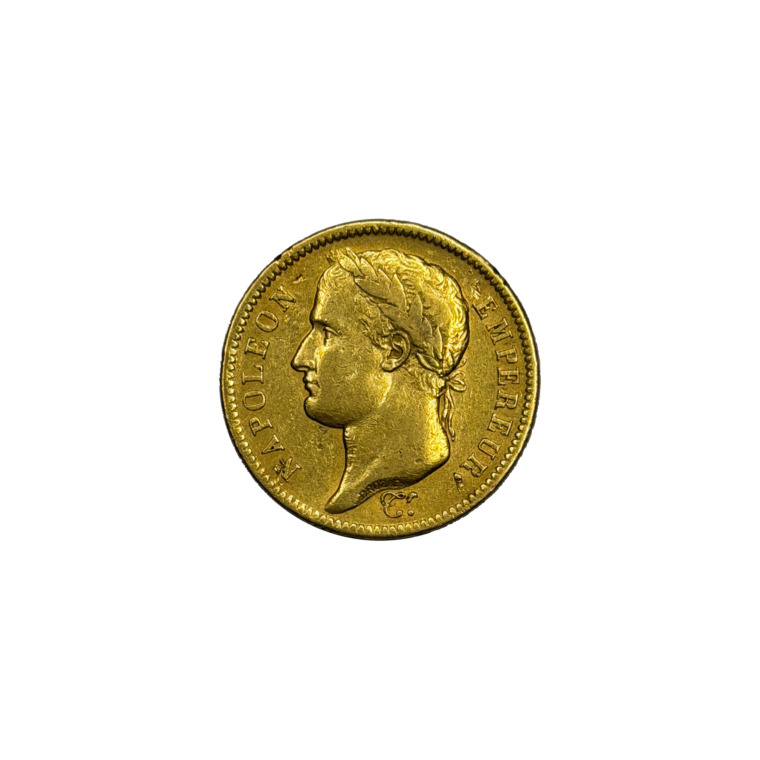
VF, XF
1803-1812
.3734 troy ounce
France


