

You must have an order with a minimum of $1,000.00 to place your order, your current order total is $0.00.
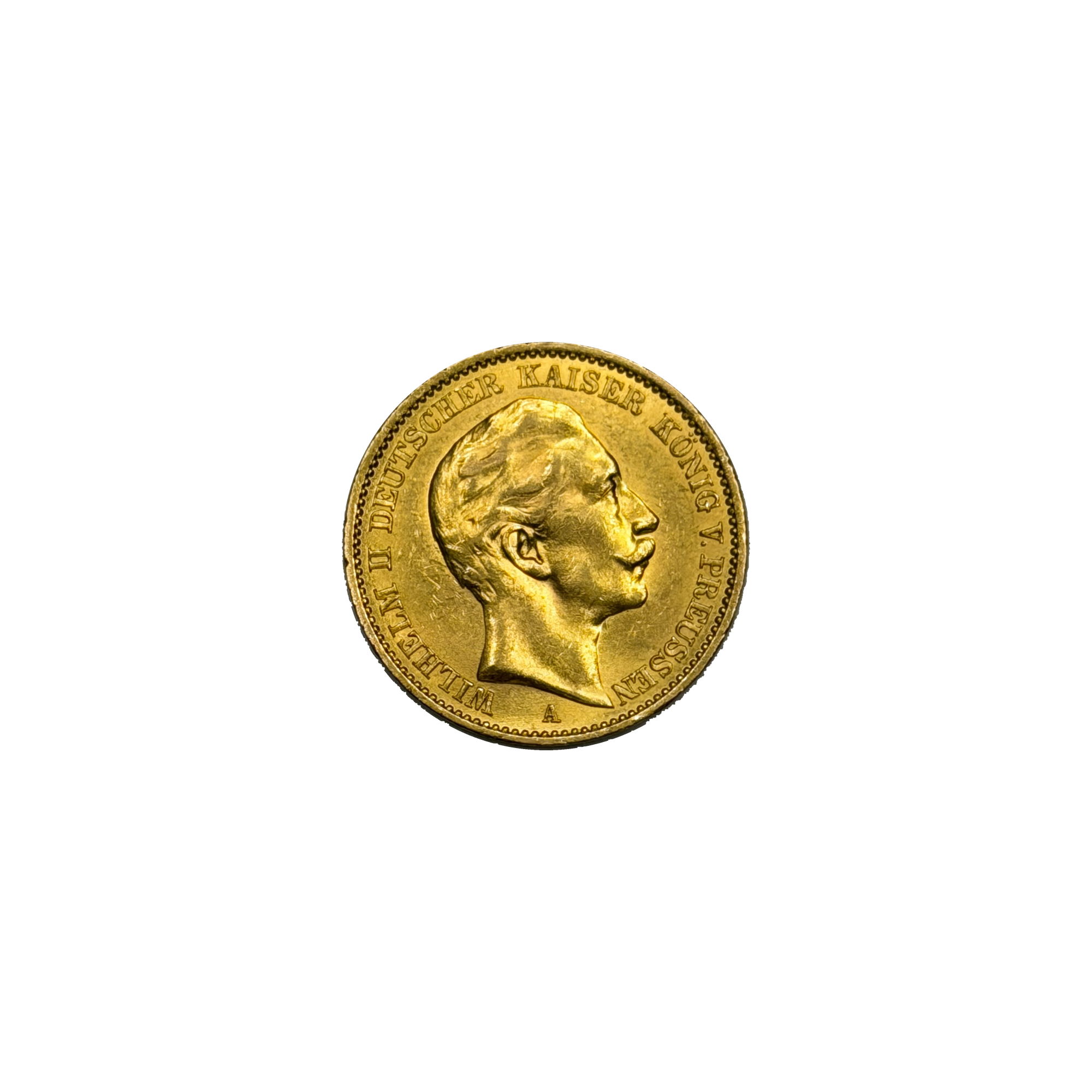
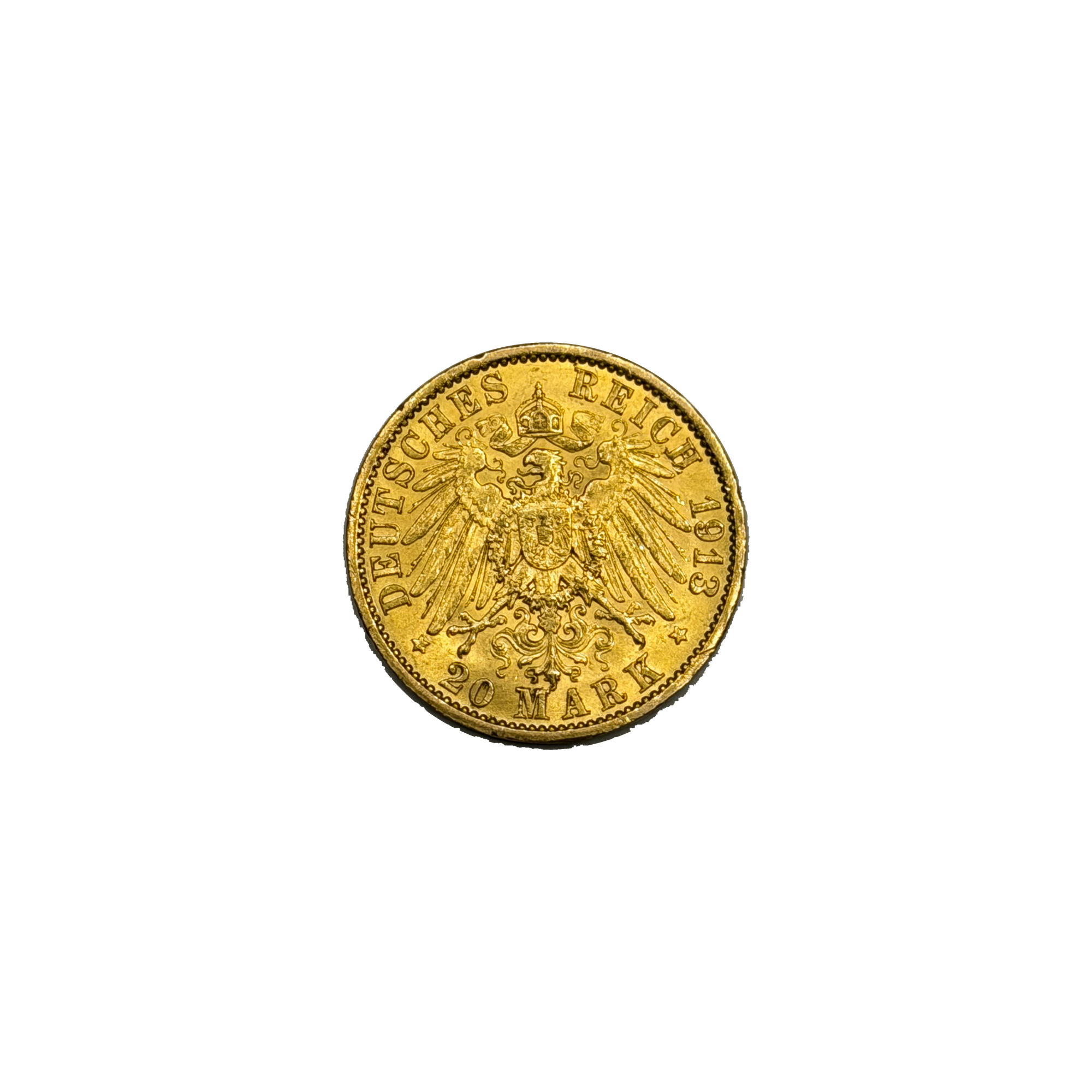
The German 20 Mark gold coins struck under Kaiser Wilhelm II were among the last gold coins produced by the German Empire. When Germany entered the First World War in August 1914, the Reichsbank suspended the right to exchange paper marks for gold — and the gold coinage that had circulated since the unification of Germany in 1871 effectively ceased as a monetary instrument. The 1914 and 1915 issues, struck in the opening months of the war, were the final gold pieces the Imperial Mint produced before the gold standard became a casualty of the conflict.
The common Prussian issues of the Wilhelm II 20 Mark are available today at per ounce acquisition costs comparable to modern bullion, tracking directly with the spot price of gold over time — an unusual price point for a coin that is simultaneously the terminal expression of Wilhelmine Germany’s gold monetary tradition and a piece of genuine historical weight. Each coin contains 0.2304 troy ounces of pure gold. At close to one-quarter of a troy ounce, the coin also offers divisible negotiability: affording its owner the flexibility to liquidate positions incrementally, in amounts proportionate to the specific needs of the moment and across a variety of circumstances. For investors whose priorities are low cost per ounce, on-sight recognizability, and ready two-way liquidity—with an optional scarcity dimension through the state varieties—the German 20 Mark is one of the most efficient entries into historic European gold available today.
The obverse bears the profile portrait of Kaiser Wilhelm II, conveying the confident authority of a ruler who commanded one of the most powerful military and industrial states in the world. The reverse displays the crowned Imperial Eagle of Germany — wings spread, a shield at its breast, the imperial crown above — with the inscription DEUTSCHES REICH and the denomination 20 MARK. The coins offered here (1888–1913) show Wilhelm in civilian profile; the final issues of 1913–1915, which carry the older, uniformed portrait, are offered separately as the Wilhelm II Military 20 Mark.
At 22.5mm in diameter and 7.965 grams total weight, each coin contains 0.2304 troy ounces of pure gold in a .900 fine alloy. Grade range: AU/UNC. Minted 1888–1913. Common Prussian issues — struck at the Berlin Mint, whose A mint mark they bear — are available at near-bullion acquisition costs. Coins from the smaller German states — Hamburg, Bavaria, Saxony, Württemberg — carry premiums reflecting their more limited mintages.
Wilhelm II was born in 1859, the grandson of both Queen Victoria of Britain and Kaiser Wilhelm I of Germany. He came to the throne in 1888, dismissed Otto von Bismarck in 1890 — removing the single most important restraining force in German foreign policy — and presided over two decades of accelerating naval buildup and diplomatic brinksmanship that culminated in the summer of 1914. The declaration of war that August was not solely his responsibility, but it ended the gold standard he and his predecessors had maintained since 1871.
Wilhelm II abdicated on November 9, 1918 — the same day the German Republic was proclaimed — and went into exile in the Netherlands, where he died in 1941. The gold coins bearing his portrait span the arc from his confident ascendancy to the collapse that ended his world. The uniformed-portrait issues of 1914–1915 that followed, struck as the gold standard was being abandoned for war finance, are the last statement of a monetary system the war destroyed.
The German monetary union of 1871, established in the aftermath of the Franco-Prussian War, unified the coinage of the German states — Prussia, Bavaria, Saxony, Württemberg, Hamburg, and the rest — under a common imperial standard. The 20 Mark gold coin was the centerpiece of that system, circulating from Hamburg to Munich to Berlin with the same gold content regardless of which state mint produced it. The system worked for forty-three years, until August 1914.
The world these coins document no longer exists. The German Empire, the Prussian military establishment, the patchwork of royal houses that issued coins to the imperial standard — all of it was dismantled between 1914 and 1918. The gold coins of that world are the monetary record of a Germany at the moment of its peak and its collapse: not the long continuity of the British sovereign or the Swiss franc, but the frozen moment of a system that functioned until it catastrophically did not.
Common-date Prussian issues of the Wilhelm II 20 Mark trade at per ounce acquisition costs comparable to the Swiss 20 Franc Helvetia — among the lowest premiums in the pre-1933 European gold market. For investors whose primary criterion is maximum gold content at minimum acquisition cost, the common Prussian issues are the most economically efficient entry point into Imperial German gold.
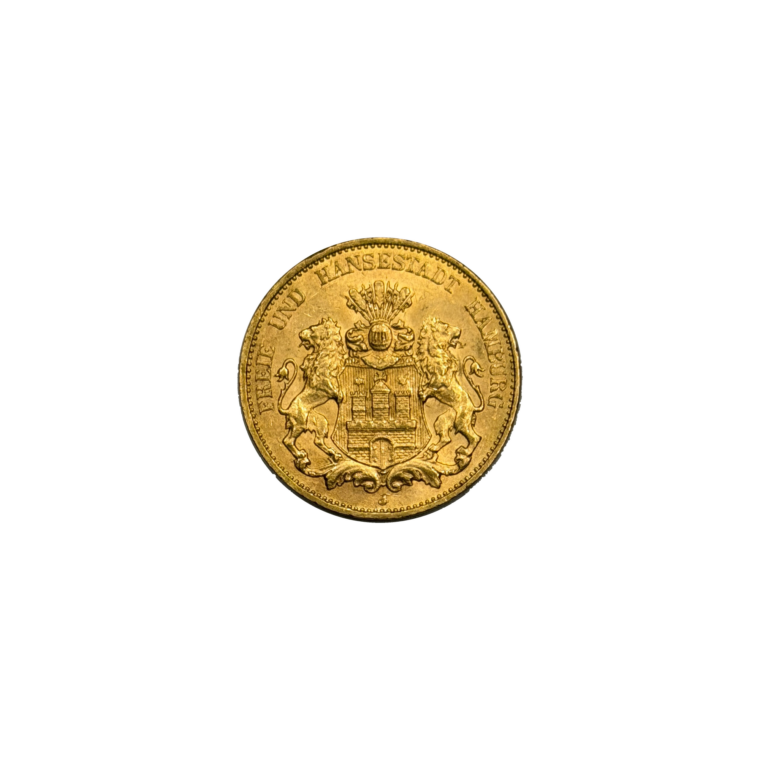
The state variety dimension adds a scarcity layer without requiring the investor to abandon affordability. Hamburg issues — struck at the Hamburg Mint, whose J mint mark they carry — have more limited mintages and command modest premiums over Prussian equivalents. Bavarian, Saxon, and Württemberg issues carry higher premiums still, reflecting substantially smaller production runs — supply that is fixed and permanently thinner than the Prussian baseline. An investor can begin with common Prussian issues at near-bullion and build selectively toward scarcer state issues over time, pursuing diminished supply within the same historical type.
The German 20 Mark Wilhelm II maintains an active investor market in both the United States and Europe. The German-American community provides a consistent domestic demand base; the broader European market adds depth. Prussian issues are widely recognized by dealers on both continents, and the coin’s standardized gold content and well-documented specifications ensure that bid-ask spreads remain tight in active markets. The state variety dimension adds a documented scarcity distinction to specific issues without reducing the baseline liquidity of the common Prussian type.
In 1933, FDR issued Executive Order 6102, requiring Americans to surrender their gold coin and bullion to the Treasury — but the order and the regulations that followed it exempted gold coins of recognized special value to collectors of rare and unusual coins. Subsequent clarifications by the Treasury identified pre-1933 gold coins — a classification that includes the German 20 Mark Wilhelm II, struck from 1888 through 1913 — as falling within that collector classification as historical items.
Under current constitutional law, a government intervention in the gold market would be executed through the power of eminent domain — the government’s right to take private property for public use provided it pays the owner just compensation. Historic coins complicate the government’s ability to broadly establish “just compensation” or “fair value,” which was precisely the reasoning behind the original “recognized special value” exemption in 1933. That complexity, and the precedent surrounding pre-1933 gold coins, creates a notable impediment to the government’s ability to restrict them broadly — particularly compared to modern bullion, which can be valued easily and consistently at a single price. In essence, it is a bureaucratic question of whether the government would undertake the enormous task of valuing the diversity and complexity of the historic-coin genre — every coin, every date, every condition, every personal holding — and that difficulty is what insulates the owner’s legal liquidity rights in the event of capital controls.
Whether a future government intervention in private gold markets is a risk an investor assigns significant weight to is a personal judgment. The factual point is narrower: the pre-1933 status represents a layer of portfolio differentiation that this coin carries at minimal added per-ounce cost over comparable modern bullion, along with a measure of insulation for the legal liquidity rights of its owner.
For a more in-depth study, we invite you to read our comprehensive memorandum on this subject: Preparing for a Potential Gold Confiscation
The German 20 Mark Wilhelm II is the last gold coinage of a Germany the twentieth century would dismantle entirely — a monetary system that worked for forty-three years and ended in a week in August 1914. Common Prussian issues are priced near bullion and recognized on sight wherever historic European gold changes hands, making them among the lowest cost per ounce entries into the genre with genuine historical weight, while the state varieties offer diminished supply within the same type at modest premium steps. No other European gold coin delivers this combination of historical gravity, recognizability, and built-in scarcity dimension at so accessible a price.
| Year | Mintage |
|---|---|
| 1888 | 10,885,270 |
| 1889 | 775,512 |
| 1890 | 3,694,754 |
| 1891 | 2,752,457 |
| 1892 | 1,814,842 |
| 1893 | 3,171,741 |
| 1894 | 5,814,982 |
| 1895 | 4,134,809 |
| 1896 | 4,238,568 |
| 1897 | 5,393,628 |
| 1898 | 6,542,219 |
| 1899 | 5,873,229 |
| 1900 | 5,162,616 |
| 1901 | 5,188,340 |
| 1902 | 4,138,128 |
| 1903 | 2,870,073 |
| 1904 | 3,452,625 |
| 1905 | 5,096,577 |
| 1906 | 7,869,808 |
| 1907 | 2,576,286 |
| 1908 | 3,274,168 |
| 1909 | 5,562,964 |
| 1910 | 9,398,766 |
| 1911 | 4,745,790 |
| 1912 | 6,071,928 |
| 1913 | 6,102,730 |
| Total | 126,602,810 |
Mintage figures per the Standard Catalog of World Coins, via the NGC World Price Guide. Dates NGC lists without figures are shown with a dash. Prussian issues only — the near-bullion tier this page describes; Berlin (A) and Hamburg (J) mint production combined. Other state coinages additional.
AU, UNC
1888 – 1913
.2304 troy ounce
Germany
| Quantity | Wire | Card |
|---|---|---|
| 1–21 | $1,101.45 | $1,147.34 |
| 22–43 | $1,090.44 | $1,135.87 |
| 44+ | $1,079.42 | $1,124.39 |
Quantity tiers reflect the historic & fractional gold order discount (1% at $25,000+ · 2% at $50,000+ in qualifying coins). Any mix of qualifying historic coins counts toward the same order total.
Prices shown under Wire include a 4% cash discount. Card prices are the full list price. ACH bank transfer is available to established clients only. First-time orders can be paid by wire transfer or card.
Interested in gold but struggling to find the right firm?

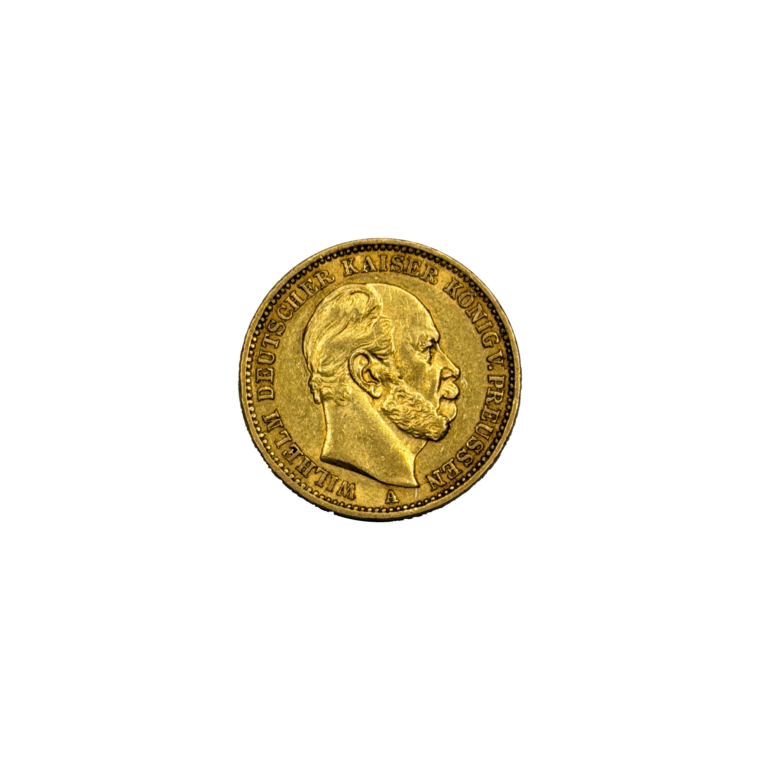
XF
1871 – 1888
.2304 troy ounce
Germany
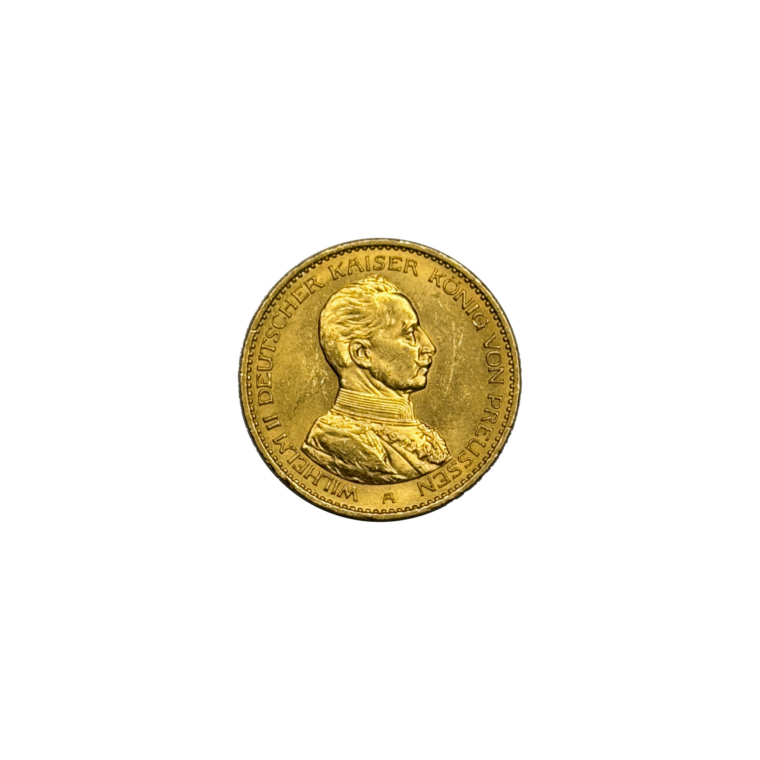
BU, PL
1913-1915
.2304 troy ounce
Germany
XF
1888
.2304 troy ounce
Germany
AU, UNC
1893-1913
.2304 troy ounce
Germany


