

You must have an order with a minimum of $1,000.00 to place your order, your current order total is $0.00.
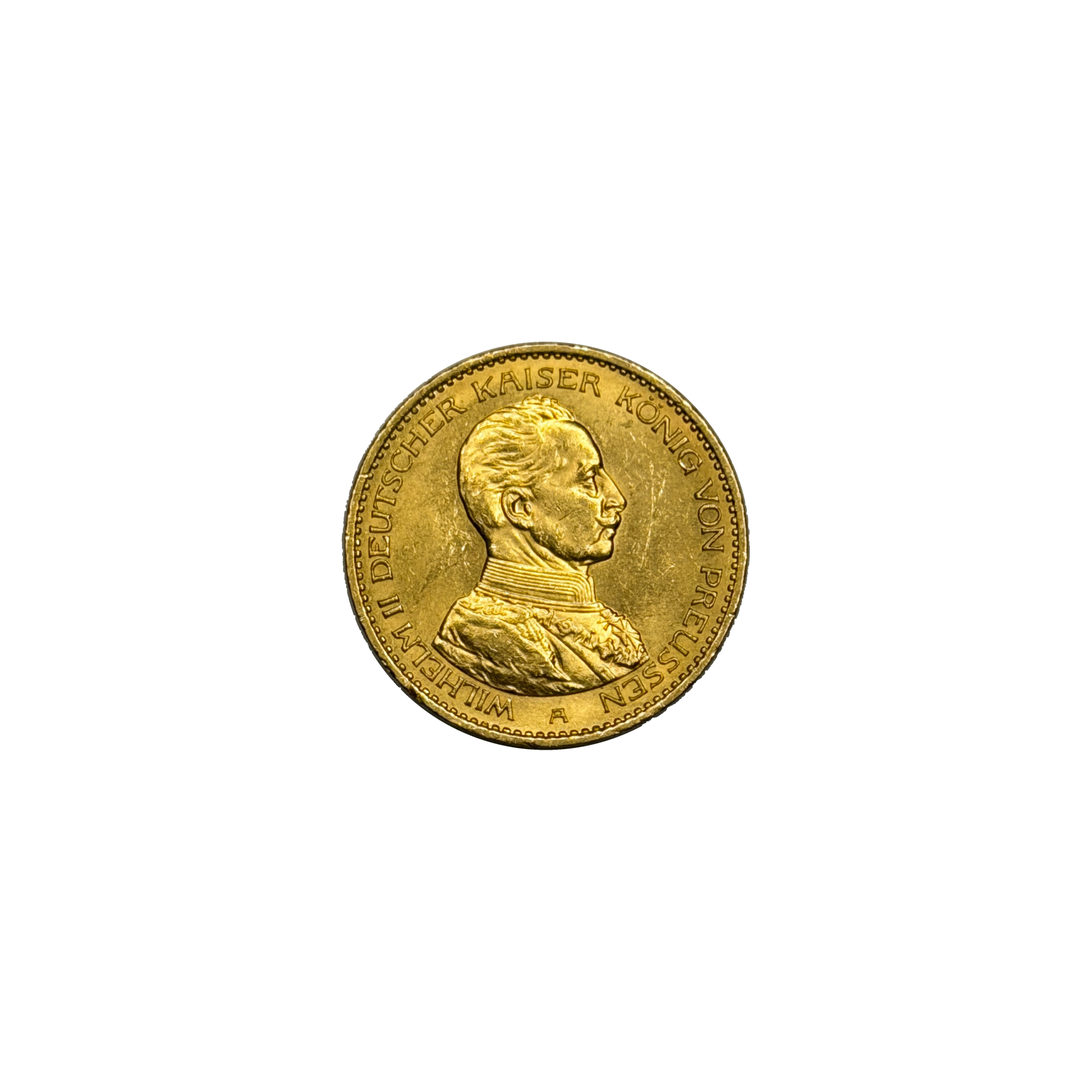
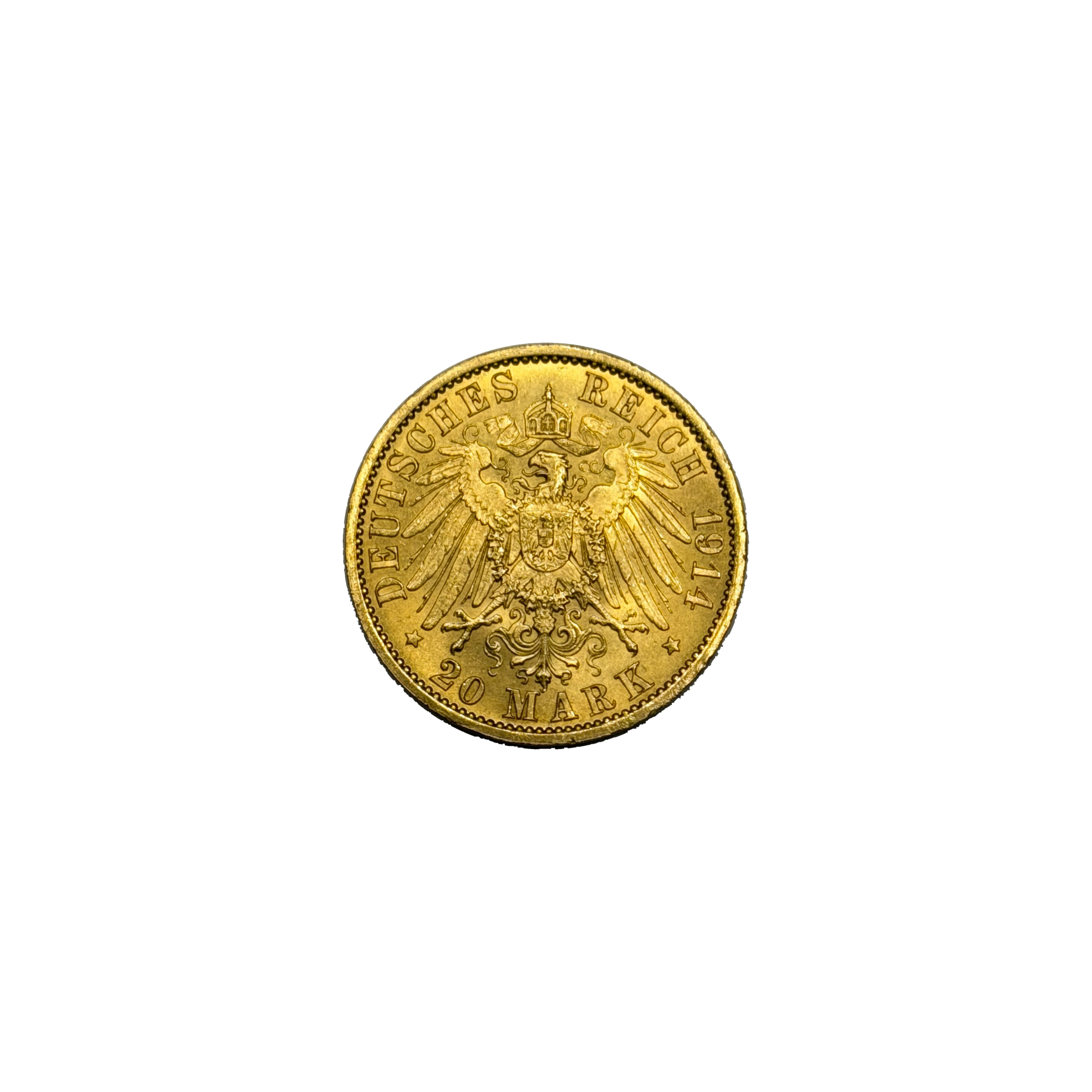
In 1913, the Berlin mint introduced a new obverse for the Prussian 20 Mark: Kaiser Wilhelm II no longer in the plain bare-headed profile of the previous quarter century, but in the uniform of a Prussian general — high embroidered collar, epaulette at the shoulder. Within two years the type was extinct. When Germany entered the First World War in August 1914, the Reichsbank suspended gold convertibility, and the uniformed-bust issues of 1913–1915 became the last gold coins the German Empire ever struck. The military portrait, adopted at the height of imperial confidence, ended up documenting its final act.
The investor case carries a second chapter. Less than a decade after these coins left the mint, the paper mark they once anchored was destroyed in the hyperinflation of the early 1920s — an episode in which a family’s life savings could not purchase a cup of coffee, while a purse of 20 Mark gold coins stubbornly held its value. That lesson has not been lost on the modern saver. The military-type 20 Mark, a common Prussian issue, is classified instructively as “historical bullion”: it trades at per ounce acquisition costs comparable to modern bullion and tracks the spot price of gold over time, while carrying the historic (pre-1933) designation and the associated insulation against the possibility of future government intervention. At close to one-quarter of a troy ounce, it also offers divisible negotiability: affording its owner the flexibility to liquidate positions incrementally, in amounts proportionate to the specific needs of the moment and across a variety of circumstances. For investors whose priorities are a coin steeped in historical significance, a high state of preservation in Brilliant Uncirculated to proof-like condition, and the on-sight recognizability of the Prussian 20 Mark type—all for near-bullion pricing—the uniformed-bust 20 Mark is the terminal issue of Imperial German gold and the coin that carries its hardest-won monetary lesson.
The obverse bears the uniformed bust of Wilhelm II facing right in the dress of a Prussian general, with the inscription WILHELM II DEUTSCHER KAISER KÖNIG VON PREUSSEN and the A mint mark of the Berlin mint below. The reverse carries the large crowned Imperial Eagle with the Prussian shield at its breast, the inscription DEUTSCHES REICH, the date, and the denomination 20 MARK. The uniformed portrait distinguishes the type at a glance from the bare-headed issues of 1888–1912, giving the final imperial gold its own unmistakable identity.
At 22.5mm in diameter and 7.965 grams total weight, each coin contains 0.2304 troy ounces of pure gold in a .900 fine alloy — the imperial standard. Grade range: BU/PL. The type was struck at Berlin from 1913 through the final imperial gold issues of 1914–1915.
The military portrait suited its subject. Wilhelm II — grandson of both Queen Victoria and Kaiser Wilhelm I — was rarely photographed out of uniform, and his reign was defined by the armed establishment he adored: the naval buildup that alienated Britain, the war planning that hardened Europe’s alliances, and the personal diplomatic blunders that repeatedly strained Germany’s position abroad. He dismissed Bismarck in 1890 and steered the empire’s course personally for the next quarter century, until the war his policies helped provoke swept the empire away. He abdicated on November 9, 1918, and died in exile in the Netherlands in 1941.
There is a certain historical exactness in the fact that the empire’s last gold coin shows its last emperor dressed for the war that ended both. The 1914 and 1915 pieces were struck in the opening months of that war, as gold was already disappearing from circulation into war finance and private hoards — the final statement of a monetary system the conflict destroyed.
German 20 Mark gold coins are among the most popular historic coins with investors, and the reason is written in the decade that followed them. The imperial gold standard functioned for forty-three years, from unification in 1871 until August 1914. The paper regime that replaced it collapsed within a decade into the Nightmare Inflation of the 1920s, when the mark’s value evaporated by the hour. Those Germans who had set gold coins aside before the disaster — and many did, as gold vanished from circulation in 1914 — preserved their purchasing power through one of the most complete currency destructions in modern history. It is said that the memory of that episode shapes German central banking policy to this day. The uniformed-bust 20 Mark is the very last coin of the system that worked, struck on the eve of the system that failed — as direct a monetary lesson as any coin can carry.
As a Prussian issue of the Berlin mint, the military type trades at the affordable baseline of the German 20 Mark family — per ounce acquisition costs comparable to the Swiss 20 Franc Helvetia, among the lowest in the pre-1933 European gold market. Investors gain the distinctive final-type portrait and its history without paying a scarcity premium: the coin trades on its gold content first and its history second, and that is exactly what creates the value: the history comes at essentially no added cost. Within the family, the state varieties — Hamburg and the rarer royal issues — offer a scarcity dimension at modest premium steps, while the military type anchors the position at minimum cost per ounce.
The German 20 Mark Wilhelm II maintains an active investor market in both the United States and Europe — the German-American community provides a consistent domestic demand base, and the broader European market adds depth. The uniformed-bust type shares the family’s universally documented specifications and standardized gold content, and dealers on both continents recognize it on sight. Bid-ask spreads remain tight in active markets, and the coin converts to cash quickly wherever gold trades.
In 1933, FDR issued Executive Order 6102, requiring Americans to surrender their gold coin and bullion to the Treasury — but the order and the regulations that followed it exempted gold coins of recognized special value to collectors of rare and unusual coins. Subsequent clarifications by the Treasury identified pre-1933 gold coins — a classification that includes the German 20 Mark Wilhelm II military type, struck from 1913 through 1915 — as falling within that collector classification as historical items.
Under current constitutional law, a government intervention in the gold market would be executed through the power of eminent domain — the government’s right to take private property for public use provided it pays the owner just compensation. Historic coins complicate the government’s ability to broadly establish “just compensation” or “fair value,” which was precisely the reasoning behind the original “recognized special value” exemption in 1933. That complexity, and the precedent surrounding pre-1933 gold coins, creates a notable impediment to the government’s ability to restrict them broadly — particularly compared to modern bullion, which can be valued easily and consistently at a single price. In essence, it is a bureaucratic question of whether the government would undertake the enormous task of valuing the diversity and complexity of the historic-coin genre — every coin, every date, every condition, every personal holding — and that difficulty is what insulates the owner’s legal liquidity rights in the event of capital controls.
Whether a future government intervention in private gold markets is a risk an investor assigns significant weight to is a personal judgment. The factual point is narrower: the pre-1933 status represents a layer of portfolio differentiation that this coin carries at minimal added per-ounce cost over comparable modern bullion, along with a measure of insulation for the legal liquidity rights of its owner.
For a more in-depth study, we invite you to read our comprehensive memorandum on this subject: Preparing for a Potential Gold Confiscation
The military-type 20 Mark is the punctuation mark at the end of Imperial German gold — the last emperor in the uniform of the war that ended his world, struck in the final months before the gold standard became a casualty of the conflict and less than a decade before the hyperinflation proved, catastrophically, why the coins mattered. It delivers that history at the affordable baseline of the historic European market, in Brilliant Uncirculated to proof-like condition, with the on-sight recognizability and divisible negotiability of the Prussian 20 Mark type. No other European gold coin pairs so consequential a monetary lesson with so low a cost of entry.
| Year | Mintage |
|---|---|
| 1913 | — |
| 1914 | 2,136,861 |
| 1915 | 1,268,055 |
| Total (listed figures) | 3,404,916 |
Mintage figures per the Standard Catalog of World Coins, via the NGC World Price Guide. Dates NGC lists without figures are shown with a dash. Berlin Mint (A), uniformed-bust type (KM-537).
BU, PL
1913-1915
.2304 troy ounce
Germany
| Quantity | Wire | Card |
|---|---|---|
| 1–19 | $1,202.79 | $1,252.91 |
| 20–39 | $1,190.76 | $1,240.38 |
| 40+ | $1,178.73 | $1,227.85 |
Quantity tiers reflect the historic & fractional gold order discount (1% at $25,000+ · 2% at $50,000+ in qualifying coins). Any mix of qualifying historic coins counts toward the same order total.
Prices shown under Wire include a 4% cash discount. Card prices are the full list price. ACH bank transfer is available to established clients only. First-time orders can be paid by wire transfer or card.
Interested in gold but struggling to find the right firm?

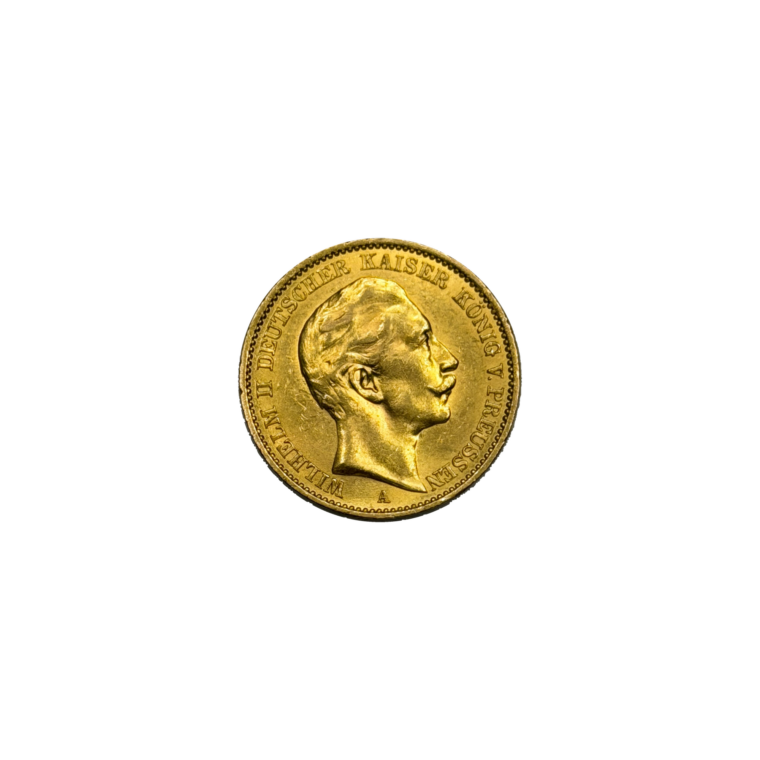
AU, UNC
1888 – 1913
.2304 troy ounce
Germany
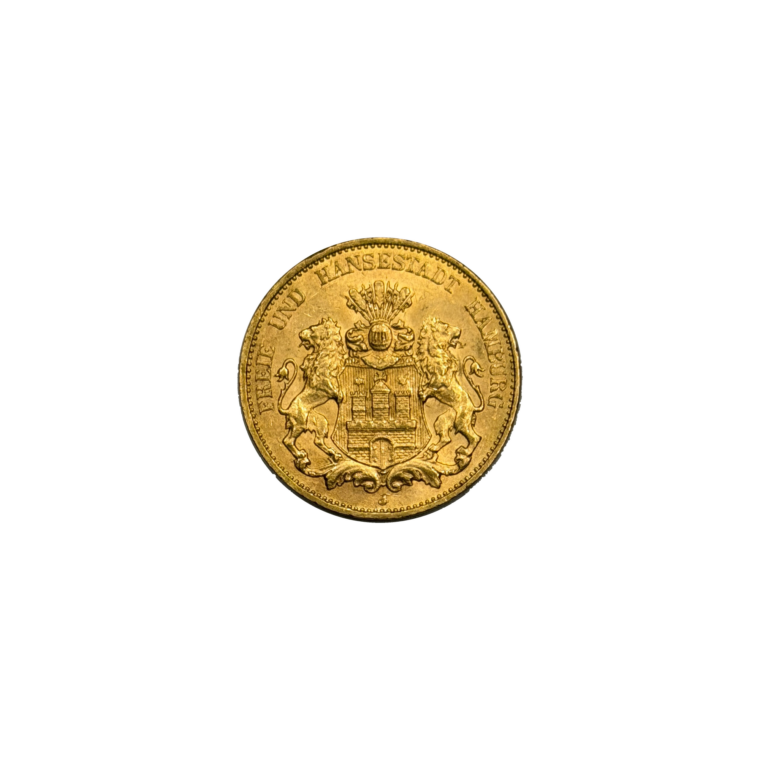
AU, UNC
1893-1913
.2304 troy ounce
Germany
XF
1888
.2304 troy ounce
Germany
XF
1871 – 1888
.2304 troy ounce
Germany


