

You must have an order with a minimum of $1,000.00 to place your order, your current order total is $0.00.
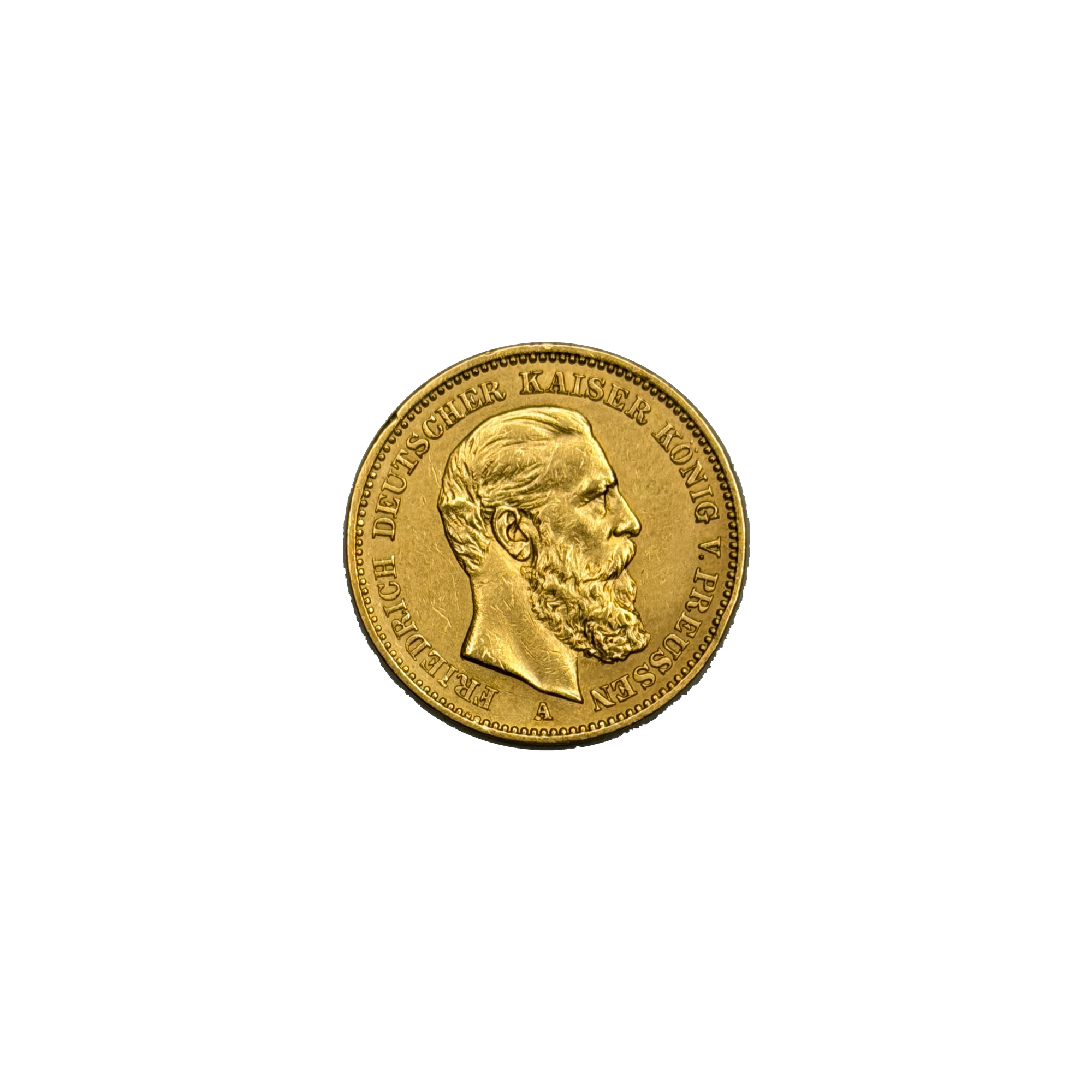
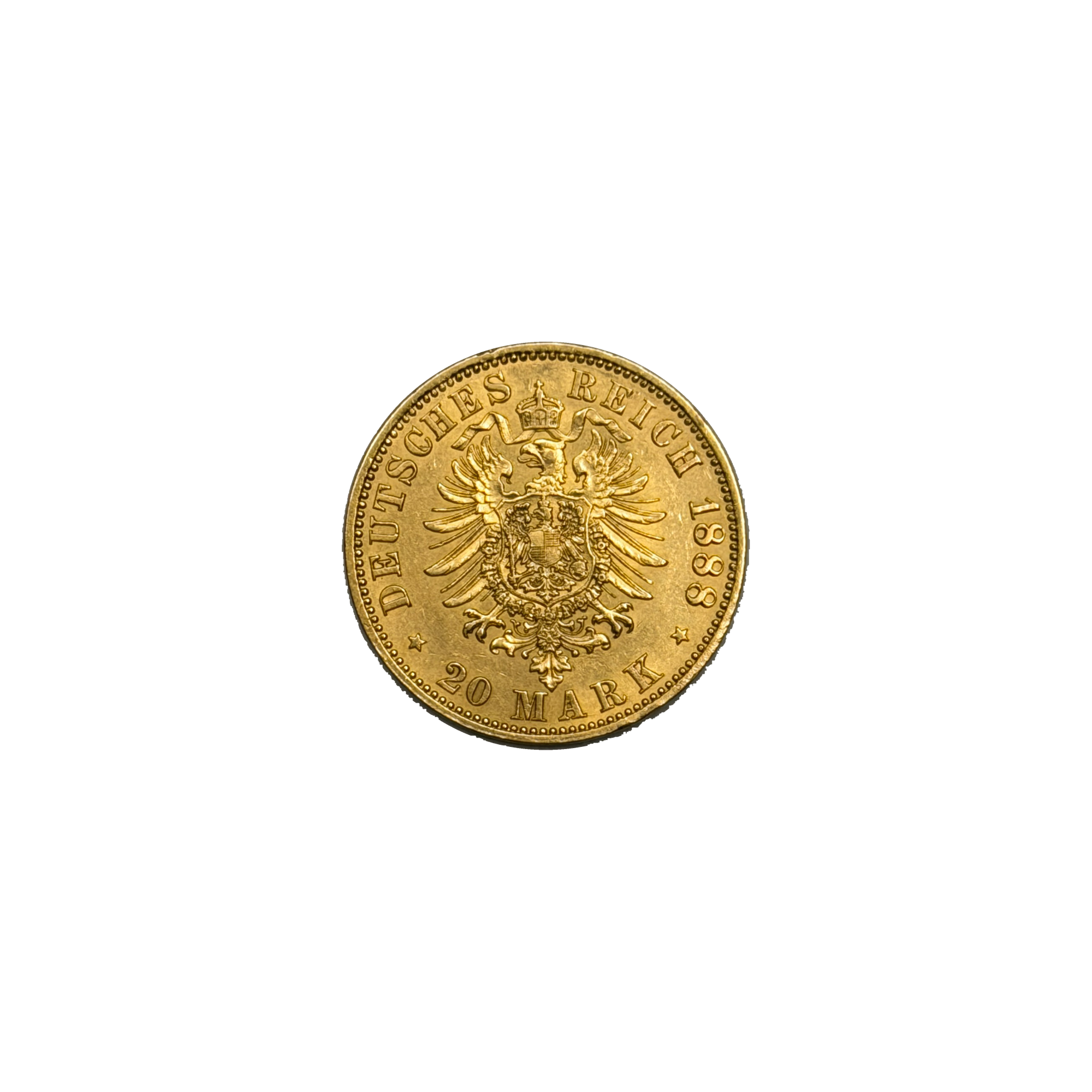
The year 1888 is remembered in Germany as the Year of the Three Emperors. Wilhelm I died in March at the age of 90. His son Friedrich III, already gravely ill with throat cancer, reigned for just 99 days before his death in June. His son, Wilhelm II, took the throne that same month and held it until the empire itself collapsed in 1918. Three Kaisers in a single calendar year — and the entire gold coinage of the middle reign was struck within it. The Friedrich III 20 Mark is a single-year type: every example carries the date 1888, and no more of them can ever exist.
For investors, that compressed history translates into a distinct position within the German 20 Mark family. The coin trades in the same market as its Wilhelm I and Wilhelm II siblings, tracking the spot price of gold over time as “historical bullion,” while carrying the historic (pre-1933) designation and the associated insulation against the possibility of future government intervention. Its supply is fixed in a way no multi-year issue can match — one date, one reign, one year of production — which gives the type a built-in scarcity dimension relative to the common Wilhelm II issues struck across nearly three decades. At close to one-quarter of a troy ounce, it also offers divisible negotiability: affording its owner the flexibility to liquidate positions incrementally, in amounts proportionate to the specific needs of the moment and across a variety of circumstances. For investors whose priorities are a highly coveted coin steeped in historical significance, notable scarcity due to a single year of production during the Year of the Three Emperors, and a standardized and widely recognized gold content—all within an affordable coin family—the Friedrich III 20 Mark occupies a niche no other German gold coin can fill.
The obverse bears the right-facing profile of Friedrich III, full-bearded in the fashion of the era, with the inscription FRIEDRICH DEUTSCHER KAISER KÖNIG V. PREUSSEN and the A mint mark of the Berlin mint below the portrait. The reverse displays the crowned Imperial Eagle with the Prussian shield at its breast, the inscription DEUTSCHES REICH, the single year of issue 1888, and the denomination 20 MARK.
At 22.5mm in diameter and 7.965 grams total weight, each coin contains 0.2304 troy ounces of pure gold in a .900 fine alloy — the imperial standard shared across the German 20 Mark family. Grade range: XF. Minted 1888.
Friedrich III is one of European history’s great might-have-beens. Born in 1831, he was a decorated commander in the wars of unification, yet he was known equally for his liberal convictions — convictions reinforced by his marriage to Victoria, Princess Royal, the eldest daughter of Queen Victoria of Britain. He and his wife openly favored a constitutional monarchy on the British model, and German liberals looked toward his eventual accession as the moment the empire might turn away from Bismarck’s authoritarian course.
By the time the throne finally came to him in March 1888, he was dying. He reigned for 99 days, unable to speak for most of them, and died on June 15, 1888. His son Wilhelm II promptly reversed his parents’ liberal direction, dismissed Bismarck two years later, and steered Germany toward the naval buildup and diplomatic brinksmanship that ended in the First World War. Historians have debated ever since how differently the twentieth century might have unfolded had Friedrich III been granted a full reign. The 20 Mark bearing his portrait is the principal gold coin of that unrealized Germany.
Single-year gold types are rare in any national series, and the Friedrich III 20 Mark is the German Empire’s definitive example. The coin documents a precise historical hinge: the moment between the founding generation of Wilhelm I and Bismarck and the fateful personal rule of Wilhelm II. For an investor assembling a position in the German 20 Mark family, the three portraits of 1888 — the dying of the old Kaiser, the 99-day reign, and the accession of the last — together tell the compressed story of the empire’s turn, and the Friedrich III issue is the keystone among them.
The scarcity argument here is structural rather than absolute. The Friedrich III 20 Mark was struck in substantial quantities during its single year — enough that the type remains readily available and trades at accessible premiums within the family — but production ended permanently in 1888. Where the common Wilhelm II type was struck across nearly three decades at multiple mints, the Friedrich III type had one year. A fixed, single-date supply is a permanent characteristic, and the coin offers it without requiring the investor to pay a numismatic rarity price. It trades on its gold content first and its finite, single-year supply second — and that is exactly what creates the value: the single-year scarcity comes at essentially no added cost.
The Friedrich III issue shares the standardized specifications, documented gold content, and two-continent dealer recognition of the entire German 20 Mark family — an active market in both the United States, anchored by consistent German-American demand, and across Europe. Because the type is instantly identifiable by its single date and distinct portrait, it trades without ambiguity wherever German gold trades. The investor holds a distinctive issue while retaining the baseline liquidity of one of the most widely traded pre-1933 European gold coin families.
In 1933, FDR issued Executive Order 6102, requiring Americans to surrender their gold coin and bullion to the Treasury — but the order and the regulations that followed it exempted gold coins of recognized special value to collectors of rare and unusual coins. Subsequent clarifications by the Treasury identified pre-1933 gold coins — a classification that includes the German 20 Mark Friedrich III, struck in 1888 — as falling within that collector classification as historical items.
Under current constitutional law, a government intervention in the gold market would be executed through the power of eminent domain — the government’s right to take private property for public use provided it pays the owner just compensation. Historic coins complicate the government’s ability to broadly establish “just compensation” or “fair value,” which was precisely the reasoning behind the original “recognized special value” exemption in 1933. That complexity, and the precedent surrounding pre-1933 gold coins, creates a notable impediment to the government’s ability to restrict them broadly — particularly compared to modern bullion, which can be valued easily and consistently at a single price. In essence, it is a bureaucratic question of whether the government would undertake the enormous task of valuing the diversity and complexity of the historic-coin genre — every coin, every date, every condition, every personal holding — and that difficulty is what insulates the owner’s legal liquidity rights in the event of capital controls.
Whether a future government intervention in private gold markets is a risk an investor assigns significant weight to is a personal judgment. The factual point is narrower: the pre-1933 status represents a layer of portfolio differentiation that this coin carries at minimal added per-ounce cost over comparable modern bullion, along with a measure of insulation for the legal liquidity rights of its owner.
For a more in-depth study, we invite you to read our comprehensive memorandum on this subject: Preparing for a Potential Gold Confiscation
The Friedrich III 20 Mark compresses more history into a single date than perhaps any other European gold coin: the Year of the Three Emperors, the 99-day reign of Germany’s liberal hope, and the last moment before the empire turned down the road to 1914. Its supply was fixed forever in 1888, yet it trades at accessible premiums within the most affordable family in historic European gold—though a highly coveted issue of this kind reaches the market irregularly, in small quantities that are quickly subscribed, and lends itself naturally to heirloom positions. No other German gold coin offers a permanently fixed single-year supply wrapped in this much history at so reachable a price.
| Year | Mintage |
|---|---|
| 1888 | 5,363,501 |
| Total | 5,363,501 |
Mintage figures per the Standard Catalog of World Coins, via the NGC World Price Guide. Dates NGC lists without figures are shown with a dash. Berlin Mint (A).
XF
1888
.2304 troy ounce
Germany
| Quantity | Wire | Card |
|---|---|---|
| 1–20 | $1,154.85 | $1,202.97 |
| 21–41 | $1,143.30 | $1,190.94 |
| 42+ | $1,131.75 | $1,178.91 |
Quantity tiers reflect the historic & fractional gold order discount (1% at $25,000+ · 2% at $50,000+ in qualifying coins). Any mix of qualifying historic coins counts toward the same order total.
Prices shown under Wire include a 4% cash discount. Card prices are the full list price. ACH bank transfer is available to established clients only. First-time orders can be paid by wire transfer or card.
Interested in gold but struggling to find the right firm?

AU, UNC
1893-1913
.2304 troy ounce
Germany
XF
1871 – 1888
.2304 troy ounce
Germany
AU, UNC
1888 – 1913
.2304 troy ounce
Germany
BU, PL
1913-1915
.2304 troy ounce
Germany


