

You must have an order with a minimum of $1,000.00 to place your order, your current order total is $0.00.
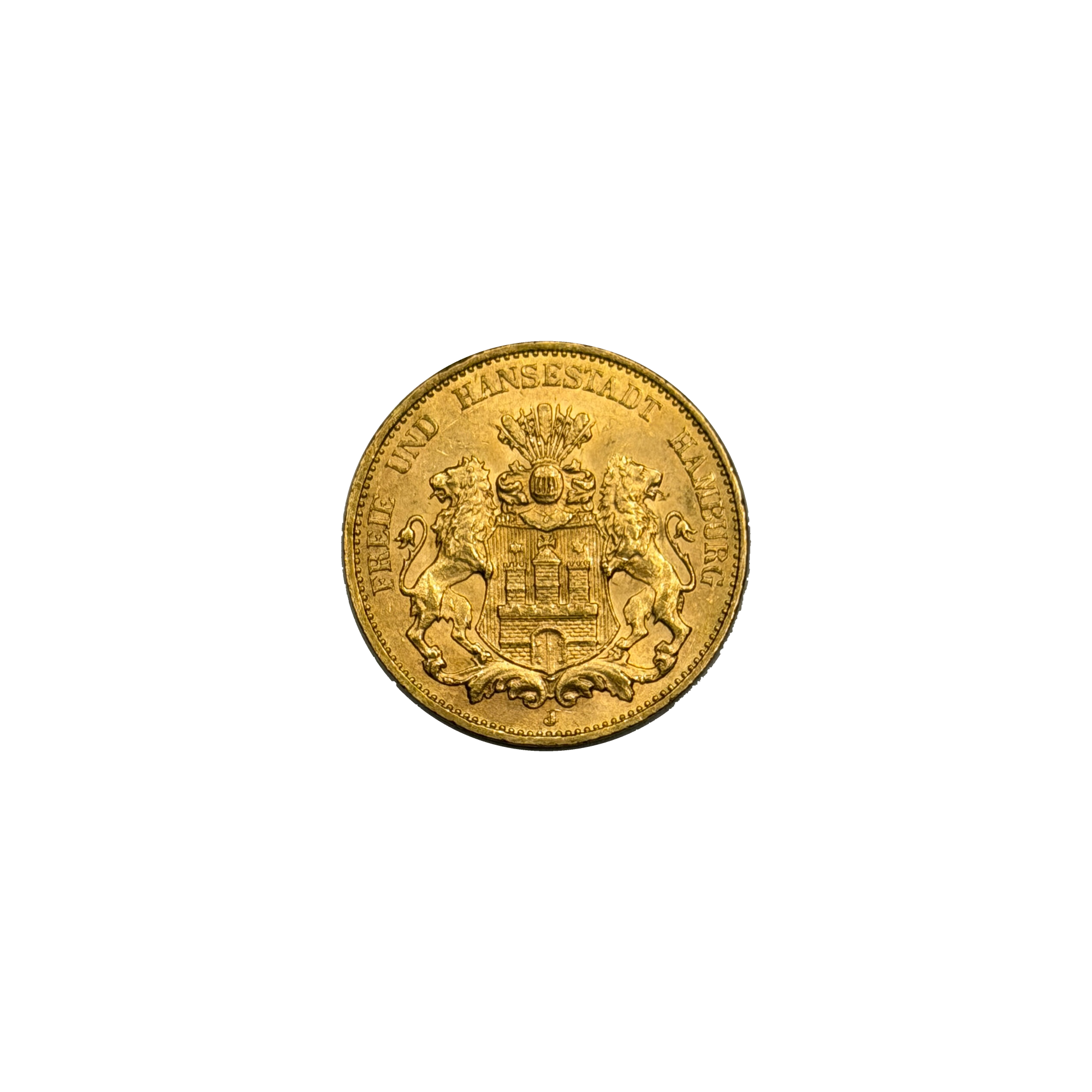
When the German states unified in 1871, not every member of the new empire was a kingdom or a duchy. Three ancient merchant republics — Hamburg, Bremen, and Lübeck — entered the empire as free cities, self-governing survivors of the medieval Hanseatic League. Hamburg, the greatest of them, had been a sovereign trading power for centuries, and when it issued gold to the new imperial standard, it put no monarch on the coin. The Hamburg 20 Mark carries the city’s coat of arms instead — the only widely available German 20 Mark whose obverse bears a republic’s emblem rather than a royal portrait.
For investors, the Hamburg issue is the accessible scarcity play within the German 20 Mark family. It shares the family’s defining economics — classified instructively as “historical bullion,” tracking the spot price of gold over time, with the historic (pre-1933) designation and the associated insulation against the possibility of future government intervention — while its more limited city-state mintages support a modest premium over the common Prussian Wilhelm II issues. At close to one-quarter of a troy ounce, it also offers divisible negotiability: affording its owner the flexibility to liquidate positions incrementally, in amounts proportionate to the specific needs of the moment and across a variety of circumstances. For investors whose priorities are comparative scarcity rooted in limited city-state mintages, the distinctive civic arms of a thousand-year merchant republic, and a standardized and widely recognized gold content—all at only a modest premium over the common Prussian type—the Hamburg 20 Mark is the natural next step beyond the family workhorse.
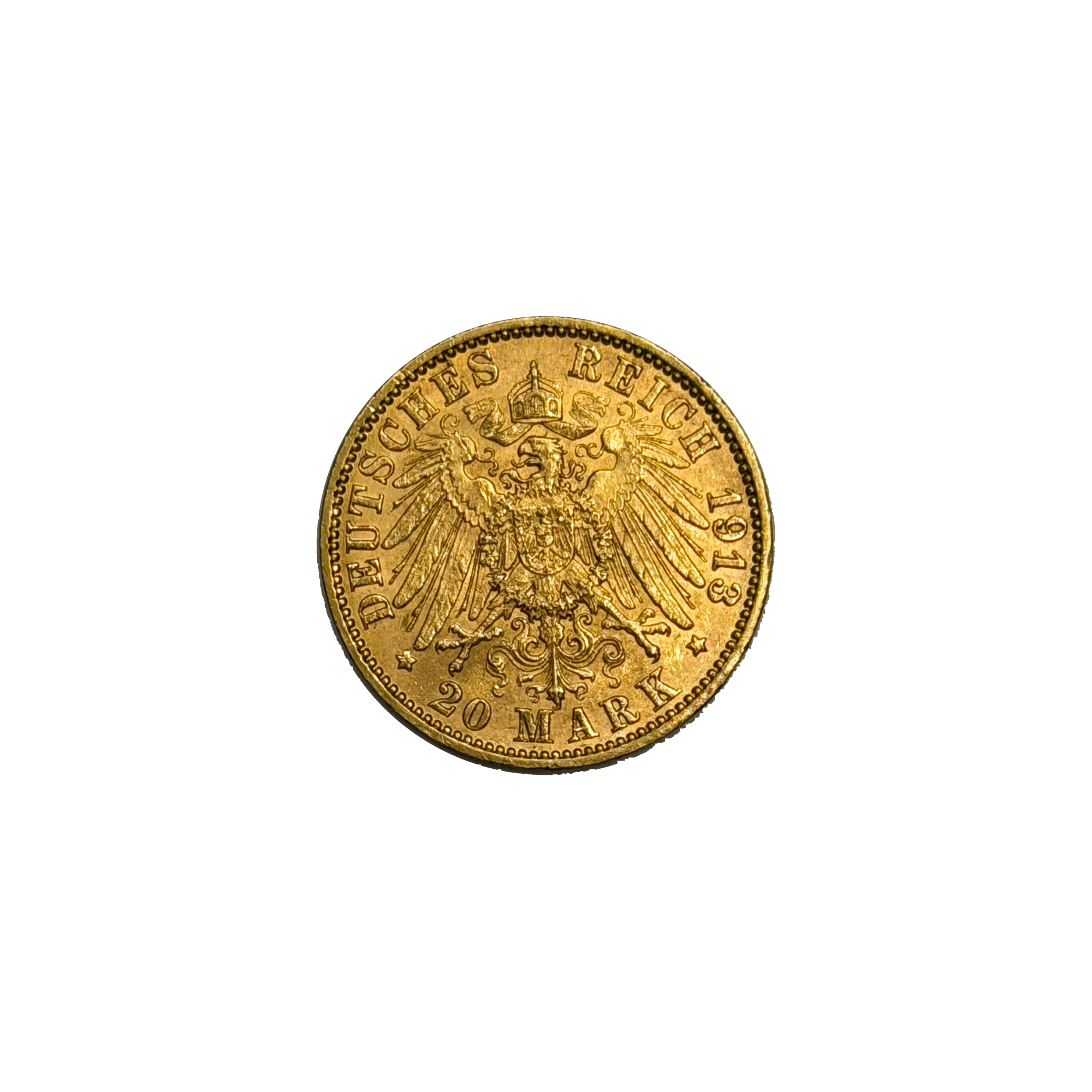
The obverse displays the arms of the city: two lions rampant supporting a shield bearing Hamburg’s three-towered castle gate, with a plumed helm above and the inscription FREIE UND HANSESTADT HAMBURG — Free and Hanseatic City of Hamburg. Below the arms appears the J mint mark of the Hamburg mint, which struck these coins in the city they represent. The reverse carries the crowned Imperial Eagle and the inscription DEUTSCHES REICH with the denomination 20 MARK — the unifying design shared across the empire’s gold, confirming that this city-state issue circulated at par with every royal issue in Germany.
At 22.5mm in diameter and 7.965 grams total weight, each coin contains 0.2304 troy ounces of pure gold in a .900 fine alloy — the imperial standard. Grade range: AU/UNC. Minted 1893–1913.
Hamburg’s independence long predates modern Germany. A leading member of the Hanseatic League from the Middle Ages, the city governed itself as a merchant republic while kingdoms rose and fell around it, and by the nineteenth century it had become continental Europe’s great North Sea port — the gateway through which German trade, and millions of German emigrants, passed to the wider world. When the empire formed in 1871, Hamburg retained its republican constitution and its formal title of Free and Hanseatic City, and the imperial minting law allowed it to issue gold under its own arms.
The result is a coin that documents a genuine constitutional curiosity: a self-governing republic issuing gold inside a monarchical empire. The lions and castle of the Hamburg arms had flown over the city’s ships and warehouses for centuries before Prussia existed as a power, and they remained on its gold until the entire imperial monetary system ended in 1914. For an investor in historic gold, the Hamburg 20 Mark represents the commercial, republican Germany — the Germany of ports, merchants, and trade — alongside the dynastic Germany of the portrait issues.
The German 20 Mark family has a well-defined scarcity hierarchy, and Hamburg occupies its most practical tier. The common Prussian Wilhelm II issues, struck in vast quantities over nearly three decades, form the affordable baseline of the family. The Hamburg city-state issues were produced in more limited numbers, and they carry modest premiums over their Prussian equivalents as a result — a documented scarcity step that does not require abandoning the family’s affordability. Rarer state issues — Bavaria, Saxony, Württemberg, and others — carry higher premiums still, reflecting substantially smaller production runs.
That structure makes the Hamburg issue the efficient middle path: diminished supply relative to the common type, acquired at a fraction of the step-up commanded by the scarcer royal state issues — a genuine scarcity distinction at a price that barely acknowledges it. An investor building within the family can anchor a position in common Prussian coins and add Hamburg examples as the scarcity layer — same gold content, same liquidity, thinner supply.
The Hamburg 20 Mark trades within the same active two-continent market as the entire German 20 Mark family — consistent German-American demand in the United States, deep dealer networks across Europe, universally documented specifications, and standardized gold content. Its distinctive civic obverse is well known to dealers and does not impair recognition; it identifies the coin instantly within the family. The state-issue dimension adds a documented scarcity distinction to the specific coin without reducing the baseline liquidity of the type.
In 1933, FDR issued Executive Order 6102, requiring Americans to surrender their gold coin and bullion to the Treasury — but the order and the regulations that followed it exempted gold coins of recognized special value to collectors of rare and unusual coins. Subsequent clarifications by the Treasury identified pre-1933 gold coins — a classification that includes the German 20 Mark Hamburg, struck between 1893 and 1913 — as falling within that collector classification as historical items.
Under current constitutional law, a government intervention in the gold market would be executed through the power of eminent domain — the government’s right to take private property for public use provided it pays the owner just compensation. Historic coins complicate the government’s ability to broadly establish “just compensation” or “fair value,” which was precisely the reasoning behind the original “recognized special value” exemption in 1933. That complexity, and the precedent surrounding pre-1933 gold coins, creates a notable impediment to the government’s ability to restrict them broadly — particularly compared to modern bullion, which can be valued easily and consistently at a single price. In essence, it is a bureaucratic question of whether the government would undertake the enormous task of valuing the diversity and complexity of the historic-coin genre — every coin, every date, every condition, every personal holding — and that difficulty is what insulates the owner’s legal liquidity rights in the event of capital controls.
Whether a future government intervention in private gold markets is a risk an investor assigns significant weight to is a personal judgment. The factual point is narrower: the pre-1933 status represents a layer of portfolio differentiation that this coin carries at minimal added per-ounce cost over comparable modern bullion, along with a measure of insulation for the legal liquidity rights of its owner.
For a more in-depth study, we invite you to read our comprehensive memorandum on this subject: Preparing for a Potential Gold Confiscation
The Hamburg 20 Mark is the coin of a thousand-year merchant republic that kept its own arms on its own gold inside the German Empire — struck in the city it represents, to the standard that unified a nation. For investors, it pairs the affordability and ready liquidity of the German 20 Mark family with a documented city-state scarcity dimension—one that surfaces in smaller quantities and less regular supply than the Prussian issues—at only a modest premium over the common type. No other German gold coin delivers a genuine scarcity advantage, a distinctive republican design, and family-level liquidity at so accessible a cost.
| Year | Mintage |
|---|---|
| 1893 | 815,000 |
| 1894 | 501,000 |
| 1895 | 501,000 |
| 1897 | 500,000 |
| 1899 | 1,002,000 |
| 1900 | 501,000 |
| 1908 | 14 |
| 1913 | 491,133 |
| Total | 4,311,147 |
Mintage figures per the Standard Catalog of World Coins, via the NGC World Price Guide. Dates NGC lists without figures are shown with a dash. Hamburg Mint (J). The 1908 striking of 14 pieces is a celebrated rarity; the earlier Hamburg type of 1875–1889 (KM-602, roughly 6.6 million) precedes the listed range.
AU, UNC
1893-1913
.2304 troy ounce
Germany
| Quantity | Wire | Card |
|---|---|---|
| 1–20 | $1,154.33 | $1,202.43 |
| 21–41 | $1,142.79 | $1,190.41 |
| 42+ | $1,131.24 | $1,178.38 |
Quantity tiers reflect the historic & fractional gold order discount (1% at $25,000+ · 2% at $50,000+ in qualifying coins). Any mix of qualifying historic coins counts toward the same order total.
Prices shown under Wire include a 4% cash discount. Card prices are the full list price. ACH bank transfer is available to established clients only. First-time orders can be paid by wire transfer or card.
Interested in gold but struggling to find the right firm?

XF
1888
.2304 troy ounce
Germany
XF
1871 – 1888
.2304 troy ounce
Germany
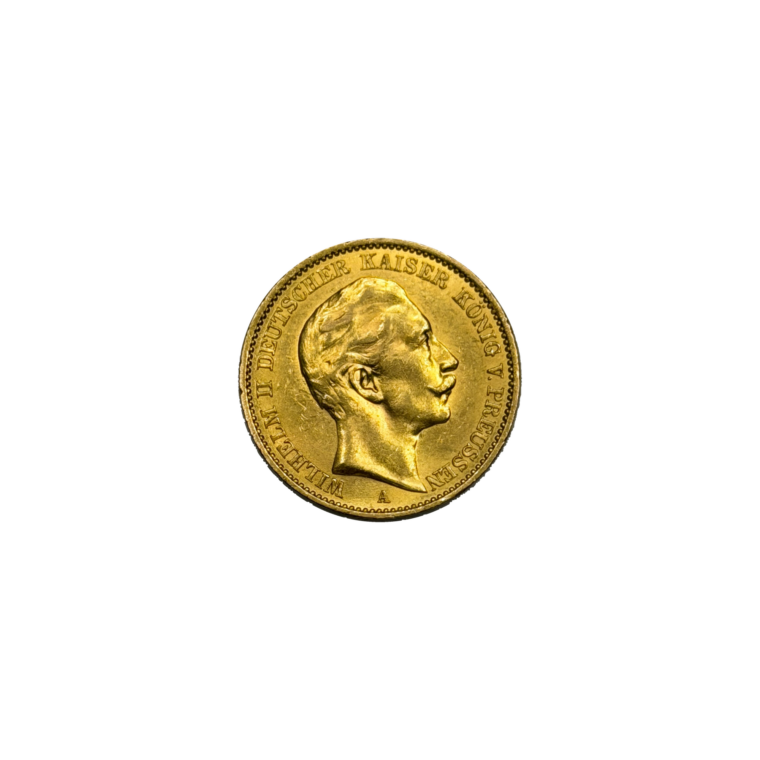
AU, UNC
1888 – 1913
.2304 troy ounce
Germany
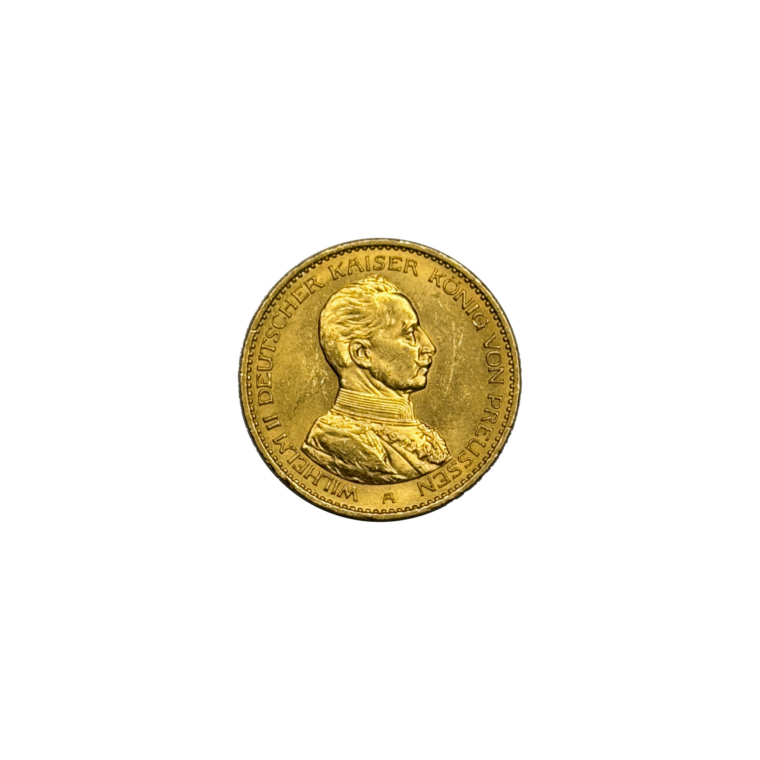
BU, PL
1913-1915
.2304 troy ounce
Germany


