

You must have an order with a minimum of $1,000.00 to place your order, your current order total is $0.00.
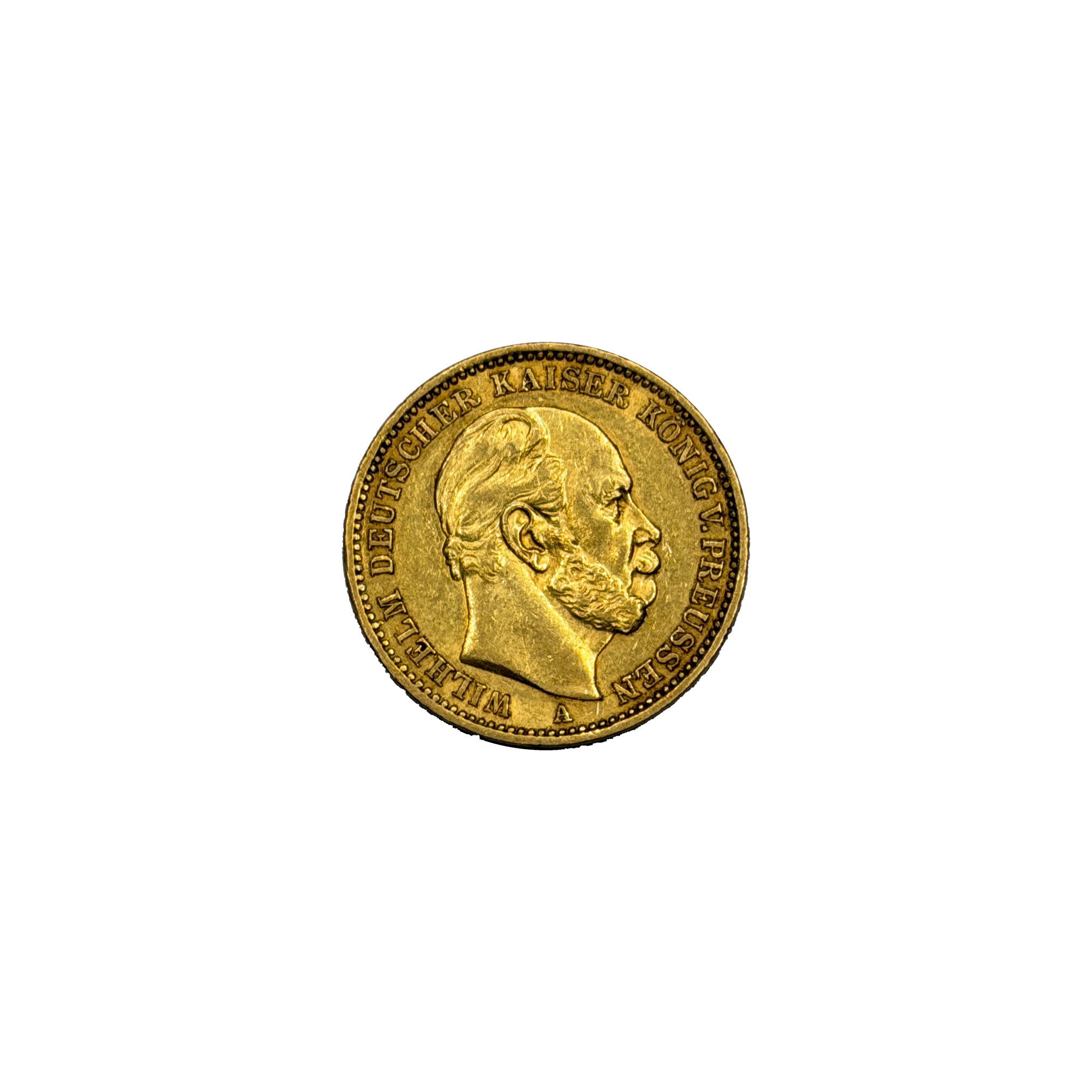
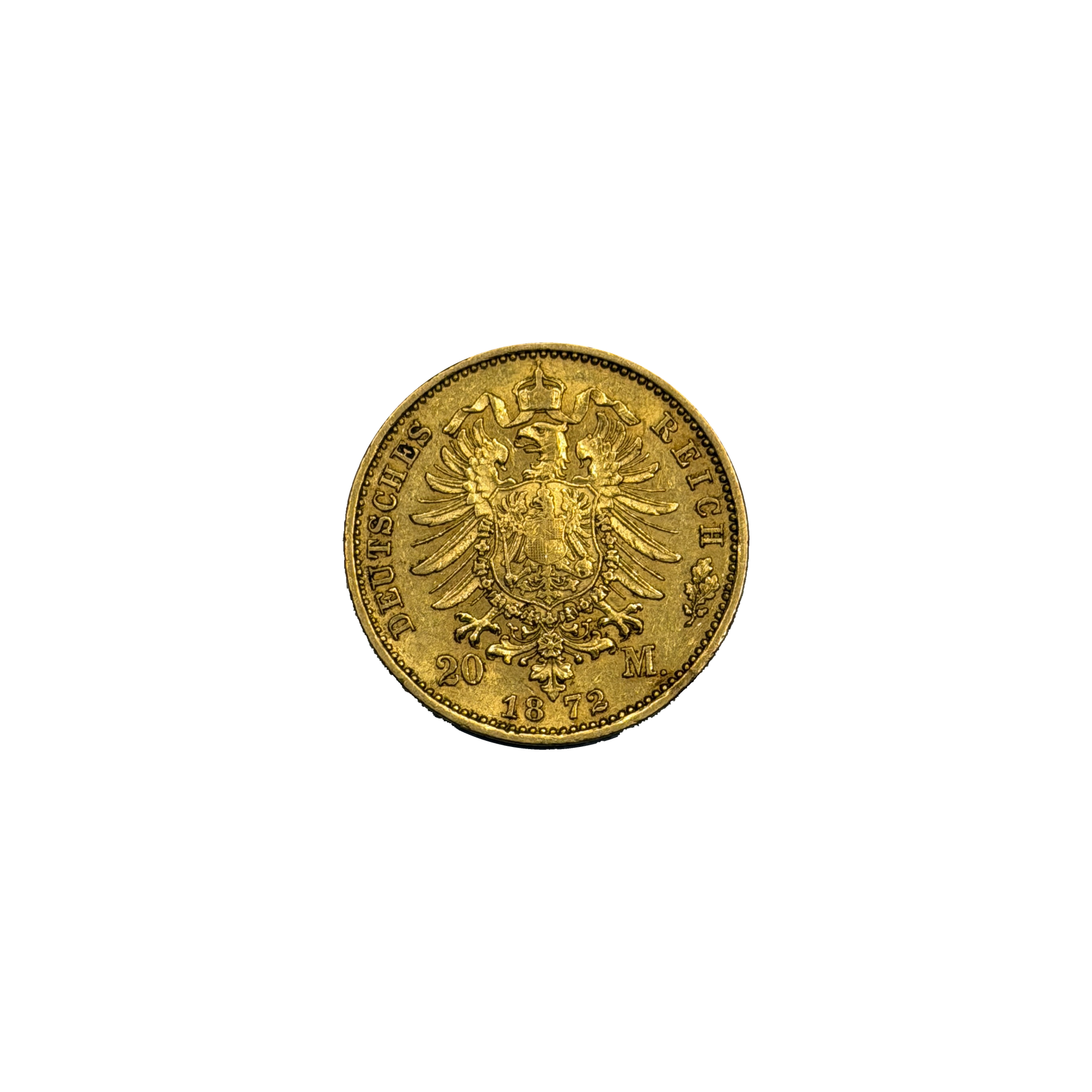
On January 18, 1871, in the Hall of Mirrors at Versailles, Wilhelm I of Prussia was proclaimed the first Kaiser of a unified Germany — a coronation staged, pointedly, in the palace of the defeated French. Among the new empire’s first acts was monetary: the patchwork of thalers, gulden, and city-state currencies that had divided the German states for centuries was replaced by a single gold-backed mark, and the 20 Mark gold coin bearing Wilhelm I’s portrait became its centerpiece. These are the first gold coins of the German Empire — the founding issues of a monetary system that served Germany until August 1914.
For investors, the Wilhelm I 20 Mark adds a genuine scarcity dimension to a coin family otherwise defined by its affordability. Classified instructively as “historical bullion,” it tracks the spot price of gold over time while carrying the historic (pre-1933) designation and the associated insulation against the possibility of future government intervention. Though minted in the millions during his reign, a great many Wilhelm I coins were lost through the course of two world wars, and surviving examples are substantially scarcer today than the commonly seen Wilhelm II issues that followed — yet they trade at only a modest step above the most affordable coins in the family. At close to one-quarter of a troy ounce, the coin also offers divisible negotiability: affording its owner the flexibility to liquidate positions incrementally, in amounts proportionate to the specific needs of the moment and across a variety of circumstances. For investors whose priorities are a coin steeped in founding-era historical significance, comparative scarcity born of two world wars’ attrition, and a standardized and widely recognized gold content—all at only a modest step above the family’s most affordable issues—the Wilhelm I 20 Mark is the foundational issue of Imperial German gold.
The obverse bears the bare-headed profile of Wilhelm I facing right — an aged, plainly rendered portrait of a king who came to empire late in life, with the inscription WILHELM DEUTSCHER KAISER KÖNIG V. PREUSSEN and the A mint mark of the Berlin mint below. The reverse displays the crowned Imperial Eagle with the Prussian shield at its breast and the inscription DEUTSCHES REICH. The type includes two distinct reverse varieties: the first issues (1871–1873) carry a smaller eagle with the denomination abbreviated 20 M., and the later issues (1874–1888) an enlarged eagle with the denomination spelled 20 MARK — a design evolution that lets an investor hold the empire’s very first gold format alongside its mature one.
At 22.5mm in diameter and 7.965 grams total weight, each coin contains 0.2304 troy ounces of pure gold in a .900 fine alloy — the imperial standard shared by every German 20 Mark that followed. Grade range: XF. Minted 1871–1888.
Wilhelm Friedrich Ludwig (1797–1888) ascended the Prussian throne in 1861. A soldier by training and temperament, his primary ambition was the reorganization and strengthening of the Prussian army, and his desire to remain above parliamentary politics led to his fateful appointment of Otto von Bismarck as minister president in 1862. It was Bismarck who engineered the wars of unification — against Denmark, Austria, and finally France — that made a German Empire possible. Upon the defeat of Napoleon III at Sedan in the Franco-Prussian War of 1870–71, Wilhelm was proclaimed Kaiser at Versailles, an honor he is said to have accepted with genuine reluctance.
He reigned until his death in March 1888 at the age of 90, a steady and unpretentious figure who left governance largely to Bismarck while presiding over Germany’s transformation into the leading industrial and military power on the European continent. The gold coins bearing his portrait span the empire’s entire founding era — from the euphoria of unification through seventeen years of consolidation and growth.
The monetary reform of 1871–1873 was among the most consequential achievements of the new empire. Funded in part by the French war indemnity, Germany moved decisively onto the gold standard, and the 20 Mark coin became the common gold currency of Prussia, Bavaria, Saxony, Württemberg, Hamburg, and the rest of the federated states — the same gold content regardless of which state issued it. The Wilhelm I issues are the first expression of that system: the coins that replaced centuries of monetary fragmentation with a single German money. Every later German 20 Mark — Friedrich III, Wilhelm II, the city-state issues — descends from the standard these coins established.
The scarcity argument for the Wilhelm I issue is straightforward and comparative. Millions were struck between 1871 and 1888, but these coins circulated hard for over four decades and then passed through two world wars, and relatively few survived into the modern era. Today the Wilhelm I 20 Mark is substantially scarcer than the Wilhelm II issues that dominate the market — a supply that is fixed and permanently thinner than the common type’s. Published NGC retail guidance for similarly conditioned examples has run meaningfully above USAGOLD’s offering price — a gap worth noting for investors weighing entry points within the German 20 Mark family. An investor can hold the empire’s founding gold issue, at its documented scarcity advantage over the common type, for only a modest step above the family’s most affordable coins.
The German 20 Mark is one of the most widely recognized pre-1933 European gold coins, with an active two-continent market anchored by consistent German-American demand in the United States and deep dealer networks across Europe. The Wilhelm I issue shares the family’s universally documented specifications and standardized gold content, so it trades within the same liquid market as the common Wilhelm II type — the scarcer coin rides on the liquidity of the family as a whole. For investors who may need to convert a holding to cash, that combination of family-level liquidity and issue-level scarcity is an unusual and favorable pairing.
In 1933, FDR issued Executive Order 6102, requiring Americans to surrender their gold coin and bullion to the Treasury — but the order and the regulations that followed it exempted gold coins of recognized special value to collectors of rare and unusual coins. Subsequent clarifications by the Treasury identified pre-1933 gold coins — a classification that includes the German 20 Mark Wilhelm I, struck between 1871 and 1888 — as falling within that collector classification as historical items.
Under current constitutional law, a government intervention in the gold market would be executed through the power of eminent domain — the government’s right to take private property for public use provided it pays the owner just compensation. Historic coins complicate the government’s ability to broadly establish “just compensation” or “fair value,” which was precisely the reasoning behind the original “recognized special value” exemption in 1933. That complexity, and the precedent surrounding pre-1933 gold coins, creates a notable impediment to the government’s ability to restrict them broadly — particularly compared to modern bullion, which can be valued easily and consistently at a single price. In essence, it is a bureaucratic question of whether the government would undertake the enormous task of valuing the diversity and complexity of the historic-coin genre — every coin, every date, every condition, every personal holding — and that difficulty is what insulates the owner’s legal liquidity rights in the event of capital controls.
Whether a future government intervention in private gold markets is a risk an investor assigns significant weight to is a personal judgment. The factual point is narrower: the pre-1933 status represents a layer of portfolio differentiation that this coin carries at minimal added per-ounce cost over comparable modern bullion, along with a measure of insulation for the legal liquidity rights of its owner.
For a more in-depth study, we invite you to read our comprehensive memorandum on this subject: Preparing for a Potential Gold Confiscation
The Wilhelm I 20 Mark is where Imperial German gold begins — the coin of the Versailles proclamation, the first issue of the monetary union that made a single Germany out of a patchwork of states, and the portrait of the founding Kaiser. Two world wars thinned its surviving supply well below that of the Wilhelm II coins that followed, yet it remains available at only a modest premium over the most affordable issues in the family, with the divisible negotiability of its quarter-ounce size and a standardized and widely recognized gold content. Surviving examples reach the market irregularly and are rarely available in quantity—positions in this founding issue tend to be quickly subscribed when they appear. No other German gold coin combines founding-era historical significance with a documented scarcity advantage at so accessible a price.
| Year | Mintage |
|---|---|
| 1871 | 502,462 |
| 1872 | 12,691,988 |
| 1873 | 17,731,456 |
| 1874 | 1,674,875 |
| 1875 | 4,203,301 |
| 1876 | 3,096,073 |
| 1877 | 1,757,849 |
| 1878 | 2,257,118 |
| 1879 | 1,023,126 |
| 1881 | 427,556 |
| 1882 | 655,102 |
| 1883 | 4,283,131 |
| 1884 | 224,422 |
| 1885 | 407,446 |
| 1886 | 175,977 |
| 1887 | 5,645,176 |
| 1888 | 533,854 |
| Total (listed figures) | 57,290,912 |
Mintage figures per the Standard Catalog of World Coins, via the NGC World Price Guide. Dates NGC lists without figures are shown with a dash. Figures combine the Berlin (A), Hannover (B), and Frankfurt (C) mints across the small-eagle (1871–1873) and large-eagle (1874–1888) types; the 1875 Hannover striking is listed without a figure.
Each coin contains 0.2304 troy ounces of pure gold in a .900 fine alloy, at 22.5mm diameter and 7.965 grams total weight — the imperial standard shared by every German 20 Mark that followed.
From 1871 to 1888, spanning Wilhelm I's reign as the first Kaiser of unified Germany. They are the first gold coins of the German Empire, introduced by the monetary reform of 1871-1873 that replaced the German states' fragmented currencies with a single gold-backed mark.
The first issues (1871-1873) carry a smaller Imperial Eagle with the denomination abbreviated 20 M.; the later issues (1874-1888) show an enlarged eagle with the denomination spelled out as 20 MARK.
Though minted in the millions during his reign, a great many Wilhelm I coins were lost through two world wars, and surviving examples are substantially scarcer today than the commonly seen Wilhelm II issues that followed.
The grade range is XF (Extremely Fine). Struck 1871-1888, the coin carries the historic pre-1933 designation.
XF
1871 – 1888
.2304 troy ounce
Germany
Prices shown under Wire include a 4% cash discount. Card prices are the full list price. ACH bank transfer is available to established clients only. First-time orders can be paid by wire transfer or card.
Call our team for availability. Monday to Friday, 8 AM to 6 PM Mountain Time.
Want to be notified when this product is back in stock?
Interested in gold but struggling to find the right firm?

AU, UNC
1888 – 1913
.2304 troy ounce
Germany
AU, UNC
1893-1913
.2304 troy ounce
Germany
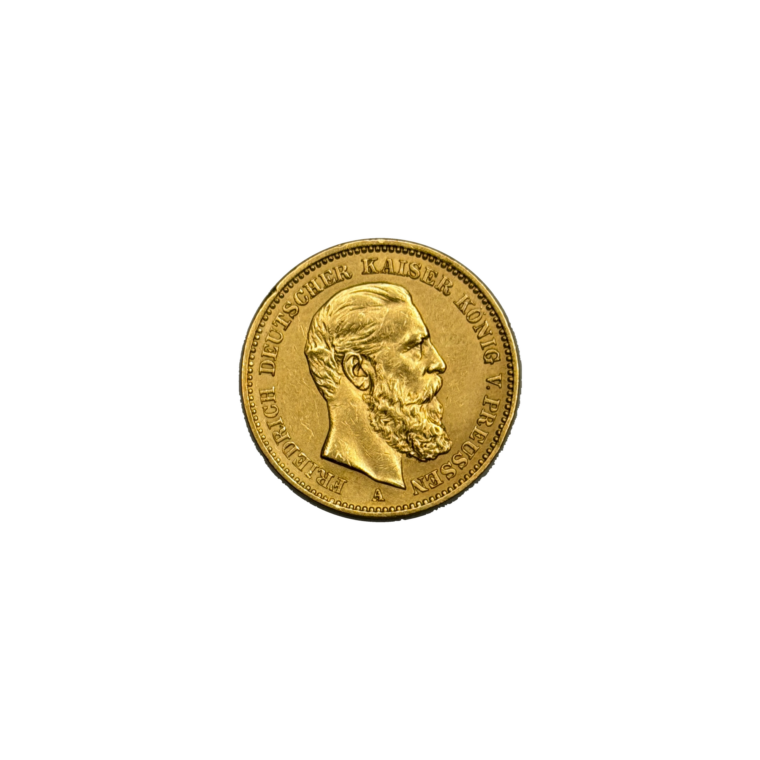
XF
1888
.2304 troy ounce
Germany
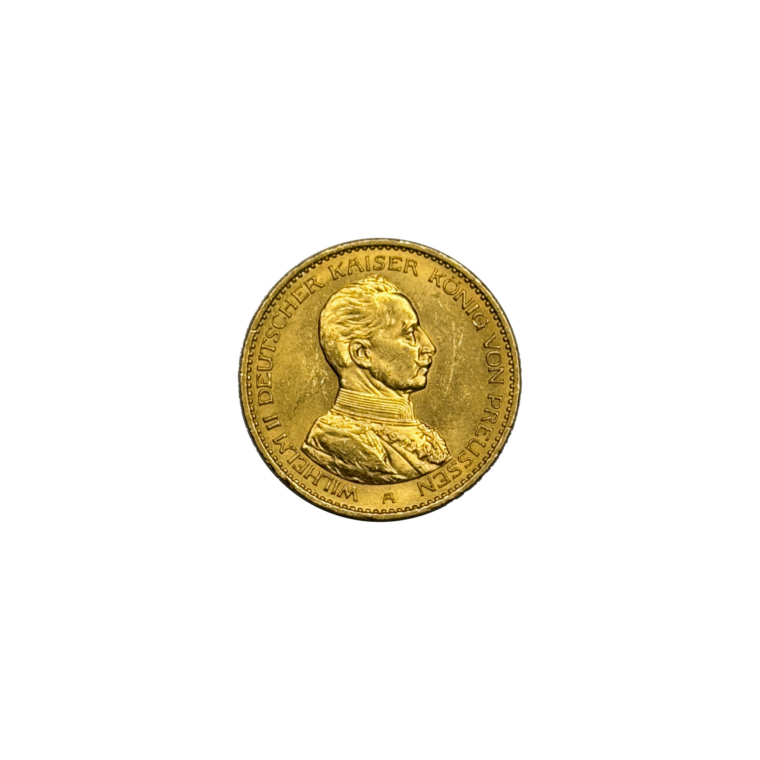
BU, PL
1913-1915
.2304 troy ounce
Germany


