

You must have an order with a minimum of $1,000.00 to place your order, your current order total is $0.00.
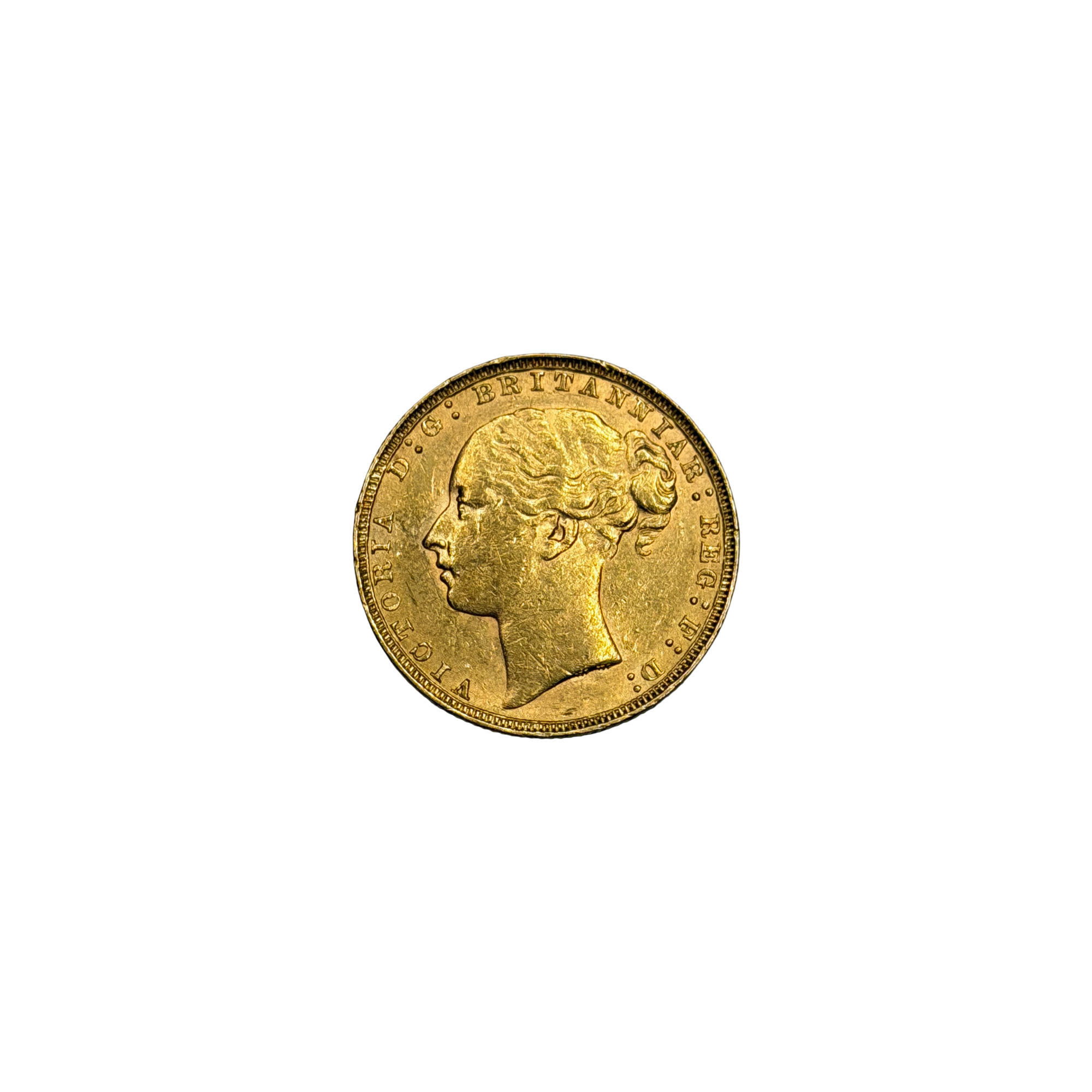
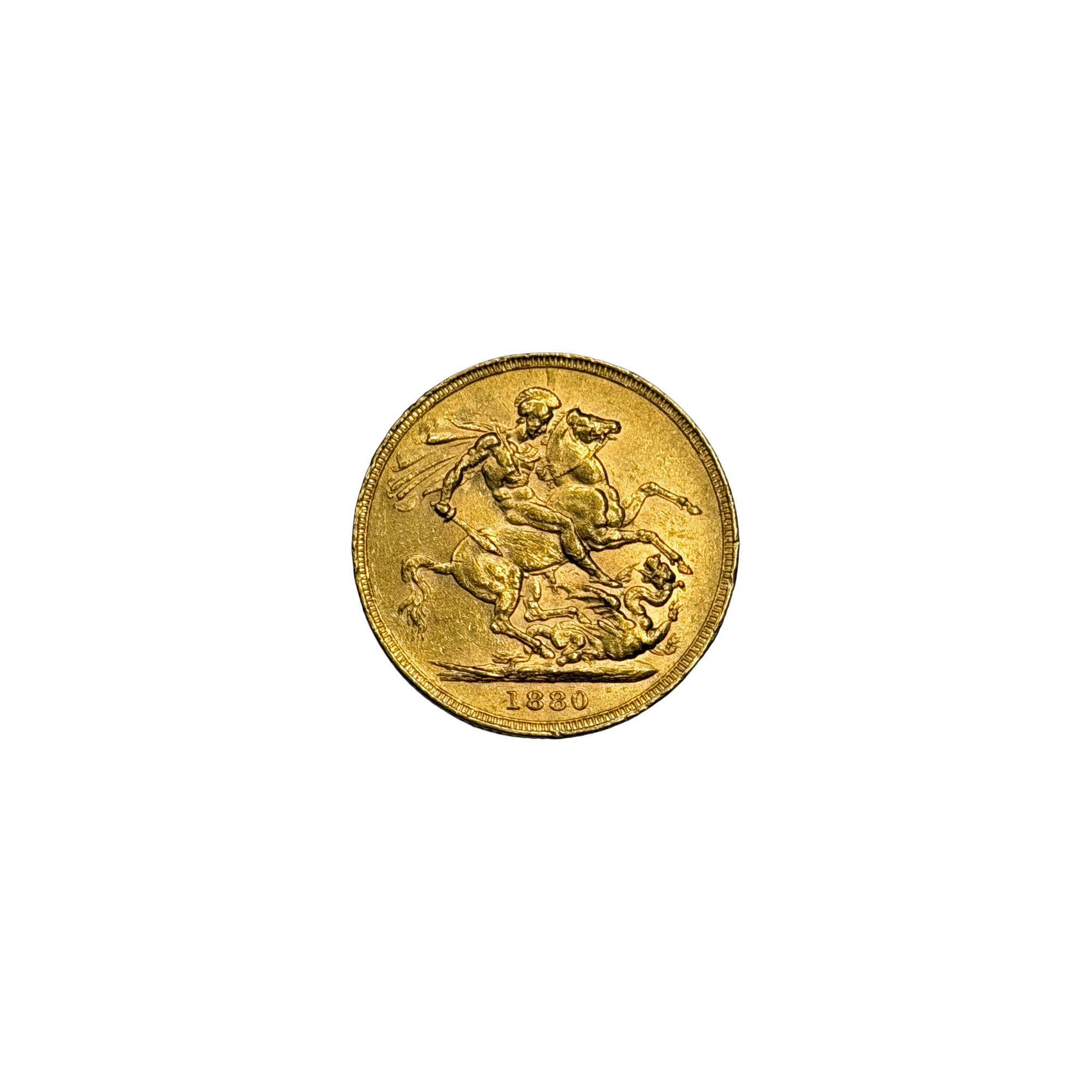
Queen Victoria came to the throne on June 20, 1837, at eighteen years old. She would reign for sixty-three years and seven months — the longest reign of any British monarch until Elizabeth II — and would become, in that time, the Empress of India, the matriarch of half of Europe’s royal houses, and the symbolic center of an empire covering nearly a quarter of the earth’s surface. William Wyon’s Young Head portrait of the young queen served the sovereign for half a century, from 1838 to 1887, and the coins offered here — struck from 1871 to 1885 — pair that portrait with Benedetto Pistrucci’s St. George and the Dragon, revived on the sovereign in 1871 after nearly half a century’s absence. These are the first Victorian sovereigns to carry the St. George reverse, the design every sovereign has borne since.
These coins carry a higher absolute premium than a George V sovereign — but the premium relative to the underlying scarcity difference is modest, and the gap between Young Head premiums and later sovereign premiums has historically been narrower than the scarcity justifies. That gap is the argument: not that this coin is inexpensive in absolute terms, but that it is priced below what a genuinely scarce instrument of this historical weight ought to command. At roughly one-quarter of a troy ounce, the coin also offers divisible negotiability: affording its owner the flexibility to liquidate positions incrementally, in amounts proportionate to the specific needs of the moment and across a variety of circumstances. For investors whose priorities are comparative scarcity, value, and the liquidity of the world’s most recognized gold coin family, the Young Head is the classic St. George design in its earliest Victorian form—priced at a premium narrower than the underlying scarcity justifies—and for the earliest dates of all, its sibling the Shield sovereign (1838–1874) extends the same portrait back to the reign’s first year.
The obverse was designed by William Wyon, chief engraver to the Royal Mint and one of the foremost coin designers of the nineteenth century. His portrait of the young Victoria — her hair arranged in a simple bun, her expression composed and direct — set the standard for sovereign portraiture for half a century. The reverse carries Benedetto Pistrucci’s iconic St. George and the Dragon, created in 1817 and restored to the sovereign in 1871, where it has remained with modifications to the present day.
At 22.05mm in diameter and 7.98 grams total weight, each coin is struck from 22-carat gold (.917 fine) and contains 0.2354 troy ounces of pure gold — legal tender at one pound sterling, and Capital Gains Tax exempt in the United Kingdom. Minted 1871–1885. Grade range: AU. The Young Head portrait itself ran from 1838 to 1887: the earlier shield-reverse coinage (1838–1874) is offered separately as our Shield sovereign, and the Sydney and Melbourne branch-mint strikes as our Australia Reverse sovereign.
George V sovereigns were produced at peak rates exceeding 30 million pieces per year across seven mints on five continents. Young Head production — a portrait retired in 1887, decades before sovereign coinage industrialized to that scale — represents a small fraction of that accumulated supply, and surviving examples are meaningfully scarcer in the market than the production figures for later types suggest.
The market has partially absorbed this scarcity differential but has not fully priced it. Young Head sovereigns in circulated grades trade at premiums over George V that reflect some awareness of the gap, but not the full extent of it. Genuine high-grade examples are encountered less frequently than the premium differential would suggest, and the numismatic demand layered on top of investment demand creates an additional price floor that later sovereign types cannot replicate — a supply structure that is fixed, and permanently so. The production gap is real. The market’s current pricing of that gap is incomplete — which is the buyer’s advantage: the scarcity comes along at little added cost. Within the Young Head family itself, the choice is one of emphasis at broadly similar cost: this St. George type for the classic design in its earliest Victorian form, the Shield sovereign for the catalog’s earliest dates, and the Australia Reverse issues for branch-mint scarcity.
The Young Head sovereign costs more per coin than a George V sovereign. That is a fact, and investors should understand it clearly. What requires more careful analysis is whether that premium is proportionate to the underlying scarcity difference — and it is not. The gap between Young Head premiums and later sovereign premiums has historically been narrower than the underlying scarcity of the older type justifies. Buying a genuinely scarce instrument at a premium the market has not fully priced is a different proposition from simply buying the cheapest available option. The George V sovereign is an excellent coin — liquid, accessible, broadly recognized. The Young Head is all of that and also among the scarcest sovereign types available at near-bullion levels — scarcity the buyer acquires at little added cost.
Victoria came to the throne in 1837, eighteen years old, the sovereign of a country undergoing a transformation — industrial, demographic, imperial — that neither she nor anyone else fully understood. In her first decade she married Prince Albert of Saxe-Coburg and Gotha, began the family that would seed royal houses across Europe, and watched the railway network expand across Britain at a pace without historical precedent. The Crystal Palace Great Exhibition of 1851, attended by six million people, was the public apex of that transformation.
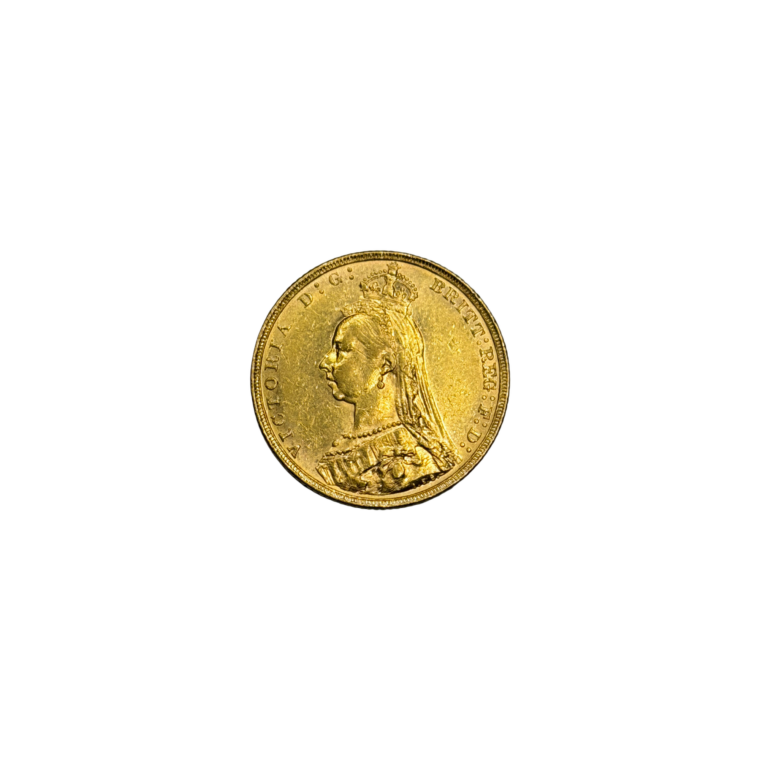
She became Empress of India in 1876. By the Jubilee year of 1887 — when the Young Head design was retired in favor of the Jubilee Head portrait — she had been on the throne for fifty years. Her nine children married into the royal families of Germany, Denmark, Russia, Spain, and Romania, making her, at her death in 1901, the grandmother of most of the crowned heads of Europe, including Kaiser Wilhelm II and Tsar Nicholas II.
The Young Head design captures Victoria before all of that — not the Empress of India, not the grandmother of emperors, not the black-clad widow of Windsor. It is the coin of the queen before she became the institution, and no subsequent sovereign type carries that specificity.
The 1871–1885 issues belong to the High Victorian era — the years of the empire’s confident expansion between the completion of the Suez Canal and the beginning of the Scramble for Africa, with London established as the clearinghouse of world trade and the sovereign at the center of the global gold standard. The 1871 date itself marks a turning point in the coin’s own history: the Royal Mint’s revival of Pistrucci’s St. George reverse, retiring the heraldic shield that had served since 1838 and fixing the sovereign’s identity as the world has known it ever since. A Young Head St. George sovereign participated in the daily commerce of the most dynamic economy on earth — trade settlements, military payrolls, the financing of railways and shipping lines — during the decades that shaped the modern world.
The British gold sovereign is, alongside the French 20 Franc and the American $20 Double Eagle, one of the foundational instruments of the pre-1933 gold market. It is recognized by dealers and investors globally, liquid in virtually every market where gold changes hands, and accepted as a standard fractional holding by institutional buyers who might not recognize a Swiss Helvetia or an Italian 20 Lira on sight. The Young Head St. George type is the entry into this globally recognized instrument at the deepest level the classic design allows — the earliest sovereigns to carry the reverse the whole world associates with the coin — with numismatic demand providing a secondary price floor that reinforces liquidity beyond what bullion demand alone would provide.
In 1933, FDR issued Executive Order 6102, requiring Americans to surrender their gold coin and bullion to the Treasury — but the order and the regulations that followed it exempted gold coins of recognized special value to collectors of rare and unusual coins. Subsequent clarifications by the Treasury identified pre-1933 gold coins — a classification that includes the Young Head sovereign, struck between 1871 and 1885 — as falling within that collector classification as historical items.
Under current constitutional law, a government intervention in the gold market would be executed through the power of eminent domain — the government’s right to take private property for public use provided it pays the owner just compensation. Historic coins complicate the government’s ability to broadly establish “just compensation” or “fair value,” which was precisely the reasoning behind the original “recognized special value” exemption in 1933. That complexity, and the precedent surrounding pre-1933 gold coins, creates a notable impediment to the government’s ability to restrict them broadly — particularly compared to modern bullion, which can be valued easily and consistently at a single price. In essence, it is a bureaucratic question of whether the government would undertake the enormous task of valuing the diversity and complexity of the historic-coin genre — every coin, every date, every condition, every personal holding — and that difficulty is what insulates the owner’s legal liquidity rights in the event of capital controls.
Whether a future government intervention in private gold markets is a risk an investor assigns significant weight to is a personal judgment. The factual point is narrower: the pre-1933 status represents a layer of portfolio differentiation that this coin carries at minimal added per-ounce cost over comparable modern bullion, along with a measure of insulation for the legal liquidity rights of its owner.
For a more in-depth study, we invite you to read our comprehensive memorandum on this subject: Preparing for a Potential Gold Confiscation
The Young Head sovereign is not the cheapest British sovereign. It is Victoria at the height of the High Victorian age, on the first sovereigns to carry the St. George reverse the world now knows the coin by, available at premiums narrower than the underlying scarcity justifies — a supply meaningfully thinner than every later sovereign type, priced only a modest step above the common Kings issues. That is the value: the buyer pays close to common-sovereign cost and receives one of the scarcest sovereign types in the bargain. No other sovereign combines this blend of scarcity, historical depth, and value at so modest a premium over the common types.
| Year | Mintage |
|---|---|
| 1871 | — |
| 1872 | — |
| 1873 | — |
| 1874 | — |
| 1876 | 3,319,000 |
| 1878 | 1,091,000 |
| 1879 | 20,000 |
| 1880 | 3,650,000 |
| 1884 | 1,770,000 |
| 1885 | 718,000 |
| Total (listed figures) | 10,568,000 |
Mintage figures per the Standard Catalog of World Coins, via the NGC World Price Guide. Dates NGC lists without figures are shown with a dash. London Mint figures; branch-mint production additional.
Learn More:
British Gold Sovereign Buyer’s Guide: Complete Investment Analysis
XF, AU
1871-1885
.2354 troy ounce
Britain
| Quantity | Wire | Card |
|---|---|---|
| 1–21 | $1,118.50 | $1,165.10 |
| 22–42 | $1,107.32 | $1,153.45 |
| 43+ | $1,096.13 | $1,141.80 |
Quantity tiers reflect the historic & fractional gold order discount (1% at $25,000+ · 2% at $50,000+ in qualifying coins). Any mix of qualifying historic coins counts toward the same order total.
Prices shown under Wire include a 4% cash discount. Card prices are the full list price. ACH bank transfer is available to established clients only. First-time orders can be paid by wire transfer or card.
Interested in gold but struggling to find the right firm?

AU
1893-1901
.2354 troy ounce
Britain
AU
1838-1887
.2354 troy ounce
Britain
AU
1887-1893
.2354 troy ounce
Britain
AU, UNC, BU
1902-1910
.2354 troy ounce
Britain


