

You must have an order with a minimum of $1,000.00 to place your order, your current order total is $0.00.
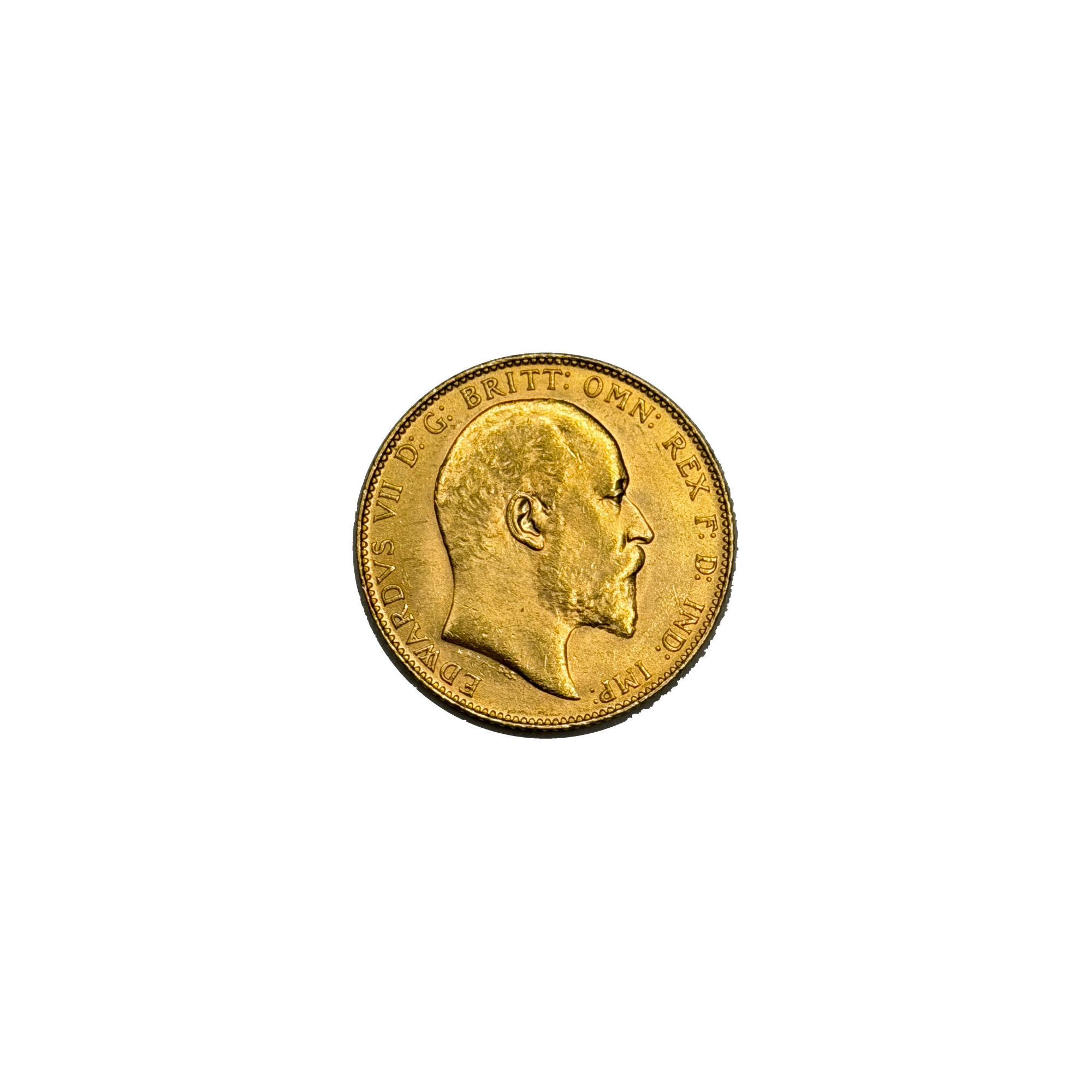
The Edwardian era was the final stretch of unclouded British confidence — a brief, prosperous interlude between the long Victorian age and the catastrophe of the First World War. The sovereigns struck between 1902 and 1910, bearing the bare-headed portrait of King Edward VII, are the coins of that decade: gold that moved through the banks and trading houses of an empire still at its full extent, in the last years anyone believed the nineteenth-century world would simply continue.
For investors, the Edward VII sovereign delivers the full package of advantages that has made the British sovereign probably the most widely owned and recognized gold coin in the world — so much so that the U.S. Army included sovereigns in its special forces survival packs for a number of years. Classified instructively as “historical bullion,” it trades at per ounce acquisition costs comparable to modern bullion coins and tracks directly with the spot price of gold over time, while carrying the historic (pre-1933) designation and the associated insulation against the possibility of future government intervention. At roughly one-quarter of a troy ounce, it also provides divisible negotiability: affording its owner the flexibility to liquidate positions incrementally, in amounts proportionate to the specific needs of the moment and across a variety of circumstances. For investors whose priorities are recognizability, liquidity, and divisible negotiability—all for near-bullion pricing—the Edward VII sovereign delivers everything its George V successor delivers, with the earlier dates and tighter issue window of the century’s first reign.
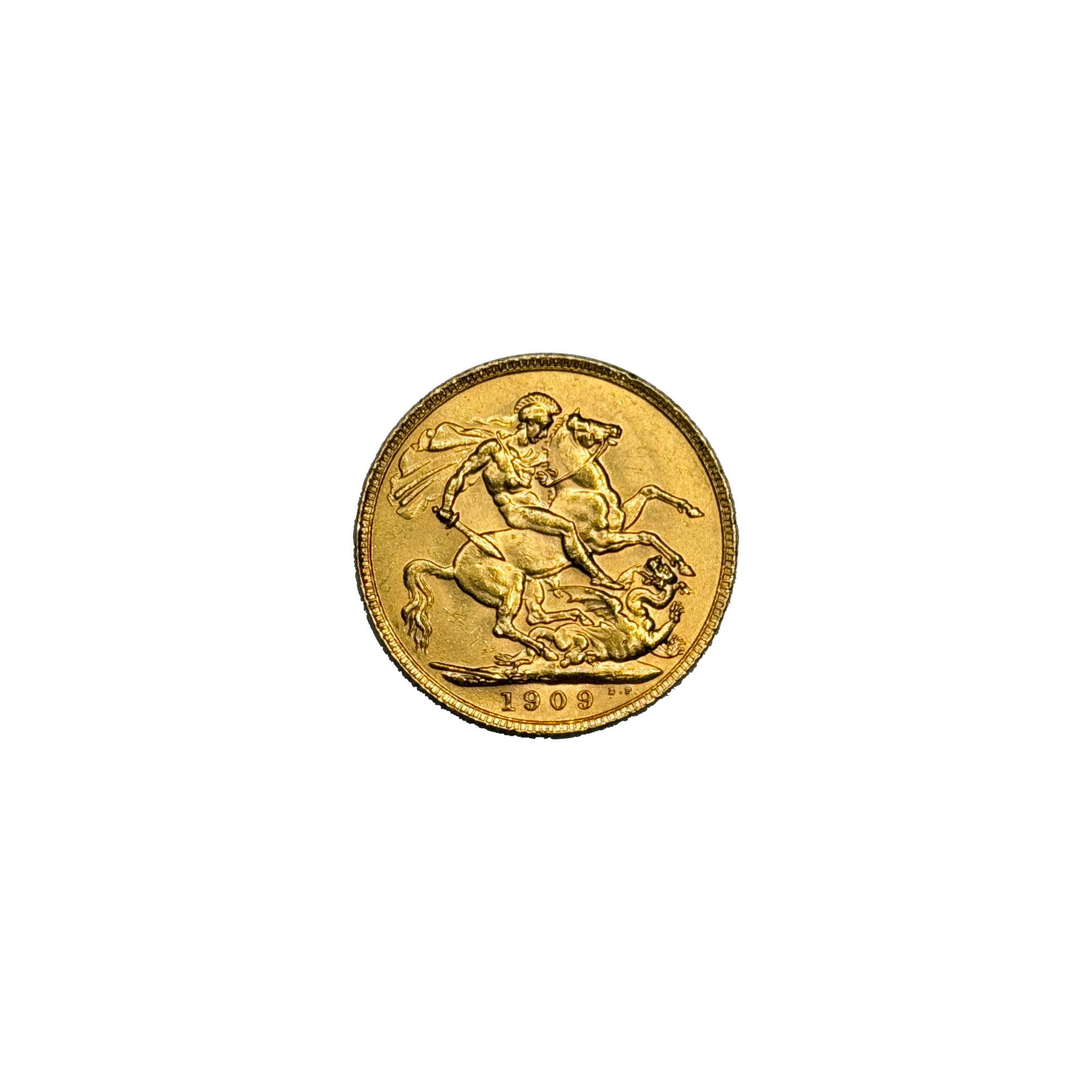
The obverse bears George William de Saulles’ portrait of Edward VII — bare-headed, bearded, facing right, with the legend EDWARDVS VII D:G: BRITT: OMN: REX F:D: IND: IMP: encircling the bust. It was the first new sovereign portrait of the twentieth century, replacing the veiled image of the king’s mother after more than six decades of Victoria’s coinage. The reverse carries Benedetto Pistrucci’s St. George and the Dragon, the design that has appeared on British sovereigns with only minor modifications since 1817 — among the longest-running images in the history of gold coinage.
At 22.05mm in diameter and 7.98 grams total weight, each coin is struck from 22-carat gold (.917 fine) and contains 0.2354 troy ounces of pure gold — legal tender at one pound sterling and Capital Gains Tax exempt in the United Kingdom. Grade range: AU/UNC/BU. Minted 1902–1910. Edward VII sovereigns were struck at the Royal Mint in London, at the Australian branch mints in Melbourne, Sydney, and Perth, and — beginning in 1908 — at the new Ottawa Mint, which made the Edward VII type the first sovereign ever struck in Canada.
Edward VII waited longer for the throne than almost any heir in British history. The eldest son of Queen Victoria, he spent nearly six decades as Prince of Wales under his mother’s famously strict regimen, excluded from political affairs and widely criticized for an indulgent private life that many predicted would compromise the monarchy. The prediction failed. When he succeeded in 1901, Edward proved a steady and surprisingly effective king — he stabilized Britain’s finances, modernized the ceremonial monarchy, and applied his personal charm to diplomacy at the highest level, helping secure the Entente Cordiale with France in 1904. Europe’s press called him “the Uncle of Europe”; he was related by blood or marriage to nearly every ruling house on the continent.
His reign, 1901 to 1910, gave its name to an era remembered for peace, prosperity, and a certain unhurried elegance — the last full decade before the First World War rearranged the world. The sovereigns bearing his portrait are the monetary artifacts of exactly those years.
The Edward VII sovereign opened the final chapter of the sovereign’s life as working money. Production spanned a global network of mints that was still expanding — the Perth Mint had opened in 1899, and Ottawa joined in 1908, extending sovereign coinage to North America for the first time. These coins settled accounts across an empire covering roughly a quarter of the world’s land surface, at the height of the classical gold standard, when the pound sterling — and the sovereign that embodied it — served as the reference currency of world trade. More than 600 million St. George sovereigns were struck between 1817 and 1932; the Edward VII issues sit at the confident midpoint of the coin’s final circulating decades, after which his son George V’s issues would carry the type through war, upheaval, and the end of gold coinage itself in 1932.
Alongside its George V successor, the Edward VII sovereign belongs to the coin family that serves as the benchmark against which fractional historical gold liquidity is measured. Dealers across North America, Europe, and Asia recognize the sovereign immediately, its specifications are universally documented, and its trading history is deep enough that bid-ask spreads remain tight across all international markets. The military endorsement is the most compelling evidence: during the Second World War, the United States and Britain both sewed sovereigns into aircrew escape-and-evasion kits, and the practice was revived during the 1991 Gulf War — the documented judgment of two governments, across two wars fifty years apart, that no coin is more likely to be recognized, valued, and accepted anywhere on earth. Because the Edward VII issues share the sovereign’s exact specifications and iconic St. George reverse, they inherit that liquidity in full — while adding the earlier date and the shorter production window of a nine-year reign compared with the two decades of George V coinage that followed. One further point deserves passing mention: the genre’s supply is fixed, and in flight-to-safety episodes — 2008, when premiums rose across all European historic coins on tight supplies, or the early-2010s banking crisis, when Greek savers moved into sovereigns to exit the banking system — the sovereign has seen modest premium firmness that same-priced modern bullion did not share.
In 1933, FDR issued Executive Order 6102, requiring Americans to surrender their gold coin and bullion to the Treasury — but the order and the regulations that followed it exempted gold coins of recognized special value to collectors of rare and unusual coins. Subsequent clarifications by the Treasury identified pre-1933 gold coins — a classification that includes the Edward VII sovereign, struck between 1902 and 1910 — as falling within that collector classification as historical items.
Under current constitutional law, a government intervention in the gold market would be executed through the power of eminent domain — the government’s right to take private property for public use provided it pays the owner just compensation. Historic coins complicate the government’s ability to broadly establish “just compensation” or “fair value,” which was precisely the reasoning behind the original “recognized special value” exemption in 1933. That complexity, and the precedent surrounding pre-1933 gold coins, creates a notable impediment to the government’s ability to restrict them broadly — particularly compared to modern bullion, which can be valued easily and consistently at a single price. In essence, it is a bureaucratic question of whether the government would undertake the enormous task of valuing the diversity and complexity of the historic-coin genre — every coin, every date, every condition, every personal holding — and that difficulty is what insulates the owner’s legal liquidity rights in the event of capital controls.
Whether a future government intervention in private gold markets is a risk an investor assigns significant weight to is a personal judgment. The factual point is narrower: the pre-1933 status represents a layer of portfolio differentiation that this coin carries at minimal added per-ounce cost over comparable modern bullion, along with a measure of insulation for the legal liquidity rights of its owner.
For a more in-depth study, we invite you to read our comprehensive memorandum on this subject: Preparing for a Potential Gold Confiscation
The Edward VII sovereign is the coin of the empire’s last confident decade — the first sovereign of the twentieth century, struck on both sides of the globe, backed by the same specifications, the same St. George reverse, and the same on-sight recognition that made the sovereign the coin two militaries chose as money of last resort. Priced at near-bullion acquisition costs, Capital Gains Tax exempt in the United Kingdom, and fractional in size, it delivers the complete sovereign case in the type struck during a single nine-year reign. No other gold coin family can boast this unique combination of so many notable advantages for gold investors — and the Edward VII issue is its Edwardian original.
| Year | Mintage |
|---|---|
| 1902 | 4,738,000 |
| 1903 | 8,889,000 |
| 1904 | 10,041,000 |
| 1905 | 5,910,000 |
| 1906 | 10,467,000 |
| 1907 | 18,459,000 |
| 1908 | 11,729,000 |
| 1909 | 12,157,000 |
| 1910 | 22,380,000 |
| Total | 104,770,000 |
Mintage figures per the Standard Catalog of World Coins, via the NGC World Price Guide. Dates NGC lists without figures are shown with a dash. London Mint figures; branch-mint production additional.
Learn More:
British Gold Sovereign Buyer’s Guide: Complete Investment Analysis
AU, UNC, BU
1902-1910
.2354 troy ounce
Britain
| Quantity | Wire | Card |
|---|---|---|
| 1–21 | $1,096.51 | $1,142.20 |
| 22–43 | $1,085.54 | $1,130.78 |
| 44+ | $1,074.58 | $1,119.36 |
Quantity tiers reflect the historic & fractional gold order discount (1% at $25,000+ · 2% at $50,000+ in qualifying coins). Any mix of qualifying historic coins counts toward the same order total.
Prices shown under Wire include a 4% cash discount. Card prices are the full list price. ACH bank transfer is available to established clients only. First-time orders can be paid by wire transfer or card.
Interested in gold but struggling to find the right firm?

AU, UNC
1911-1915
.1177 troy ounce
Britain
XF, AU
1871-1885
.2354 troy ounce
Britain
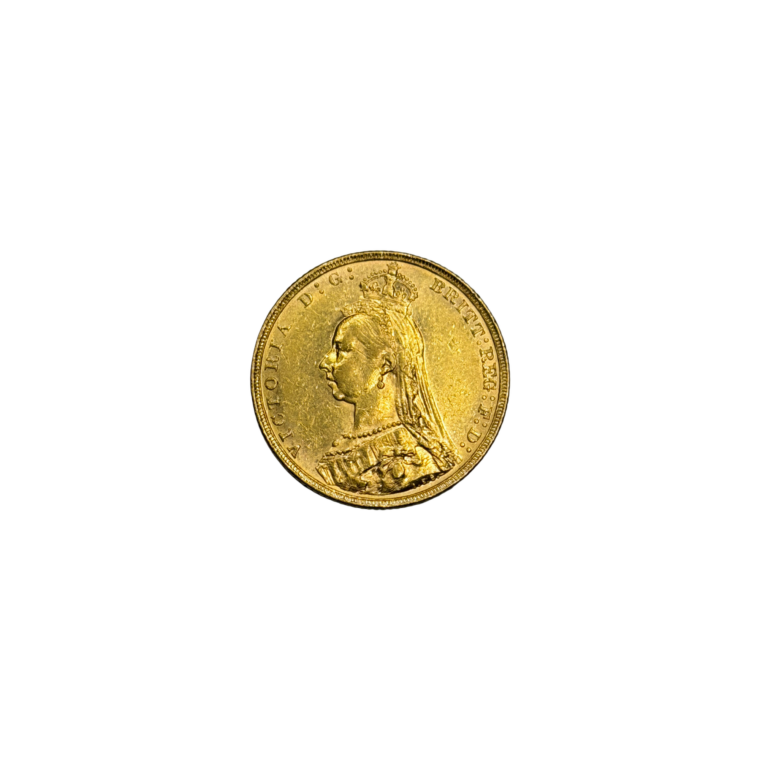
AU
1887-1893
.2354 troy ounce
Britain
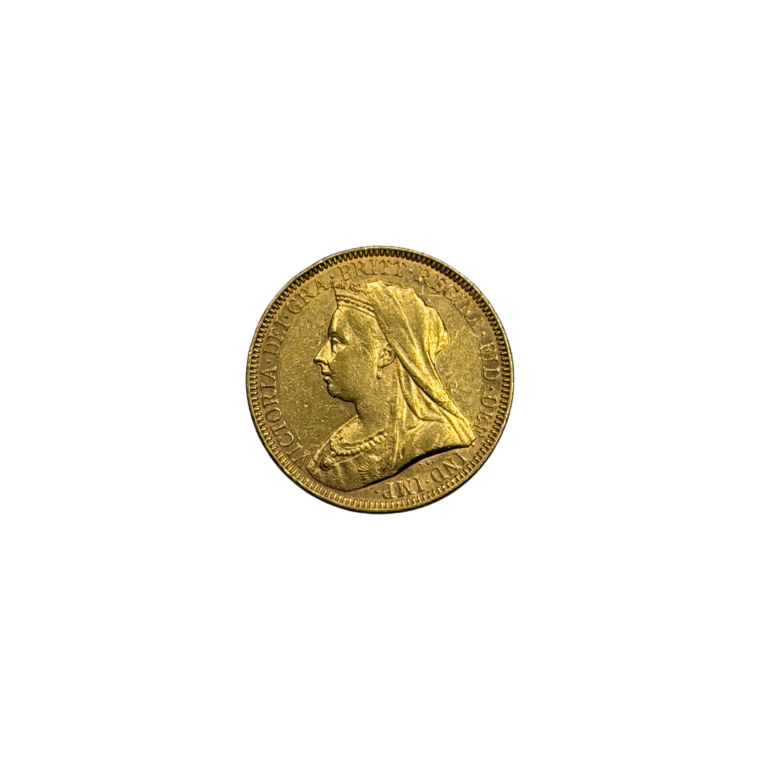
AU
1893-1901
.2354 troy ounce
Britain
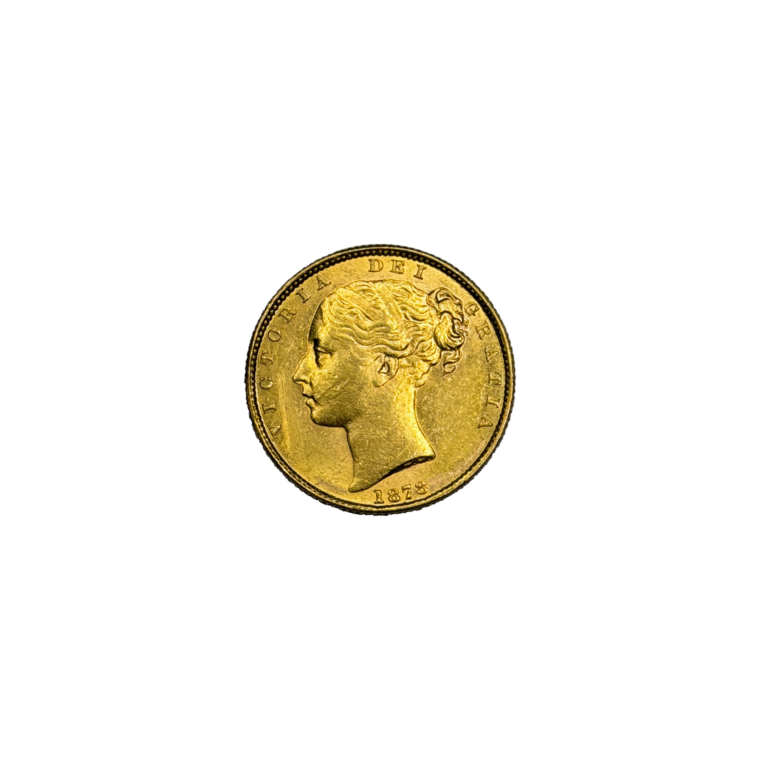
AU
1838-1887
.2354 troy ounce
Britain


