

You must have an order with a minimum of $1,000.00 to place your order, your current order total is $0.00.
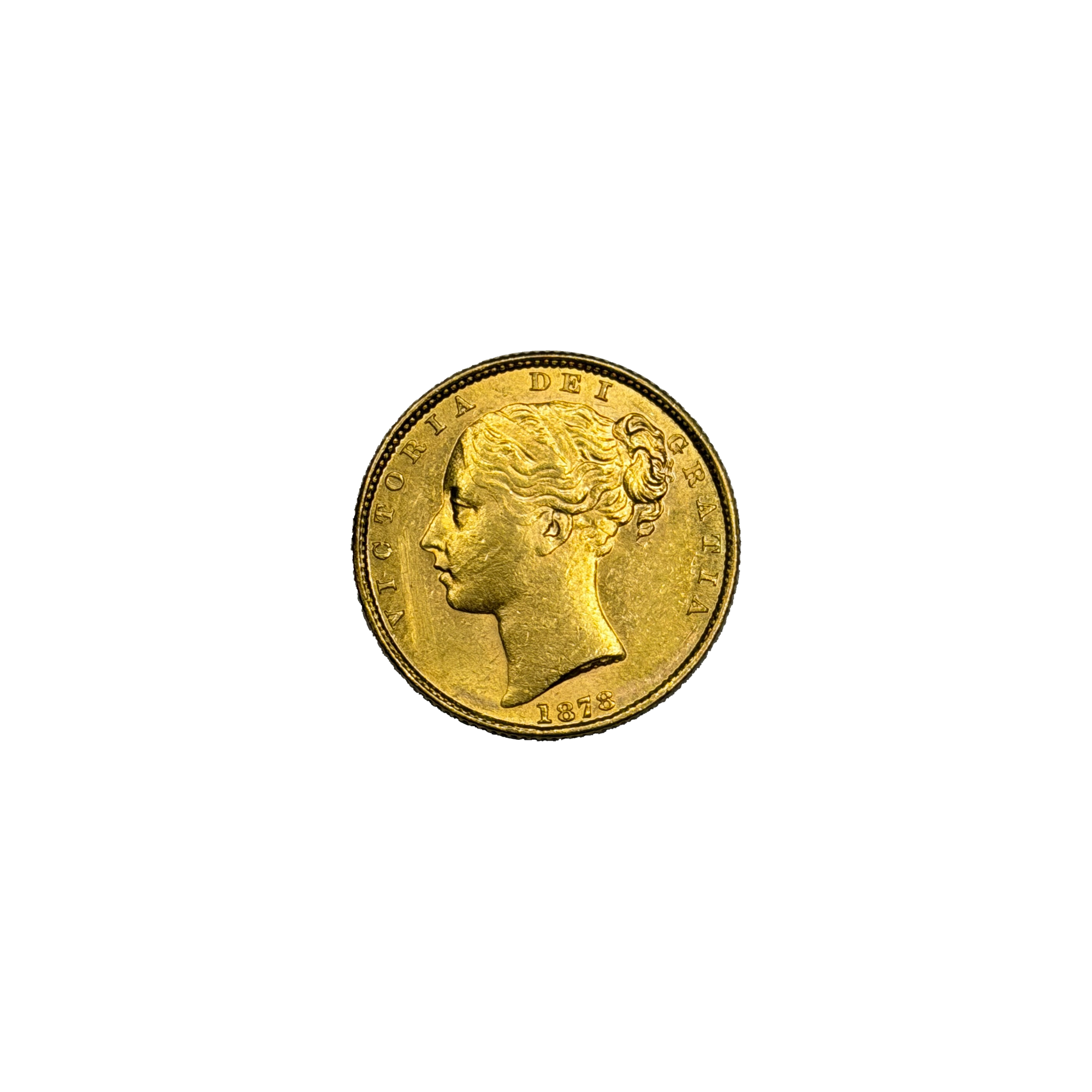
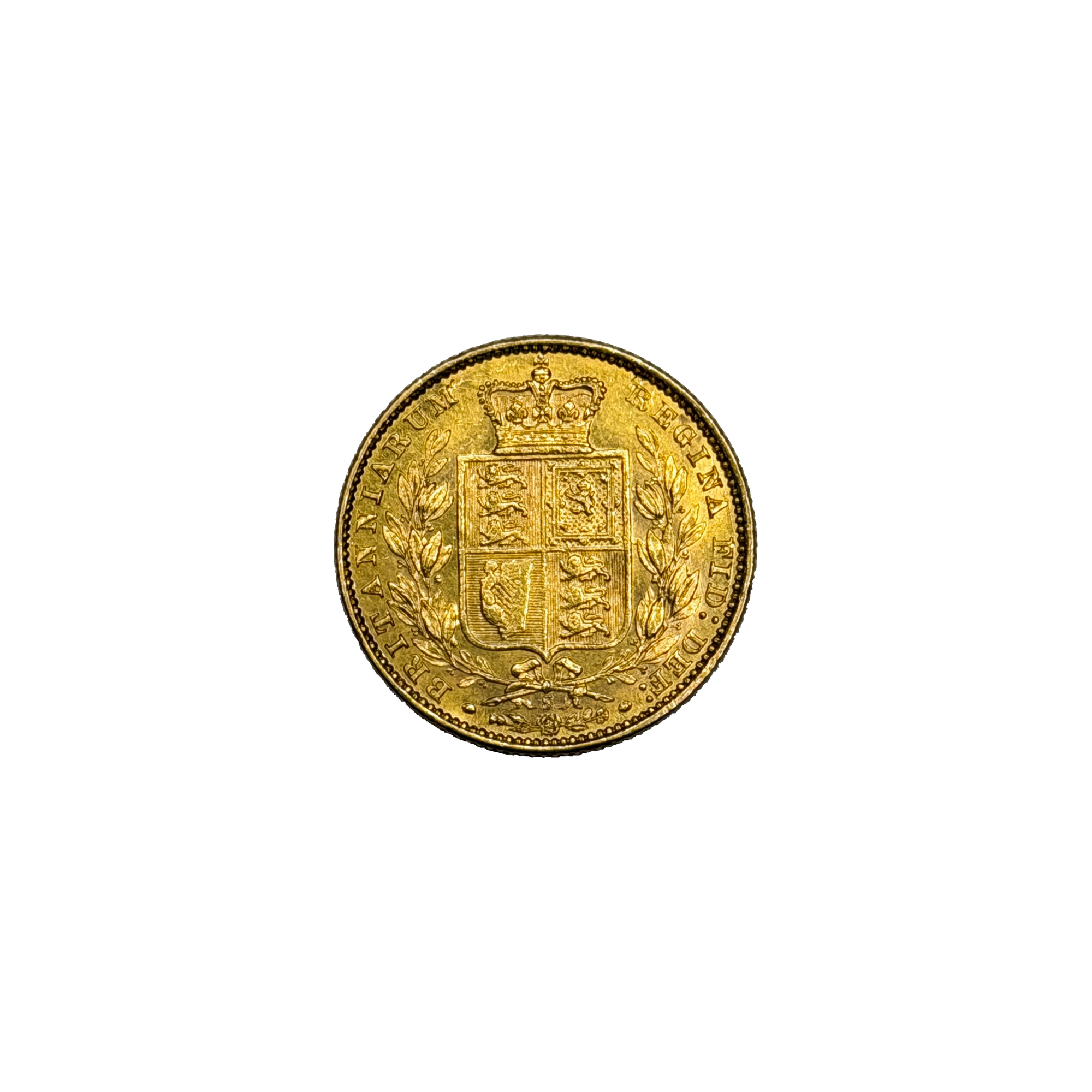
When the Royal Mint struck the first sovereigns of Victoria’s reign in 1838, the young queen had been on the throne for less than a year, the London-to-Birmingham railway had just opened, and the British gold standard that would anchor world finance for the next three-quarters of a century was still being built. The Shield reverse sovereign — William Wyon’s Young Head portrait paired with the crowned Shield of the Royal Arms — is the coin of that founding moment, struck in London from 1838 to 1874 and at the Sydney and Melbourne branch mints through 1887, and it carries the earliest dates of any sovereign in USAGOLD’s catalog.
For investors, that age comes packaged in the most recognized gold coin family in the world. The Shield sovereign is struck to the identical standard as every sovereign since 1817 — 0.2354 troy ounces of 22-karat gold — and trades within the deep international sovereign market, tracking the spot price of gold over time while carrying the historic (pre-1933) designation and the associated insulation against the possibility of future government intervention. Its production era predates the mass sovereign output of the later types, giving it a comparative scarcity profile the George V and Edward VII issues cannot match. At roughly one-quarter of a troy ounce, it also offers divisible negotiability: affording its owner the flexibility to liquidate positions incrementally, in amounts proportionate to the specific needs of the moment and across a variety of circumstances. For investors whose priorities are a highly coveted early type steeped in historical significance, the catalog’s earliest sovereign dates, and the liquidity of the world’s most recognized gold coin family, the Shield sovereign is the deepest historical position the sovereign market makes available—at premiums that remain modest relative to the scarcity difference.
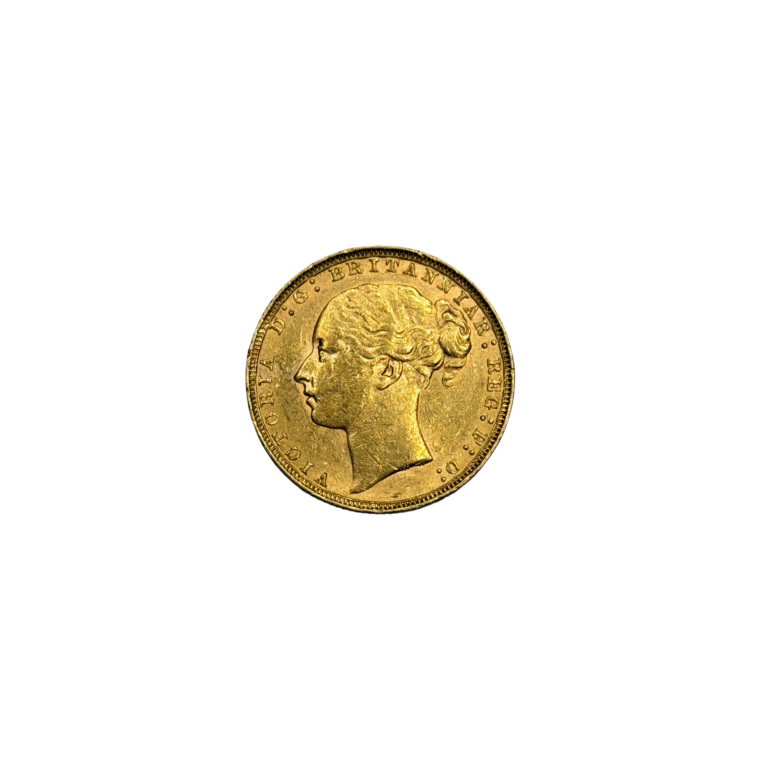
The obverse bears William Wyon’s celebrated Young Head portrait of Victoria — her hair drawn back in a simple bun, her expression composed and direct — the image that defined sovereign portraiture for half a century. The reverse is what sets this coin apart from every other sovereign USAGOLD offers: in place of Benedetto Pistrucci’s St. George and the Dragon stands the crowned Shield of the Royal Arms of the United Kingdom, surrounded by a laurel wreath. It is the only sovereign type in our catalog without the St. George reverse — a heraldic design in the older tradition of British coinage, and the reason collectors and dealers worldwide know the type simply as the “Shield sovereign.”
At 22.05mm in diameter and 7.98 grams total weight, each coin is struck from 22-karat gold (.917 fine) and contains 0.2354 troy ounces of pure gold — legal tender at one pound sterling, and Capital Gains Tax exempt in the United Kingdom. Minted 1838–1887 (London 1838–1874; Sydney 1871–1887; Melbourne 1872–1887). Grade range: AU.
Victoria came to the throne in June 1837 at eighteen years old, and the Shield sovereigns capture her at the very start of the sixty-three-year reign that would define an age — before the title Empress of India, before her children and grandchildren occupied half the thrones of Europe, before the queen became the institution. A fuller portrait of the monarch appears on our Queen Victoria Young Head sovereign page (the St. George reverse type); what matters here is the specificity of the dates. A Shield sovereign dated in the 1840s or 1850s is the money of Victoria’s first decades — the era of the railway boom, the Great Exhibition of 1851, and Britain’s emergence as the dominant economic power of the nineteenth century.
The Shield era belongs mostly to London. Where the George V sovereign was struck at seven mints on five continents, Shield sovereign production ran for its first three decades exclusively at the Royal Mint; London struck its last Shield sovereigns in 1874, while the new Australian branch mints at Sydney (from 1871) and Melbourne (from 1872) continued the type, with a small S or M mint mark below the shield, through 1887. The coin pictured, dated 1878, is one of those Australian branch-mint strikings. These are the sovereigns that financed Britain’s mid-Victorian ascendancy — settling accounts in the City of London when it was becoming the clearinghouse of world trade, moving through an economy that produced the first railways, the first telegraph networks, and the gold standard itself.
That concentration is also the scarcity argument. Sovereign production in the Shield decades ran at a fraction of the rates later types achieved — George V sovereigns were struck at rates exceeding 30 million pieces per year at peak, across seven mints. The Shield type’s accumulated supply is a small fraction of that total, and nearly four decades of additional circulation, melts, and attrition have thinned the survivors further. The scarcity claim is comparative, not absolute: within the sovereign family, the Shield type combines the earliest dates with one of the thinnest surviving supplies, at premiums that remain modest relative to that difference.
The British sovereign is the recognition benchmark of the historic fractional gold market — identified on sight by dealers across North America, Europe, and Asia, with universally documented specifications and bid-ask spreads kept tight by one of the deepest trading pools in gold. The Shield sovereign shares that standing fully: identical weight, fineness, and gold content to every other sovereign, and instantly identifiable as a sovereign even with its distinctive reverse. An investor holding Shield sovereigns holds the oldest dates in the family without giving up any of the family’s liquidity.
In 1933, FDR issued Executive Order 6102, requiring Americans to surrender their gold coin and bullion to the Treasury — but the order and the regulations that followed it exempted gold coins of recognized special value to collectors of rare and unusual coins. Subsequent clarifications by the Treasury identified pre-1933 gold coins — a classification that includes the Shield sovereign, struck between 1838 and 1887 — as falling within that collector classification as historical items.
Under current constitutional law, a government intervention in the gold market would be executed through the power of eminent domain — the government’s right to take private property for public use provided it pays the owner just compensation. Historic coins complicate the government’s ability to broadly establish “just compensation” or “fair value,” which was precisely the reasoning behind the original “recognized special value” exemption in 1933. That complexity, and the precedent surrounding pre-1933 gold coins, creates a notable impediment to the government’s ability to restrict them broadly — particularly compared to modern bullion, which can be valued easily and consistently at a single price. In essence, it is a bureaucratic question of whether the government would undertake the enormous task of valuing the diversity and complexity of the historic-coin genre — every coin, every date, every condition, every personal holding — and that difficulty is what insulates the owner’s legal liquidity rights in the event of capital controls.
Whether a future government intervention in private gold markets is a risk an investor assigns significant weight to is a personal judgment. The factual point is narrower: the pre-1933 status represents a layer of portfolio differentiation that this coin carries at minimal added per-ounce cost over comparable modern bullion, along with a measure of insulation for the legal liquidity rights of its owner.
For a more in-depth study, we invite you to read our comprehensive memorandum on this subject: Preparing for a Potential Gold Confiscation
The Shield sovereign is the beginning of the Victorian sovereign story — the earliest dates in USAGOLD’s sovereign catalog, the only sovereign type we offer without the St. George reverse, and a coin whose London-era production base makes it meaningfully scarcer than the later types it trades alongside. It delivers the sovereign family’s benchmark recognizability and liquidity, quarter-ounce divisible negotiability, and UK Capital Gains Tax exemption in the oldest sovereign dates USAGOLD offers — heirloom positions that surface irregularly and are rarely available in quantity. No other sovereign combines this depth of history and comparative scarcity with the full liquidity of the world’s most recognized gold coin family.
| Year | Mintage |
|---|---|
| 1838 | 2,719,000 |
| 1839 | 504,000 |
| 1841 | 124,000 |
| 1842 | 4,865,000 |
| 1843 | 5,982,000 |
| 1844 | 3,000,000 |
| 1845 | 3,801,000 |
| 1846 | 3,803,000 |
| 1847 | 4,667,000 |
| 1848 | 2,247,000 |
| 1849 | 1,755,000 |
| 1850 | 1,402,000 |
| 1851 | 4,014,000 |
| 1852 | 8,053,000 |
| 1853 | 10,598,000 |
| 1854 | 3,590,000 |
| 1855 | 8,448,000 |
| 1856 | 4,806,000 |
| 1857 | 4,496,000 |
| 1858 | 803,000 |
| 1859 | 1,548,000 |
| 1860 | 2,556,000 |
| 1861 | 7,623,000 |
| 1862 | 7,836,000 |
| 1863 | 5,922,000 |
| 1864 | 8,656,000 |
| 1865 | 1,450,000 |
| 1866 | 4,047,000 |
| 1868 | 1,653,000 |
| 1869 | 6,441,000 |
| 1870 | 2,190,000 |
| 1871 | 8,767,000 |
| 1872 | 13,487,000 |
| 1873 | 2,368,000 |
| 1874 | 521,000 |
| Total | 154,742,000 |
Mintage figures per the Standard Catalog of World Coins, via the NGC World Price Guide. Dates NGC lists without figures are shown with a dash. London Mint figures; Sydney and Melbourne Shield production (1871–1887) is additional. The 1859 ‘Ansell’ variety adds a further 168,000; rows from 1863 onward include the die-number type.
Learn More:
British Gold Sovereign Buyer’s Guide: Complete Investment Analysis
AU
1838-1887
.2354 troy ounce
Britain
Prices shown under Wire include a 4% cash discount. Card prices are the full list price. ACH bank transfer is available to established clients only. First-time orders can be paid by wire transfer or card.
Call our team for availability. Monday to Friday, 8 AM to 6 PM Mountain Time.
Want to be notified when this product is back in stock?
Interested in gold but struggling to find the right firm?

AU
1893-1901
.2354 troy ounce
Britain
AU, UNC, BU
1902-1910
.2354 troy ounce
Britain
AU
1887-1893
.2354 troy ounce
Britain
XF, AU
1871-1885
.2354 troy ounce
Britain


