

You must have an order with a minimum of $1,000.00 to place your order, your current order total is $0.00.
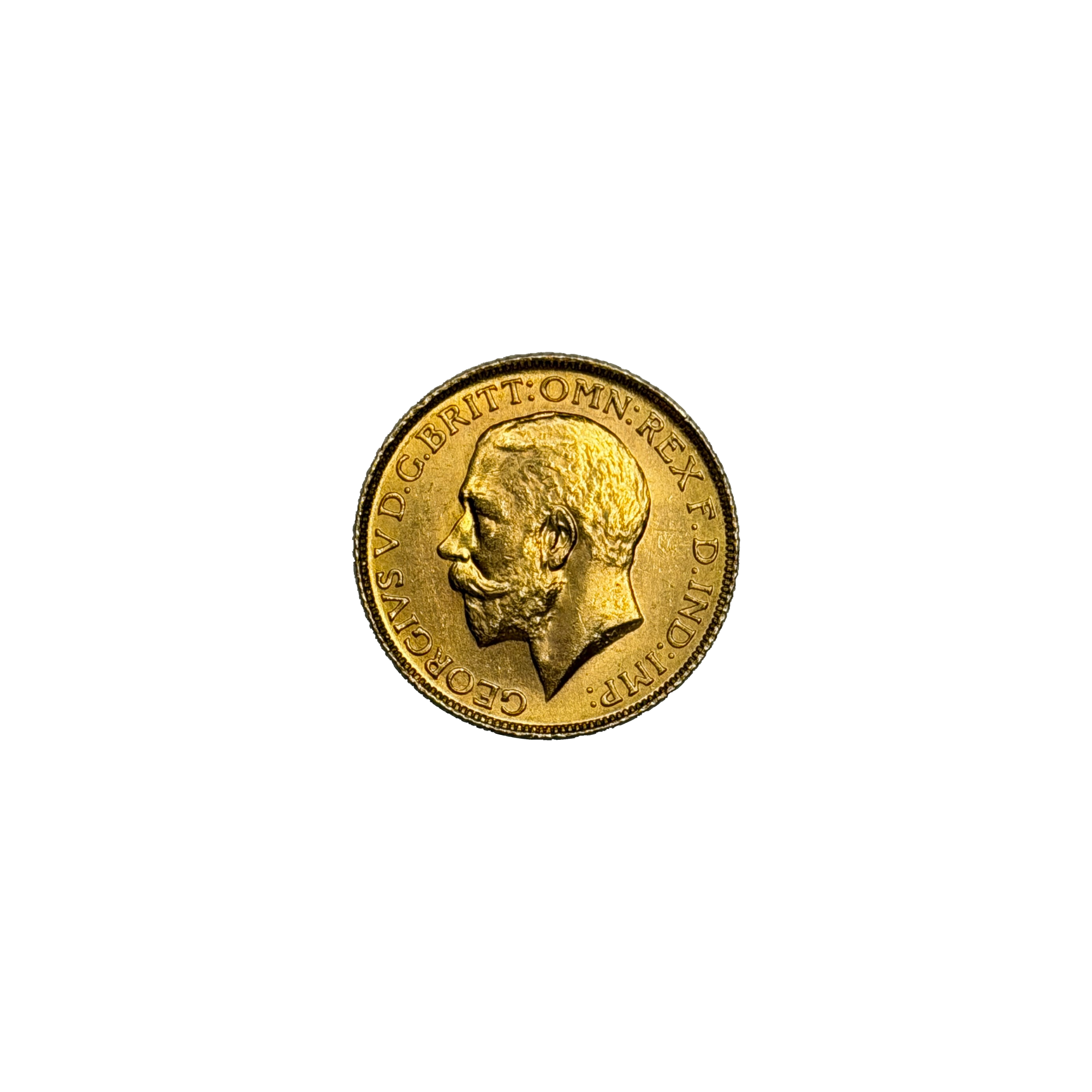
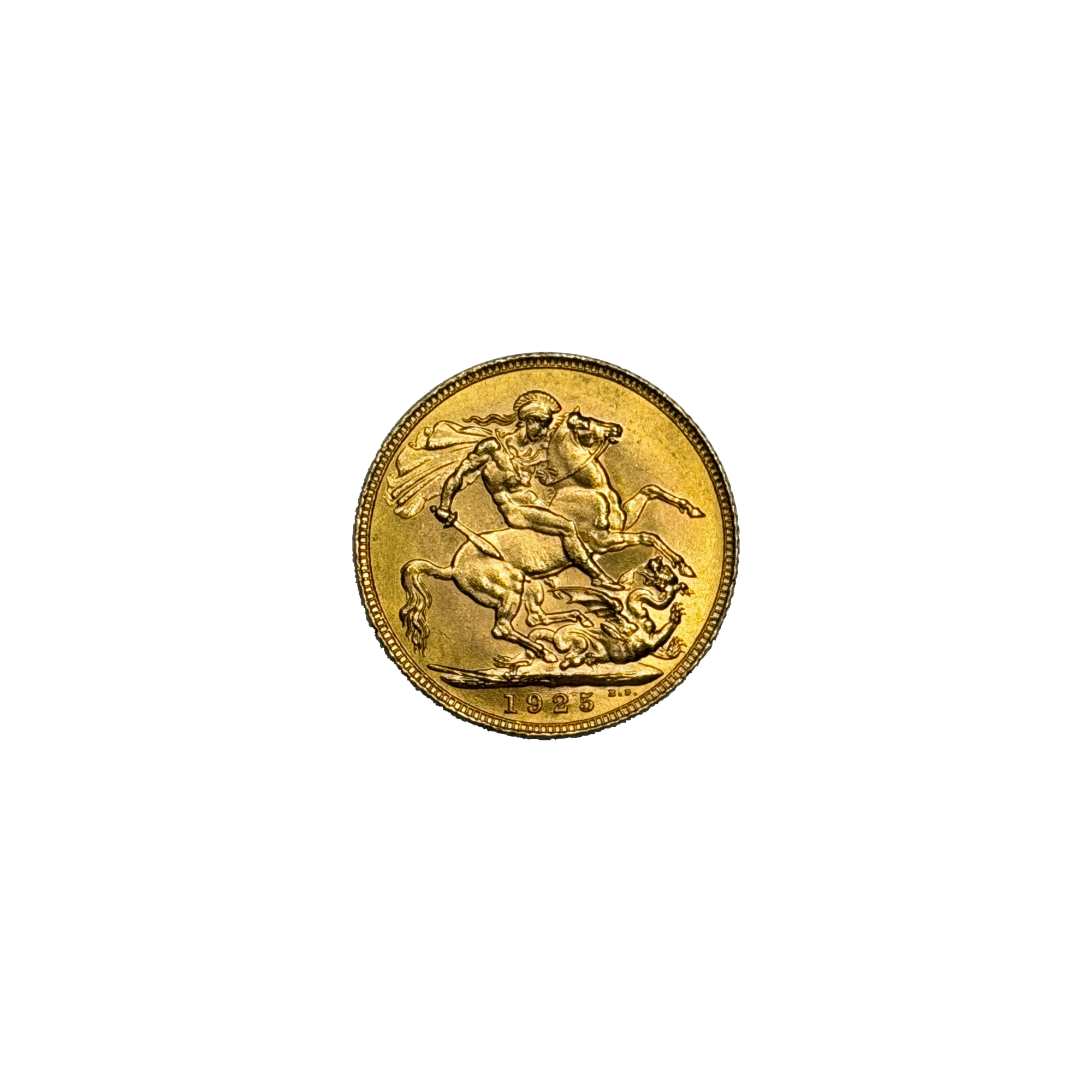
No gold coin in history was minted at as many locations for regular circulation as the British sovereign of the George V era. Between 1911 and 1932, the sovereign bearing Sir Edgar Bertram Mackennal’s portrait of King George V was struck not only at the Royal Mint in London but at branch mints in Melbourne, Sydney, and Perth in Australia, Ottawa in Canada, Pretoria in South Africa, and Bombay in India — seven mint facilities on five continents, producing a coin that was legal tender throughout an empire covering roughly a quarter of the world’s land surface.
That geographic scope produced a gold coin with genuine international recognition that predates the era of global financial markets — used to settle accounts in Singapore and Lagos and Calcutta and Toronto, recognized on sight by merchants and bankers from Cape Town to Hong Kong. It retains that standing today. George V sovereigns trade at per ounce acquisition costs comparable to modern bullion coins and track directly with the spot price of gold over time, while carrying the historic (pre-1933) designation and the associated insulation against the possibility of future government intervention. At roughly one-quarter of a troy ounce, the sovereign also provides practical flexibility: affording its owner the flexibility to liquidate positions incrementally, in amounts proportionate to the specific needs of the moment and across a variety of circumstances. For investors whose priorities are on-sight recognizability, deep two-way liquidity, and divisible negotiability—all for near-bullion pricing—the George V sovereign is the most readily available member of the world’s most recognized gold coin family, and the natural workhorse of a fractional gold holding.
The obverse bears Mackennal’s portrait of George V — his head bare, his beard close-cropped, his expression carrying a quiet authority that suited a king who had served in the Royal Navy and preferred understatement to display. The reverse retains Benedetto Pistrucci’s St. George and the Dragon, the design that has appeared on British sovereigns with only minor modifications since 1817 — older than the reign of Queen Victoria and among the longest-running images in the history of gold coinage.
At 22.05mm in diameter and 7.98 grams total weight, each coin is struck from 22-carat gold (.917 fine) and contains 0.2354 troy ounces of pure gold — legal tender at one pound sterling and Capital Gains Tax exempt in the United Kingdom. Grade range: AU/BU/UNC. Minted 1911–1932. George V sovereigns in circulated condition trade at modest premiums over gold content. Uncirculated examples from less common mint marks — Bombay 1918, early Ottawa, Pretoria — carry additional premiums for their relative scarcity within the type.
George V came to the throne in 1910, succeeding his father Edward VII. His background was naval — he had served as an officer in the Royal Navy before his elder brother’s death made him heir apparent — and he brought to the monarchy a preference for duty over ceremony. He was the first British monarch to broadcast to his subjects by radio, the first to visit the Western Front during a world war, and the monarch who, in 1917, renounced the German family name Saxe-Coburg-Gotha in favor of Windsor.
The sovereigns minted during his reign cover the period from pre-war imperial confidence through the First World War, the Versailles settlement, the General Strike of 1926, and the beginnings of the Great Depression. George V was a steady constitutional figure across two decades of extraordinary disruption, and the coins bearing his portrait span the years in which the British Empire reached its maximum territorial extent and began, quietly, to recede.
The geographic scope of George V sovereign production is the defining feature of the type. The London Mint’s issues are the baseline. The Australian mints at Melbourne, Sydney, and Perth descended from the gold-rush economies that had driven branch mint expansion since the 1850s. The Ottawa Mint served Canadian markets. The Pretoria Mint, opened in 1923, served the gold-producing economy of South Africa. The Bombay issue of 1918 was struck specifically for Indian markets, where gold coin demand was structurally different from European demand — a practical recognition that the empire required different monetary instruments for different populations. No other gold coin was produced this way, at this scale, across this much of the world.
Alongside the Swiss 20 Franc Helvetia, the George V sovereign is the benchmark against which fractional historical gold liquidity is measured. Dealers across North America, Europe, and Asia recognize it immediately, its specifications are universally documented, and its trading history is deep enough that bid-ask spreads remain tight across all international markets. For investors who need to convert a gold holding to cash on short notice, the sovereign performs that function as reliably, and across more geographies, than any other fractional gold coin available at near-bullion pricing.
The most compelling endorsement of that liquidity comes from the historical record. During the Second World War, the United States military issued sealed escape-and-evasion “barter kits” to American pilots and paratroopers flying over hostile territory — serial-numbered pouches containing British sovereigns and half sovereigns alongside French gold francs, intended to buy passage, food, or cooperation where paper currency would be refused. The British Special Operations Executive and Royal Air Force equipped their own aircrew the same way. The practice did not end in 1945: during the 1991 Gulf War, American aircrew survival kits again carried gold sovereigns alongside the blood chit, and the British Ministry of Defence purchased 60,000 sovereigns from the Bank of England, issuing them to SAS units and RAF Tornado crews operating behind Iraqi lines.
The detail worth pausing on: the American military had its own historic gold coinage available, and chose the British sovereign — the coin most likely to be recognized, valued, and accepted by anyone, anywhere on earth. That is not a marketing claim about liquidity. It is the documented judgment of two governments, across two wars fifty years apart, selecting the sovereign as the one form of money that works when nothing else does.
The mint mark variety dimension adds choice without reducing baseline liquidity. Common London issues trade at the tightest spreads and lowest premiums. Australian mint marks (M, S, P) carry modest premiums, the Bombay I and early Ottawa issues higher still — premiums that scale predictably with scarcity, within the most liquid fractional gold type in the market.
One characteristic of the historic-coin market deserves passing mention here. The sovereign trades at essentially bullion pricing, but its supply — unlike bullion’s — is permanently fixed, and in flight-to-safety episodes that limitation shows. In 2008, premiums rose modestly across the entire European historic-coin genre as available supplies were taxed, common issues and rare ones alike; during the European banking crisis of the early 2010s, savers in countries like Greece moved into sovereigns to get their wealth out of the banking system, and sovereign premiums rose again. Modern bullion, its supply replenished by the mints on demand, experiences none of this — and when two instruments cost the same per ounce, that behavior is simply another advantage of the historic coin.
In 1933, FDR issued Executive Order 6102, requiring Americans to surrender their gold coin and bullion to the Treasury — but the order and the regulations that followed it exempted gold coins of recognized special value to collectors of rare and unusual coins. Subsequent clarifications by the Treasury identified pre-1933 gold coins — a classification that includes the George V sovereign, struck between 1911 and 1932 — as falling within that collector classification as historical items.
Under current constitutional law, a government intervention in the gold market would be executed through the power of eminent domain — the government’s right to take private property for public use provided it pays the owner just compensation. Historic coins complicate the government’s ability to broadly establish “just compensation” or “fair value,” which was precisely the reasoning behind the original “recognized special value” exemption in 1933. That complexity, and the precedent surrounding pre-1933 gold coins, creates a notable impediment to the government’s ability to restrict them broadly — particularly compared to modern bullion, which can be valued easily and consistently at a single price. In essence, it is a bureaucratic question of whether the government would undertake the enormous task of valuing the diversity and complexity of the historic-coin genre — every coin, every date, every condition, every personal holding — and that difficulty is what insulates the owner’s legal liquidity rights in the event of capital controls.
Whether a future government intervention in private gold markets is a risk an investor assigns significant weight to is a personal judgment. The factual point is narrower: the pre-1933 status represents a layer of portfolio differentiation that this coin carries at minimal added per-ounce cost over comparable modern bullion, along with a measure of insulation for the legal liquidity rights of its owner.
For a more in-depth study, we invite you to read our comprehensive memorandum on this subject: Preparing for a Potential Gold Confiscation
The British gold sovereign under George V is simultaneously one of the most historically significant and one of the most practically liquid gold instruments available to investors today. It circled the empire as working money, was sewn into the survival kits of American and British airmen across two wars, and is still recognized on sight by dealers in every city where gold trades. Priced at near-bullion acquisition costs, with Capital Gains Tax exemption in the United Kingdom, it pairs the safety and liquidity that define a safe-haven gold position with the flexibility of fractional size. No other gold coin can boast this unique combination of so many notable advantages for gold investors.
| Year | Mintage |
|---|---|
| 1911 | 30,044,000 |
| 1912 | 30,318,000 |
| 1913 | 24,540,000 |
| 1914 | 11,501,000 |
| 1915 | 20,295,000 |
| 1916 | 1,554,000 |
| 1917 | 1,014,999 |
| 1925 | 4,406,000 |
| Total | 123,672,999 |
Mintage figures per the Standard Catalog of World Coins, via the NGC World Price Guide. Dates NGC lists without figures are shown with a dash. London Mint figures; branch-mint production additional. Production of 1918–1924 was at the branch mints.
Learn More:
British Gold Sovereign Buyer’s Guide: Complete Investment Analysis
AU, UNC, BU
1911-1932
.2354 troy ounce
Britain
| Quantity | Wire | Card |
|---|---|---|
| 1–21 | $1,100.40 | $1,146.25 |
| 22–43 | $1,089.40 | $1,134.79 |
| 44+ | $1,078.39 | $1,123.33 |
Quantity tiers reflect the historic & fractional gold order discount (1% at $25,000+ · 2% at $50,000+ in qualifying coins). Any mix of qualifying historic coins counts toward the same order total.
Prices shown under Wire include a 4% cash discount. Card prices are the full list price. ACH bank transfer is available to established clients only. First-time orders can be paid by wire transfer or card.
Interested in gold but struggling to find the right firm?

AU
1887-1893
.2354 troy ounce
Britain
AU
1838-1887
.2354 troy ounce
Britain
XF, AU
1871-1885
.2354 troy ounce
Britain
AU, UNC
1911-1915
.1177 troy ounce
Britain
AU
1893-1901
.2354 troy ounce
Britain


