

You must have an order with a minimum of $1,000.00 to place your order, your current order total is $0.00.
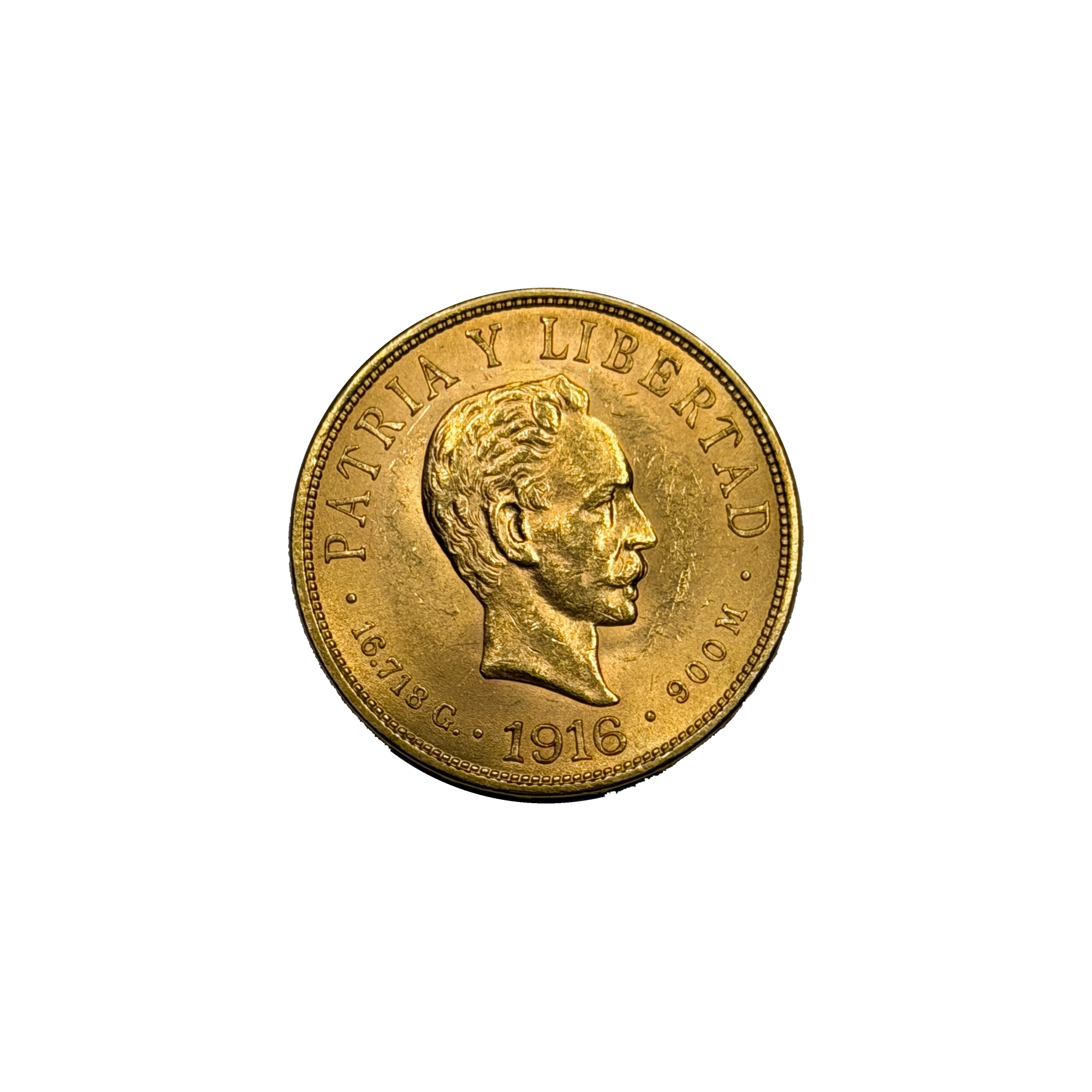
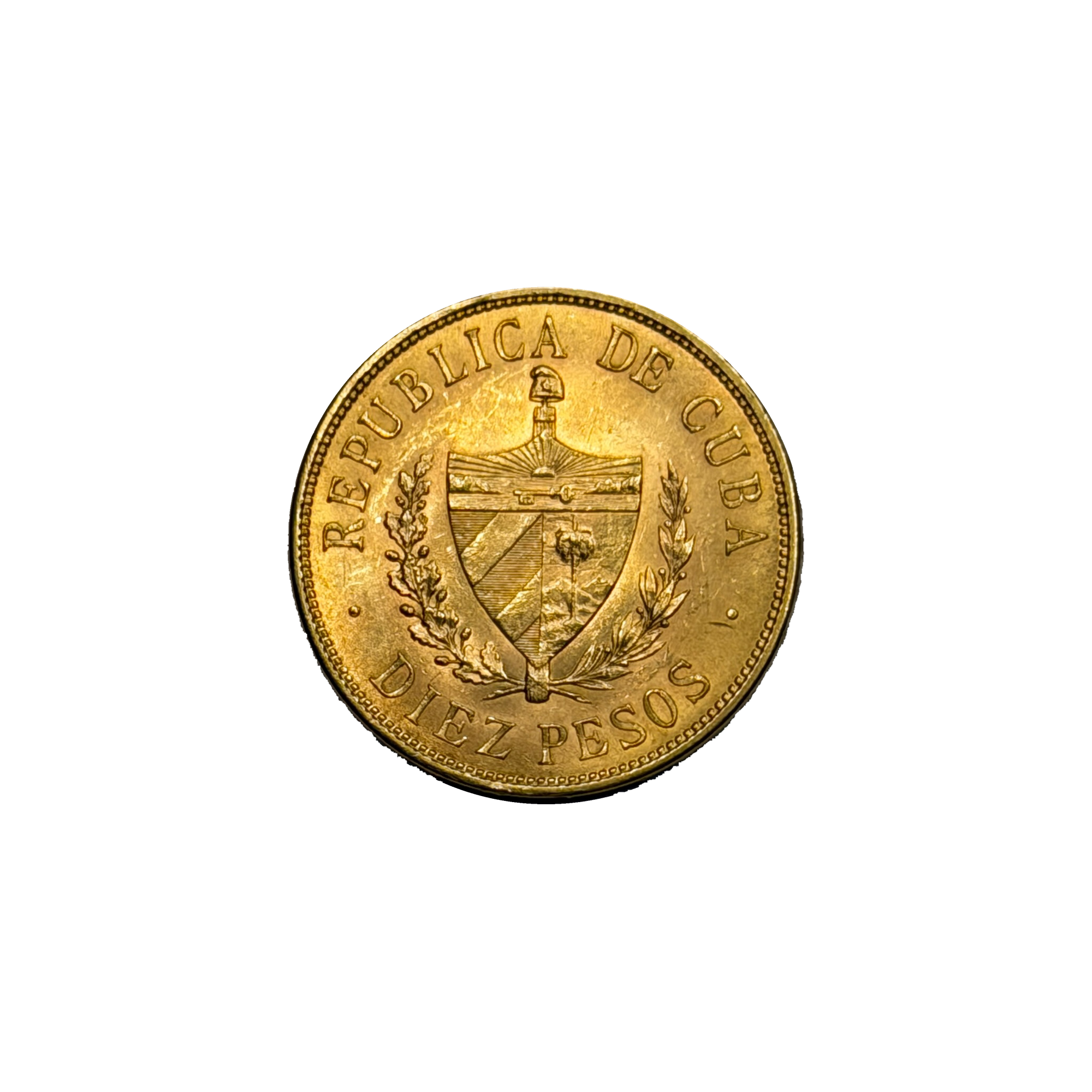
Cuba coined gold exactly once. In 1915 and 1916, the young republic — independent barely a decade — commissioned a national gold coinage from the United States Mint at Philadelphia, placing on it the portrait of José Martí, the poet and essayist who gave his life for Cuban independence. Two years later, the program ended, never to resume. The 10 Pesos that resulted is that rarest of things in the historic gold market: a complete national gold coinage contained in a two-year window, struck to full U.S. Mint standards.
The investor case follows directly. Struck to the same weight standard as the U.S. $10 gold piece — 16.72 grams of .900 fine gold, 0.4838 troy ounces of pure gold — the Cuban 10 Pesos delivers the American eagle’s size class with a total mintage of about 1.26 million coins, less than a tenth that of the $10 Indian alone, at per ounce acquisition costs comparable to modern bullion. It trades on its gold content, tracks the spot price over time, and carries the historic (pre-1933) designation and the associated insulation against the possibility of future government intervention — with every coin in the series, by definition, a pre-1933 date. For investors whose priorities are a highly coveted two-year national coinage, comparative scarcity against far more plentiful American counterparts, and a standardized and widely recognized gold content in a mid-sized coin—all for near-bullion pricing—the Cuban 10 Pesos is one of the most distinctive values in the historic gold market.
The obverse bears the head of José Martí facing right, encircled by the republic’s motto PATRIA Y LIBERTAD — Homeland and Liberty — with the date below and, stamped directly into the coin’s face, its own specifications: 16.718 G. and 900 M., the weight and millesimal fineness. The reverse carries the arms of the Republic of Cuba — the shield with its key between two headlands at sunrise (Cuba as the “key to the Gulf”), the royal palm, and the single star — within a wreath, under the legend REPUBLICA DE CUBA above the denomination DIEZ PESOS. The design work was executed at the Philadelphia Mint, and the coins match U.S. gold coinage standards of the era.
Each coin weighs 16.72 grams in .900 fine gold and contains 0.4838 troy ounces of pure gold, at a diameter of approximately 27mm. Grade range: UNC. Struck 1915–1916 only, at the Philadelphia Mint.
José Martí is to Cuba what Hidalgo is to Mexico and Washington is to the United States — the founding figure of the nation’s independence, and something more besides: one of the great literary voices of the Spanish language. Poet, journalist, and organizer of the independence movement from exile in New York, Martí returned to Cuba in 1895 to join the war he had spent a lifetime preparing and was killed in battle at Dos Ríos within weeks. He never saw the republic founded in 1902.
When that republic created its first and only gold coinage in 1915, the choice of portrait was self-evident. The choice of mint was equally telling: Cuba’s monetary law placed the peso on par with the U.S. dollar, and the coins were struck at Philadelphia to the exact standards of American gold coinage — which is why the 10 Pesos corresponds precisely to the U.S. $10 gold piece. The program lasted two years. By 1917, wartime economics had ended Cuban gold coinage permanently, sealing the series at two dates and giving the coin its defining scarcity.
The comparison that frames the Cuban 10 Pesos is the American coin it was built to match. Total production of the 10 Pesos across its entire two-year existence was 1,263,530 coins. The $10 Indian — its exact contemporary and dimensional twin — was struck to the tune of 13.9 million pieces; include the $10 Liberty and total U.S. $10 gold piece production exceeds 56 million coins, more than forty times the Cuban issue. Two individual dates of the $10 Indian (1910-D and 1932) exceed the entire Cuban series by themselves. Yet the Cuban coin trades at per ounce acquisition costs comparable to modern bullion — a fraction of the premium routinely commanded by its far more plentiful American counterpart. That gap between comparative scarcity and price is the value: the client acquires a supply one-fortieth the size at a fraction of the premium — the comparative scarcity, in effect, comes at no added cost.
The Cuban 10 Pesos carries its own credentials on its face — 16.718 G. 900 M. — a self-documenting statement of weight and fineness legible to any dealer in any market, the same practical liquidity feature that distinguishes the Mexican gold family. Its U.S. Mint striking and dollar-standard specifications make it immediately intelligible to the North American trade: it is, dimensionally, a coin every American gold dealer already knows. Recognized throughout North America and Europe and priced readily against its documented gold content, it converts to cash efficiently wherever gold trades.
In 1933, FDR issued Executive Order 6102, requiring Americans to surrender their gold coin and bullion to the Treasury — but the order and the regulations that followed it exempted gold coins of recognized special value to collectors of rare and unusual coins. Subsequent clarifications by the Treasury identified pre-1933 gold coins — a classification that includes the Cuban 10 Pesos, struck in 1915 and 1916 — as falling within that collector classification as historical items. The Cuban series carries a tidy distinction here: because the coinage ended in 1916, every date in existence is a pre-1933 date.
Under current constitutional law, a government intervention in the gold market would be executed through the power of eminent domain — the government’s right to take private property for public use provided it pays the owner just compensation. Historic coins complicate the government’s ability to broadly establish “just compensation” or “fair value,” which was precisely the reasoning behind the original “recognized special value” exemption in 1933. That complexity, and the precedent surrounding pre-1933 gold coins, creates a notable impediment to the government’s ability to restrict them broadly — particularly compared to modern bullion, which can be valued easily and consistently at a single price. In essence, it is a bureaucratic question of whether the government would undertake the enormous task of valuing the diversity and complexity of the historic-coin genre — every coin, every date, every condition, every personal holding — and that difficulty is what insulates the owner’s legal liquidity rights in the event of capital controls.
Whether a future government intervention in private gold markets is a risk an investor assigns significant weight to is a personal judgment. The factual point is narrower: the pre-1933 status represents a layer of portfolio differentiation that this coin carries at minimal added per-ounce cost over comparable modern bullion, along with a measure of insulation for the legal liquidity rights of its owner.
For a more in-depth study, we invite you to read our comprehensive memorandum on this subject: Preparing for a Potential Gold Confiscation
The Cuban 10 Pesos compresses everything investors seek in historic gold into a two-year window: the size and standards of the U.S. $10 gold piece with less than a tenth of the $10 Indian’s mintage, a complete national gold coinage struck at the Philadelphia Mint, the portrait of one of the hemisphere’s great independence heroes, and its weight and fineness stamped on its face — all at per ounce acquisition costs comparable to modern bullion. A coinage this brief is steeped in historical significance and rarely available in quantity; it surfaces irregularly and in small lots. No other gold coin of the Americas combines this degree of comparative scarcity with this little premium, and few coins anywhere carry a more complete set of advantages for gold investors.
| Year | Mintage |
|---|---|
| 1915 | 95,020 |
| 1916 | 1,168,510 |
| Total mintage | 1,263,530 |
UNC
1915-1916
Cuba
Prices shown under Wire include a 4% cash discount. Card prices are the full list price. ACH bank transfer is available to established clients only. First-time orders can be paid by wire transfer or card.
Call our team for availability. Monday to Friday, 8 AM to 6 PM Mountain Time.
Want to be notified when this product is back in stock?
Interested in gold but struggling to find the right firm?


