

You must have an order with a minimum of $1,000.00 to place your order, your current order total is $0.00.
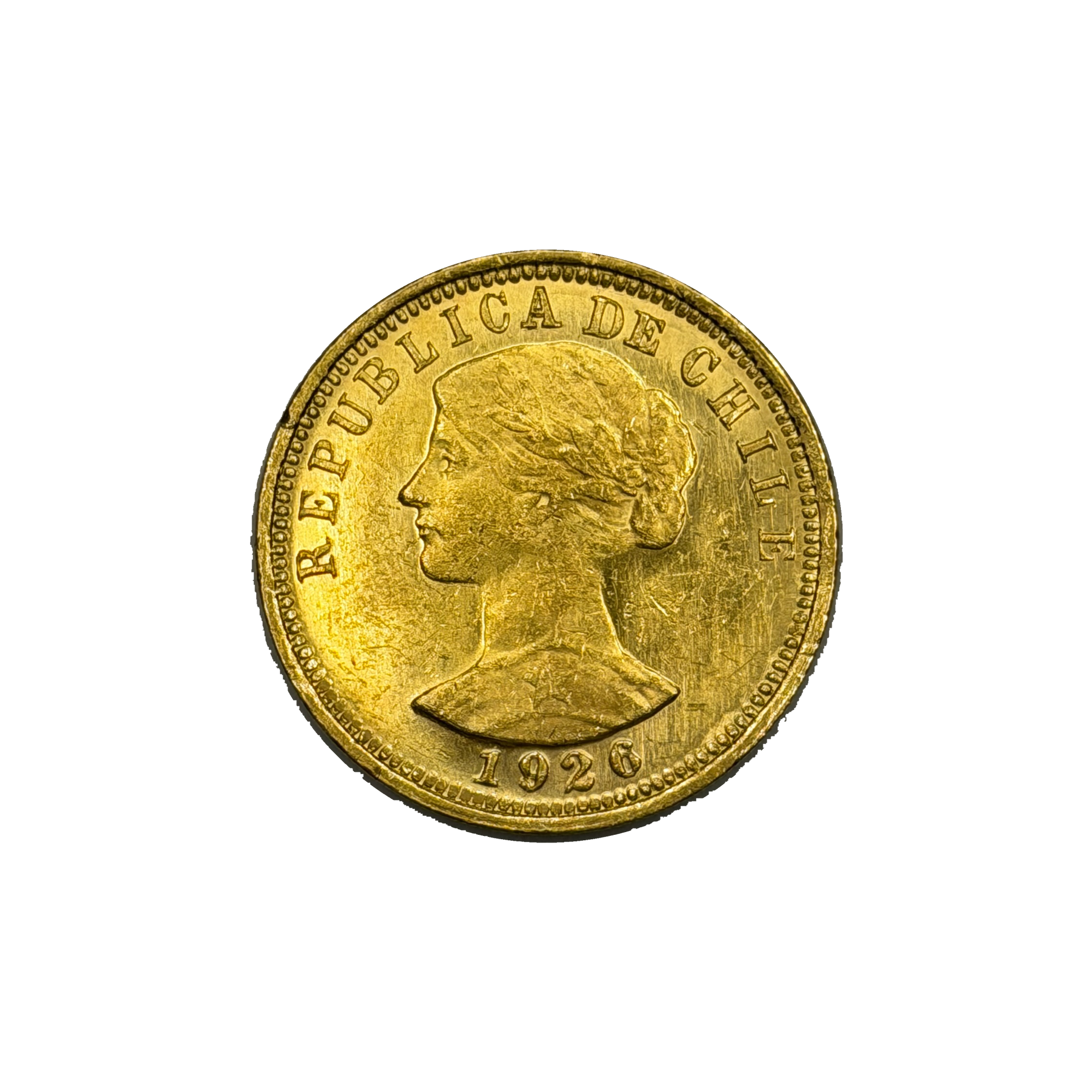
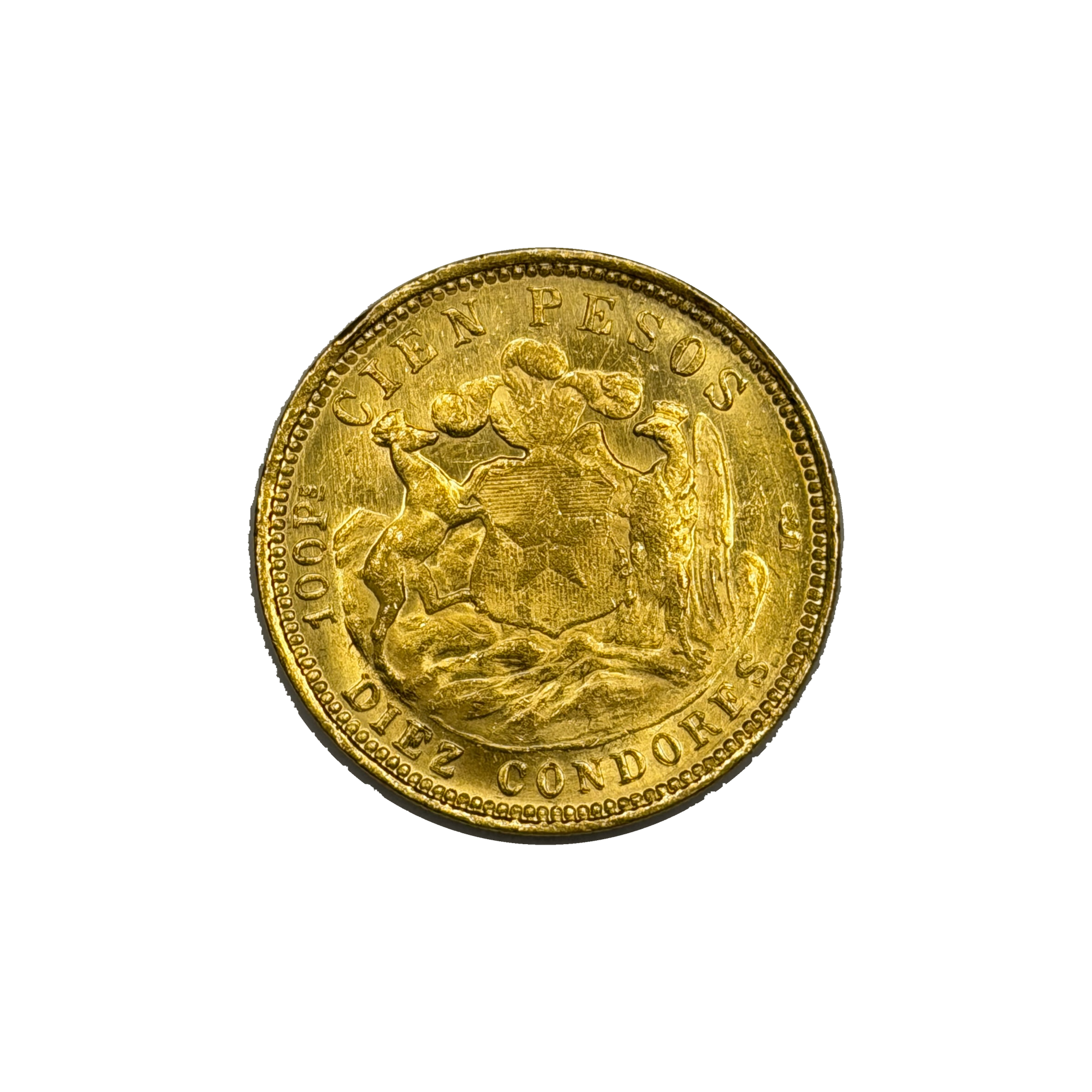
In 1926, the Republic of Chile — then among the world’s great mining economies — introduced the largest gold coin in its history: the 100 Pesos, denominated on its own face a second way as DIEZ CONDORES, ten cóndores, after the Andean bird on its reverse. At roughly 0.59 troy ounces of pure gold, it stands above the familiar half-ounce class of the historic era — a substantial coin from a nation whose identity has always been tied to what it draws from the earth.
For investors, the 100 Pesos is classified instructively as “historical bullion.” It trades at per ounce acquisition costs comparable to modern bullion and tracks directly with the spot price of gold over time, while its pre-1933 dates (1926–1932) carry the historic designation and the associated insulation against the possibility of future government intervention. Larger historic coins accumulate gold efficiently — fewer coins, more metal — and the Chilean piece does so at a fraction of the per-coin outlay of a full-ounce instrument. For investors whose priorities are efficient accumulation in a substantial coin, a standardized and widely recognized gold content, and a measure of distinction most portfolios have never encountered—all for near-bullion pricing—the Chile 100 Pesos is one of the historic gold market’s genuinely underappreciated instruments.
The obverse presents an allegorical figure of Liberty — a young woman in profile facing left, her hair braided and coiled in the classical manner, a small star at her breast — encircled by REPUBLICA DE CHILE with the date below. The reverse carries the national arms of Chile: the plumed shield supported by its two national animals, the huemul (the Andean deer) on the left and the condor on the right, set against a rocky Andean landscape, with CIEN PESOS above, the value 100 Ps. and the Santiago Mint’s S flanking, and DIEZ CONDORES below — the coin stating its value in both of Chile’s gold units.
Each coin contains 0.5886 troy ounces of pure gold — approximately 20.34 grams total weight in .900 fine gold. Grade range: AU/UNC. Minted 1926 and 1932. The Liberty type was struck at the Santiago Mint beginning in 1926, with the series continuing intermittently for decades; pre-1933 issues carry dates 1926–1932.
Chile’s monetary tradition is inseparable from its geology. The nation that holds the world’s greatest copper deposits and the nitrate fields that once financed its treasury also coined its own gold from the early days of the republic, and the cóndor — the great bird of the Andes — served as the name of its principal gold unit, the way the eagle served the United States. The 100 Pesos of 1926 was the culmination of that tradition: ten cóndores in a single coin, introduced as Chile, like much of the world in the 1920s, worked to anchor its currency to gold after the disruptions of the First World War.
The Liberty head obverse places the coin in the same classical family as the great gold coinages of the era — a republic personified rather than a monarch portrayed — and gives the type its market name. Chileans themselves commonly know the coin simply as the “cien pesos” or the “diez cóndores.”
The Chile 100 Pesos is the benchmark historic gold coin of South America — the piece by which the continent’s gold coinage is known in the North American and European trade. Its specifications are universally documented, the Liberty/condor design is unmistakable, and the coin appears regularly enough in the international market that dealers price it readily against gold content. For investors, it offers the liquidity profile of a recognized world gold coin in a size class — above a half ounce — that few historic instruments occupy, converting to cash efficiently wherever gold trades.
In 1933, FDR issued Executive Order 6102, requiring Americans to surrender their gold coin and bullion to the Treasury — but the order and the regulations that followed it exempted gold coins of recognized special value to collectors of rare and unusual coins. Subsequent clarifications by the Treasury identified pre-1933 gold coins — a classification that includes the early-date Chile 100 Pesos, struck between 1926 and 1932 — as falling within that collector classification as historical items.
An important note on dates: the 100 Pesos Liberty series did not end in 1932 — striking continued intermittently for decades afterward, and those later dates fall outside the pre-1933 classification entirely. The date on the coin is what carries the designation — and the coins USAGOLD offers are dated 1926 and 1932, entirely within the pre-1933 era.
Under current constitutional law, a government intervention in the gold market would be executed through the power of eminent domain — the government’s right to take private property for public use provided it pays the owner just compensation. Historic coins complicate the government’s ability to broadly establish “just compensation” or “fair value,” which was precisely the reasoning behind the original “recognized special value” exemption in 1933. That complexity, and the precedent surrounding pre-1933 gold coins, creates a notable impediment to the government’s ability to restrict them broadly — particularly compared to modern bullion, which can be valued easily and consistently at a single price. In essence, it is a bureaucratic question of whether the government would undertake the enormous task of valuing the diversity and complexity of the historic-coin genre — every coin, every date, every condition, every personal holding — and that difficulty is what insulates the owner’s legal liquidity rights in the event of capital controls.
Whether a future government intervention in private gold markets is a risk an investor assigns significant weight to is a personal judgment. The factual point is narrower: the pre-1933 status represents a layer of portfolio differentiation that this coin carries at minimal added per-ounce cost over comparable modern bullion, along with a measure of insulation for the legal liquidity rights of its owner.
For a more in-depth study, we invite you to read our comprehensive memorandum on this subject: Preparing for a Potential Gold Confiscation
The Chile 100 Pesos occupies a place few coins can: nearly six-tenths of an ounce of gold in a single historic coin, a standardized and widely recognized gold content, per ounce acquisition costs comparable to modern bullion, and — in the two dates USAGOLD offers, 1926 and 1932 — an availability that is irregular and rarely large. It is the rare instrument that adds both efficiency and genuine distinction to a gold holding at bullion-class cost. Among South American gold coins, none offers investors this combination of size, standardized content, and historic character.
| Year | Mintage |
|---|---|
| 1926 | 678,000 |
| 1932 | 9,315 |
| Total | 687,315 |
Mintage figures per the Standard Catalog of World Coins, via the NGC World Price Guide. Dates NGC lists without figures are shown with a dash. Santiago Mint. The 1932 striking of 9,315 pieces is the scarce date of the pre-1933 pair.
AU, UNC
1926, 1932
.5886 troy ounce
Chile
Prices shown under Wire include a 4% cash discount. Card prices are the full list price. ACH bank transfer is available to established clients only. First-time orders can be paid by wire transfer or card.
Call our team for availability. Monday to Friday, 8 AM to 6 PM Mountain Time.
Want to be notified when this product is back in stock?
Interested in gold but struggling to find the right firm?


