

You must have an order with a minimum of $1,000.00 to place your order, your current order total is $0.00.
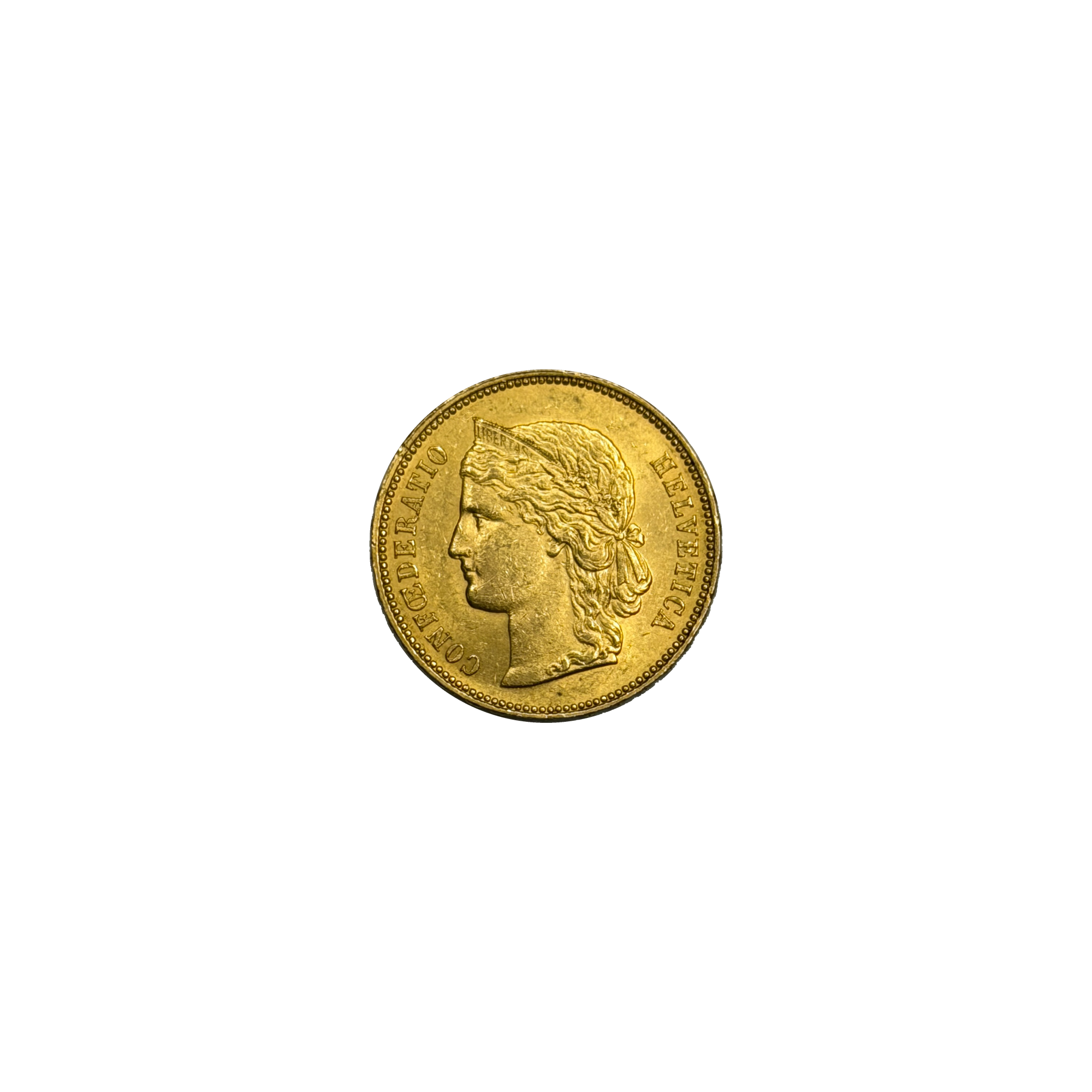

Before the Helvetia, there was Libertas. From 1883 to 1896, the Swiss Federal Mint in Bern struck its first regular-issue gold 20 franc—a young female head of Liberty wearing a diadem inscribed LIBERTAS, surrounded by the legend CONFOEDERATIO HELVETICA. In 1897 the design gave way to Fritz Landry’s Helvetia portrait, which then ran for fifty-two years and 58.6 million coins, becoming the benchmark for liquid fractional European gold. The Confederatio type is the coin the Helvetia replaced: identical in weight, fineness, and gold content, struck to the same Latin Monetary Union standard at the same mint—but produced for only fourteen years, in a total quantity amounting to a small fraction of its successor’s mintage.
That relationship defines the investment case. The Confederatio trades within the recognition and liquidity of the Swiss 20 franc family—the most standardized fractional gold instrument in Europe—while carrying a supply profile dramatically tighter than the coin that made the family famous. Classified instructively as “historical bullion,” it trades at per ounce acquisition costs comparable to modern fractional bullion and tracks the spot gold price over time—and it shares the genre-wide behavior that same-priced bullion never shows: during high-demand “flight-to-safety” episodes such as the 2008–09 financial crisis, the limited supplies of historic European gold have produced modest premium rises across the genre as a whole, common and scarce issues alike. And unlike the Helvetia series—whose 1945–1947 issues require careful date specification—every Confederatio coin is pre-1933 by definition: the series ended thirty-seven years before the date ever mattered. At roughly one-fifth of a troy ounce, it also offers divisible negotiability: affording its owner the flexibility to liquidate positions incrementally, in amounts proportionate to the specific needs of the moment and across a variety of circumstances. For investors whose priorities are comparative scarcity within Switzerland’s benchmark type, a high state of preservation in Brilliant Uncirculated to Uncirculated condition, divisible negotiability, and a standardized and widely recognized gold content, the Swiss 20 Franc Confederatio is one of the most quietly compelling coins in the fractional gold market today.
The obverse presents the head of Libertas facing left—a young woman with her hair gathered in a loose chignon, curls falling at the neck, wearing a diadem inscribed LIBERTAS—surrounded by the legend CONFOEDERATIO HELVETICA. The reverse carries the Swiss federal shield with its bold cross, set within a wreath of oak and laurel tied at the base, with a star above, the denomination 20 FR divided at either side of the shield, and the date below. The Bern mint mark “B” appears beneath the wreath.
At 21mm in diameter and 6.45 grams total weight, each coin is struck in .900 fine gold and contains 0.1867 troy ounces of pure gold—the same Latin Monetary Union standard as the Helvetia, the French 20 Franc, and the Italian 20 Lira, and interchangeable with all of them at the gold-content level. Grade range: BU/UNC. Minted 1883–1896.
Switzerland joined the Latin Monetary Union in 1865, but for its first decades of federal coinage the country struck little gold of its own—French and other LMU gold circulated freely across its borders. The Confederatio 20 franc of 1883 marked the Swiss Confederation’s commitment to producing its own gold coinage at the Bern mint, and it carried the full weight of the Swiss monetary tradition from the start: a neutral country, unbanked by war since 1815, whose franc would go on to survive every monetary catastrophe the twentieth century produced. The Libertas design lasted fourteen years before the Federal Council commissioned a more distinctly national image—the Helvetia with the Alps at her back—to replace the generic head of Liberty. Production of the old type stopped in 1896, fixing its supply permanently at a level the successor coin would eventually exceed many times over.
Comparative scarcity is the Confederatio’s defining feature. The Helvetia that replaced it was struck across fifty-two years to a documented total of 58.6 million pieces. The Confederatio’s entire production window was fourteen years at the same single mint, and its series total is a small fraction of the Helvetia’s—yet the two coins are identical in gold content and trade in the same recognized Swiss 20 franc market. The market consequence is unusual: an investor can hold the scarcer predecessor type while paying acquisition costs anchored to the same gold content that prices the common successor. The supply gap is real and permanent; the pricing gap, historically, has been modest. That asymmetry is the value.
The Swiss 20 franc is, alongside the British sovereign, the benchmark for liquid fractional historical gold in both American and European markets, and the Confederatio trades squarely inside that market—same diameter, same weight, same fineness, same Swiss federal shield on the reverse. Dealers on both continents recognize and price it readily, its specifications are universally documented, and it converts to cash wherever gold trades. The investor gives up none of the family’s liquidity to gain the predecessor type’s scarcity.
In 1933, FDR issued Executive Order 6102, requiring Americans to surrender their gold coin and bullion to the Treasury—but the order and the regulations that followed it exempted gold coins of recognized special value to collectors of rare and unusual coins. Subsequent clarifications by the Treasury identified pre-1933 gold coins—a classification that includes the Swiss 20 Franc Confederatio, struck between 1883 and 1896—as falling within that collector classification as historical items. Worth noting: where the successor Helvetia series requires date specification because its 1945–1947 issues fall outside the exemption entirely, the Confederatio presents no such question—every coin of the type predates 1933 by decades.
Under current constitutional law, a government intervention in the gold market would be executed through the power of eminent domain—the government’s right to take private property for public use provided it pays the owner just compensation. Historic coins complicate the government’s ability to broadly establish “just compensation” or “fair value,” which was precisely the reasoning behind the original “recognized special value” exemption in 1933. That complexity, and the precedent surrounding pre-1933 gold coins, creates a notable impediment to the government’s ability to restrict them broadly—particularly compared to modern bullion, which can be valued easily and consistently at a single price. In essence, it is a bureaucratic question of whether the government would undertake the enormous task of valuing the diversity and complexity of the historic-coin genre—every coin, every date, every condition, every personal holding—and that difficulty is what insulates the owner’s legal liquidity rights in the event of capital controls.
Whether a future government intervention in private gold markets is a risk an investor assigns significant weight to is a personal judgment. The factual point is narrower: the pre-1933 status represents a layer of portfolio differentiation that this coin carries at minimal added per-ounce cost over comparable modern bullion, along with a measure of insulation for the legal liquidity rights of its owner.
For a more in-depth study, we invite you to read our comprehensive memorandum on this subject: Preparing for a Potential Gold Confiscation
The Swiss 20 Franc Confederatio is the coin the famous Helvetia replaced—same gold, same mint, same monetary tradition, a fraction of the supply. It offers the liquidity of Europe’s benchmark fractional gold family, a production window that closed permanently in 1896, and acquisition costs still anchored to gold content—though a predecessor issue this scarce surfaces irregularly and is rarely available in quantity. No other coin lets an investor step from the most common fractional European type to its far scarcer predecessor at so little added cost—a combination of advantages for gold investors that the Confederatio holds alone.
| Year | Mintage |
|---|---|
| 1883 | 250,000 |
| 1886 | 250,000 |
| 1887 | 176 |
| 1888 | 4,224 |
| 1889 | 100,000 |
| 1890 | 125,000 |
| 1891 | 100,000 |
| 1892 | 100,000 |
| 1893 | 100,000 |
| 1894 | 121,000 |
| 1895 | 200,000 |
| 1896 | 400,000 |
| Total | 1,750,400 |
Mintage figures per the Standard Catalog of World Coins, via the NGC World Price Guide. Dates NGC lists without figures are shown with a dash. A series total of roughly 1.75 million against the Helvetia’s approximately 58.6 million; the 1887 (176 struck) and 1888 (4,224) are the rarities of the type.
UNC, BU
1883-1896
.1867 troy ounce
Switzerland
| Quantity | Wire | Card |
|---|---|---|
| 1–27 | $866.33 | $902.43 |
| 28–55 | $857.67 | $893.41 |
| 56+ | $849.00 | $884.38 |
Quantity tiers reflect the historic & fractional gold order discount (1% at $25,000+ · 2% at $50,000+ in qualifying coins). Any mix of qualifying historic coins counts toward the same order total.
Prices shown under Wire include a 4% cash discount. Card prices are the full list price. ACH bank transfer is available to established clients only. First-time orders can be paid by wire transfer or card.
Interested in gold but struggling to find the right firm?

UNC, BU
1897 – 1930
.1867 troy ounce
Switzerland


