

You must have an order with a minimum of $1,000.00 to place your order, your current order total is $0.00.
Every unified nation has a founding figure, and Italy’s is Vittorio Emanuele II — the king whose collaboration with the revolutionary leader Giuseppe Garibaldi transformed a loose confederation of states into a single kingdom in 1861. The 20 Lira gold coins struck in his name are the first gold coinage of unified Italy: the money of the Risorgimento’s completion, bearing the portrait of the man Italians called “the honest king” and history remembers as the Father of the Fatherland.
These coins trade at per ounce acquisition costs comparable to modern bullion and track directly with the spot price of gold over time — the profile USAGOLD classifies instructively as “historical bullion.” The Vittorio Emanuele II 20 Lira is a Latin Monetary Union coin, interchangeable at the gold content level with the French 20 Franc and Swiss 20 Franc Helvetia, yet considerably scarcer in the market than either — and scarcer still than the Umberto I issues that succeeded it. At roughly one-fifth of a troy ounce, the coin also offers divisible negotiability: affording its owner the flexibility to liquidate positions incrementally, in amounts proportionate to the specific needs of the moment and across a variety of circumstances. For investors whose priorities are a coin steeped in the founding history of modern Italy, comparative scarcity against both its French counterparts and its own successors, divisible negotiability, and a standardized and widely recognized gold content—all for near-bullion pricing—the Vittorio Emanuele II 20 Lira is among the most historically significant instruments in the fractional gold market today.
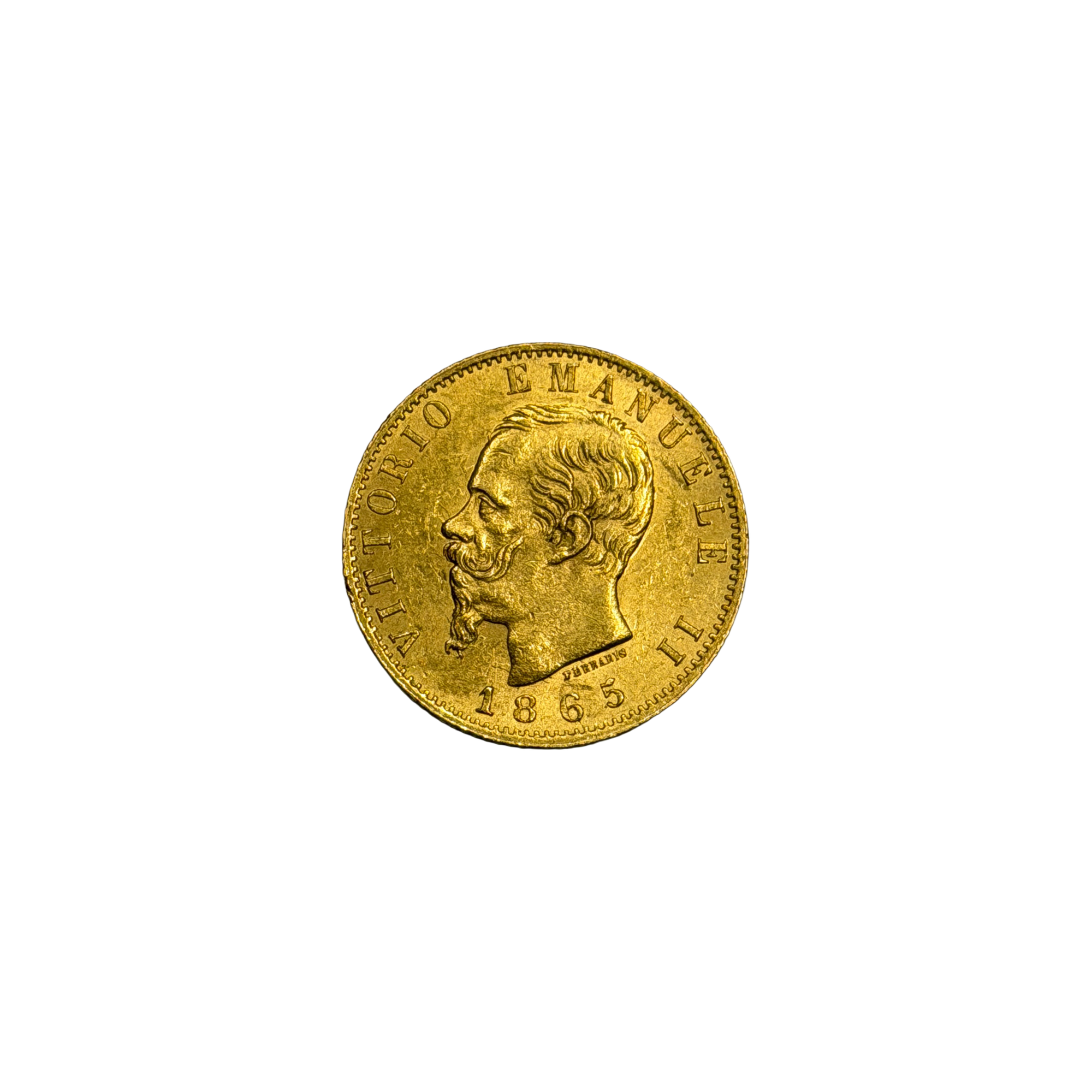
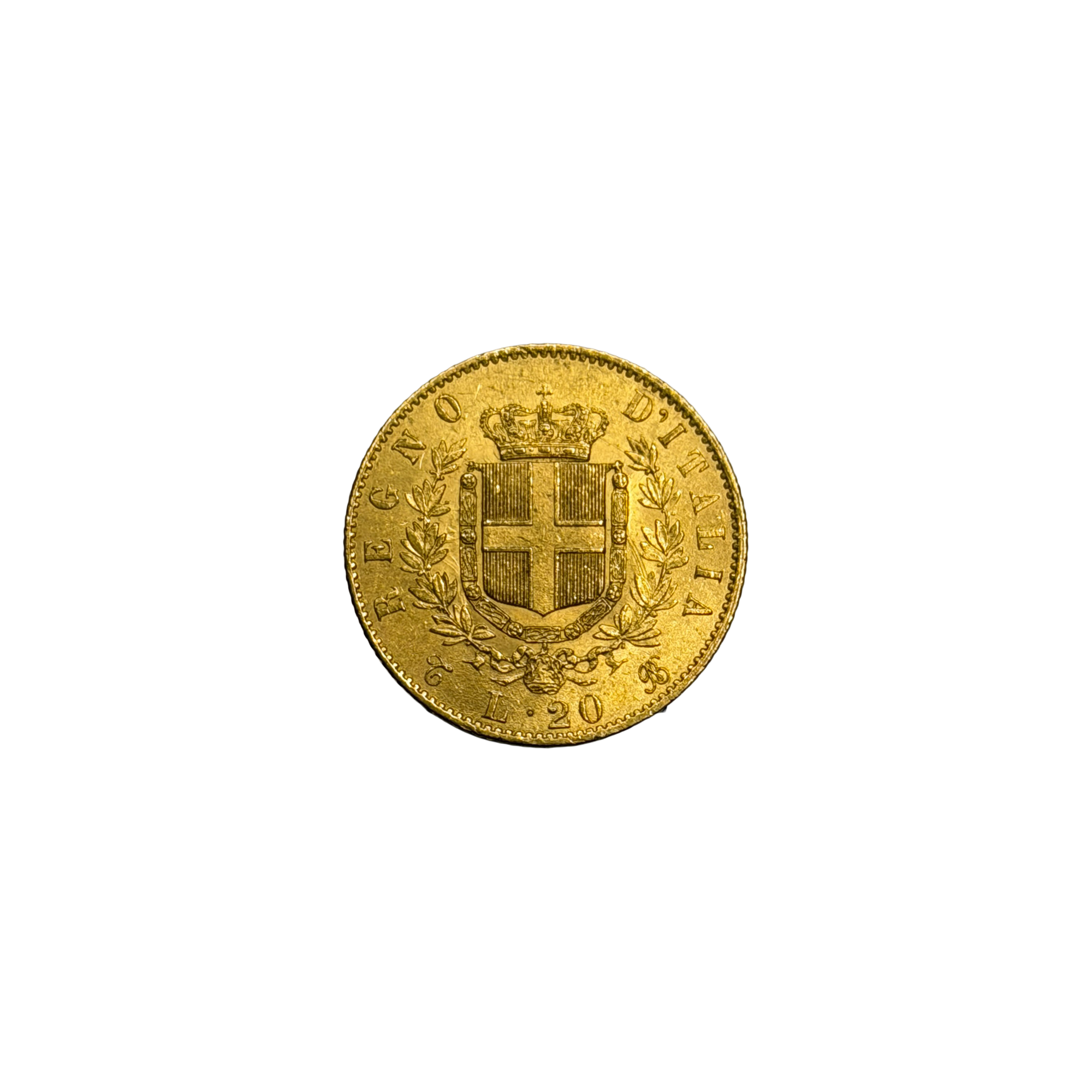
The obverse bears a left-facing bare-head portrait of Vittorio Emanuele II, his mustache and distinctive pointed beard rendered in fine detail, encircled by the inscription VITTORIO EMANUELE II with the date below. The reverse displays the crowned shield of Savoy — the plain cross that had identified the House of Savoy for centuries — framed by a laurel wreath beneath the arcing legend REGNO D’ITALIA (“Kingdom of Italy”), with the denomination L·20 at the base flanked by mint marks.
At 21mm in diameter and 6.45 grams total weight, each coin is struck from .900 fine gold and contains 0.1867 troy ounces of actual gold content — the Latin Monetary Union standard, identical to the French 20 Franc, the Swiss 20 Franc Helvetia, and the Belgian 20 Franc, a specification adopted expressly to facilitate cross-border trade among the participating nations. Grade range: AU/XF. Minted 1861–1878.
Vittorio Emanuele II came to the throne of the Kingdom of Sardinia in 1849, at one of the lowest points in the struggle for Italian independence, and spent the next decade building Sardinia-Piedmont into the engine of unification. His partnership with Garibaldi — the king’s armies advancing from the north while Garibaldi’s volunteers swept up through the south — brought the peninsula together under a single crown, and in 1861 the first Italian parliament proclaimed him King of Italy. He was known among the Italian people as il Re galantuomo, “the honest king,” and became the symbol and central figure of the Risorgimento. He spent the remainder of his reign consolidating the new kingdom — absorbing Venetia in 1866 and Rome itself in 1870 — and when he died in 1878, he was mourned as the Padre della Patria, the Father of the Fatherland. The monument that dominates the center of Rome to this day, the Vittoriano, is his.
The 20 Lira coins bearing his portrait are the coinage of that founding reign — gold struck while the unification it announced was still being completed.
A new kingdom needs more than a flag; it needs a currency. The lira of unified Italy replaced the assorted coinages of the pre-unification states, and in 1865 Italy joined France, Belgium, and Switzerland as a founding member of the Latin Monetary Union — a declaration that the new nation intended to participate in the architecture of European finance as an equal. The Vittorio Emanuele II 20 Lira is the coin that carried that declaration: the same gold content as the French 20 Franc, struck in the name of a king whose kingdom had not existed a decade earlier. Where the Umberto I 20 Lira is the currency of Italy’s first full generation of national existence, the Vittorio Emanuele II issues are the generation before that — the money of unification itself.
Italian gold production was modest by the standards of the Latin Monetary Union’s larger economies, and within the Italian series the Vittorio Emanuele II issues occupy the thinnest tier of supply. Nearly 11.8 million pieces were minted across the series’ 18 years of production — a total that is itself a small fraction of French 20 Franc output, which ran to hundreds of millions across the Napoleon and Rooster series — and Vittorio Emanuele II coins are considerably scarcer in today’s market than the Umberto I varieties that followed them, generally surfacing only in small lots. Only a fraction of the original mintage has survived into the modern era in collectible condition — a reality reflected in NGC’s suggested retail pricing of $700–$800 per coin for examples in condition comparable to those USAGOLD offers. Supply that is fixed and demonstrably thinner than comparable coins, acquired at near-bullion cost — that is the value argument in its cleanest form: the scarcity comes with the coin, at no added charge.
As a Latin Monetary Union coin, the Vittorio Emanuele II 20 Lira belongs to the most widely recognized family of fractional gold coins in the world. Its specifications are universally documented and identical to those of the French and Swiss 20 Franc pieces that dealers across North America and Europe handle daily, which means it converts to cash quickly wherever gold trades — the scarcer Italian portrait on a completely familiar gold standard. The fractional size adds practical flexibility: holdings can be liquidated a coin at a time, in increments of roughly one-fifth of an ounce, rather than in the full-ounce steps modern bullion often requires.
In 1933, FDR issued Executive Order 6102, requiring Americans to surrender their gold coin and bullion to the Treasury — but the order and the regulations that followed it exempted gold coins of recognized special value to collectors of rare and unusual coins. Subsequent clarifications by the Treasury identified pre-1933 gold coins — a classification that includes the Italian 20 Lira Vittorio Emanuele II, struck between 1861 and 1878 — as falling within that collector classification as historical items.
Under current constitutional law, a government intervention in the gold market would be executed through the power of eminent domain — the government’s right to take private property for public use provided it pays the owner just compensation. Historic coins complicate the government’s ability to broadly establish “just compensation” or “fair value,” which was precisely the reasoning behind the original “recognized special value” exemption in 1933. That complexity, and the precedent surrounding pre-1933 gold coins, creates a notable impediment to the government’s ability to restrict them broadly — particularly compared to modern bullion, which can be valued easily and consistently at a single price. In essence, it is a bureaucratic question of whether the government would undertake the enormous task of valuing the diversity and complexity of the historic-coin genre — every coin, every date, every condition, every personal holding — and that difficulty is what insulates the owner’s legal liquidity rights in the event of capital controls.
Whether a future government intervention in private gold markets is a risk an investor assigns significant weight to is a personal judgment. The factual point is narrower: the pre-1933 status represents a layer of portfolio differentiation that this coin carries at minimal added per-ounce cost over comparable modern bullion, along with a measure of insulation for the legal liquidity rights of its owner.
For a more in-depth study, we invite you to read our comprehensive memorandum on this subject: Preparing for a Potential Gold Confiscation
The Italian 20 Lira Vittorio Emanuele II is the founding gold coin of a unified Italy — struck in the name of the Father of the Fatherland, on the Latin Monetary Union standard that made it interchangeable with the most liquid fractional gold coins in Europe, and surviving today in far thinner supply than either its French counterparts or its own Umberto I successors. It offers investors divisible negotiability, genuine comparative scarcity, and a standardized and widely recognized gold content, all at near-bullion acquisition cost — a highly coveted piece of the Risorgimento that surfaces far less often than its French siblings. No other coin of the Italian series combines this much history and this much scarcity at so low a cost per ounce.
| Year | Mintage |
|---|---|
| 1861 (T) | 3,267 |
| 1862 (T) | 1,955,000 |
| 1863 (T) | 2,981,000 |
| 1864 (T) | 609,000 |
| 1865 (T) | 3,109,000 |
| 1866 (T) | 196,000 |
| 1867 (T) | 276,000 |
| 1868 (T) | 340,000 |
| 1869 (T) | 185,000 |
| 1870 (T) | 55,000 |
| 1870 (R) | — |
| 1871 (R) | 23,500 |
| 1872 (M) | — |
| 1873 (M) | 1,018,000 |
| 1873 (R) | 2,174 |
| 1874 (M) | 255,000 |
| 1874 (R) | 41,000 |
| 1875 (R) | 51,000 |
| 1876 (R) | 108,000 |
| 1877 (R) | 247,000 |
| 1878 (R) | 316,000 |
| Total (listed figures) | 11,770,941 |
Mintage figures per the Standard Catalog of World Coins, via the NGC World Price Guide. Dates NGC lists without figures are shown with a dash. T = Turin, R = Rome, M = Milan. The 1861 Turin figure (3,267) is the rare first-year striking of the unified kingdom.
XF, AU
1861-1878
.1867 troy ounce
Italy
| Quantity | Wire | Card |
|---|---|---|
| 1–26 | $900.95 | $938.49 |
| 27–53 | $891.94 | $929.11 |
| 54+ | $882.93 | $919.72 |
Quantity tiers reflect the historic & fractional gold order discount (1% at $25,000+ · 2% at $50,000+ in qualifying coins). Any mix of qualifying historic coins counts toward the same order total.
Prices shown under Wire include a 4% cash discount. Card prices are the full list price. ACH bank transfer is available to established clients only. First-time orders can be paid by wire transfer or card.
Interested in gold but struggling to find the right firm?

UNC, BU, PL
1879-1897
.1867 troy ounce
Italy
XF, AU
1850-1861
.1867 troy ounce
Italy


