

You must have an order with a minimum of $1,000.00 to place your order, your current order total is $0.00.
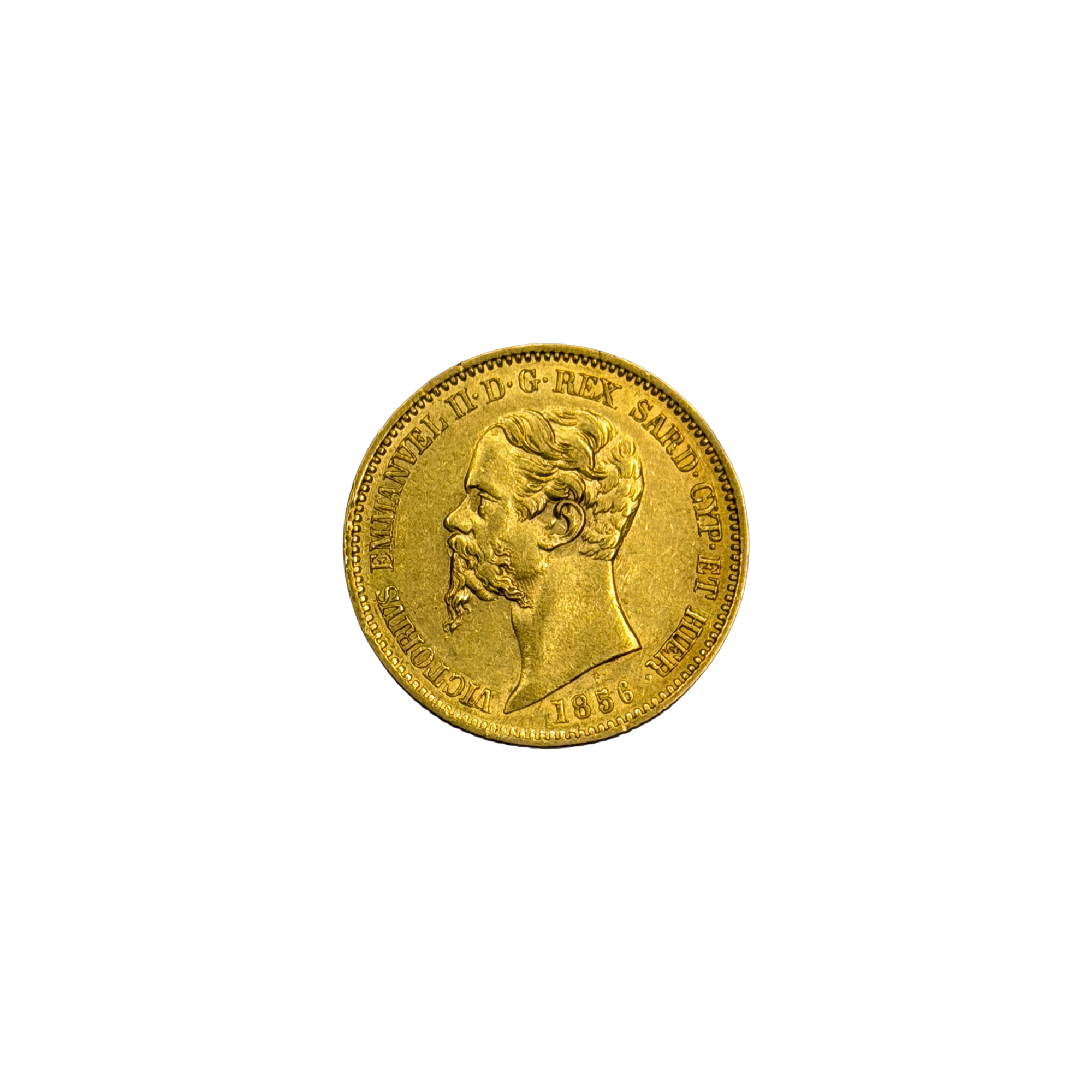
Before there was a Kingdom of Italy, there was the Kingdom of Sardinia — the Savoy monarchy, ruled from Turin, that supplied the dynasty, the army, and the statecraft that unified the peninsula. The 20 Lira gold coins struck in the name of Vittorio Emanuele II between 1850 and 1861 belong to that pre-unification kingdom: their legends are in Latin rather than Italian, they title him King of Sardinia rather than King of Italy, and they were minted while the campaigns that created modern Italy were actually underway. These are, quite literally, the coins of Italy before Italy — the working gold of the kingdom that made the nation.
For investors, the coins carry the same practical profile as the rest of the 20 Lira family. They trade at per ounce acquisition costs comparable to modern bullion and track directly with the spot price of gold over time. Struck to the French germinal-franc standard that the Latin Monetary Union later formalized, they are interchangeable at the gold content level with the French 20 Franc and Swiss 20 Franc Helvetia — yet as issues of a kingdom that ceased to exist in 1861, they surface in the market far less frequently than either, and less frequently than the unified-Italy issues that followed them. At roughly one-fifth of a troy ounce, they also offer divisible negotiability: affording its owner the flexibility to liquidate positions incrementally, in amounts proportionate to the specific needs of the moment and across a variety of circumstances. For investors whose priorities are a highly coveted issue of a kingdom that no longer exists, comparative scarcity, divisible negotiability, and a standardized and widely recognized gold content—all for near-bullion pricing—the Sardinian 20 Lira is one of the most distinctive instruments in the historic gold market today.
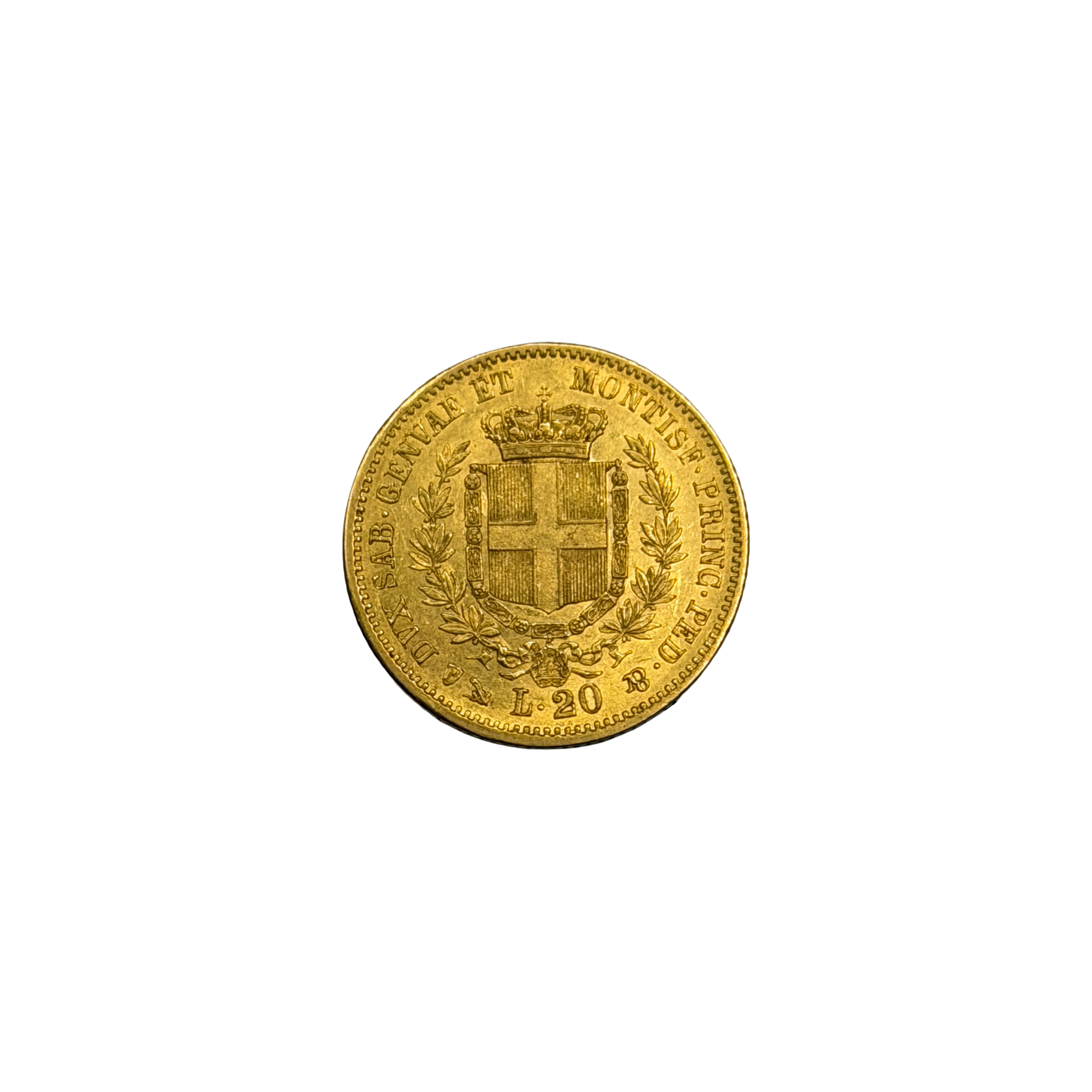
The obverse bears a left-facing bare-head portrait of a young Vittorio Emanuele II, his sweeping mustache already unmistakable, surrounded by the Latin legend VICTORIUS EMMANUEL II D·G·REX SARD·CYP·ET HIER — “Victor Emmanuel II, by the Grace of God, King of Sardinia, Cyprus, and Jerusalem,” the full accumulation of titles the House of Savoy had gathered across eight centuries — with the date below. The reverse displays the crowned shield of Savoy within a wreath beneath the continuing legend DVX SAB·GENVAE ET MONTISF·PRINC·PED — “Duke of Savoy, Genoa, and Montferrat, Prince of Piedmont” — with the denomination L·20 at the base flanked by mint marks.
At 21mm in diameter and 6.45 grams total weight, each coin is struck from .900 fine gold and contains 0.1867 troy ounces of actual gold content. Grade range: AU/XF. Minted 1850–1861. The Kingdom of Sardinia coined to the French germinal-franc standard decades before the Latin Monetary Union of 1865 wrote that standard into treaty — which means these pre-unification coins carry specifications identical to the French 20 Franc, the Swiss 20 Franc Helvetia, and the later 20 Lira issues of unified Italy.
Vittorio Emanuele II inherited the Sardinian throne in 1849 under the worst possible circumstances — his father Carlo Alberto abdicated after a crushing defeat by Austria at the Battle of Novara. The young king kept the constitution his father had granted, making Sardinia-Piedmont the only Italian state to preserve constitutional government through the reaction that followed 1848, and it became the rallying point for nationalists across the peninsula. With his prime minister Camillo di Cavour, he modernized the kingdom’s economy and army, brought Sardinia into the Crimean War to earn a seat among the great powers, and in 1859–1860 joined the campaigns — and the partnership with Giuseppe Garibaldi — that swept the peninsula toward unification. In 1861 the first Italian parliament proclaimed him King of Italy, and the Kingdom of Sardinia passed into history.
The 20 Lira coins of his Sardinian reign document the apprenticeship of the man Italians would call the Father of the Fatherland — struck in the decade when unification was a project, not yet a fact.
The Kingdom of Sardinia is one of history’s great disappearing acts: a state that succeeded so completely in its national project that it abolished itself. Its coinage stopped in 1861, its Latin royal titles were retired in favor of REGNO D’ITALIA, and its gold became the direct ancestor of the Italian lira. That gives the Sardinian 20 Lira a quality shared by few coins at near-bullion cost — it is the money of a vanished founding state, the numismatic bridge between the old dynastic Europe of Savoy, Cyprus, and Jerusalem and the modern nation-state of Italy. Supply of such coinage is fixed in the most absolute sense: the issuing kingdom has not existed since 1861. Against the hundreds of millions of French 20 Francs minted on the same standard, and the tens of millions of later Italian issues, the surviving Sardinian 20 Lira population is a comparative sliver — yet the market prices it at essentially the level of the family’s most abundant members. The scarcity comes with the coin, at no added cost — one of the quiet values of the historic fractional gold market.
Because the Sardinian 20 Lira was struck to the same standard the Latin Monetary Union later adopted, it trades within the most widely recognized family of fractional gold coins in the world. Dealers who handle French 20 Francs, Swiss Helvetias, and Italian 20 Lira daily recognize its weight, fineness, and gold content on sight, and it converts to cash quickly wherever gold trades. The fractional size adds practical flexibility: holdings can be liquidated a coin at a time, in increments of roughly one-fifth of an ounce, rather than in the full-ounce steps modern bullion often requires. The result is an unusual pairing — the liquidity profile of Europe’s most familiar gold standard, attached to the coinage of a kingdom that vanished before the standard even had a treaty.
In 1933, FDR issued Executive Order 6102, requiring Americans to surrender their gold coin and bullion to the Treasury — but the order and the regulations that followed it exempted gold coins of recognized special value to collectors of rare and unusual coins. Subsequent clarifications by the Treasury identified pre-1933 gold coins — a classification that includes the Sardinian 20 Lira of Vittorio Emanuele II, struck between 1850 and 1861 — as falling within that collector classification as historical items.
Under current constitutional law, a government intervention in the gold market would be executed through the power of eminent domain — the government’s right to take private property for public use provided it pays the owner just compensation. Historic coins complicate the government’s ability to broadly establish “just compensation” or “fair value,” which was precisely the reasoning behind the original “recognized special value” exemption in 1933. That complexity, and the precedent surrounding pre-1933 gold coins, creates a notable impediment to the government’s ability to restrict them broadly — particularly compared to modern bullion, which can be valued easily and consistently at a single price. In essence, it is a bureaucratic question of whether the government would undertake the enormous task of valuing the diversity and complexity of the historic-coin genre — every coin, every date, every condition, every personal holding — and that difficulty is what insulates the owner’s legal liquidity rights in the event of capital controls.
Whether a future government intervention in private gold markets is a risk an investor assigns significant weight to is a personal judgment. The factual point is narrower: the pre-1933 status represents a layer of portfolio differentiation that this coin carries at minimal added per-ounce cost over comparable modern bullion, along with a measure of insulation for the legal liquidity rights of its owner.
For a more in-depth study, we invite you to read our comprehensive memorandum on this subject: Preparing for a Potential Gold Confiscation
The Sardinian 20 Lira of Vittorio Emanuele II is the gold of Italy before Italy — struck by the kingdom that engineered unification, in the name of the king who would become the Father of the Fatherland, on the same standard that makes the French and Swiss 20 Franc pieces the most liquid fractional gold coins in the world. It pairs that standard’s liquidity with the fixed, comparatively thin supply of a state that has not existed since 1861 and divisible negotiability at roughly one-fifth of an ounce — all at near-bullion acquisition cost, though as issues of an extinct kingdom the coins surface only irregularly, and rarely in quantity. No other coin in the 20 Lira family carries this much founding history in so accessible a form.
| Year | Mintage |
|---|---|
| 1850 (T) | 66,286 |
| 1850 (G) | 139,169 |
| 1851 (T) | 162,988 |
| 1851 (G) | 295,792 |
| 1852 (T) | 45,513 |
| 1852 (G) | 102,899 |
| 1853 (G) | 136,767 |
| 1854 (G) | 142,270 |
| 1855 (T) | 41,512 |
| 1855 (G) | 148,235 |
| 1856 (T) | 61,485 |
| 1856 (G) | 113,098 |
| 1857 (T) | 67,415 |
| 1857 (G) | 58,549 |
| 1858 (T) | 102,723 |
| 1858 (G) | 176,035 |
| 1859 (T) | 186,640 |
| 1859 (G) | 453,935 |
| 1860 (T) | 110,624 |
| 1860 (G) | 163,322 |
| 1861 (T) | 155,514 |
| Total | 2,930,771 |
Mintage figures per the Standard Catalog of World Coins, via the NGC World Price Guide. Dates NGC lists without figures are shown with a dash. T = Turin, G = Genoa.
Each coin contains 0.1867 troy ounces of gold, struck in .900 fine gold at 21mm diameter and 6.45 grams total weight — the French germinal-franc standard that the Latin Monetary Union later formalized.
They were minted 1850-1861, while Vittorio Emanuele II reigned as King of Sardinia — before Italian unification. Sardinian coinage ended in 1861, when the first Italian parliament proclaimed him King of Italy and the Kingdom of Sardinia passed into history.
The legends are in Latin rather than Italian and title him King of Sardinia — VICTORIUS EMMANUEL II D-G-REX SARD-CYP-ET HIER — with the crowned shield of Savoy on the reverse. The issues of unified Italy that followed retired these titles in favor of REGNO D'ITALIA.
At the gold-content level, yes. It was struck to the same germinal-franc standard as the French 20 Franc and Swiss 20 Franc Helvetia, with identical gold content — though as issues of a kingdom that ceased to exist in 1861, Sardinian pieces surface in the market far less frequently than either.
The grade range is AU/XF (About Uncirculated to Extremely Fine).
XF, AU
1850-1861
.1867 troy ounce
Italy
| Quantity | Wire | Card |
|---|---|---|
| 1–26 | $900.95 | $938.49 |
| 27–53 | $891.94 | $929.11 |
| 54+ | $882.93 | $919.72 |
Quantity tiers reflect the historic & fractional gold order discount (1% at $25,000+ · 2% at $50,000+ in qualifying coins). Any mix of qualifying historic coins counts toward the same order total.
Prices shown under Wire include a 4% cash discount. Card prices are the full list price. ACH bank transfer is available to established clients only. First-time orders can be paid by wire transfer or card.
Interested in gold but struggling to find the right firm?

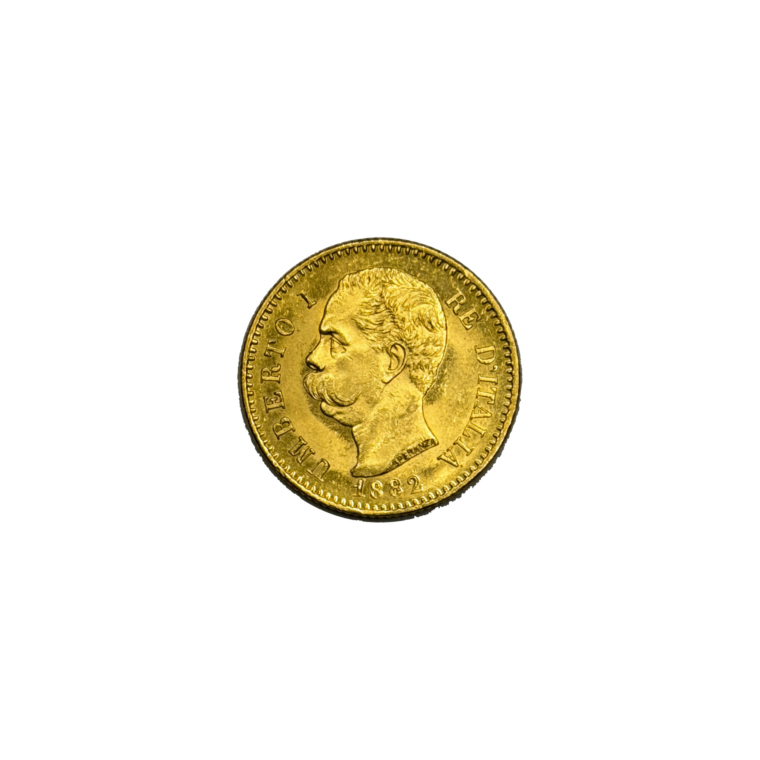
UNC, BU, PL
1879-1897
.1867 troy ounce
Italy
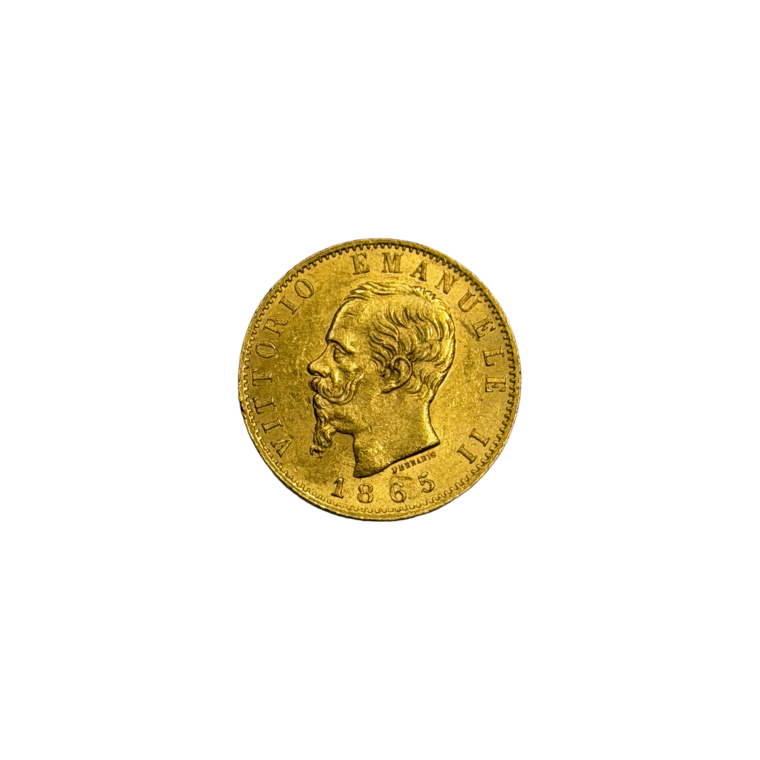
XF, AU
1861-1878
.1867 troy ounce
Italy


