

You must have an order with a minimum of $1,000.00 to place your order, your current order total is $0.00.
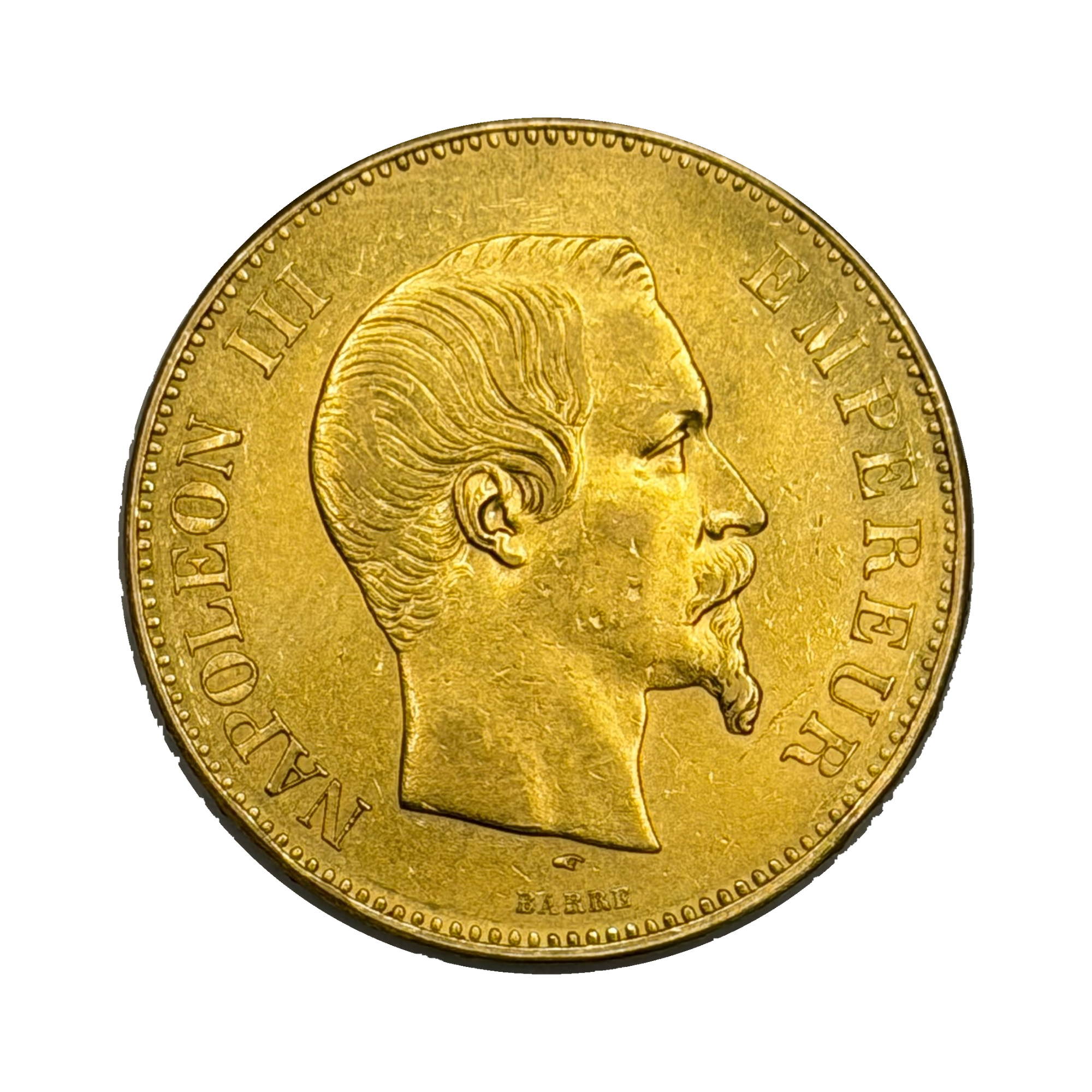
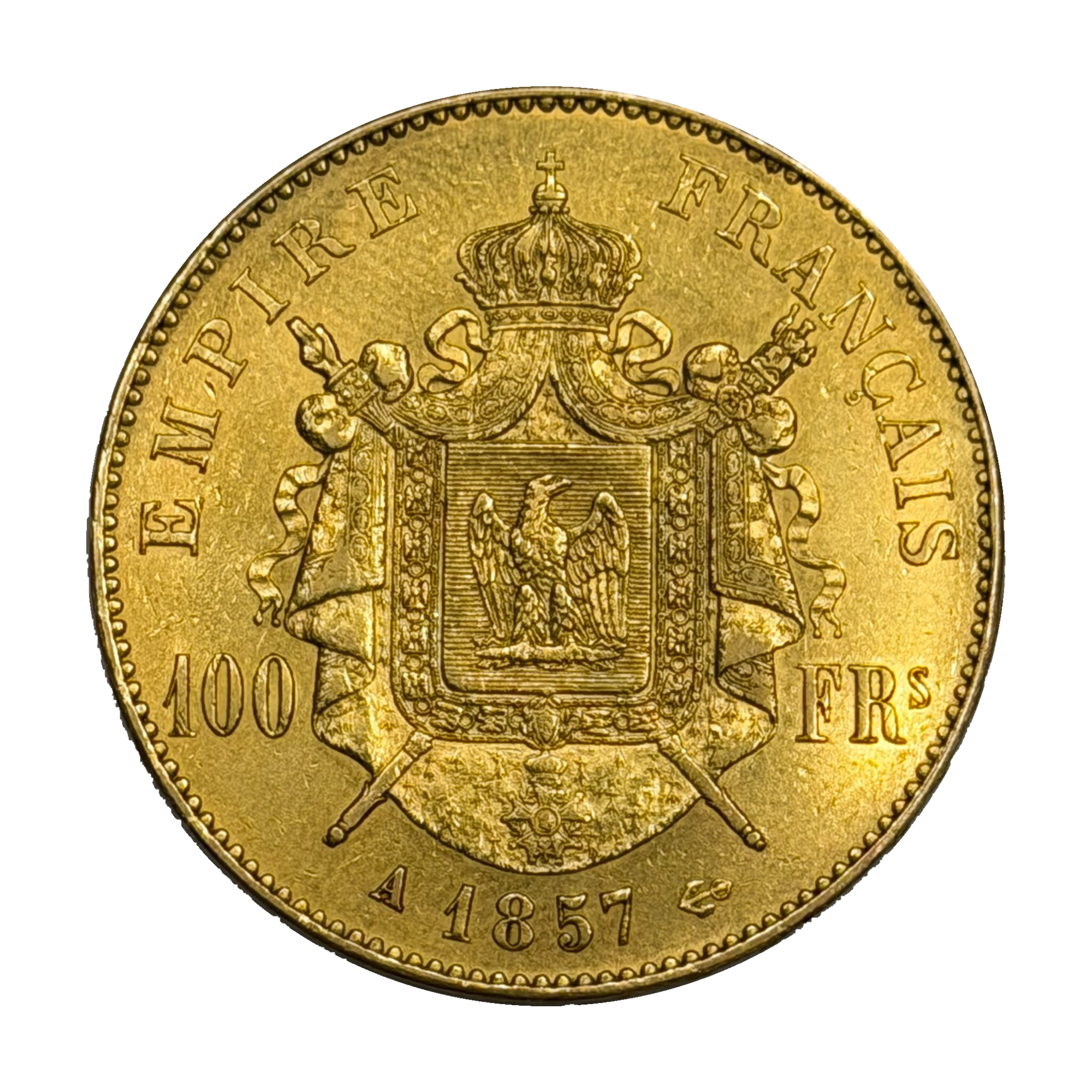
For its first half-century, the gold franc system Napoleon created in 1803 topped out at the 40 franc piece. It was his nephew, Napoleon III, who in 1855 introduced the largest gold coins France had ever struck for circulation — the 100 franc, at nearly a full troy ounce of gold, and its companion 50 franc. The Bare Head 100 franc offered here is the original: the founding issue of the denomination, struck for only five years, 1855 through 1859, with a total production of 346,101 pieces.
The investor logic of large historic coins applies at full strength. Coins at or near one troy ounce are comparatively scarce as a class — small coinage carried the utility in everyday commerce and was struck in vastly greater numbers — and within that class the Bare Head’s five-year, 346,101-piece run stands against roughly 5 million Mexico 50 Pesos and the tens of millions of U.S. $20 gold pieces struck between 1850 and 1932. As near-ounce coins of genuinely small supply, the French 100 francs command per ounce acquisition costs above modern bullion — the premium is the market acknowledgment of a fixed and tiny production record. For investors whose priorities are a coin steeped in the history of the Second Empire, notable scarcity from a five-year, 346,101-piece run, and nearly a full ounce of standardized and widely recognized gold, France’s first 100 franc is among the smallest-supply routes to a near-ounce position the historic gold market offers — and one rarely available in quantity.
The obverse bears the portrait of Napoleon III facing right — the bare-head type engraved by Jean-Jacques Barre, chief engraver of the Paris Mint — with the emperor’s hair swept back and the pointed imperial beard rendered in fine detail, encircled by NAPOLEON III EMPEREUR, the engraver’s signature below the truncation. The reverse carries the full heraldic achievement of the Second Empire: the imperial eagle on a paneled shield, set against the crowned, ermine-lined imperial mantle with scepters crossed behind, encircled by EMPIRE FRANÇAIS, with the denomination 100 FRS divided beside the arms and the date and mint mark below.
At 35mm in diameter and 32.26 grams total weight, each coin is struck from .900 fine gold and contains 0.9334 troy ounces of actual gold content — the largest gold coin France had issued for circulation to that date. Grade range: AU. Minted 1855–1859.
Napoleon III was the nephew of Napoleon Bonaparte and emperor of France from 1852 to 1870. Elected president of the Second Republic in 1848, he answered a hostile parliament with a coup in December 1851, rewrote the constitution, and declared himself emperor — claiming the throne on December 2, 1852, 48 years to the day after his uncle’s coronation. His empire rebuilt Paris, expanded French industry and banking, and presided over one of the great recoinages of the nineteenth century, as gold from California and Australia flowed into the French mints.
The 100 franc denomination was the monetary emblem of that expansion — introduced in 1855 at the height of the gold influx, struck first with Barre’s bare-head portrait. In 1861 the portrait changed to the laureate head, making the Bare Head a closed, five-year type. The Second Empire itself ended at Sedan in 1870; Napoleon III died in English exile in 1873.
Large historic gold is scarce by construction, and the record documents where the Bare Head sits. Its 346,101 pieces across 1855–1859 — with single years as thin as 36,298 (1859) — compare with roughly 270,000 for the later 100 Franc Angel series spread over nearly three decades, roughly 5 million Mexico 50 Pesos, and U.S. $20 gold piece production that dwarfs the entire French 100 franc family. Only the Laurel Head 100 franc, at under 100,000 pieces, is scarcer among French large gold. The type is closed twice over — by the portrait change of 1861 and by the fall of the empire in 1870 — and more than a century and a half of melts and attrition has applied since.
The Napoleon III portrait is among the most recognized images in historic gold — French gold is the most widely traded historic coinage in Europe, its Latin Monetary Union .900 standard documented in every reference and priced in every market. The 100 franc carries that recognition at near-ounce scale: a single coin consolidates almost a full ounce of gold in a form dealers across Europe and North America identify on sight. The founding-type status adds a second channel of demand from collectors of French imperial coinage — a demand layer common bullion-tracking issues do not enjoy.
In 1933, FDR issued Executive Order 6102, requiring Americans to surrender their gold coin and bullion to the Treasury — but the order and the regulations that followed it exempted gold coins of recognized special value to collectors of rare and unusual coins. Subsequent clarifications by the Treasury identified pre-1933 gold coins — a classification that includes the French 100 Franc Napoleon III Bare Head, struck between 1855 and 1859 — as falling within that collector classification as historical items.
Under current constitutional law, a government intervention in the gold market would be executed through the power of eminent domain — the government’s right to take private property for public use provided it pays the owner just compensation. Historic coins complicate the government’s ability to broadly establish “just compensation” or “fair value,” which was precisely the reasoning behind the original “recognized special value” exemption in 1933. That complexity, and the precedent surrounding pre-1933 gold coins, creates a notable impediment to the government’s ability to restrict them broadly — particularly compared to modern bullion, which can be valued easily and consistently at a single price. In essence, it is a bureaucratic question of whether the government would undertake the enormous task of valuing the diversity and complexity of the historic-coin genre — every coin, every date, every condition, every personal holding — and that difficulty is what insulates the owner’s legal liquidity rights in the event of capital controls.
Whether a future government intervention in private gold markets is a risk an investor assigns significant weight to is a personal judgment. The factual point is narrower: the pre-1933 status represents a layer of portfolio differentiation that this coin carries along with a measure of insulation for the legal liquidity rights of its owner.
For a more in-depth study, we invite you to read our comprehensive memorandum on this subject: Preparing for a Potential Gold Confiscation
The French 100 Franc Napoleon III Bare Head is the founding coin of France’s largest gold denomination — nearly a full ounce of gold, struck for only five years under the Second Empire, from a supply of 346,101 pieces that the portrait change of 1861 closed permanently. It combines a genuinely small fixed supply with nearly a full ounce of standardized and widely recognized gold — a highly coveted profile, quickly subscribed on the irregular occasions the market makes it available. No other near-ounce historic gold coin pairs a founding-issue pedigree with so compact a supply.
| Year | Mintage |
|---|---|
| 1855 | 55,861 |
| 1856 | 56,741 |
| 1857 | 103,330 |
| 1858 | 93,871 |
| 1859 | 36,298 |
| Total | 346,101 |
AU
1855-1859
.9334 troy ounce
France
| Quantity | Wire | Card |
|---|---|---|
| 1–5 | $4,606.52 | $4,798.46 |
| 6–10 | $4,560.45 | $4,750.48 |
| 11+ | $4,514.39 | $4,702.49 |
Quantity tiers reflect the historic & fractional gold order discount (1% at $25,000+ · 2% at $50,000+ in qualifying coins). Any mix of qualifying historic coins counts toward the same order total.
Prices shown under Wire include a 4% cash discount. Card prices are the full list price. ACH bank transfer is available to established clients only. First-time orders can be paid by wire transfer or card.
Interested in gold but struggling to find the right firm?

AU
1878-1906
.9334 troy ounce
France
AU
1862-1870
.9335 troy ounce
France


