

You must have an order with a minimum of $1,000.00 to place your order, your current order total is $0.00.
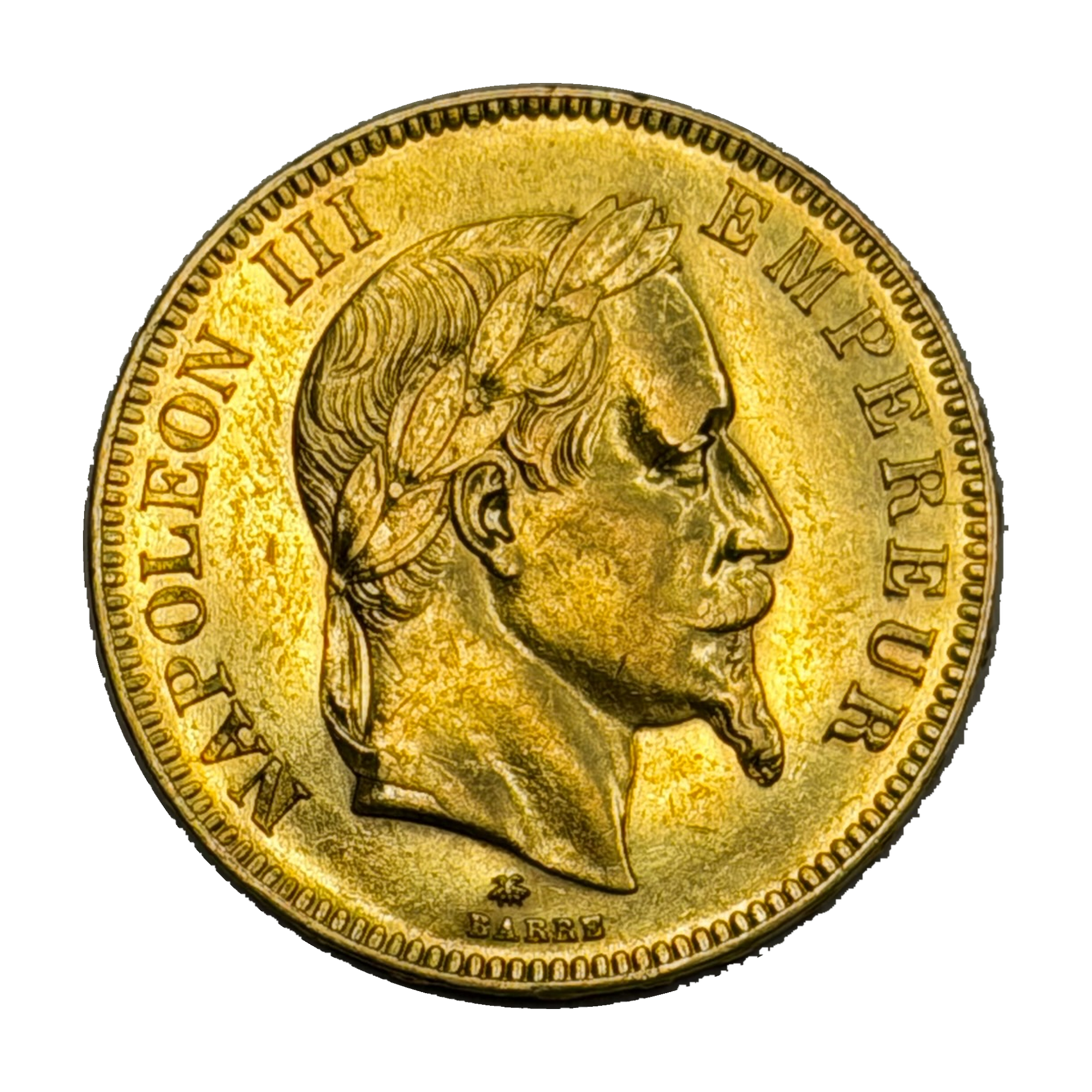
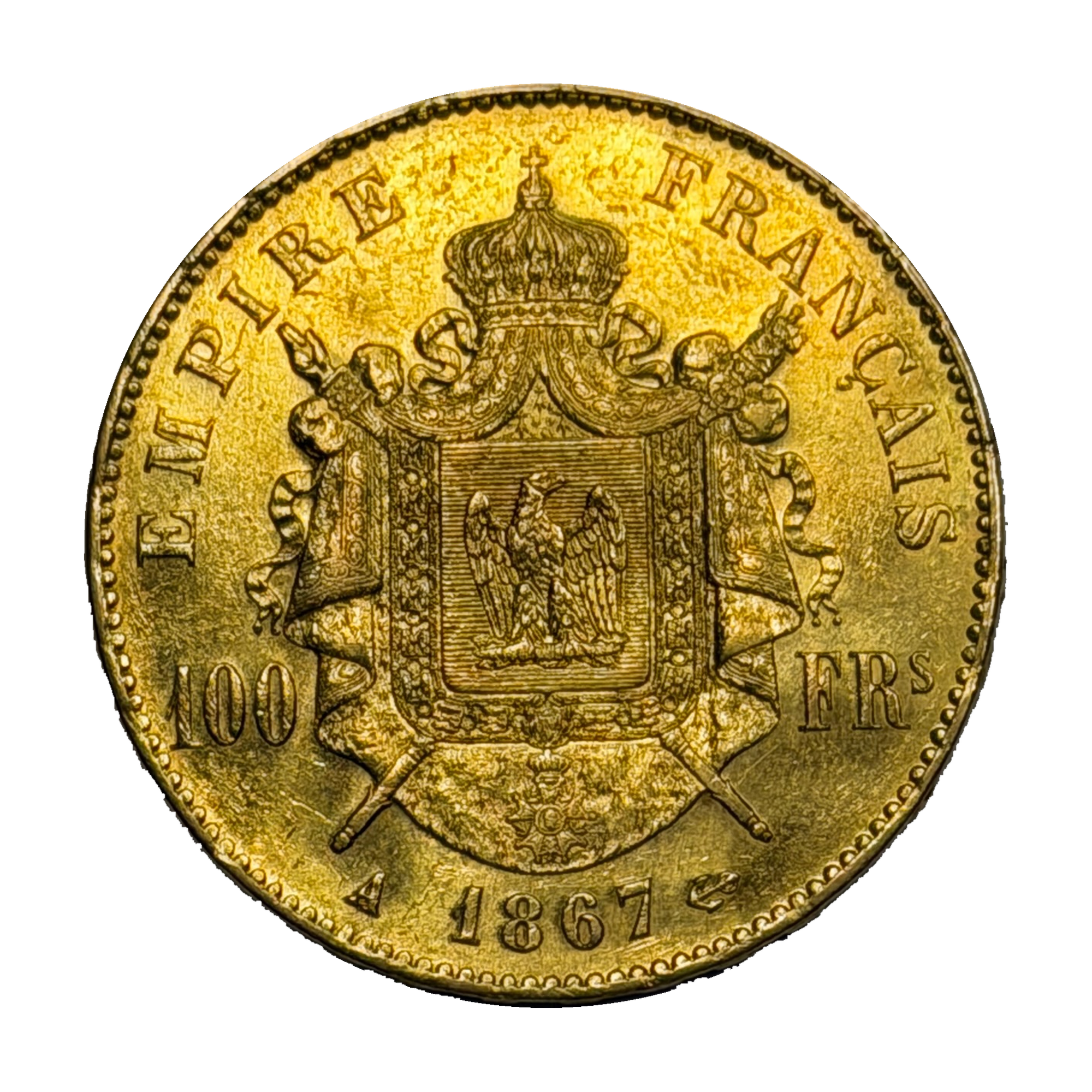
Among the large gold coins of the historical era, few carry a production record as thin as the “Laurel” 100 franc of Napoleon III. Struck during the final decade of the Second Empire with the laureate portrait introduced in the early 1860s, the entire series totals under 100,000 pieces — divided, per USAGOLD’s source records, between the Paris (A) and Strasbourg (BB) mints. For a coin containing nearly a full troy ounce of gold, that is a supply smaller than a single ordinary week of modern bullion production.
Large historic coins are comparatively scarce to begin with — small coinage carried the utility in everyday commerce and was produced in far greater numbers, leaving only a handful of at-or-near-ounce options from the entire historical era. The Laurel is scarce even within that already scarce class: less than a third the mintage of its Bare Head predecessor (approximately 346,000 pieces), roughly a third of the 100 Franc Angel (approximately 270,000), a fraction of a percent of the roughly 5 million Mexico 50 Pesos, and utterly dwarfed by the U.S. $20 gold pieces struck from 1850 to 1932. USAGOLD has historically been able to assemble only small groups of these coins, and offerings are quickly subscribed. For investors whose priorities are a highly coveted coin at maximum gold content, notable scarcity from a mintage under 100,000 pieces, a high state of preservation, and a standardized and widely recognized gold content, the Laurel 100 franc is the deepest large-coin position the French series makes available — and one best suited to heirloom positions.
The obverse bears the laureate portrait of Napoleon III facing right — the emperor crowned with the victor’s laurel, its ribbons trailing at the neck, engraved by Albert-Désiré Barre, chief engraver of the Paris Mint — encircled by NAPOLEON III EMPEREUR with the engraver’s signature below. The reverse carries the full heraldic achievement of the Second Empire: the imperial eagle on a paneled shield against the crowned, ermine-lined imperial mantle with scepters crossed behind, encircled by EMPIRE FRANÇAIS, the denomination 100 FRS divided beside the arms, and the date and mint mark below.
At 35mm in diameter and 32.26 grams total weight, each coin is struck from .900 fine gold and contains .9335 troy ounces of actual gold content. Grade range: AU (Almost Uncirculated) — a high state of preservation for a large gold coin of the 1860s, with the design fully present and only the lightest evidence of handling. Minted 1862–1870.
Napoleon III was the nephew of Napoleon Bonaparte and emperor of France from 1852 to 1870. Elected president of the Second Republic in 1848, he answered a parliament determined to block his re-election with a coup in December 1851 — seizing power, rewriting the constitution, and declaring himself emperor on December 2, 1852, 48 years to the day after his uncle’s coronation as Napoleon I.
He strove to restore France to the stature it had held under his famous uncle, rebuilding Paris into the city of boulevards the world knows today and presiding over an industrial and financial expansion that made the franc one of the world’s great currencies. But his rule was undermined by a succession of political missteps — rifts with the Vatican over papal territory, and with French industry over his free-trade policy with England — and in the Franco-Prussian War of 1870 he met defeat at Sedan. Within days a new revolution unseated him; he died in England in 1873. The laureate portrait on this coin — the laurel his uncle wore — was struck in the empire’s final decade, and production ended with the empire itself in 1870.
The standard assumption for working gold coins of the 1860s is meaningful wear — these were circulating money at very high face value, handled in bank transfers and large settlements. The coins USAGOLD offers grade AU (Almost Uncirculated): Barre’s portrait fully struck, the imperial arms sharp, the fields showing only the lightest friction. On a series this small, condition compounds scarcity — the population of high-grade survivors within a sub-100,000 mintage is by definition a small fraction of an already small number. The AU coin carries a double scarcity — of series and of state of preservation — in a single acquisition.
French gold is the most widely traded historic gold coinage in Europe, and the Napoleon III laureate portrait is one of its defining images — recognized on sight by dealers across Europe and North America, struck to the .900 fine standard documented in every reference. The 100 franc carries that recognition at near-ounce scale, consolidating almost a full ounce of gold in a single, instantly identifiable coin. Scarcity of this order within so deep and established a market is the combination investors rarely find: the Laurel trades on the strength of the French gold market as a whole, not on the narrowness of a specialist niche.
In 1933, FDR issued Executive Order 6102, requiring Americans to surrender their gold coin and bullion to the Treasury — but the order and the regulations that followed it exempted gold coins of recognized special value to collectors of rare and unusual coins. Subsequent clarifications by the Treasury identified pre-1933 gold coins — a classification that includes the Laurel Head 100 franc, struck between 1862 and 1870 — as falling within that collector classification as historical items.
Under current constitutional law, a government intervention in the gold market would be executed through the power of eminent domain — the government’s right to take private property for public use provided it pays the owner just compensation. Historic coins complicate the government’s ability to broadly establish “just compensation” or “fair value,” which was precisely the reasoning behind the original “recognized special value” exemption in 1933. That complexity, and the precedent surrounding pre-1933 gold coins, creates a notable impediment to the government’s ability to restrict them broadly — particularly compared to modern bullion, which can be valued easily and consistently at a single price. In essence, it is a bureaucratic question of whether the government would undertake the enormous task of valuing the diversity and complexity of the historic-coin genre — every coin, every date, every condition, every personal holding — and that difficulty is what insulates the owner’s legal liquidity rights in the event of capital controls. A sub-100,000-mintage imperial gold coin in Almost Uncirculated condition sits about as far from uniformly priced bullion as the market allows.
Whether a future government intervention in private gold markets is a risk an investor assigns significant weight to is a personal judgment. The factual point is narrower: the pre-1933 status represents a layer of portfolio differentiation that this coin carries along with a measure of insulation for the legal liquidity rights of its owner.
For a more in-depth study, we invite you to read our comprehensive memorandum on this subject: Preparing for a Potential Gold Confiscation
The French 100 Franc Napoleon III Laurel Head is the scarcest large gold coin France ever struck for circulation — under 100,000 pieces, nearly a full ounce of gold each, produced in the last decade of the last French empire and offered here in AU condition. It unites the smallest supply in the French large-gold series, high-grade preservation, and nearly a full ounce of standardized and widely recognized gold — a highly coveted, heirloom-caliber coin that reaches the market only irregularly and in small numbers. No other large European gold coin brings together so small a fixed supply and so many notable advantages for gold investors.
| Year | Mintage |
|---|---|
| 1862 | 9,728 |
| 1863 | 5,078 |
| 1864 | 6,929 |
| 1865 | 1,517 |
| 1866 | 12,116 |
| 1867 | 7,116 |
| 1868 | 2,315 |
| 1869 | 43,084 |
| 1870 | 10,460 |
| Total (per USAGOLD source records) | 97,225 |
Series total per USAGOLD source records: 97,225 — 68,398 Paris (A) plus 28,827 Strasbourg (BB), minted 1862–1870. Per-date figures above are drawn from USAGOLD mintage records and sum slightly higher than the series total.
AU
1862-1870
.9335 troy ounce
France
| Quantity | Wire | Card |
|---|---|---|
| 1–5 | $4,526.72 | $4,715.33 |
| 6–10 | $4,481.45 | $4,668.18 |
| 11+ | $4,436.19 | $4,621.02 |
Quantity tiers reflect the historic & fractional gold order discount (1% at $25,000+ · 2% at $50,000+ in qualifying coins). Any mix of qualifying historic coins counts toward the same order total.
Prices shown under Wire include a 4% cash discount. Card prices are the full list price. ACH bank transfer is available to established clients only. First-time orders can be paid by wire transfer or card.
Interested in gold but struggling to find the right firm?

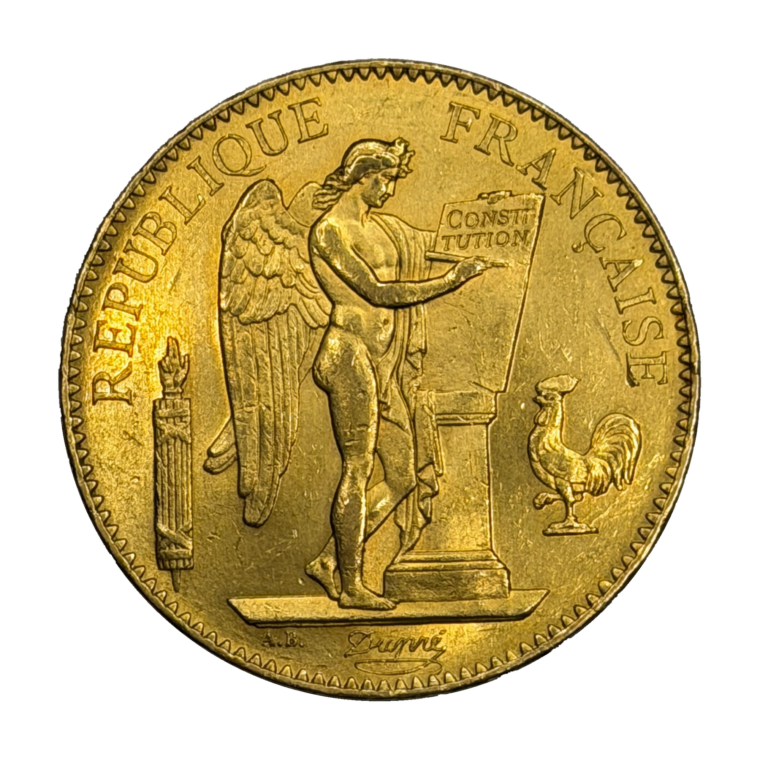
AU
1878-1906
.9334 troy ounce
France
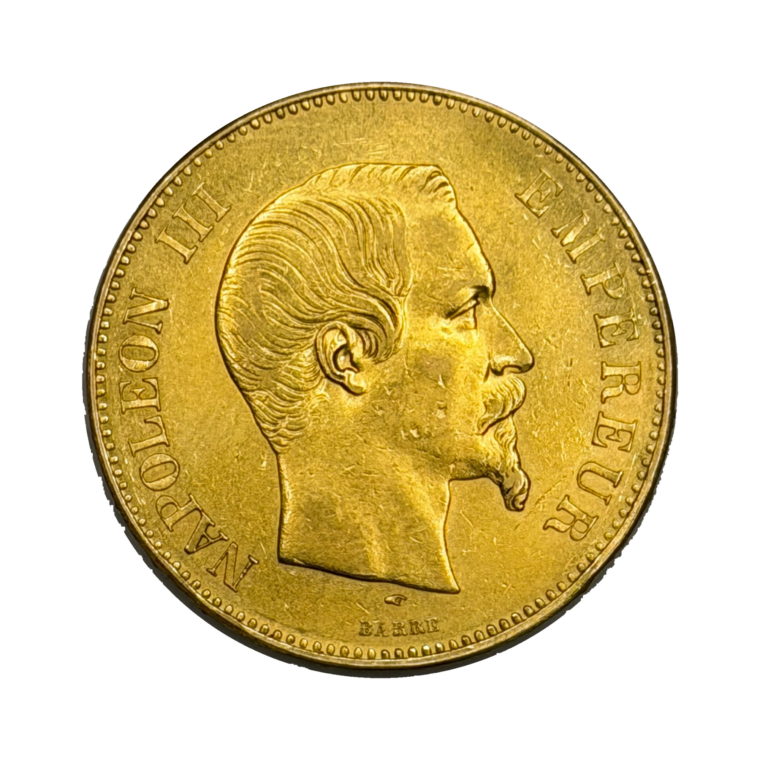
AU
1855-1859
.9334 troy ounce
France


