

You must have an order with a minimum of $1,000.00 to place your order, your current order total is $0.00.
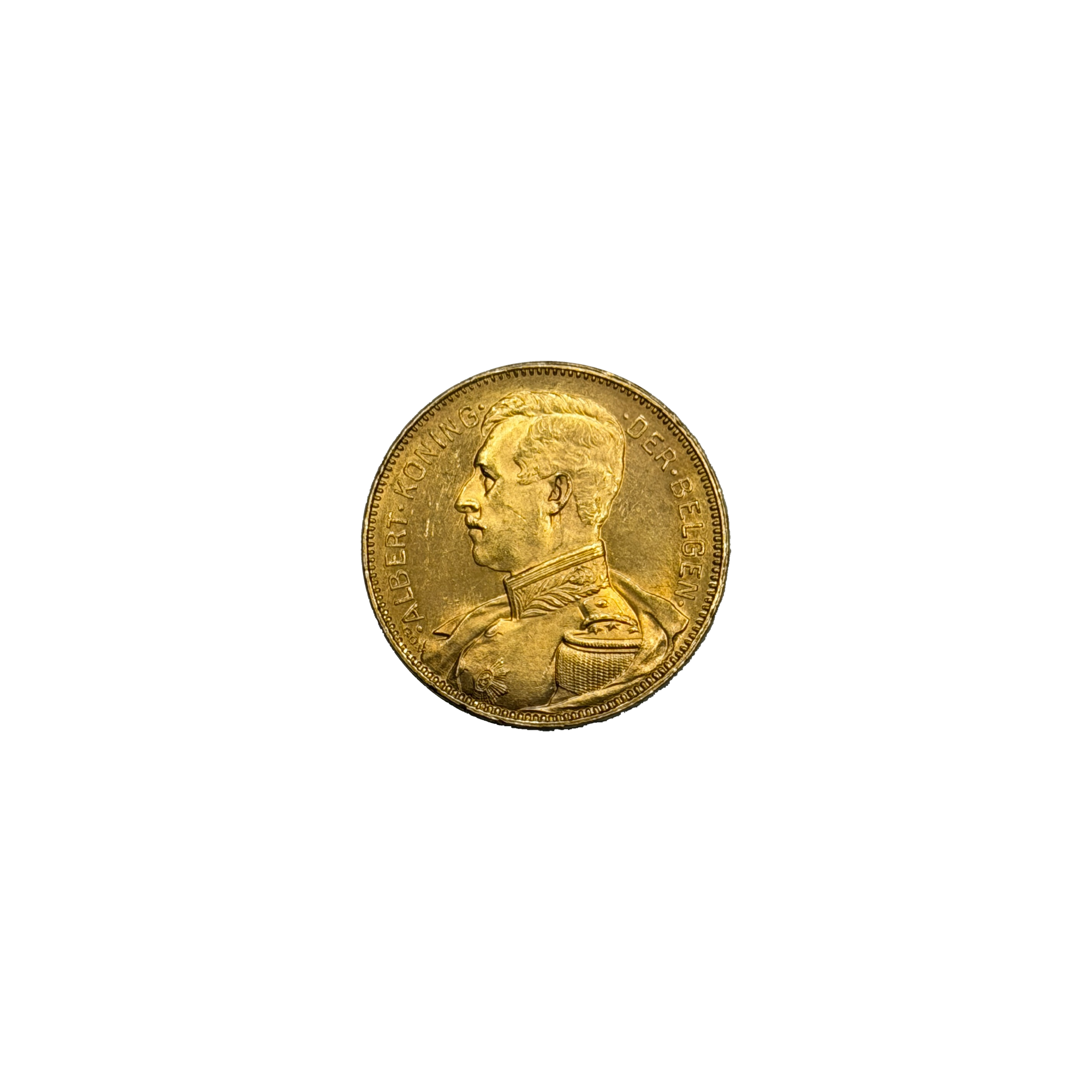
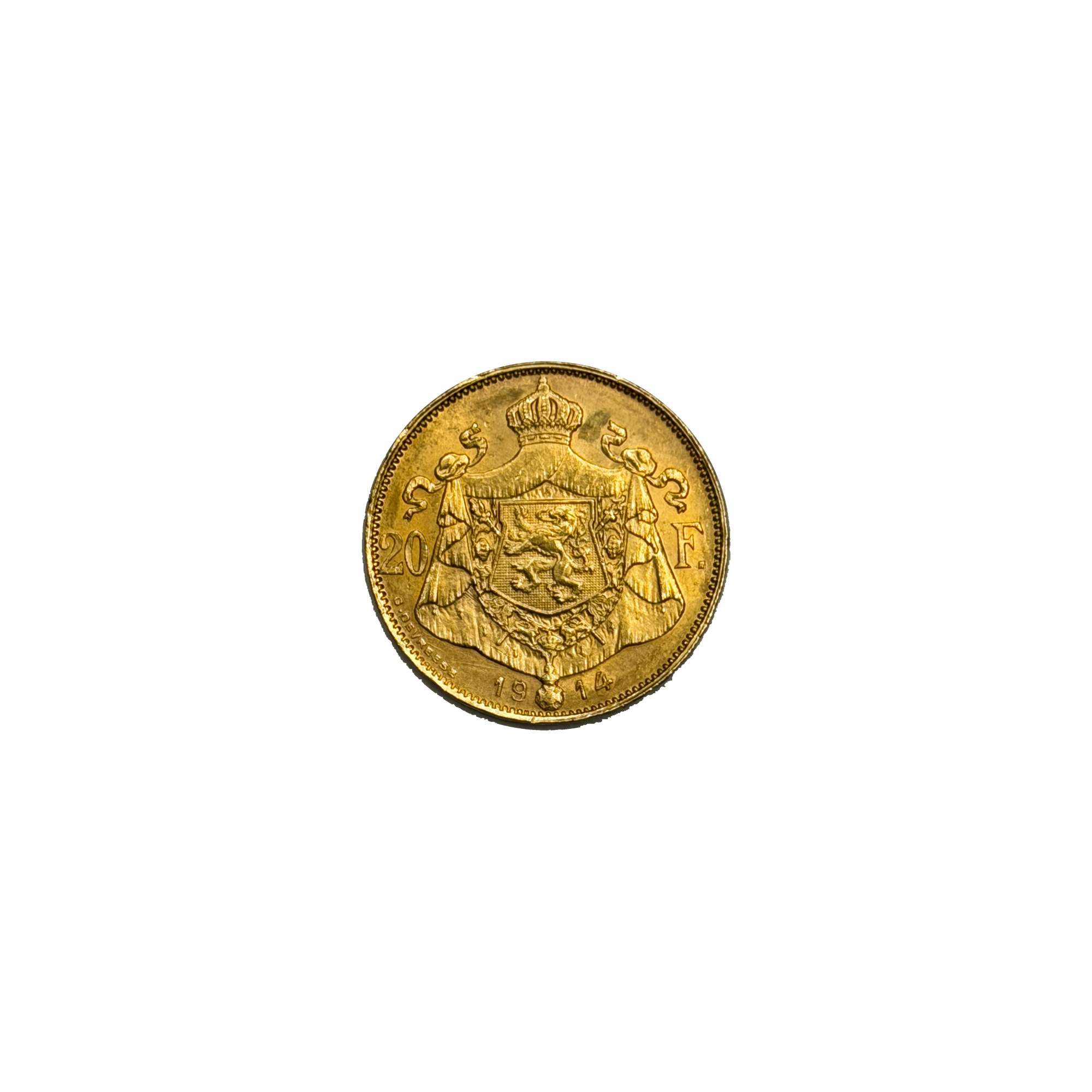
In August 1914, Germany demanded free passage through Belgium for its armies marching on France. King Albert I’s government refused, and when the invasion came, the king did what almost no other European monarch of his era did: he took personal command of his army in the field and held it in combat for the entire war. From a last unoccupied corner of Belgium behind the flooded Yser plain, the “Soldier King” commanded Belgian forces from 1914 to the final offensive of 1918, and emerged as one of the few figures of the First World War admired on all sides. The gold 20 franc bearing his uniformed portrait was struck in 1914 — the year of decision itself — and stands as the final gold coin of the Belgian franc’s classic era.
For investors, the Albert I is the Belgian family’s historical capstone: a single-year type whose date is the pivot of the twentieth century. Classified instructively as “historical bullion,” it tracks the spot price of gold over time while carrying the historic (pre-1933) designation and the associated insulation against the possibility of future government intervention. Its one-year production gives it a fixed supply within a family anchored by the abundant Leopold II issues, and its Latin Monetary Union specifications place it inside one of the most recognized fractional gold formats in the world. At just under one-fifth of a troy ounce, it also offers divisible negotiability: affording its owner the flexibility to liquidate positions incrementally, in amounts proportionate to the specific needs of the moment and across a variety of circumstances. For investors whose priorities are a highly coveted coin steeped in historical significance, notable scarcity due to a limited single-year mintage, a high state of preservation, and a standardized and widely recognized gold content—all for near-bullion pricing—the Albert I 20 Franc is the most storied coin of the Belgian series.
The obverse bears the uniformed bust of Albert I facing left — high military collar, epaulette at the shoulder — modeled by the Belgian sculptor Godefroid Devreese, whose signature appears on the reverse. The example pictured carries the Dutch-language inscription ALBERT KONING DER BELGEN; the type was struck in both French-legend (ALBERT ROI DES BELGES) and Dutch-legend varieties, a bilingual acknowledgment of the two communities of the Belgian nation. The reverse displays the crowned arms of Belgium on a draped royal mantle with the denomination 20 F. and the date 1914.
At 21mm in diameter and 6.45 grams total weight, each coin contains 0.1867 troy ounces of pure gold in a .900 fine alloy — the Latin Monetary Union standard, interchangeable with the 20 franc gold issues of France, Switzerland, and Italy. Grade range: BU. Minted 1914.
Albert I came to the throne in 1909 and brought to it a temperament unlike his predecessor’s — modest, dutiful, and privately alarmed by the storm gathering over Europe. When the German ultimatum arrived in August 1914, his reply defined his reign: Belgium, he insisted, was a nation, not a road. The invasion that followed made his small kingdom the war’s first battlefield and its king the symbol of resistance to it.
Unlike the emperors and kings who directed their wars from palaces, Albert assumed direct command under the Belgian constitution and spent the entire war with his army, while Queen Elisabeth worked in the field hospitals behind the lines. He held the last strip of unoccupied Belgium for four years and led the army group that liberated the country in 1918. His prestige at the war’s end was immense and genuinely international. He died in 1934, at 58, in a climbing accident at Marche-les-Dames — a death mourned across Europe. Among twentieth-century monarchs, his reputation remains singular, and his 1914 gold coin carries that reputation with it.
The Albert I 20 Franc closes the story the Leopold I coin opens. Belgium helped found the Latin Monetary Union in 1865, and for half a century its gold francs circulated interchangeably with those of France, Switzerland, and Italy across an integrated monetary Europe. The war that began on Belgian soil in August 1914 destroyed that system: gold coinage was suspended across the continent as the belligerents turned to paper finance, and the LMU never functioned the same way again. The 1914 Albert I issue — struck as the system entered its final months — is Belgium’s terminal gold coin of the classic era, the counterpart of the German 20 Mark issues of 1914–1915 across the lines. Few coins mark the end of an epoch as precisely: one date, one reign at its moment of trial, one monetary world about to vanish.
The scarcity argument is structural and comparative. The Albert I type was struck in a single year, so its supply is permanently fixed in a way the multi-year issues of the family cannot match — the Leopold II issues, by comparison, total a documented 27.6 million coins across eleven dates. A single-year, single-date type carries scarcity of the most permanent kind, and the Albert I offers that characteristic while still trading on its gold content first and its history second — the structure that creates the value: fixed-supply scarcity acquired without a numismatic rarity price. Within a Belgian position, it is the natural companion piece: the Leopold II supplies the affordable anchor, the Leopold I the thin early supply, and the Albert I the fixed-supply historical close.
As an LMU-standard 20 franc gold piece, the Albert I trades within one of the deepest recognition pools in the historic gold market — the same universally documented specifications as the Swiss 20 Franc Helvetia and the French and Italian 20 franc issues, priced on sight by dealers across North America and Europe. Belgian issues are somewhat harder to come by than the common French coins of the era, but the shared standard carries the liquidity: the coin converts to cash quickly wherever gold trades, in increments its fractional size makes practical.
In 1933, FDR issued Executive Order 6102, requiring Americans to surrender their gold coin and bullion to the Treasury — but the order and the regulations that followed it exempted gold coins of recognized special value to collectors of rare and unusual coins. Subsequent clarifications by the Treasury identified pre-1933 gold coins — a classification that includes the Belgian 20 Franc Albert I, struck in 1914 — as falling within that collector classification as historical items.
Under current constitutional law, a government intervention in the gold market would be executed through the power of eminent domain — the government’s right to take private property for public use provided it pays the owner just compensation. Historic coins complicate the government’s ability to broadly establish “just compensation” or “fair value,” which was precisely the reasoning behind the original “recognized special value” exemption in 1933. That complexity, and the precedent surrounding pre-1933 gold coins, creates a notable impediment to the government’s ability to restrict them broadly — particularly compared to modern bullion, which can be valued easily and consistently at a single price. In essence, it is a bureaucratic question of whether the government would undertake the enormous task of valuing the diversity and complexity of the historic-coin genre — every coin, every date, every condition, every personal holding — and that difficulty is what insulates the owner’s legal liquidity rights in the event of capital controls.
Whether a future government intervention in private gold markets is a risk an investor assigns significant weight to is a personal judgment. The factual point is narrower: the pre-1933 status represents a layer of portfolio differentiation that this coin carries at minimal added per-ounce cost over comparable modern bullion, along with a measure of insulation for the legal liquidity rights of its owner.
For a more in-depth study, we invite you to read our comprehensive memorandum on this subject: Preparing for a Potential Gold Confiscation
The Albert I 20 Franc is the coin of a king who answered an ultimatum with a refusal and spent four years in the field making it good — struck in 1914, the year his country became the first battlefield of the First World War and the last year of Belgium’s classic gold coinage. It combines a permanently fixed single-year supply, a high state of preservation, divisible negotiability, and a standardized and widely recognized gold content struck to the Latin Monetary Union formula. Highly coveted and rarely available in quantity, it is quickly subscribed when examples surface. No other Belgian gold coin carries this much history in a single date — or a stronger combination of advantages for the gold investor.
| Year | Mintage |
|---|---|
| 1914 — French legend (KM-78) | 125,000 |
| 1914 — Dutch legend (KM-79) | 125,000 |
| Total (listed figures) | 250,000 |
Mintage figures per the Standard Catalog of World Coins, via the NGC World Price Guide. Dates NGC lists without figures are shown with a dash. NGC lists the Albert I gold 20 franc for 1914 only, each legend in Position A and Position B edge varieties; Position B strikes are listed without separate figures.
BU
1914
.1867 troy ounce
Belgium
| Quantity | Wire | Card |
|---|---|---|
| 1–26 | $917.40 | $955.63 |
| 27–52 | $908.23 | $946.07 |
| 53+ | $899.05 | $936.52 |
Quantity tiers reflect the historic & fractional gold order discount (1% at $25,000+ · 2% at $50,000+ in qualifying coins). Any mix of qualifying historic coins counts toward the same order total.
Prices shown under Wire include a 4% cash discount. Card prices are the full list price. ACH bank transfer is available to established clients only. First-time orders can be paid by wire transfer or card.
Interested in gold but struggling to find the right firm?


