

You must have an order with a minimum of $1,000.00 to place your order, your current order total is $0.00.
Leopold I was Europe’s chosen king. A prince of Saxe-Coburg who had commanded cavalry against Napoleon, he was elected the first King of the Belgians in 1831, the year after Belgium won its independence — and from Brussels he became the quiet counselor of a continent. He was the uncle of Queen Victoria, the matchmaker of her marriage to his nephew Prince Albert, and one of the steadiest constitutional monarchs of the nineteenth century. In 1865, the final year of his reign, Belgium joined France, Italy, and Switzerland as a founding member of the Latin Monetary Union — and the 20 franc gold coins bearing Leopold’s portrait belong to that founding moment.
For investors, the Leopold I 20 Franc is the scarcity position within the Belgian gold family. The documented mintage of the type totals just 1,548,066 coins across two years — compared with more than 27.6 million for the Leopold II issues that followed — yet it trades within the same recognized, LMU-standard market as its far more common siblings. Classified instructively as “historical bullion,” it tracks the spot price of gold over time while carrying the historic (pre-1933) designation and the associated insulation against the possibility of future government intervention. At just under one-fifth of a troy ounce, it also offers divisible negotiability: affording its owner the flexibility to liquidate positions incrementally, in amounts proportionate to the specific needs of the moment and across a variety of circumstances. For investors whose priorities are a highly coveted founding-reign issue, notable scarcity from a documented two-year mintage of just over 1.5 million coins, a high state of preservation in Brilliant Uncirculated condition, and a standardized and widely recognized gold content struck to the LMU formula shared across four nations, the Leopold I 20 Franc is the scarcest issue of the Belgian series.
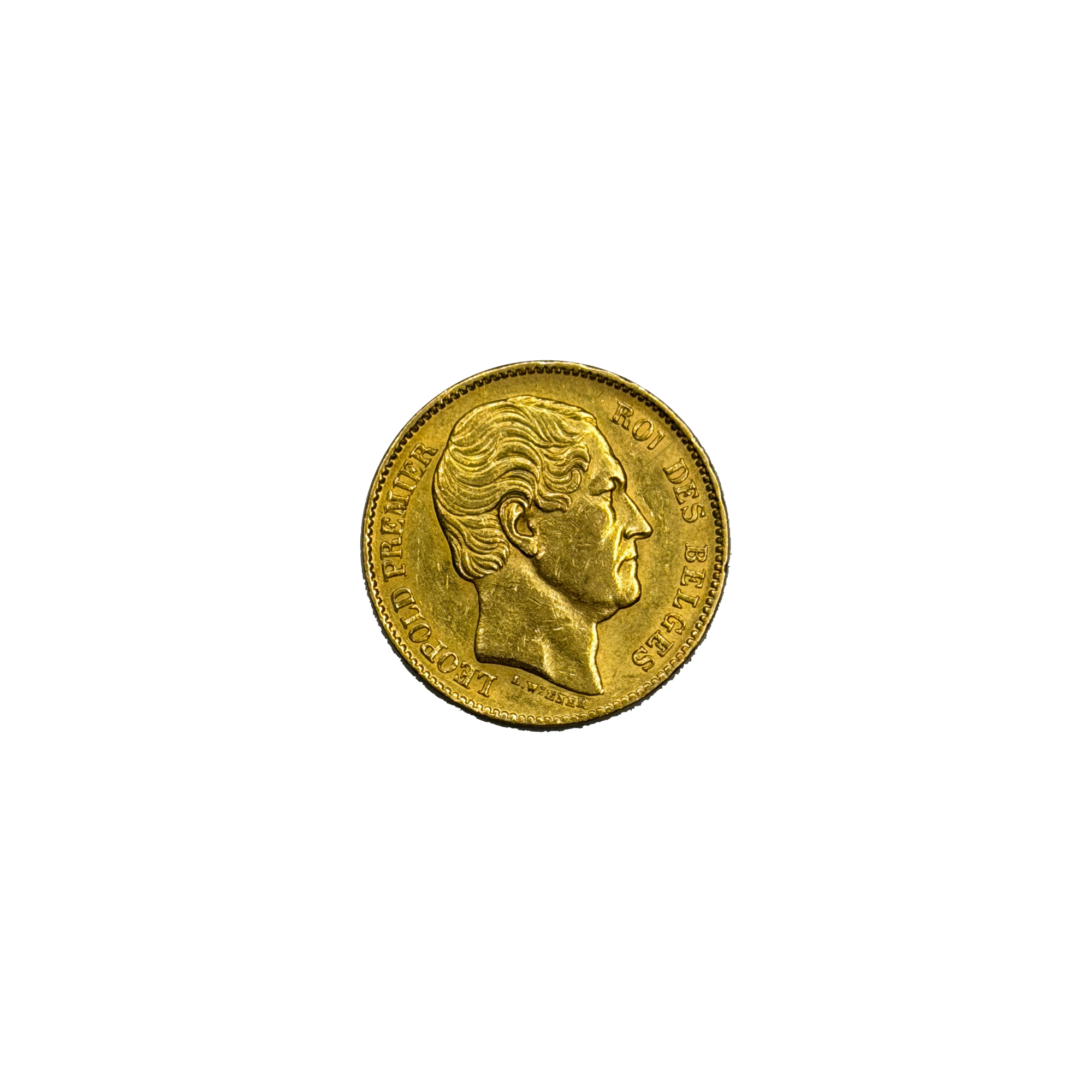
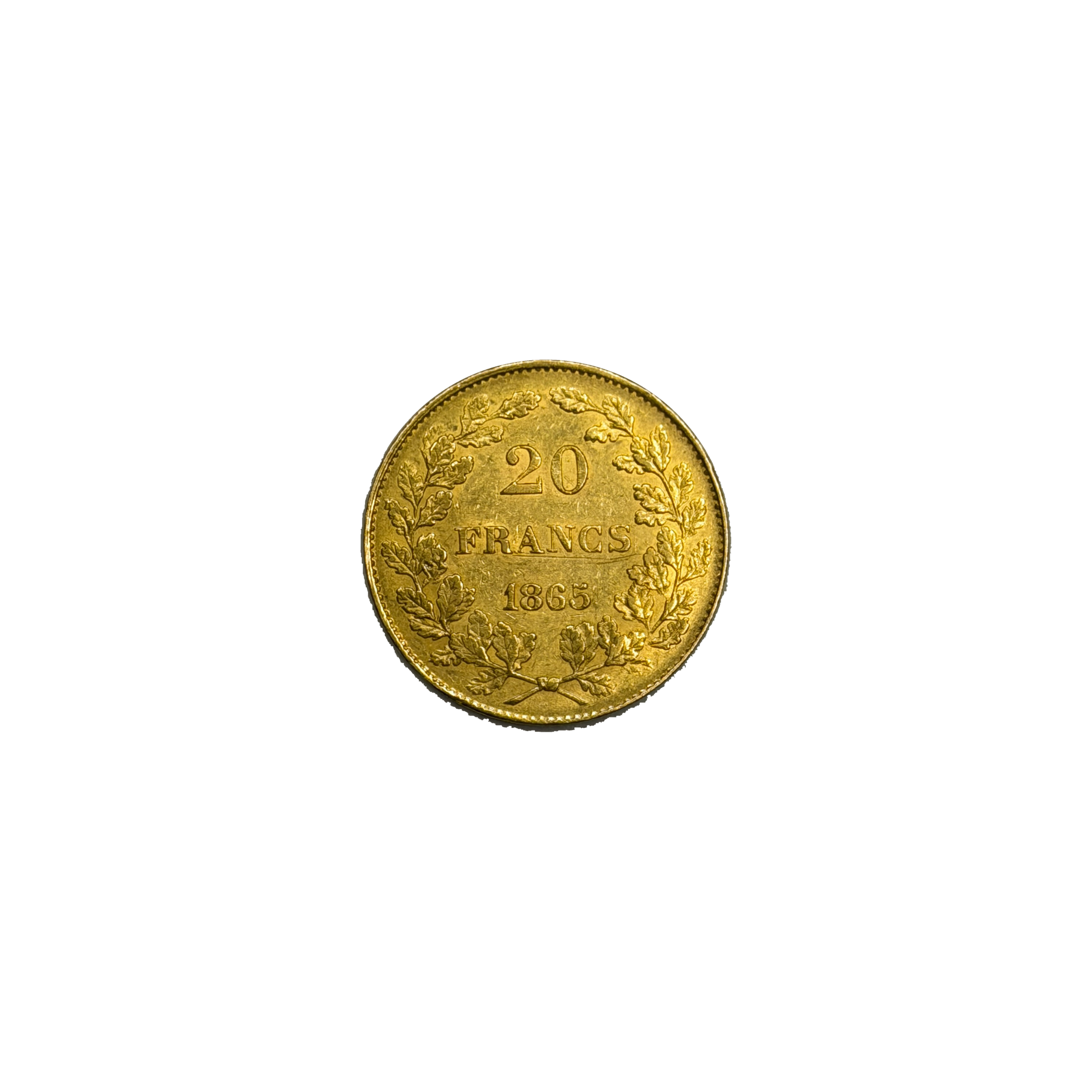
The obverse bears the bare-headed profile of Leopold I facing right, engraved by Leopold Wiener — whose signature appears below the truncation — with the inscription LEOPOLD PREMIER ROI DES BELGES. The reverse is elegantly restrained: the denomination 20 FRANCS and the date within a wreath of oak branches, a neoclassical composition in the tradition of the French francs the coin was built to trade alongside.
At 21mm in diameter and 6.45 grams total weight, each coin contains 0.1867 troy ounces of pure gold in a .900 fine alloy — the Latin Monetary Union standard, interchangeable with the 20 franc gold issues of France, Switzerland, and Italy. Grade range: BU. Minted 1864–1866.
Leopold’s road to the Belgian throne was one of the more remarkable careers of his century. Born in Coburg in 1790, he served as a cavalry officer in the wars against Napoleon, married the heir presumptive to the British throne — Princess Charlotte, whose death in 1817 changed the course of the British succession — and declined the crown of Greece before accepting Belgium’s in 1831. He took a new, fragile state whose independence the great powers doubted and gave it a generation of constitutional stability, earning the informal title “the Nestor of Europe” for the counsel he supplied to its courts.
His family network defined the era. He was uncle to both Queen Victoria and Prince Albert, and he engineered their marriage — making him, in a genuine sense, a grandfather of the royal houses that ruled Europe until 1914. He died on December 10, 1865, in the same year his kingdom helped found the Latin Monetary Union. The gold coins bearing his portrait are the final monetary act of his reign.
The Latin Monetary Union of 1865 was the nineteenth century’s great experiment in currency integration — a treaty under which France, Belgium, Italy, and Switzerland struck gold and silver coins to identical standards so that money could cross borders as freely as trade. The 20 franc gold piece was its flagship denomination: 6.45 grams, .900 fine, 0.1867 troy ounces of gold, whether struck in Paris, Brussels, Rome, or Bern. Belgium was a founding signatory, and the Leopold I 20 Franc — struck in Brussels to that standard in the union’s founding period — documents the moment a five-year-old idea of monetary Europe first became working coinage. The saver of that era knew that 20 francs deposited would translate to the same 20 francs in value when withdrawn — a promise the gold itself enforced.
The mintage record makes the comparative case plainly. The Leopold I type documented here was struck from 1864 to 1866, totaling just over 1.5 million coins:
| Year | Mintage |
|---|---|
| 1864 | — |
| 1865 | 1,016,103 |
| 1866 | 531,963 |
| Total | 1,548,066 |
The references consulted record no separate mintage figure for the 1864 issue (shown with a dash).
Set against the 27.6 million Leopold II 20 Francs struck between 1867 and 1882 — to say nothing of the far larger French 20 franc issues of the same era — the Leopold I supply is thinner by an order of magnitude, and more than a century and a half of attrition has only narrowed it. Supply of that kind is fixed and can never be replenished. The coin nonetheless trades on its gold content first and its scarcity second, at premiums that remain accessible — precisely the structure that creates the value: order-of-magnitude scarcity acquired at a price anchored to gold content.
As an LMU-standard 20 franc gold piece, the Leopold I benefits from one of the deepest recognition pools in the historic gold market. Its specifications are identical to the Swiss 20 Franc Helvetia and the French and Italian 20 franc issues, its gold content is universally documented, and dealers across North America and Europe price the format on sight. Belgian issues are somewhat harder to come by than the common French coins of the era, but they trade in the same active market — the scarcer national issue rides on the liquidity of the shared standard.
In 1933, FDR issued Executive Order 6102, requiring Americans to surrender their gold coin and bullion to the Treasury — but the order and the regulations that followed it exempted gold coins of recognized special value to collectors of rare and unusual coins. Subsequent clarifications by the Treasury identified pre-1933 gold coins — a classification that includes the Belgian 20 Franc Leopold I, struck between 1864 and 1866 — as falling within that collector classification as historical items.
Under current constitutional law, a government intervention in the gold market would be executed through the power of eminent domain — the government’s right to take private property for public use provided it pays the owner just compensation. Historic coins complicate the government’s ability to broadly establish “just compensation” or “fair value,” which was precisely the reasoning behind the original “recognized special value” exemption in 1933. That complexity, and the precedent surrounding pre-1933 gold coins, creates a notable impediment to the government’s ability to restrict them broadly — particularly compared to modern bullion, which can be valued easily and consistently at a single price. In essence, it is a bureaucratic question of whether the government would undertake the enormous task of valuing the diversity and complexity of the historic-coin genre — every coin, every date, every condition, every personal holding — and that difficulty is what insulates the owner’s legal liquidity rights in the event of capital controls.
Whether a future government intervention in private gold markets is a risk an investor assigns significant weight to is a personal judgment. The factual point is narrower: the pre-1933 status represents a layer of portfolio differentiation that this coin carries at minimal added per-ounce cost over comparable modern bullion, along with a measure of insulation for the legal liquidity rights of its owner.
For a more in-depth study, we invite you to read our comprehensive memorandum on this subject: Preparing for a Potential Gold Confiscation
The Leopold I 20 Franc unites a founding king, a founding monetary union, and the thinnest documented supply in the Belgian gold series — 1.5 million coins struck against the 27.6 million of the reign that followed. It carries that scarcity inside the most recognized fractional gold standard Europe ever produced, with the divisible negotiability of its size—though an issue this thin reaches the market irregularly, is rarely available in quantity, and tends to be quickly subscribed when it appears. No other Belgian gold coin combines so distinguished an origin with so thin a supply at so accessible a cost.
BU
1864-1866
.1867 troy ounce
Belgium
| Quantity | Wire | Card |
|---|---|---|
| 1–24 | $972.23 | $1,012.74 |
| 25–49 | $962.51 | $1,002.61 |
| 50+ | $952.79 | $992.49 |
Quantity tiers reflect the historic & fractional gold order discount (1% at $25,000+ · 2% at $50,000+ in qualifying coins). Any mix of qualifying historic coins counts toward the same order total.
Prices shown under Wire include a 4% cash discount. Card prices are the full list price. ACH bank transfer is available to established clients only. First-time orders can be paid by wire transfer or card.
Interested in gold but struggling to find the right firm?

BU
1914
.1867 troy ounce
Belgium


