

You must have an order with a minimum of $1,000.00 to place your order, your current order total is $0.00.
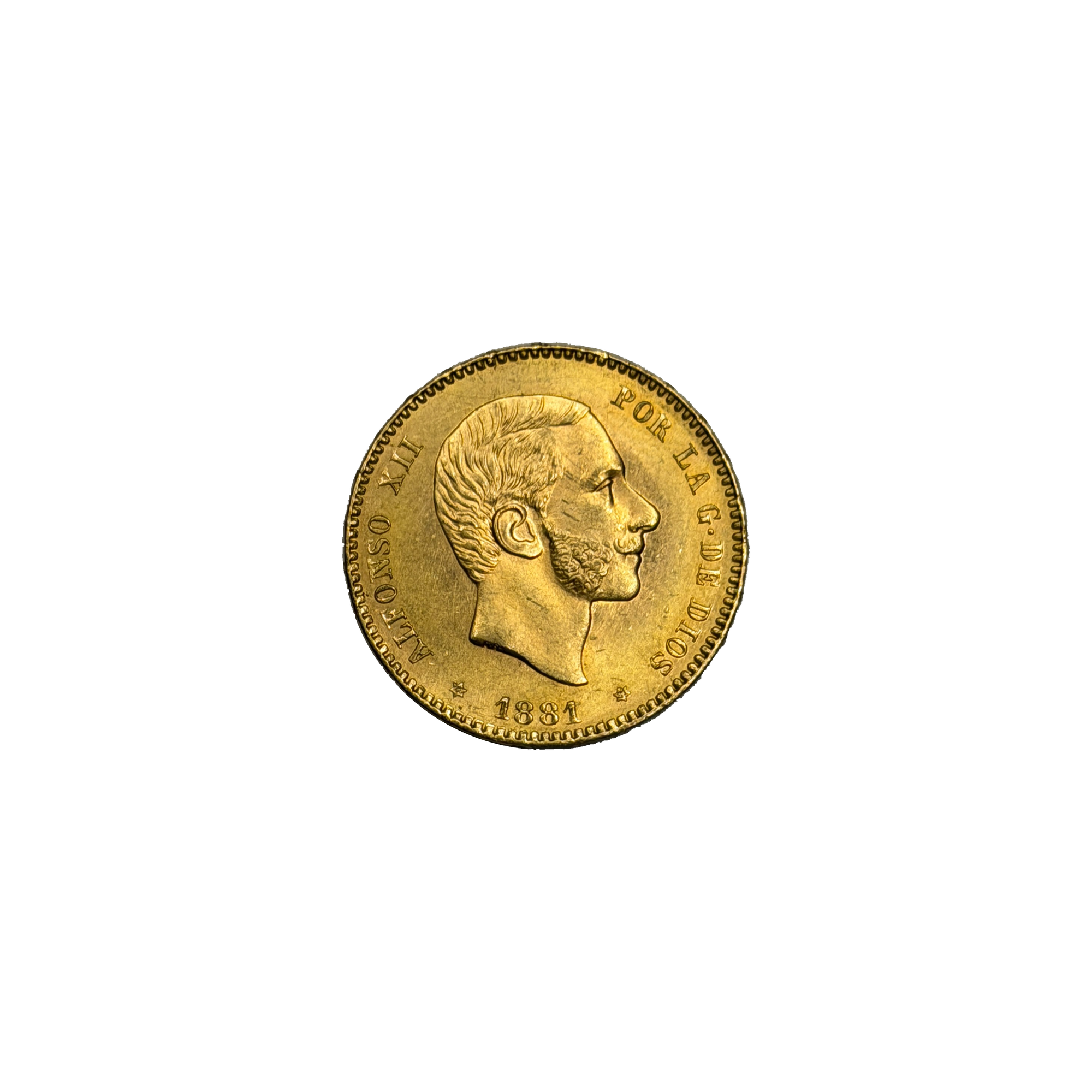
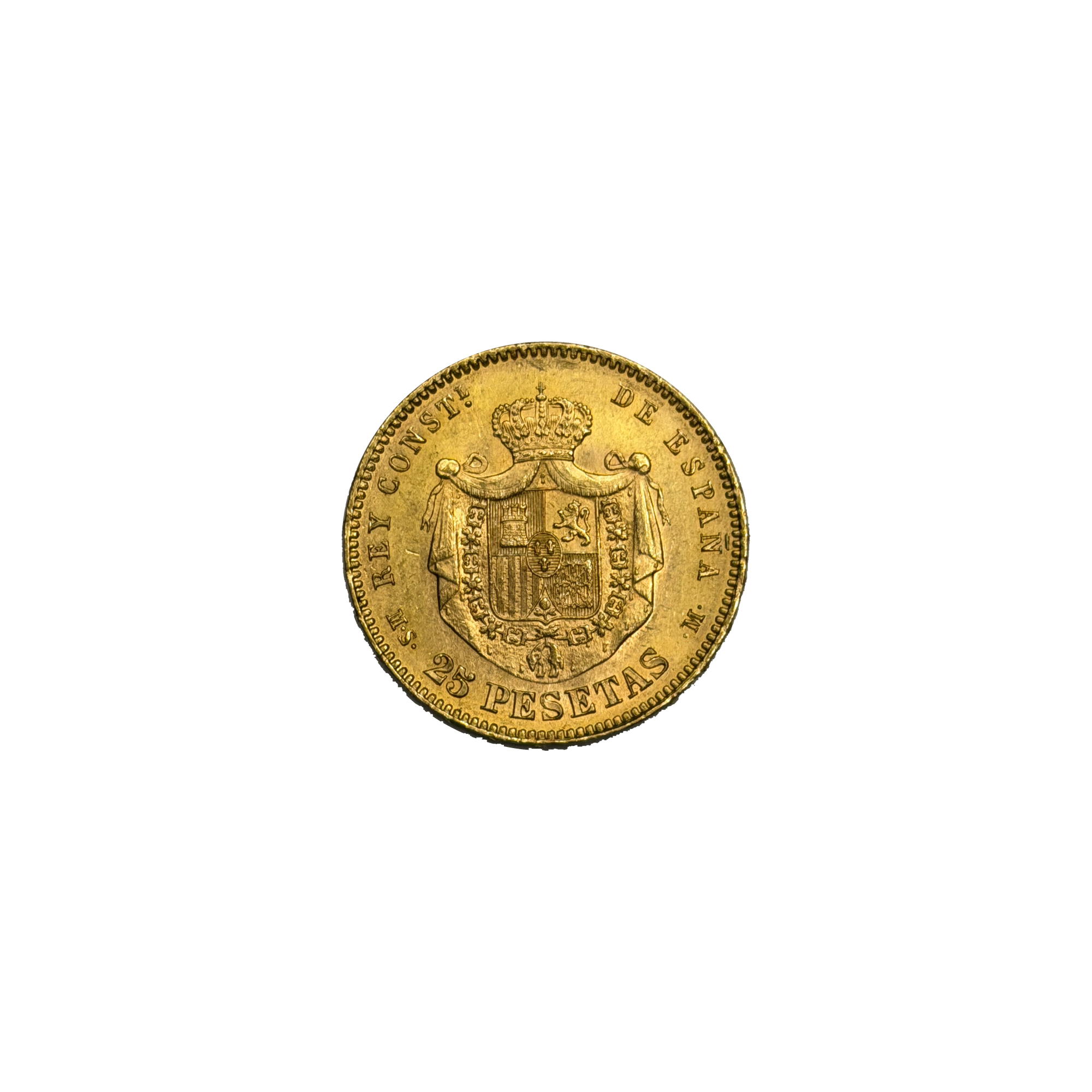
In 1874, Spain emerged from six years of upheaval — a deposed queen, an imported Italian king who abdicated, and a First Republic that collapsed within two — by restoring the Bourbon monarchy under a 17-year-old king, Alfonso XII. The restoration worked. Spain stabilized, adopted a durable constitution in 1876, and put its money where its ambitions were: a new gold 25 Peseta piece, struck to the same weight-and-fineness system as the franc-based coinage of the Latin Monetary Union, aligning Spanish gold with the monetary mainstream of Europe. The 25 Peseta coins of Alfonso XII, struck from 1876 to 1885, are the signature gold coin of that recovery — the money of a monarchy rebuilding a nation.
For investors, the coin’s profile is a familiar and attractive one. It trades at per ounce acquisition costs comparable to modern bullion and tracks directly with the spot price of gold over time — the profile USAGOLD classifies instructively as “historical bullion” — while carrying the pre-1933 designation and the associated insulation against the possibility of future government intervention. At just under one-quarter of a troy ounce, it offers divisible negotiability: affording its owner the flexibility to liquidate positions incrementally, in amounts proportionate to the specific needs of the moment and across a variety of circumstances. And because Spain coined on the European franc standard without joining the treaty that governed it, the 25 Peseta surfaces in the American market far less often than the French, Swiss, and Italian pieces it matches — familiar specifications, less familiar supply. For investors whose priorities are notable scarcity from a five-year striking window, divisible negotiability, and a standardized and widely recognized gold content—all for near-bullion pricing—the Alfonso XII 25 Peseta is among the most distinctive instruments in the historic gold market today.
The obverse bears a right-facing portrait of King Alfonso XII with short-cropped hair and the full whiskers of his adult years, surrounded by the inscription ALFONSO XII POR LA G. DE DIOS — “Alfonso XII, by the Grace of God” — with the date below flanked by six-pointed stars. The reverse carries the crowned arms of Spain — the quartered castles and lions of Castile and León with the Bourbon escutcheon at center — draped in the royal mantle beneath the continuing legend REY CONSTL. DE ESPAÑA (“Constitutional King of Spain”), with the denomination 25 PESETAS below and the Madrid mint and assayer marks flanking the arms. The title itself is part of the design’s story: Spanish kings had reigned by divine right for centuries, and this coin pairs “by the Grace of God” with “Constitutional King” — the Restoration’s compromise, stamped in gold.
Each coin weighs 8.06 grams, is struck from .900 fine gold, and contains 0.2333 troy ounces of actual gold content — the 25-unit denomination of the franc-based system on which the peseta was built, placing it between the 20 Franc pieces (0.1867 oz) and the British sovereign (0.2354 oz) in gold content. Grade range: VF/XF. Minted 1881–1885.
Alfonso XII spent his adolescence in exile — in Paris and Vienna, and at the British Royal Military Academy at Sandhurst — while Spain cycled through revolution, a provisional government, an experimental monarchy, and a short-lived republic. When the army pronounced for the Bourbon restoration in December 1874, the young king returned with a manifesto promising constitutional monarchy, and he largely delivered: the Constitution of 1876 endured into the twentieth century, and his reign brought an end to the Carlist civil war and a period of genuine political calm that Spaniards had not known in a generation. He earned the epithet el Pacificador — the Peacemaker. His death from tuberculosis in 1885, at just 27, cut the reign short; his son Alfonso XIII was born posthumously the following year, and the 25 Peseta denomination effectively belongs to the father’s decade alone.
The peseta itself was a product of Spain’s turbulent 1860s: the provisional government of 1868 created it as a decimal currency deliberately aligned with the French franc, at par, in weight and fineness. Spain never formally signed the Latin Monetary Union treaty, but it built its coinage to the Union’s specifications — which is why the Alfonso XII 25 Peseta slots precisely into the same monetary family as the French 20 Franc, Swiss 20 Franc Helvetia, and Italian 20 Lira, as the system’s quarter-ounce-class gold piece. The coins circulated through the years when Spain still administered an empire from Cuba to the Philippines, and they remain the most recognizable gold coinage of Spain’s constitutional monarchy — struck in the brief window of one reign, in one decade, before Spanish gold coinage dwindled in the 1890s and ceased for circulation early in the twentieth century.
The 25 Peseta’s franc-standard specifications make it immediately intelligible to dealers across North America and Europe: .900 fine gold on the same system as the most heavily traded historic fractional coins in the world, documented in every standard reference. It converts to cash quickly wherever gold trades, and its fractional size adds practical flexibility — holdings can be liquidated a coin at a time, in increments of just under a quarter ounce, rather than in the full-ounce steps modern bullion often requires. Within that familiar system, the Spanish issues offer something the French pieces cannot: a coin that trades on completely standard specifications while appearing in the market far less frequently, giving investors comparative scarcity without any sacrifice of recognizability.
In 1933, FDR issued Executive Order 6102, requiring Americans to surrender their gold coin and bullion to the Treasury — but the order and the regulations that followed it exempted gold coins of recognized special value to collectors of rare and unusual coins. Subsequent clarifications by the Treasury identified pre-1933 gold coins — a classification that includes the Spanish 25 Peseta of Alfonso XII, struck between 1876 and 1885 — as falling within that collector classification as historical items.
Under current constitutional law, a government intervention in the gold market would be executed through the power of eminent domain — the government’s right to take private property for public use provided it pays the owner just compensation. Historic coins complicate the government’s ability to broadly establish “just compensation” or “fair value,” which was precisely the reasoning behind the original “recognized special value” exemption in 1933. That complexity, and the precedent surrounding pre-1933 gold coins, creates a notable impediment to the government’s ability to restrict them broadly — particularly compared to modern bullion, which can be valued easily and consistently at a single price. In essence, it is a bureaucratic question of whether the government would undertake the enormous task of valuing the diversity and complexity of the historic-coin genre — every coin, every date, every condition, every personal holding — and that difficulty is what insulates the owner’s legal liquidity rights in the event of capital controls.
Whether a future government intervention in private gold markets is a risk an investor assigns significant weight to is a personal judgment. The factual point is narrower: the pre-1933 status represents a layer of portfolio differentiation that this coin carries at minimal added per-ounce cost over comparable modern bullion, along with a measure of insulation for the legal liquidity rights of its owner.
For a more in-depth study, we invite you to read our comprehensive memorandum on this subject: Preparing for a Potential Gold Confiscation
The Spanish 25 Peseta of Alfonso XII compresses an entire national recovery into a single gold coin — the Bourbon restoration, the Constitution of 1876, and Spain’s deliberate alignment with the European gold mainstream, all struck within one ten-year reign. It offers investors a standardized and widely recognized gold content on the franc-standard model, divisible negotiability at just under a quarter ounce, and comparative scarcity in the American market — at per ounce acquisition costs comparable to modern bullion, in a coin that surfaces on this side of the Atlantic only irregularly. No other Spanish gold coin offers investors this combination of familiarity, history, and value in so practical a form.
| Year | Mintage |
|---|---|
| 1881 (81) | 4,366,000 |
| 1882 (82) | 414,000 |
| 1883 (83) | 669,000 |
| 1884 (84) | 1,033,000 |
| 1885 (85) | 503,000 |
| 1885 (86) | 491,000 |
| Total | 7,476,000 |
Mintage figures per the Standard Catalog of World Coins, via the NGC World Price Guide. Dates NGC lists without figures are shown with a dash. (xx) is the star date in the coin’s field. The earlier Alfonso XII type of 1876–1880 (KM-673) adds roughly 29.9 million beyond the listed range.
VF, XF
1881-1885
.2333 troy ounce
Spain
| Quantity | Wire | Card |
|---|---|---|
| 1–18 | $1,263.34 | $1,315.98 |
| 19–37 | $1,250.71 | $1,302.82 |
| 38+ | $1,238.07 | $1,289.66 |
Quantity tiers reflect the historic & fractional gold order discount (1% at $25,000+ · 2% at $50,000+ in qualifying coins). Any mix of qualifying historic coins counts toward the same order total.
Prices shown under Wire include a 4% cash discount. Card prices are the full list price. ACH bank transfer is available to established clients only. First-time orders can be paid by wire transfer or card.
Interested in gold but struggling to find the right firm?


