

You must have an order with a minimum of $1,000.00 to place your order, your current order total is $0.00.
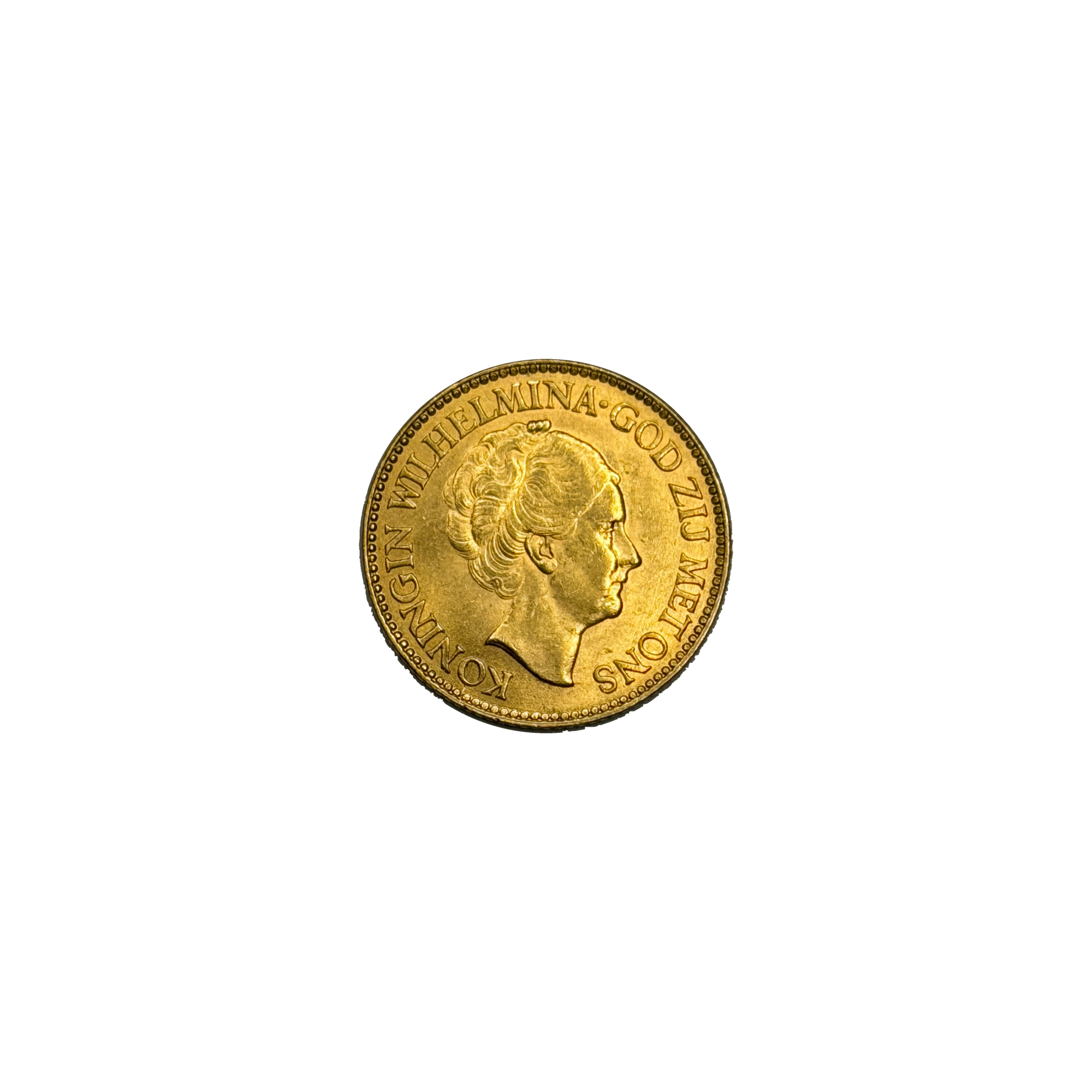
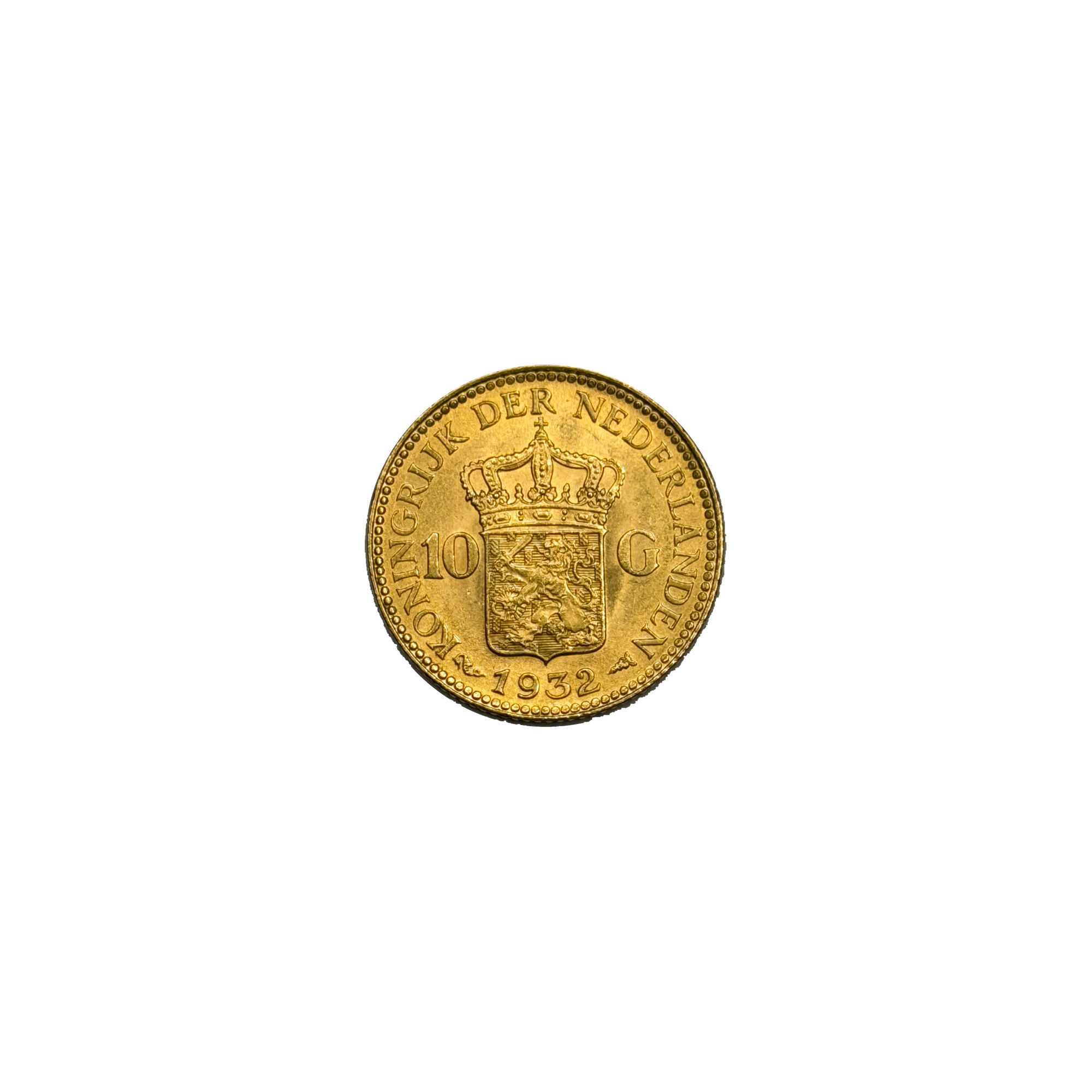
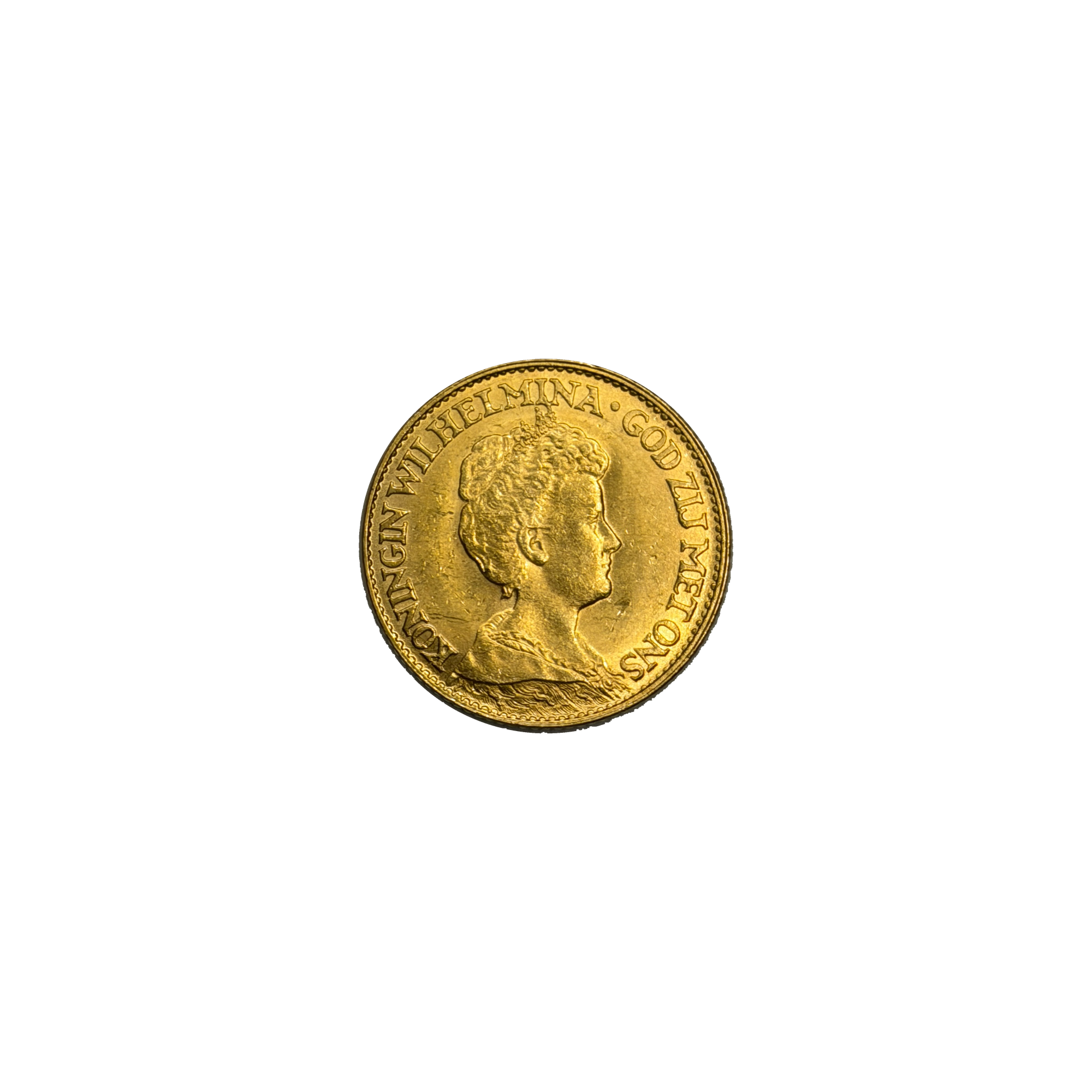
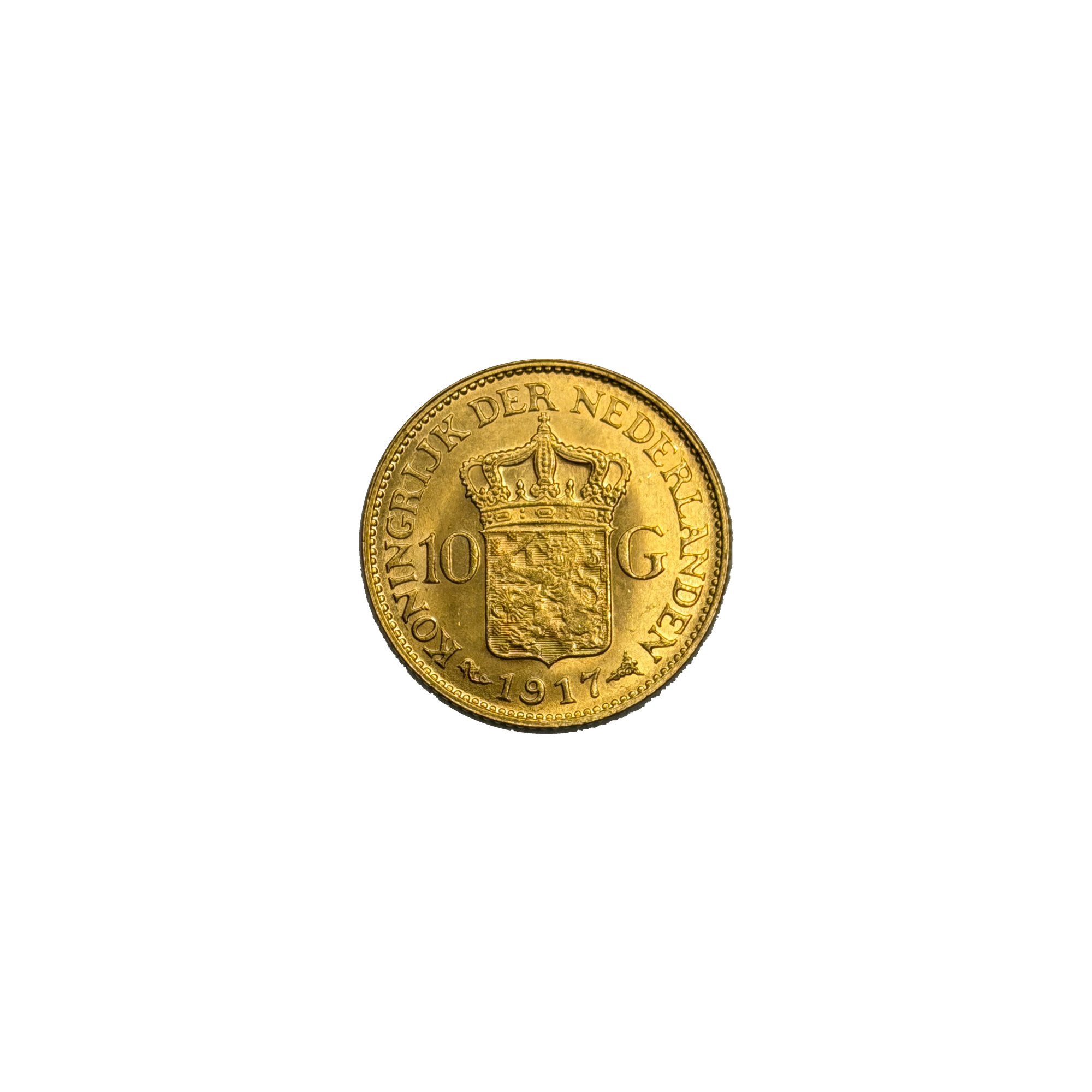
The Netherlands 10 Guilder Queen Wilhelmina is among the most practical entries into pre-1933 European gold available to investors today. At 0.1947 troy ounces of .900 fine gold, it trades at per ounce acquisition costs comparable to modern fractional bullion coins and tracks directly with the spot price of gold over time — while carrying the historic (pre-1933) designation and the associated insulation against the possibility of future government intervention.
The comparison to the British sovereign makes the scarcity argument clearly: sovereign production during peak years regularly exceeded 30 million coins per year. Total production of the Queen Wilhelmina Guilder across all nine dates of the series — spanning more than two decades — amounts to approximately 21.2 million pieces. The Guilder is a meaningfully scarcer instrument than the sovereign, and it is priced as though the difference does not exist. At roughly one-fifth of a troy ounce, the coin also offers divisible negotiability: affording its owner the flexibility to liquidate positions incrementally, in amounts proportionate to the specific needs of the moment and across a variety of circumstances. For investors whose priorities are the on-sight recognizability and deep liquidity of one of Europe’s most widely traded gold coin families, joined to meaningful comparative scarcity against the British sovereign—all for near-bullion pricing—the Wilhelmina Guilder is the flagship of the Dutch series and among the most efficient instruments in the fractional gold market today.
The obverse bears the portrait of Queen Wilhelmina in her mature years — her bearing composed and authoritative, carrying the quiet gravity of a monarch who had already navigated the First World War. The reverse displays the Dutch coat of arms: the crowned rampant lion of the House of Nassau, flanked by the denomination 10 G, set within an ornate shield — clean, heraldically precise, and consistent with the Dutch tradition of understated official imagery.
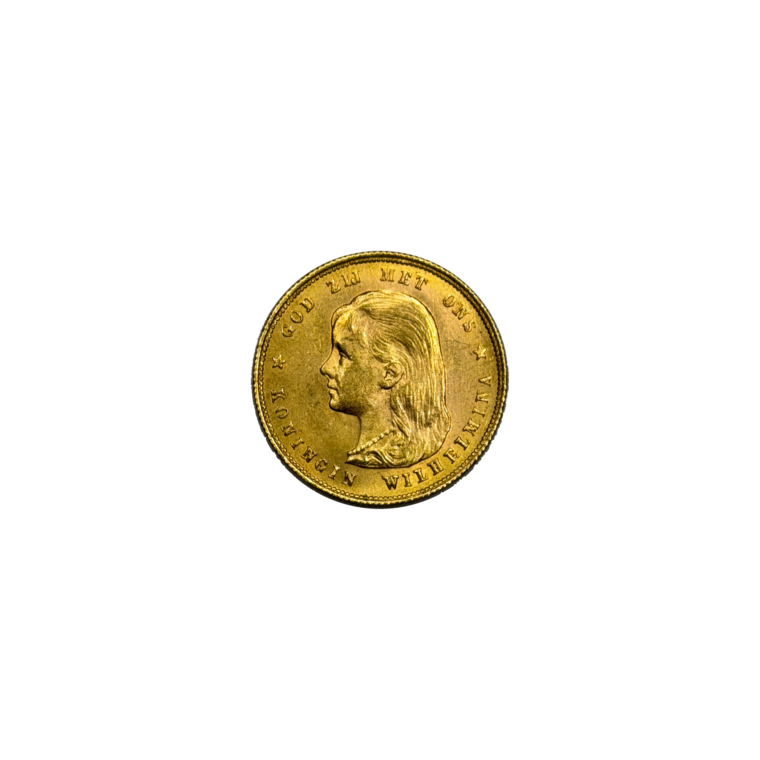
At 22.5mm in diameter and 6.72 grams total weight, the coin contains 0.1947 troy ounces of pure gold in a .900 fine alloy — slightly more gold content than the Swiss 20 Franc Helvetia (0.1866 oz) or the French 20 Franc (0.1867 oz), making it a marginally better value per premium dollar at equivalent pricing. Grade range is BU to UNC. Minted 1911–1933 (the Long Hair portrait of 1892–1897 is offered separately). USAGOLD specifies pre-1933 dated coins.
Wilhelmina Helena Pauline Maria of Orange-Nassau ascended to the Dutch throne in 1890 at age ten, formally taking power in 1898 at eighteen after the Dutch parliament passed special legislation permitting a woman to reign. She would hold the throne for fifty-eight years — one of the longest reigns of any European monarch of the modern era.
Her intelligence was evident early. At a pre-war diplomatic meeting, Kaiser Wilhelm II boasted that his palace guards stood seven feet tall, while the Dutch guards barely reached their shoulders. Wilhelmina replied without hesitation: “Quite true, Your Majesty — but when we open our dikes, the water is ten feet deep.”
Beyond statecraft, Wilhelmina demonstrated a rare talent for finance. Through strategic investments and careful management of the Dutch royal estates, she accumulated a personal fortune exceeding one billion dollars — making her the first female billionaire in recorded history, and an insider in the highest circles of international finance in an era when almost no women occupied such positions.
When Germany invaded the Netherlands in May 1940, Wilhelmina refused to capitulate. She relocated to London and led the Dutch government-in-exile throughout the occupation, broadcasting to her occupied countrymen via Radio Oranje and calling Adolf Hitler “the archenemy of mankind.” After liberation she returned to the Netherlands and abdicated in 1948 in favor of her daughter Juliana. In 1953, when catastrophic floods devastated the Dutch coast, she was seventy-two years old; she bicycled through the affected countryside offering encouragement to survivors. The coins this page describes were struck during the decades when that woman was the reigning monarch of the Netherlands.
The Netherlands 10 Guilder is the coin of a country that essentially invented the modern financial system. In the seventeenth century, Amsterdam was the financial capital of the world: the Dutch East India Company was the first publicly traded joint-stock corporation in history; the Amsterdam Exchange Bank was the prototype for central banking; and the Dutch guilder was the reserve currency of European trade for more than a century. The tulip mania of 1637 — still the textbook example of speculative excess — was a Dutch phenomenon precisely because Holland was the most financially sophisticated society on earth.
The coins in this series were struck between 1911 and 1933 — across the First World War, the Roaring Twenties, and into the opening years of the Great Depression. They witnessed the destruction of the gold standard in stages: Germany’s suspension in 1914, Britain’s in 1931, the United States’ domestic gold recall in 1933. The 1933 date on the final Wilhelmina issue is historically pointed: it is the same year President Roosevelt signed Executive Order 6102, effectively ending American private gold ownership for a generation. The coins that survive from that series are the physical record of the last of the pre-1933 era.
Among pre-1933 European fractional gold coins, the Netherlands 10 Guilder stands alongside the Swiss 20 Franc Helvetia and the British sovereign as one of the most immediately recognized instruments in the international gold market. Dealers across North America and Europe identify it on sight, its gold content is standardized and well-documented, and its trading history is deep enough that bid-ask spreads remain tight in active markets. For investors who prioritize the ability to convert a holding to cash quickly, the Guilder performs that function reliably.
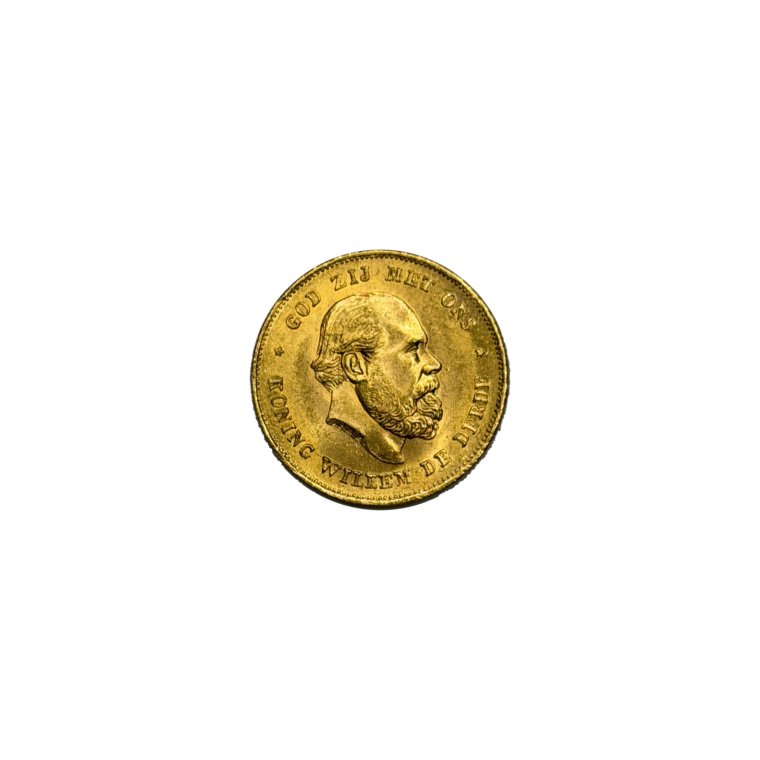
The series is offered in both the Queen Wilhelmina mature portrait (1911–1933) and the Long Hair variety (1892–1897), as well as the King Willem III issues (1875–1889). Each variety carries the same gold content and the same liquidity profile. Collectively, the Dutch 10 Guilder series remains one of the most consistently in-demand pre-1933 fractional gold offerings in both the American and European markets — a coin investors return to because it delivers maximum gold, minimum premium, and immediate recognizability.
In 1933, FDR issued Executive Order 6102, requiring Americans to surrender their gold coin and bullion to the Treasury — but the order and the regulations that followed it exempted gold coins of recognized special value to collectors of rare and unusual coins. Subsequent clarifications by the Treasury identified pre-1933 gold coins — a classification that includes the Netherlands 10 Guilder, as specified by USAGOLD in pre-1933 dated form — as falling within that collector classification as historical items.
Under current constitutional law, a government intervention in the gold market would be executed through the power of eminent domain — the government’s right to take private property for public use provided it pays the owner just compensation. Historic coins complicate the government’s ability to broadly establish “just compensation” or “fair value,” which was precisely the reasoning behind the original “recognized special value” exemption in 1933. That complexity, and the precedent surrounding pre-1933 gold coins, creates a notable impediment to the government’s ability to restrict them broadly — particularly compared to modern bullion, which can be valued easily and consistently at a single price. In essence, it is a bureaucratic question of whether the government would undertake the enormous task of valuing the diversity and complexity of the historic-coin genre — every coin, every date, every condition, every personal holding — and that difficulty is what insulates the owner’s legal liquidity rights in the event of capital controls.
Whether a future government intervention in private gold markets is a risk an investor assigns significant weight to is a personal judgment. The factual point is narrower: the pre-1933 status represents a layer of portfolio differentiation that this coin carries at minimal added per-ounce cost over comparable modern bullion, along with a measure of insulation for the legal liquidity rights of its owner.
For a more in-depth study, we invite you to read our comprehensive memorandum on this subject: Preparing for a Potential Gold Confiscation
The Netherlands 10 Guilder Queen Wilhelmina is the gold coin of the country that invented modern finance — struck during the reign of a monarch who understood, firsthand, what money was worth when governments failed. It is meaningfully scarcer than the British sovereign yet priced at near-bullion levels, it carries slightly more gold than its Swiss and French counterparts at equivalent pricing, and it anchors one of the most recognized and readily traded gold coin families in Europe. No other fractional European gold coin combines this degree of comparative scarcity, liquidity, and value per premium dollar for gold investors.
| Year | Mintage |
|---|---|
| 1911 | 775,000 |
| 1912 | 3,000,000 |
| 1913 | 1,133,000 |
| 1917 | 4,000,000 |
| 1925 | 2,000,000 |
| 1926 | 2,500,000 |
| 1927 | 1,000,000 |
| 1932 | 4,324,000 |
| 1933 | 2,462,000 |
| Total | 21,194,000 |
Per USAGOLD’s classification convention, the 1933-dated final issue is grouped with the pre-1933 coins — the entire series total above carries the pre-1933 classification described in the Pre-1933 Advantage section.
UNC, BU
1911-1933
.1947 troy ounce
Netherlands
| Quantity | Wire | Card |
|---|---|---|
| 1–27 | $887.13 | $924.09 |
| 28–54 | $878.26 | $914.85 |
| 55+ | $869.39 | $905.61 |
Quantity tiers reflect the historic & fractional gold order discount (1% at $25,000+ · 2% at $50,000+ in qualifying coins). Any mix of qualifying historic coins counts toward the same order total.
Prices shown under Wire include a 4% cash discount. Card prices are the full list price. ACH bank transfer is available to established clients only. First-time orders can be paid by wire transfer or card.
Interested in gold but struggling to find the right firm?

UNC, BU
1892-1897
.1947 troy ounce
Netherlands
UNC, BU
1875 – 1889
.1947 troy ounce
Netherlands


