

You must have an order with a minimum of $1,000.00 to place your order, your current order total is $0.00.
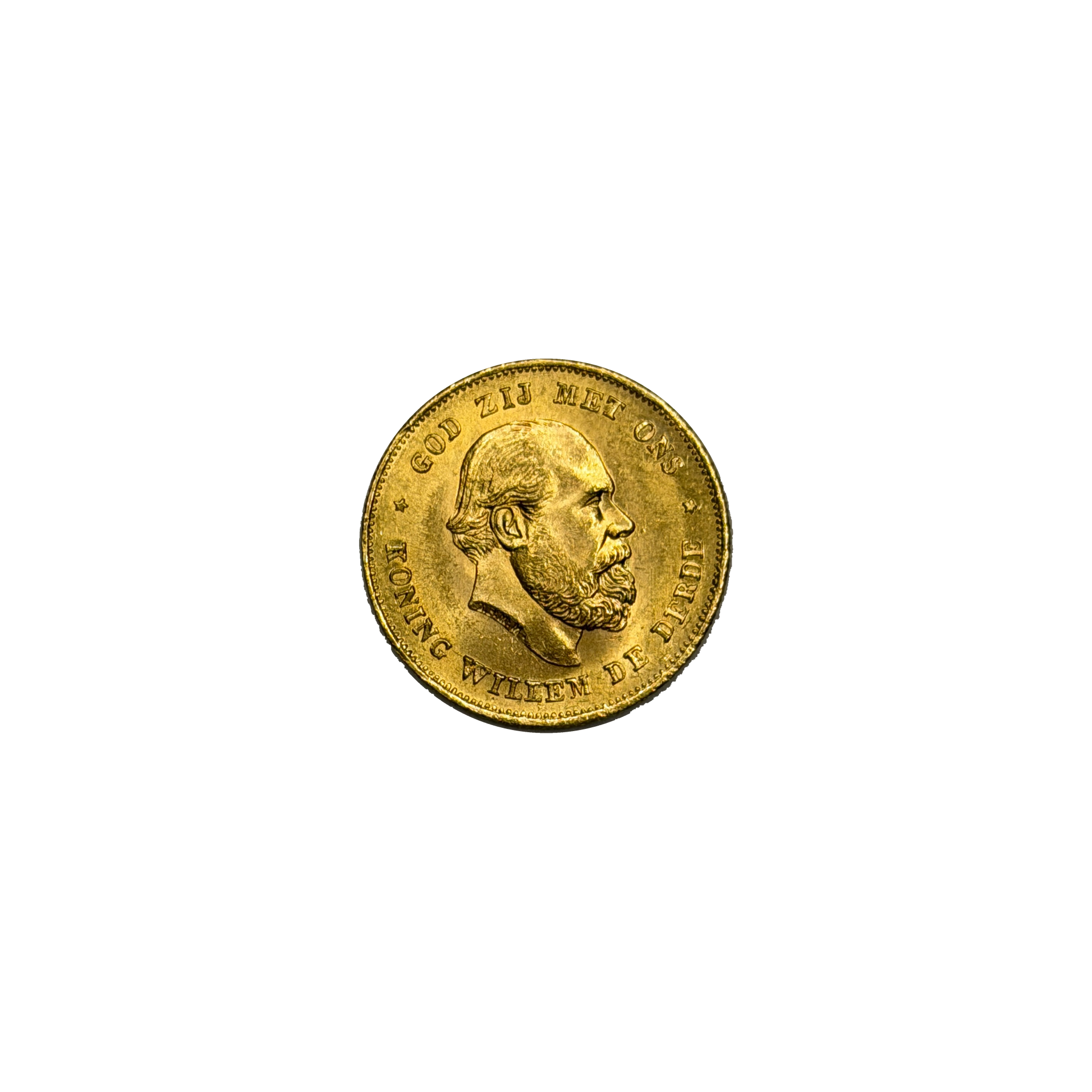
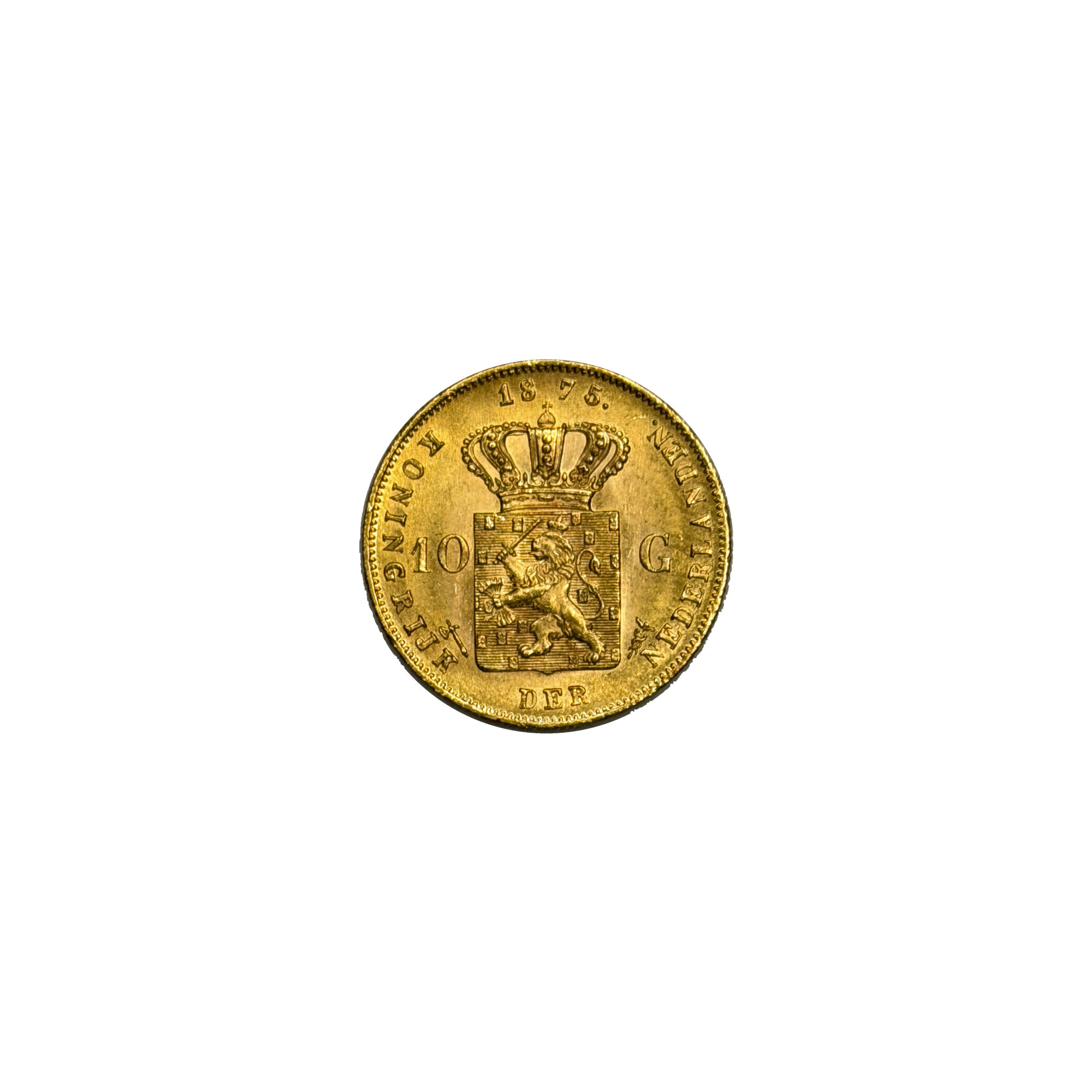
The King Willem III variety is the older and considerably scarcer member of the Dutch 10 Guilder family. Struck from 1875 to 1889, its total mintage of approximately 7.8 million pieces is roughly a third of the 21.2 million Queen Wilhelmina guilders that followed — and a small fraction of the sovereigns Britain produced in single peak years. Yet the market prices the two Dutch varieties within close range of each other, and both at modest premiums to spot.
What makes the “Kings” genuinely unusual is their condition. A surprising majority of the King Willem guilders that reach the market survive in high-end uncirculated condition — a state of preservation rarely encountered in coins struck before 1890. The combination is difficult to find anywhere else in the historic fractional market: one of the oldest and least expensive pre-1900 foreign gold scarcities available in a high state of preservation, carrying the same 0.1947 troy ounces of gold, the same liquidity profile, and the same pre-1933 designation as its better-known Wilhelmina counterpart. At roughly one-fifth of a troy ounce, the coin also offers divisible negotiability: affording its owner the flexibility to liquidate positions incrementally, in amounts proportionate to the specific needs of the moment and across a variety of circumstances. For investors whose priorities are a highly coveted pre-1890 issue within one of Europe’s most recognized gold coin families, notable scarcity against its Wilhelmina successors, and a state of preservation rarely encountered in coins of this age—all for near-bullion pricing—the King Willem guilder is among the most compelling values in pre-1900 European gold.
The obverse bears the right-facing portrait of King Willem III with the legend KONING WILLEM DE DERDE. The reverse displays the crowned Dutch coat of arms — the rampant lion of the House of Nassau — flanked by the denomination 10 G. The design is formal and heraldically precise, consistent with the Dutch tradition of understated official imagery, and it established the visual template the Wilhelmina issues would carry forward.
At 22.5mm in diameter and 6.72 grams total weight, each coin is struck from .900 fine gold and contains 0.1947 troy ounces of actual gold content — identical to the Wilhelmina guilder, and slightly more gold than the Swiss 20 Franc Helvetia (0.1866 oz) or the French 20 Franc (0.1867 oz). Grade range: BU/UNC. Minted 1875–1889.
Willem III ruled the Netherlands from 1849 until his death in 1890 — a monarch of famously autocratic temperament in an age when European crowns were learning constitutional restraint. His contemporaries found him difficult; Queen Victoria, never one to mince words, referred to him as “the uneducated farmer.” He resisted the liberal constitution he inherited, clashed with his ministers for four decades, and remained, to the end, a king of the old absolutist school in a country that had moved on without him.
History gave his reign an ending he could not have scripted: he was succeeded by his ten-year-old daughter Wilhelmina, who would rule for fifty-eight years, become one of the most formidable monarchs of the twentieth century, and preside over the guilders that made the Dutch coin family famous. The King Willem guilders are the coins of the last Dutch king for more than a century — the country was reigned over by queens from 1890 until 2013 — and they carry that distinction with mintages a fraction of their successors’.
The Netherlands occupies a singular place in financial history. Amsterdam was the world’s financial capital in the seventeenth century — home of the first publicly traded joint-stock company and the prototype of central banking — and the site of the tulip mania of 1637, the prototype financial bubble against which all others are still measured. At its 1637 peak, a single rare bulb commanded 5,500 guilders; shortly after, prices collapsed to a fraction of a percent of that level. Manias involving paper assets have recurred with regularity ever since. The gold guilder, by contrast, has done nothing in the intervening centuries but hold its metal.
The King Willem issues belong to the pre-1890 era of that monetary tradition — coins struck when the guilder was gold, under the last Dutch king, in the first generation of the modern Dutch gold standard. Every coin in the series is now well over 130 years old.
The scarcity argument is straightforwardly comparative. Total King Willem production across all dates: approximately 7.8 million. The Wilhelmina series that followed: 21.2 million. British sovereign production at peak: more than 30 million in single years. Within the series itself, the concentration is severe — the 1875–1877 issues account for the great majority, while the 1880s dates were struck in quantities of 36,000 to 205,000 pieces, figures that would qualify as notable rarities in almost any other European series.
The conditional advantage compounds the scarcity. Most pre-1900 European gold survives worn, because it circulated as working money. The King Willem guilders are the exception: a good majority of surviving examples present in high-end uncirculated condition, their original detail and luster intact. A pre-1890 gold coin in that state of preservation, at a modest premium over its gold content, is an offer the historic coin market rarely extends — which is why these coins are a popular portfolio inclusion whenever they are available, and why availability comes and goes.
The Dutch 10 Guilder family — King Willem, Wilhelmina Long Hair, and Wilhelmina mature portrait — is one of the most consistently recognized fractional gold types in the international market. Dealers across North America and Europe identify it on sight, its gold content is standardized and well-documented, and its trading history is deep in both markets. The King Willem variety carries the family’s full liquidity profile while adding the scarcity and condition dimensions the later issues cannot match.
In 1933, FDR issued Executive Order 6102, requiring Americans to surrender their gold coin and bullion to the Treasury — but the order and the regulations that followed it exempted gold coins of recognized special value to collectors of rare and unusual coins. Subsequent clarifications by the Treasury identified pre-1933 gold coins — a classification that includes the King Willem guilder, struck 1875–1889 — as falling within that collector classification as historical items.
Under current constitutional law, a government intervention in the gold market would be executed through the power of eminent domain — the government’s right to take private property for public use provided it pays the owner just compensation. Historic coins complicate the government’s ability to broadly establish “just compensation” or “fair value,” which was precisely the reasoning behind the original “recognized special value” exemption in 1933. That complexity, and the precedent surrounding pre-1933 gold coins, creates a notable impediment to the government’s ability to restrict them broadly — particularly compared to modern bullion, which can be valued easily and consistently at a single price. In essence, it is a bureaucratic question of whether the government would undertake the enormous task of valuing the diversity and complexity of the historic-coin genre — every coin, every date, every condition, every personal holding — and that difficulty is what insulates the owner’s legal liquidity rights in the event of capital controls.
Whether a future government intervention in private gold markets is a risk an investor assigns significant weight to is a personal judgment. The factual point is narrower: the pre-1933 status represents a layer of portfolio differentiation that this coin carries at minimal added per-ounce cost over comparable modern bullion, along with a measure of insulation for the legal liquidity rights of its owner.
For a more in-depth study, we invite you to read our comprehensive memorandum on this subject: Preparing for a Potential Gold Confiscation
The Netherlands 10 Guilder King Willem III is the scarcest and oldest member of one of Europe’s most recognized gold coin families — a pre-1890 coin, from the last Dutch king of the nineteenth century, that survives against all expectation in high-end uncirculated condition and trades at a modest premium over its gold content. It offers a third of the Wilhelmina’s supply at a comparable cost per ounce and with the family’s full liquidity — an heirloom-quality holding rarely available in quantity, and quickly subscribed when it is. No other pre-1900 European gold coin delivers this combination of age, scarcity, and preservation at so accessible a price.
| Year | Mintage |
|---|---|
| 1875 | 4,110,000 |
| 1876 | 1,581,000 |
| 1877 | 1,108,000 |
| 1879 | 581,000 |
| 1880 | 50,000 |
| 1885 | 67,000 |
| 1886 | 54,000 |
| 1887 | 41,000 |
| 1888 | 36,000 |
| 1889 | 205,000 |
| Total | 7,833,000 |
UNC, BU
1875 – 1889
.1947 troy ounce
Netherlands
Prices shown under Wire include a 4% cash discount. Card prices are the full list price. ACH bank transfer is available to established clients only. First-time orders can be paid by wire transfer or card.
Interested in gold but struggling to find the right firm?

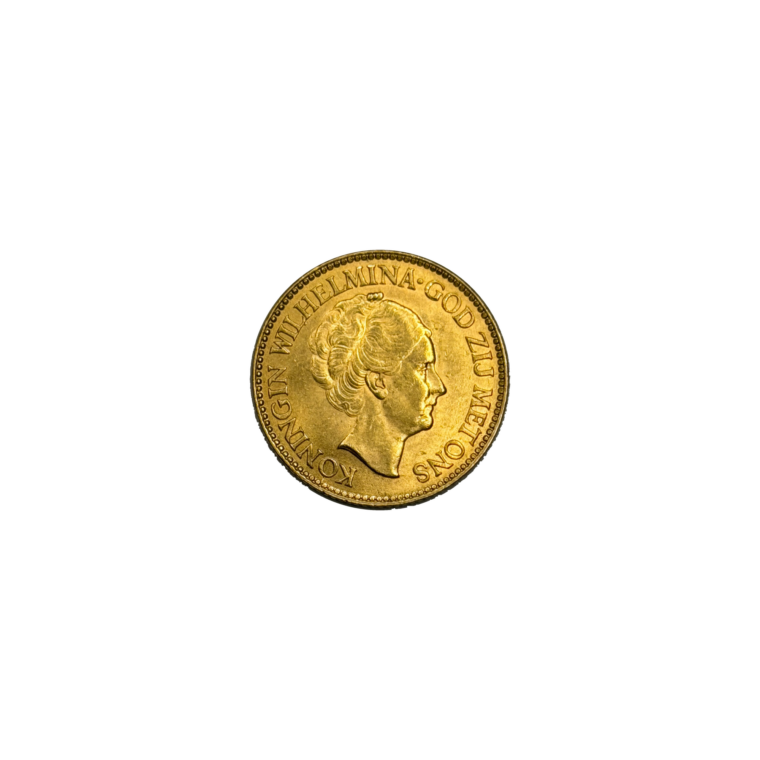
UNC, BU
1911-1933
.1947 troy ounce
Netherlands
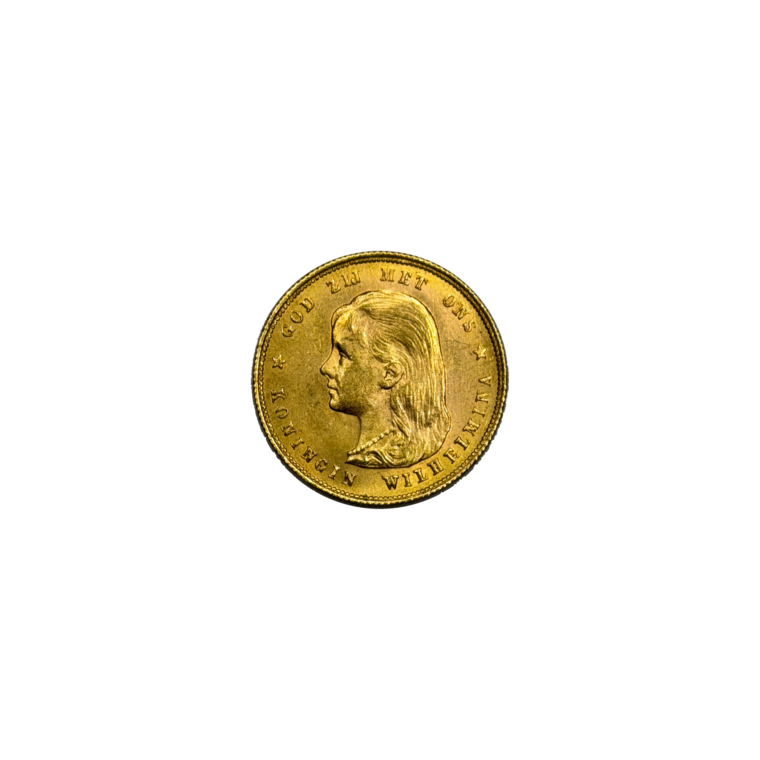
UNC, BU
1892-1897
.1947 troy ounce
Netherlands


