

You must have an order with a minimum of $1,000.00 to place your order, your current order total is $0.00.
Monaco is a sovereign state smaller than New York’s Central Park, and in the 1890s its ruling prince was neither a general nor an empire-builder but a scientist — Albert I, the oceanographer prince, who spent his reign charting the deep Atlantic while his tiny principality struck gold to the same exacting standard as France, Switzerland, and Italy. The 100 franc pieces bearing his portrait, issued in the 1891–1904 era, are among the more unusual artifacts of the classical gold standard: full-weight Latin Monetary Union gold from one of the smallest sovereign states in the world.
For investors, the coin combines three genuine advantages. First, size — at 0.9334 troy ounces of pure gold, the 100 franc is a near-full-ounce holding in a single classic coin, the largest denomination of the pre-1914 European gold system. Second, standard — it was struck to the Latin Monetary Union’s 100-franc specification, the same weight and fineness the market has priced for over a century, which means it trades on documented gold content rather than negotiation. Third, comparative scarcity — a principality of a few thousand residents necessarily struck gold in quantities that are a small fraction of the French issues on the identical standard, giving the Monaco piece a supply profile the major-power coinages cannot match. For investors whose priorities are a highly coveted large-format coin steeped in the history of the Belle Époque, notable comparative scarcity born of a principality’s small mintages, and a standardized and widely recognized gold content, the Albert I 100 Franc is one of the most distinctive large holdings in historic gold — a coin that surfaces irregularly and is rarely available in quantity.
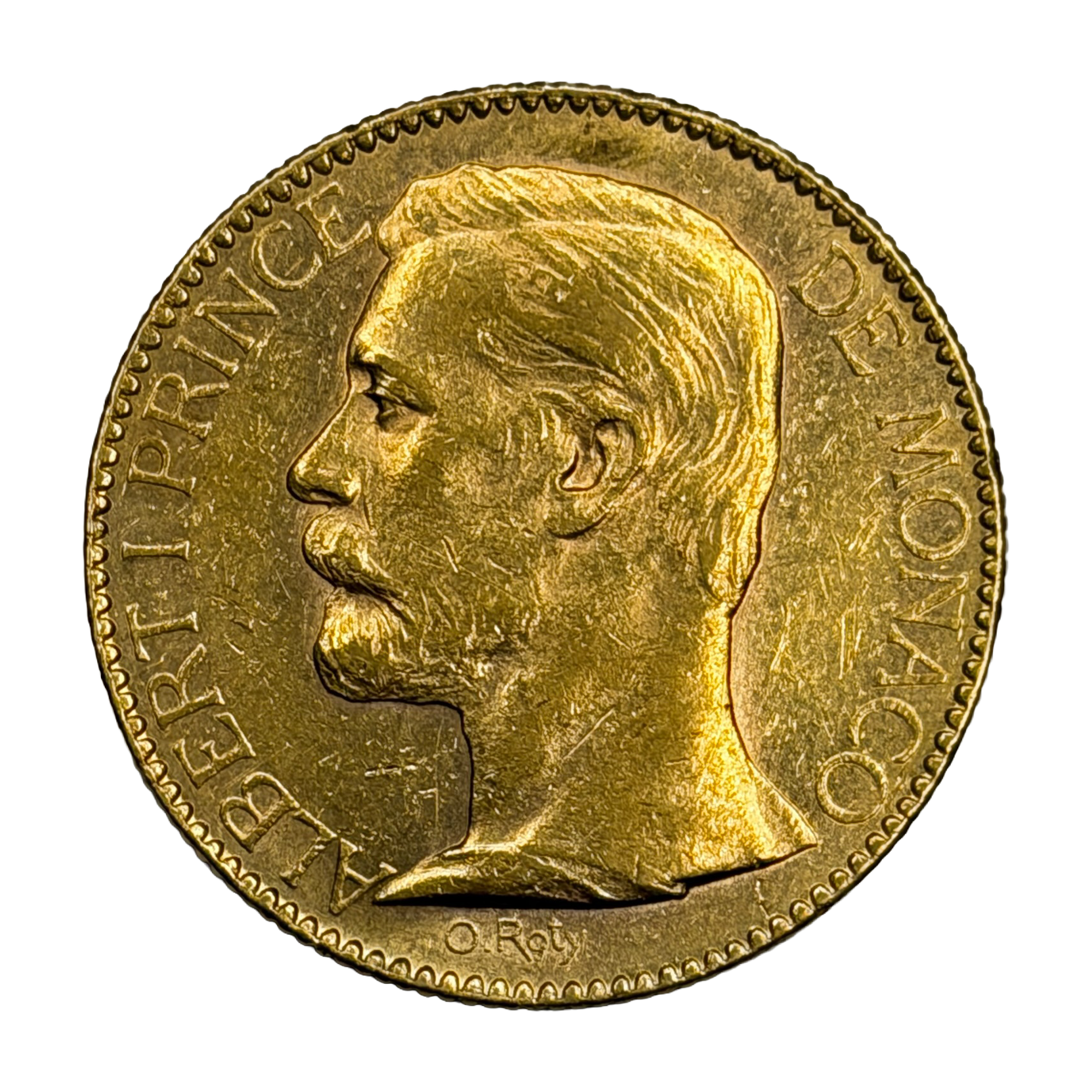
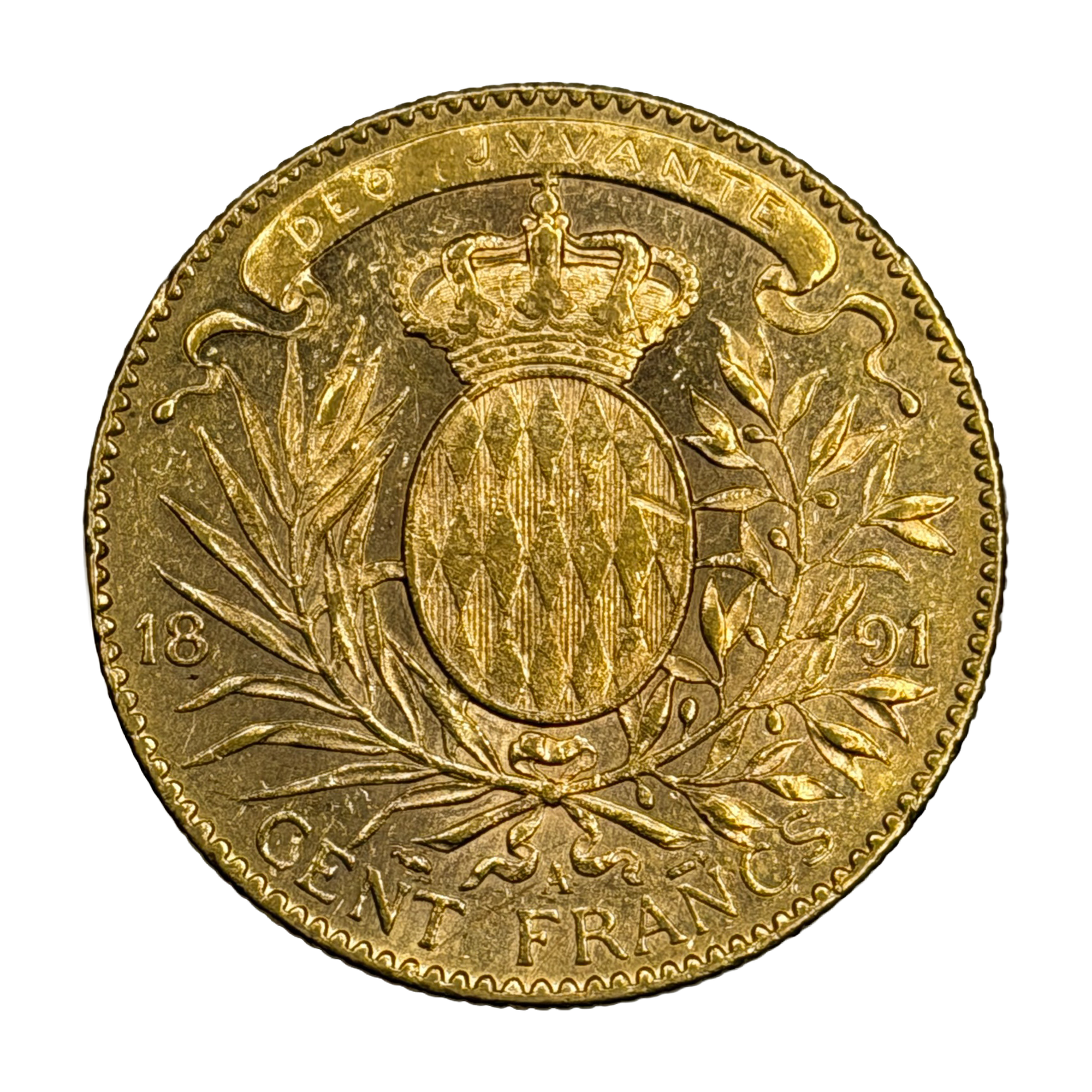
The obverse bears a mature, bearded portrait of Albert I facing left, encircled by the legend ALBERT I PRINCE DE MONACO, with the engraver’s signature at the truncation of the bust. The reverse displays the crowned oval shield of the House of Grimaldi — its field of lozenges instantly identifiable as Monaco’s arms — flanked by branches and surmounted by a banner carrying the Grimaldi motto DEO JUVANTE (“With God’s Help”), with the denomination CENT FRANCS below and the date divided at either side. The example pictured is dated 1891 and carries the A mintmark of the Paris Mint below the wreath.
Struck to the Latin Monetary Union 100-franc standard: 32.26 grams total weight, .900 fine gold, 0.9334 troy ounces of pure gold. Grade range: AU/UNC. Minted 1891–1904. The 100 franc is the largest denomination of the LMU system — roughly four times the gold content of the familiar European 20 franc coins and just under a full troy ounce.
Albert I ruled Monaco from 1889 to 1922, and he remains one of the most singular figures ever to appear on a gold coin. His life’s work was the sea: he personally led oceanographic expeditions aboard research vessels he commissioned and equipped, pioneering techniques for studying deep-ocean life and meteorology decades before oceanography existed as an organized discipline. He founded Monaco’s Oceanographic Museum — opened in 1910 and still one of the world’s leading marine institutions — and endowed oceanographic science in Paris as well. He was also, by the standards of turn-of-the-century monarchs, a notable political modernizer, granting Monaco its first constitution in 1911.
The contrast gives the coin its character. Most gold coins of the era carry the portraits of monarchs who commanded fleets and armies; the Monaco 100 franc carries a scientist who commanded research ships. It is the money of the Belle Époque Riviera — the same years in which Monte Carlo made the principality one of the wealthiest places in Europe per square meter — struck by a prince better remembered by scientists than by generals.
The Latin Monetary Union, formed in 1865 around the French franc, standardized the gold coinage of France, Belgium, Switzerland, Italy, and a constellation of smaller states — one of history’s most successful experiments in international monetary coordination before 1914. Monaco’s participation is the system working exactly as designed: a microstate’s coinage, struck to the common standard at the Paris Mint, circulated and was accepted at par alongside the issues of the great powers. The Albert I 100 franc is therefore two things at once — a document of the classical gold standard’s remarkable reach, and a reminder that under that standard, the credibility of a coin came from its metal, not the size of the country behind it.
The Monaco 100 franc trades on the strength of its standard. Dealers across Europe and North America price LMU gold off specifications that have been universally documented for more than a century, and the 100-franc format — 32.26 grams, .900 fine — is the same whether the coin was struck for France or for Monaco. The Grimaldi arms and the DEO JUVANTE banner make the piece immediately identifiable, while its gold content keeps it anchored to the spot price like any large bullion instrument. For investors, that means the principality’s scarcity comes without a liquidity penalty on the metal itself: the coin converts to cash wherever gold trades, on the basis of a standard the market already knows. As a near-one-ounce coin, it is a concentrated holding rather than a divisible one — investors seeking incremental liquidation flexibility typically pair large-format pieces like this with fractional coins such as the British sovereign.
In 1933, FDR issued Executive Order 6102, requiring Americans to surrender their gold coin and bullion to the Treasury — but the order and the regulations that followed it exempted gold coins of recognized special value to collectors of rare and unusual coins. Subsequent clarifications by the Treasury identified pre-1933 gold coins — a classification that includes the Monaco 100 franc, struck in the 1891–1904 era — as falling within that collector classification as historical items.
Under current constitutional law, a government intervention in the gold market would be executed through the power of eminent domain — the government’s right to take private property for public use provided it pays the owner just compensation. Historic coins complicate the government’s ability to broadly establish “just compensation” or “fair value,” which was precisely the reasoning behind the original “recognized special value” exemption in 1933. That complexity, and the precedent surrounding pre-1933 gold coins, creates a notable impediment to the government’s ability to restrict them broadly — particularly compared to modern bullion, which can be valued easily and consistently at a single price. In essence, it is a bureaucratic question of whether the government would undertake the enormous task of valuing the diversity and complexity of the historic-coin genre — every coin, every date, every condition, every personal holding — and that difficulty is what insulates the owner’s legal liquidity rights in the event of capital controls.
Whether a future government intervention in private gold markets is a risk an investor assigns significant weight to is a personal judgment. The factual point is narrower: the pre-1933 status represents a layer of portfolio differentiation that this coin carries at minimal added per-ounce cost over comparable modern bullion, along with a measure of insulation for the legal liquidity rights of its owner.
For a more in-depth study, we invite you to read our comprehensive memorandum on this subject: Preparing for a Potential Gold Confiscation
The Monaco 100 franc of Albert I is nearly a full ounce of Belle Époque gold in a single coin — struck to the continental standard the market has priced for over a century, issued by a principality whose entire coinage is a small fraction of the French output on the same specification, and carrying the portrait of the only oceanographer ever to rule a European state. Highly coveted and rarely available in quantity — positions are quickly subscribed when examples surface — it offers large-format holdings a scarcity and character that no major-power coinage of the era can match. No other classic gold coin combines this much gold, this small an issuing state, and this distinctive a story in one instrument.
| Year | Mintage |
|---|---|
| 1891 | 20,000 |
| 1895 | 20,000 |
| 1896 | 20,000 |
| 1901 | 15,000 |
| 1904 | 10,000 |
| Total | 85,000 |
Mintage figures per the Standard Catalog of World Coins, via the NGC World Price Guide. Dates NGC lists without figures are shown with a dash. All struck at the Paris Mint (A).
AU, UNC
1891-1904
.9334 troy ounce
Monaco
Prices shown under Wire include a 4% cash discount. Card prices are the full list price. ACH bank transfer is available to established clients only. First-time orders can be paid by wire transfer or card.
Call our team for availability. Monday to Friday, 8 AM to 6 PM Mountain Time.
Want to be notified when this product is back in stock?
Interested in gold but struggling to find the right firm?


