

You must have an order with a minimum of $1,000.00 to place your order, your current order total is $0.00.
In 1921, Mexico marked the centenary of its independence by striking the largest circulating gold coin in its history — the 50 Pesos “Centenario,” carrying 37.5 grams (1.2057 troy ounces) of pure gold beneath the winged figure of Victory. Among the largest gold coins ever struck for circulation, it remains the heftiest pre-1933 era coin an investor can still readily obtain at near-bullion cost in the market today.
For gold owners, the Centenario’s first job is efficiency: it accumulates more than a full ounce of gold per coin at per ounce acquisition costs comparable to modern bullion alternatives — typically offered at per ounce acquisition costs 5%+ below those of uncirculated U.S. $20 gold pieces, and at rates competitive with circulated versions of the most common historic era fractional coinage. At the same time, authentic pre-1933 dated pieces (1921–1931, not the mid-1940s restrikes) carry the historic designation and the associated insulation against the possibility of future government intervention, along with genuine comparative scarcity within the large-coin genre. For investors whose priorities are efficient gold accumulation, genuine comparative scarcity, and liquidity anchored by a gold weight stamped on the coin itself (37.5 Gr. ORO PURO)—all for near-bullion pricing—the original-date Mexico 50 Pesos is among the most compelling large gold coins available anywhere, when it can be sourced at all.
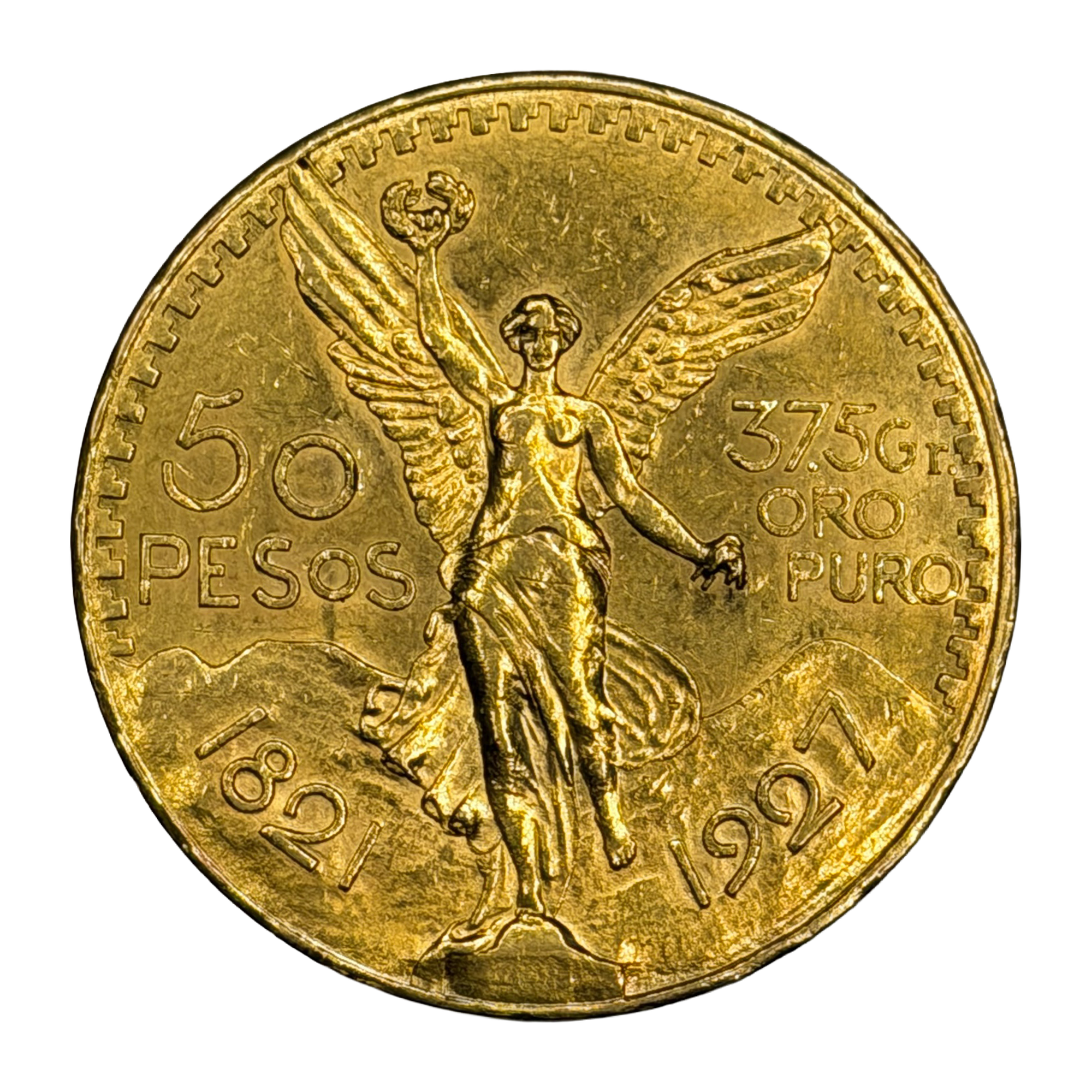
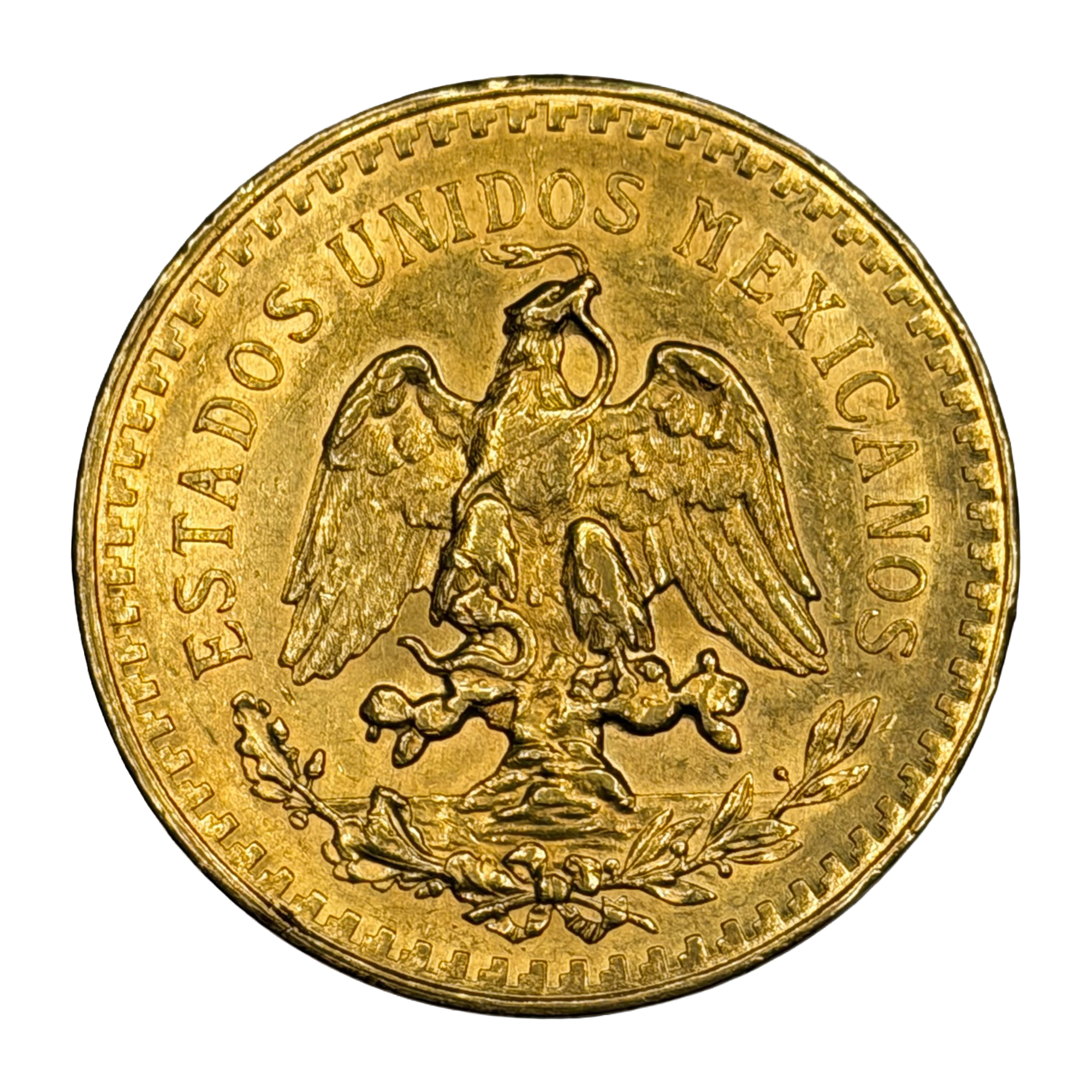
The obverse presents Winged Victory — the golden angel atop Mexico City’s Independence Column, El Ángel de la Independencia — striding forward with a laurel crown of victory raised in her right hand and the broken chain of freedom in her left, the volcanoes Popocatépetl and Iztaccíhuatl rising behind her. She is flanked by the denomination and the coin’s defining inscription: 37.5 Gr. ORO PURO — the pure gold weight, stated directly on the coin. Below, each piece is dual-dated: 1821, the year Mexico’s independence was consummated, alongside the year of striking. The reverse carries the Mexican national arms — the eagle on a cactus devouring a serpent, from the Aztec foundation legend of Tenochtitlan — encircled by ESTADOS UNIDOS MEXICANOS.
Each coin weighs 41.67 grams in .900 fine gold and contains 1.2057 troy ounces of pure gold, at a diameter of 37mm. Grade: Uncirculated/Brilliant Uncirculated. USAGOLD’s offering is limited to pre-1933 dates (1921–1931) — no restrikes.
In 1910, Mexico celebrated the centennial of the beginning of its War of Independence by erecting a great column in the heart of Mexico City, crowned with a 6.7-meter statue of El Ángel de la Independencia — the Winged Victory, holding the laurel of triumph and the broken chain of freedom. When the centenary of independence itself arrived in 1921, the young post-revolutionary republic placed that same figure on its grandest coin. The Centenario was a statement piece in the most literal sense: a nation that had just emerged from a decade of revolution declaring its permanence in more than an ounce of gold.
Mexico’s later monetary history gives the coin a second, more practical resonance for investors. When the government’s surprise devaluation of December 1994 set off a general financial panic — inflation surging to 50%, interest rates to 70% — it was savers who had diversified into gold beforehand, in many cases through the physical former-coinage of the country, who found themselves insulated. Immediately after the devaluation, the price of gold went from 1,200 pesos per ounce to 2,500 pesos, and above 3,000 pesos in 1995. The Centenario is not just a monument to Mexico’s independence; within living memory it has done exactly the job asset-preservation investors acquire gold to do.
Large gold coins were comparatively scarce from the outset — in an era when gold circulated as working money, smaller denominations were produced in far greater numbers for day-to-day commerce. During its brief original run from 1921 to 1931, just under five million Mexico 50 Pesos were struck, compared to nearly 50 million U.S. $20 St. Gaudens over the same period. Include the full eighty-year production of $20 gold pieces back to 1850, and the Centenario’s original mintage amounts to roughly 3% of the combined $20 Liberty and St. Gaudens total.
Survival compounds the scarcity. A great many original-date coins were melted and re-struck in the Banco de México’s mid-1940s reproduction of the coin — restrikes that remain common bullion items to this day. As a result, pre-1933 groupings rarely surface, are often the product of painstaking sorting out of large restrike tranches, and are typically extremely limited in availability. That is precisely why any offering in high-grade Uncirculated/Brilliant Uncirculated condition is a notable acquisition: the coin trades on its gold content first and its finite original supply second, and that combination is the value — original-date scarcity acquired at what amounts to bullion pricing.
The Mexico 50 Pesos has been a fixture of the North American gold trade for a century. Like the Mexico 20 Pesos, it carries a liquidity feature almost no other historic coin shares: its pure gold weight is stamped on its face — 37.5 Gr. ORO PURO — making the coin self-documenting in any language, to any dealer, in any market. Its specifications are universally published, its trading history is deep, and it converts to cash as readily as any large gold instrument available. For investors who want size without sacrificing salability, the Centenario is the standard answer.
In 1933, FDR issued Executive Order 6102, requiring Americans to surrender their gold coin and bullion to the Treasury — but the order and the regulations that followed it exempted gold coins of recognized special value to collectors of rare and unusual coins. Subsequent clarifications by the Treasury identified pre-1933 gold coins — a classification that includes the original-issue Mexico 50 Pesos, struck between 1921 and 1931 — as falling within that collector classification as historical items.
An important note on dates: the 50 Pesos was also restruck by the Banco de México in the mid-1940s and after, and those later pieces fall outside the pre-1933 classification entirely. The coins USAGOLD offers are dated 1921–1931 — entirely within the pre-1933 era — the date on the coin is what carries the designation, and it is the reason original-date Centenarios warrant the sorting effort they require.
Under current constitutional law, a government intervention in the gold market would be executed through the power of eminent domain — the government’s right to take private property for public use provided it pays the owner just compensation. Historic coins complicate the government’s ability to broadly establish “just compensation” or “fair value,” which was precisely the reasoning behind the original “recognized special value” exemption in 1933. That complexity, and the precedent surrounding pre-1933 gold coins, creates a notable impediment to the government’s ability to restrict them broadly — particularly compared to modern bullion, which can be valued easily and consistently at a single price. In essence, it is a bureaucratic question of whether the government would undertake the enormous task of valuing the diversity and complexity of the historic-coin genre — every coin, every date, every condition, every personal holding — and that difficulty is what insulates the owner’s legal liquidity rights in the event of capital controls.
Whether a future government intervention in private gold markets is a risk an investor assigns significant weight to is a personal judgment. The factual point is narrower: the pre-1933 status represents a layer of portfolio differentiation that this coin carries at minimal added per-ounce cost over comparable modern bullion, along with a measure of insulation for the legal liquidity rights of its owner.
For a more in-depth study, we invite you to read our comprehensive memorandum on this subject: Preparing for a Potential Gold Confiscation
The original-date Mexico 50 Pesos combines advantages no other single coin matches: more gold per coin than any other historic-era piece an investor can still readily obtain, per ounce acquisition costs below uncirculated U.S. $20 gold pieces, an original mintage that is a small fraction of its American counterparts’, and its gold weight stamped on its face for instant recognition anywhere in the world. Original-date groupings surface irregularly and in limited quantity, and they are quickly subscribed when they do. No other large gold coin can boast this unique combination of so many notable advantages for gold investors.
| Year | Mintage |
|---|---|
| 1921 | 180,000 |
| 1922 | 463,000 |
| 1923 | 432,000 |
| 1924 | 439,000 |
| 1925 | 716,000 |
| 1926 | 600,000 |
| 1927 | 606,000 |
| 1928 | 538,000 |
| 1929 | 458,000 |
| 1930 | 372,000 |
| 1931 | 137,000 |
| Pre-1933 total | 4,941,000 |
(Restrike issues followed: 1944 — 593,000; 1945 — 1,012,000; 1946 — 1,588,000; 1947 — 4,758,554; post-1933 total 7,951,554 per USAGOLD’s mintage records. Restrikes are excluded from this offering.)
Each coin contains 37.5 grams - 1.2057 troy ounces - of pure gold, with a total weight of 41.67 grams in .900 fine gold. The pure gold weight is stamped directly on the coin's face as 37.5 Gr. ORO PURO.
The original run was struck from 1921 to 1931, beginning with the centenary of Mexico's independence, with just under five million coins produced. The Banco de Mexico later restruck the coin in the mid-1940s; those restrikes are far more common than original-date pieces.
The obverse shows Winged Victory - the golden angel atop Mexico City's Independence Column - holding a laurel crown and a broken chain, with the volcanoes Popocatepetl and Iztaccihuatl behind her. The reverse carries the Mexican national arms: an eagle on a cactus devouring a serpent, from the Aztec foundation legend of Tenochtitlan.
Each Centenario is dual-dated. 1821 is the year Mexico's independence was consummated, and it appears alongside the year the coin was actually struck.
Original strikes dated 1921-1931 fall within the pre-1933 classification associated with the collector exemption that followed Executive Order 6102. The mid-1940s restrikes fall outside that classification entirely - the date on the coin is what carries the designation.
The grade is Uncirculated to Brilliant Uncirculated, and the offering is limited to original pre-1933 dates (1921-1931), not restrikes.
UNC, BU
1921-1931
1.2057 troy ounce
Mexico
| Quantity | Wire | Card |
|---|---|---|
| 1–4 | $5,605.36 | $5,838.92 |
| 5–8 | $5,549.31 | $5,780.53 |
| 9+ | $5,493.25 | $5,722.14 |
Quantity tiers reflect the historic & fractional gold order discount (1% at $25,000+ · 2% at $50,000+ in qualifying coins). Any mix of qualifying historic coins counts toward the same order total.
Prices shown under Wire include a 4% cash discount. Card prices are the full list price. ACH bank transfer is available to established clients only. First-time orders can be paid by wire transfer or card.
Interested in gold but struggling to find the right firm?

AU, UNC
1905-1959
.2411 troy ounce
Mexico
BU
1917-1921
.4823 troy ounce
Mexico
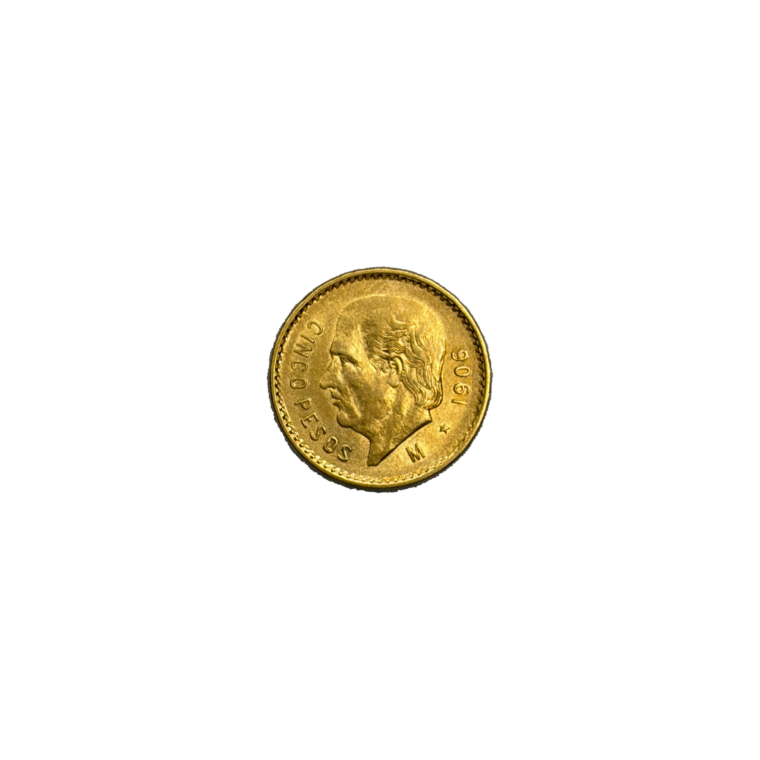
AU, UNC
1905-1955
.1206 troy ounce
Mexico


