

You must have an order with a minimum of $1,000.00 to place your order, your current order total is $0.00.
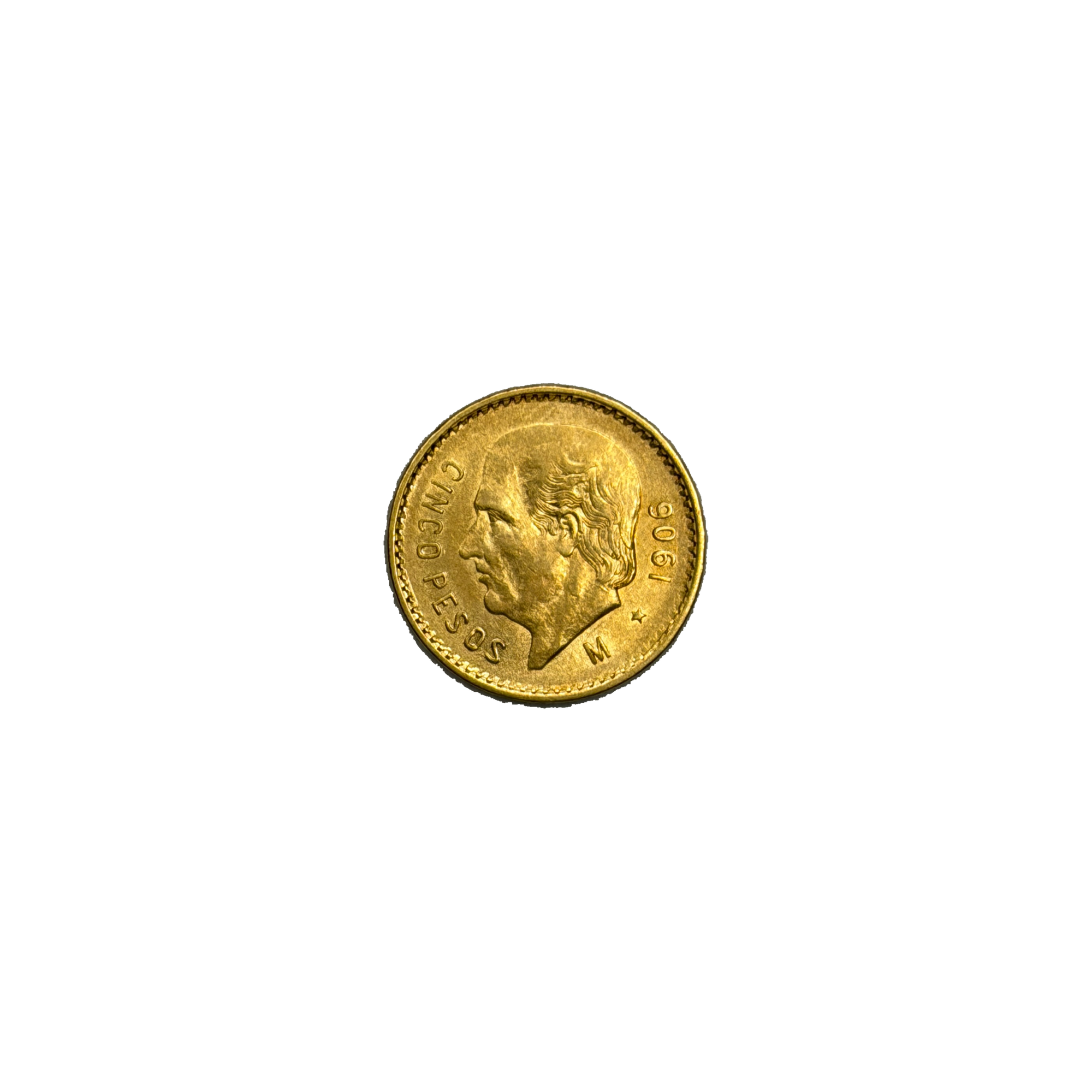
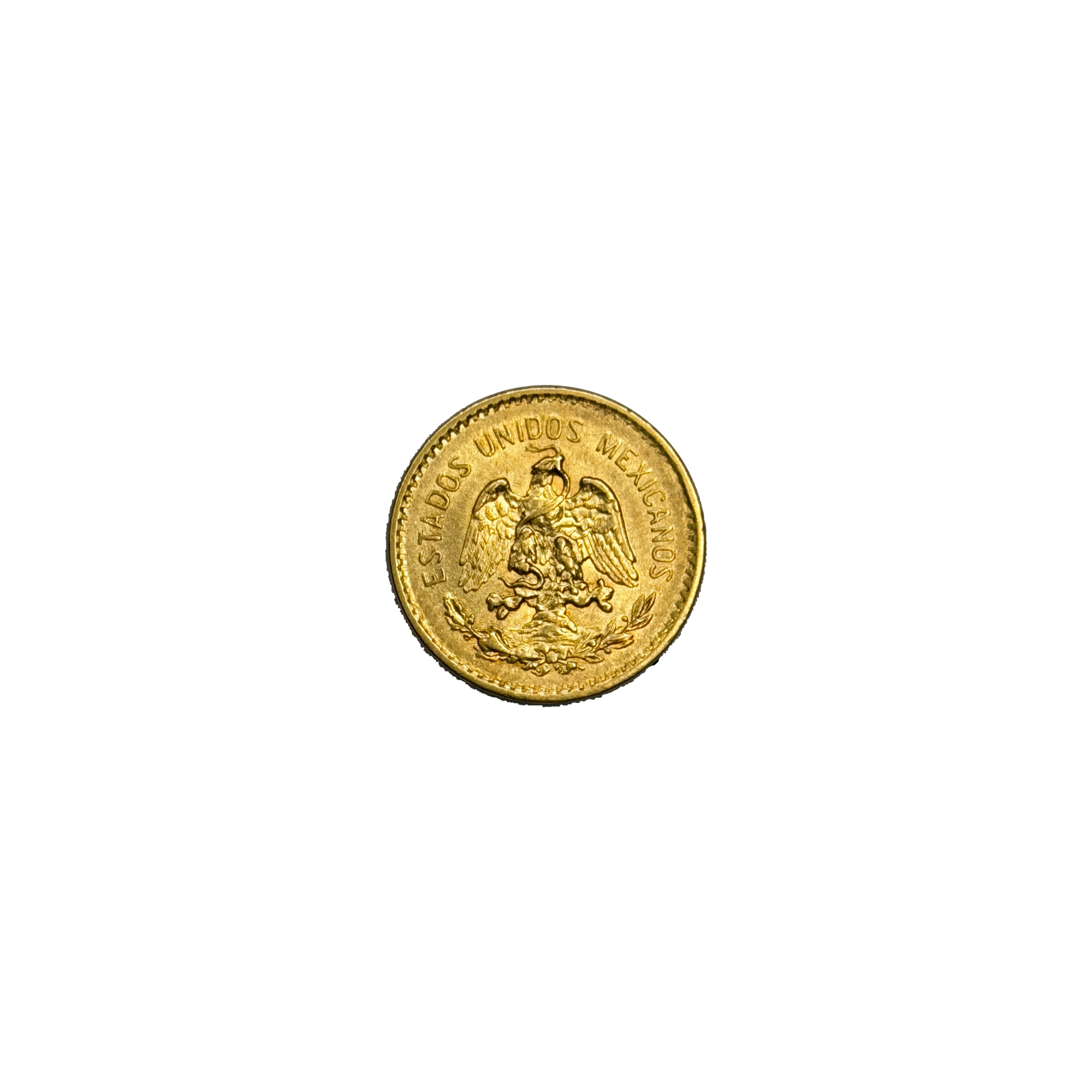
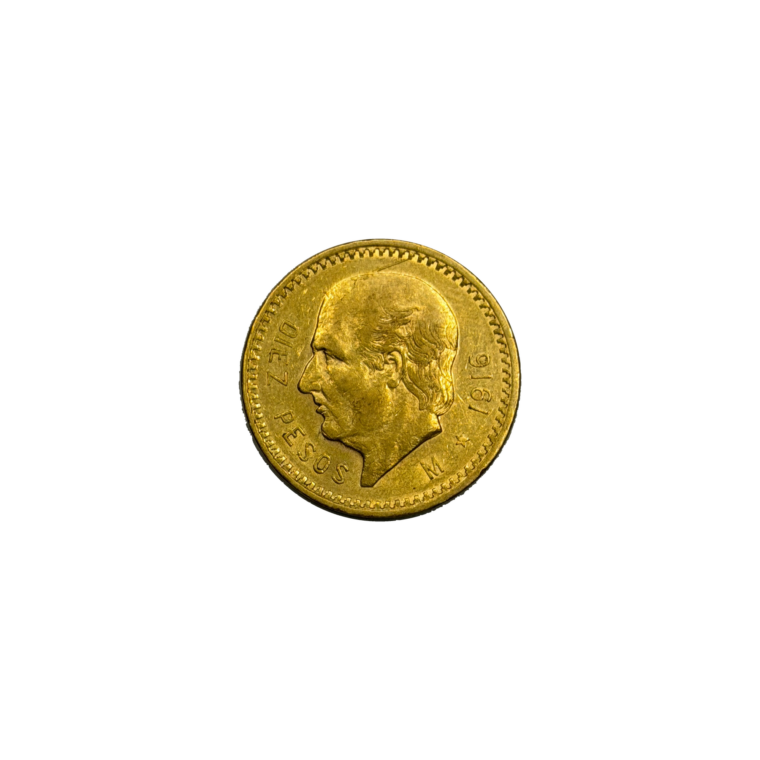
The Mexico 5 Pesos carries the same portrait as its larger Hidalgo siblings — Miguel Hidalgo y Costilla, the parish priest whose Grito de Dolores in 1810 began Mexico’s War of Independence — struck to the smallest size in USAGOLD’s Mexican historic gold family. At 0.1206 troy ounces of pure gold, it is the coin in that family built for flexibility.
That flexibility is the heart of the investor case. Classified instructively as “historical bullion,” the 5 Pesos trades at per ounce acquisition costs comparable to modern fractional bullion and tracks directly with the spot price of gold over time, while carrying the historic (pre-1933) designation and the associated insulation against the possibility of future government intervention. And at roughly an eighth of an ounce, it provides divisible negotiability that no large coin can: a position built from 5 Pesos can be liquidated a small increment at a time, in amounts proportionate to the specific needs of the moment and across a variety of circumstances. For investors whose priorities are safety, a standardized and fully documented gold content, liquidity, and divisible negotiability at a modest per-coin outlay—all for near-bullion pricing—the Mexico 5 Pesos is among the most efficient and readily available small gold instruments in the market today.
The obverse bears Hidalgo’s left-facing portrait with the denomination CINCO PESOS, the date, and the M mint mark of the Mexico City Mint. The reverse carries the Mexican national arms — the eagle on a cactus devouring a serpent, from the Aztec foundation legend of Tenochtitlan — with the legend ESTADOS UNIDOS MEXICANOS and a laurel-and-oak wreath.
Each coin weighs 4.17 grams in .900 fine gold and contains 0.1206 troy ounces of pure gold, at a diameter of 19mm. Grade range: AU/UNC. Minted 1905–1955. The original pre-1933 run was struck 1905–1920 at the Mexico City Mint, the oldest mint in the Americas, founded in 1535; a small restrike issue of 48,000 pieces followed in 1955.
The 5 Pesos was created by Mexico’s monetary reform of 1905, which placed the country on the gold standard and introduced the Hidalgo gold coinage. As the smallest gold denomination of the new system, it was the workhorse of the series — nearly 4.7 million coins struck in 1906 alone, more than any other single date across the Hidalgo gold denominations. Then came the Revolution. Production broke off after 1910, the year the uprising began, and resumed only in the late war years, with the final date struck in 1920 as the fighting wound down. Like its 10 Pesos sibling, the coin bearing the face of the man who began Mexico’s first revolution served as working money through the second — and its seven-date, fifteen-year run ended with the same worldwide retreat from circulating gold that would close the American mints to gold coinage in 1933.
Comparative context matters more than raw numbers. The complete Mexico 5 Pesos series — all seven dates, 1905 through 1920 — totals about 9.3 million coins. The British sovereign family, the standard against which fractional historic gold is measured, saw peak production exceeding 30 million coins in a single year. Yet the 5 Pesos trades at per ounce acquisition costs comparable to modern fractional bullion: the finite original supply comes at little added cost. That combination — fixed supply, modest premium — is the value: the client acquires the comparative scarcity essentially free. And when flight-to-safety episodes tax supplies across the historic gold market, premiums have historically risen modestly across the genre as a whole — a quiet second argument that same-price modern bullion never carries, for a coin whose first argument is flexibility.
Mexican gold trades in an established, active market throughout the Western Hemisphere — anchored by the 50 Pesos Centenario — and the 5 Pesos trades within that family. Dealers who handle historic world gold know the Hidalgo type on sight, its specifications are universally documented, and small coins of this class are perennially in demand, keeping spreads tight and conversion to cash quick. Small denominations sell as easily as they are acquired — that, together with the low per-coin outlay, is precisely their utility.
In 1933, FDR issued Executive Order 6102, requiring Americans to surrender their gold coin and bullion to the Treasury — but the order and the regulations that followed it exempted gold coins of recognized special value to collectors of rare and unusual coins. Subsequent clarifications by the Treasury identified pre-1933 gold coins — a classification that includes the Mexico 5 Pesos, struck between 1905 and 1920 — as falling within that collector classification as historical items.
Under current constitutional law, a government intervention in the gold market would be executed through the power of eminent domain — the government’s right to take private property for public use provided it pays the owner just compensation. Historic coins complicate the government’s ability to broadly establish “just compensation” or “fair value,” which was precisely the reasoning behind the original “recognized special value” exemption in 1933. That complexity, and the precedent surrounding pre-1933 gold coins, creates a notable impediment to the government’s ability to restrict them broadly — particularly compared to modern bullion, which can be valued easily and consistently at a single price. In essence, it is a bureaucratic question of whether the government would undertake the enormous task of valuing the diversity and complexity of the historic-coin genre — every coin, every date, every condition, every personal holding — and that difficulty is what insulates the owner’s legal liquidity rights in the event of capital controls.
Whether a future government intervention in private gold markets is a risk an investor assigns significant weight to is a personal judgment. The factual point is narrower: the pre-1933 status represents a layer of portfolio differentiation that this coin carries at minimal added per-ounce cost over comparable modern bullion, along with a measure of insulation for the legal liquidity rights of its owner.
Note on dates: the series was also restruck in 1955, and USAGOLD’s pre-1933-dated pieces are the ones that fall within this classification — the date on the coin is the controlling fact.
For a more in-depth study, we invite you to read our comprehensive memorandum on this subject: Preparing for a Potential Gold Confiscation
The Mexico 5 Pesos is the flexibility instrument of the Mexican historic gold family: an eighth-ounce-class coin at per ounce acquisition costs comparable to modern fractional bullion, from a seven-date original series smaller than a single peak year of sovereign production, carrying the portrait of the father of Mexican independence within the established market of the Mexican gold family — all at the lowest per-coin outlay in that family. For investors building a holding designed to be spent, if ever, a little at a time, no other small gold coin of the Americas offers this combination of divisible negotiability, documented gold content, and historic distinction.
| Year | Mintage |
|---|---|
| 1905 | 18,000 |
| 1906 | 4,638,000 |
| 1907 | 1,088,000 |
| 1910 | 100,000 |
| 1918 | 609,000 |
| 1919 | 506,000 |
| 1920 | 2,385,000 |
| Pre-1933 total | 9,344,000 |
(A separate restrike issue of 48,000 pieces was produced in 1955.)
Each Mexican 5 pesos contains 0.1206 troy ounces of pure gold - roughly an eighth of an ounce. The coin weighs 4.17 grams overall and is struck in .900 fine (90%) gold.
The 5 pesos was created by Mexico's monetary reform of 1905, which placed the country on the gold standard. The original run of seven dates was struck 1905-1920 at the Mexico City Mint - the oldest mint in the Americas, founded in 1535 - and a small restrike issue of 48,000 pieces followed in 1955.
The obverse carries a left-facing portrait of Miguel Hidalgo y Costilla, the parish priest whose 1810 Grito de Dolores began Mexico's War of Independence. The reverse bears the Mexican national arms - an eagle on a cactus devouring a serpent - with the legend ESTADOS UNIDOS MEXICANOS.
Original strikes dated 1905-1920 fall within the pre-1933 classification associated with the collector exemption that followed Executive Order 6102. The 1955 restrikes fall outside it - the date on the coin is the controlling fact.
The typical grade range is About Uncirculated (AU) to Uncirculated (UNC).
AU, UNC
1905-1955
.1206 troy ounce
Mexico
| Quantity | Wire | Card |
|---|---|---|
| 1–41 | $575.88 | $599.88 |
| 42–83 | $570.12 | $593.88 |
| 84+ | $564.36 | $587.88 |
Quantity tiers reflect the historic & fractional gold order discount (1% at $25,000+ · 2% at $50,000+ in qualifying coins). Any mix of qualifying historic coins counts toward the same order total.
Prices shown under Wire include a 4% cash discount. Card prices are the full list price. ACH bank transfer is available to established clients only. First-time orders can be paid by wire transfer or card.
Interested in gold but struggling to find the right firm?

BU
1917-1921
.4823 troy ounce
Mexico
UNC, BU
1921-1931
1.2057 troy ounce
Mexico
AU, UNC
1905-1959
.2411 troy ounce
Mexico


