

You must have an order with a minimum of $1,000.00 to place your order, your current order total is $0.00.
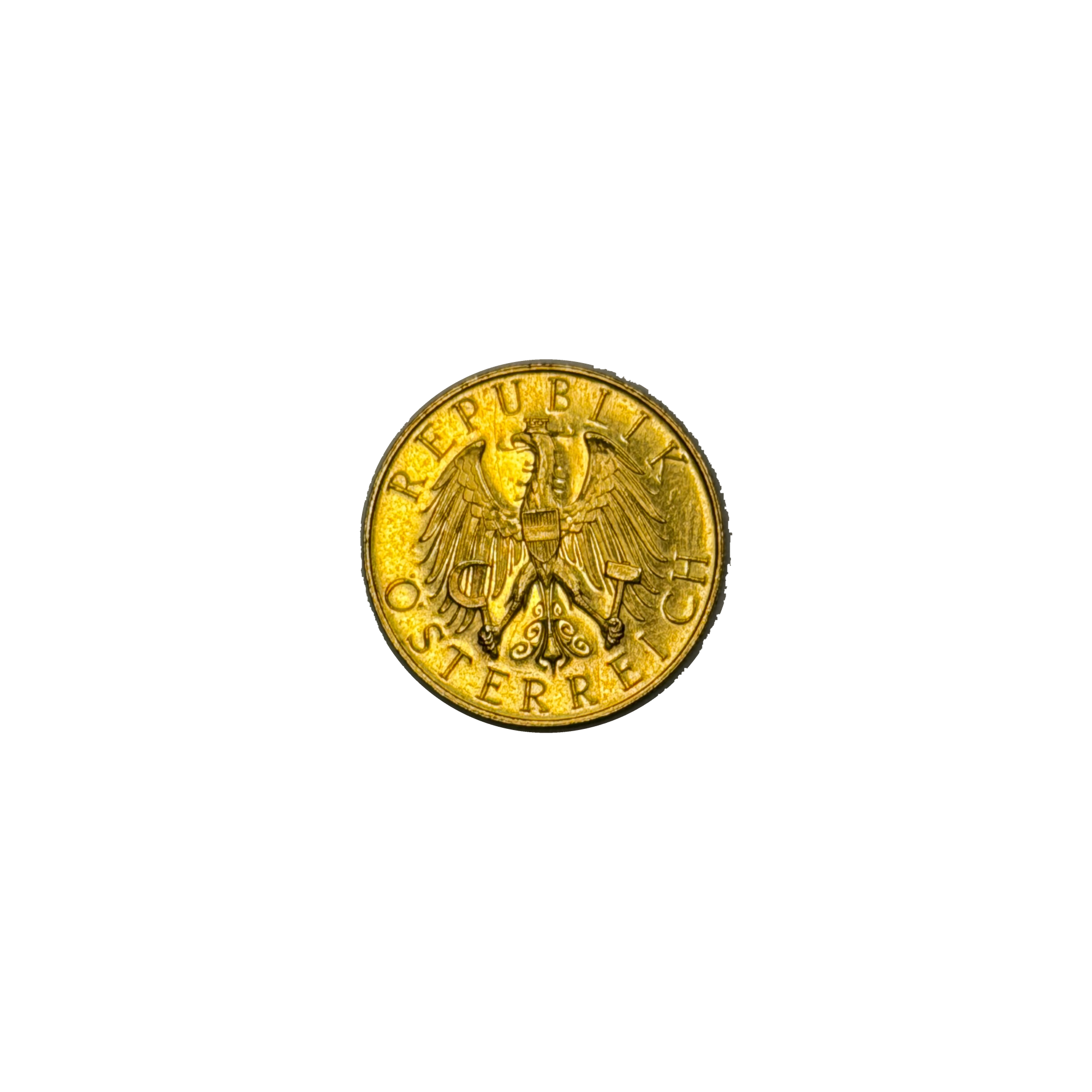
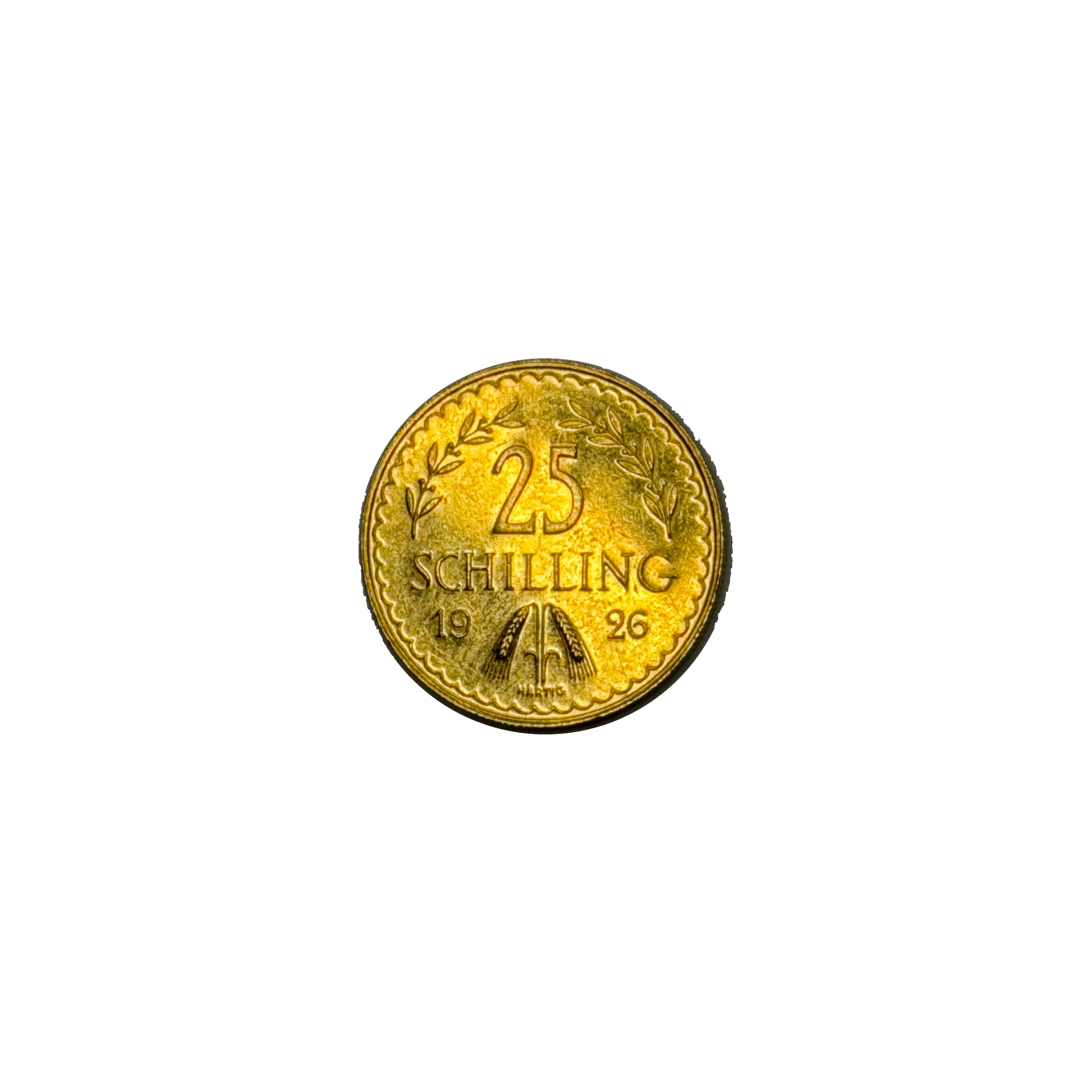
The Republic of Austria that emerged from the First World War had to rebuild its money from nothing. The empire was gone, the crown had been destroyed by hyperinflation, and the schilling introduced in 1925 was the product of one of the most disciplined stabilization programs of the interwar period. The gold 25 Schilling, struck at the Vienna Mint from 1926 to 1934, is the fractional expression of that recovery—and its numbers tell the story of how brief the window was. Total production across the entire series was roughly one million coins. For comparison, the Swiss 20 Franc Helvetia—the benchmark fractional European gold coin of similar size—was struck to the tune of 58.6 million pieces.
Classified instructively as “historical bullion,” the 25 Schilling trades at per ounce acquisition costs comparable to modern fractional bullion and tracks the spot gold price over time, while carrying a supply profile a small fraction the size of its fractional competitors. That combination—bullion-like pricing on a genuinely diminished supply—is the coin’s value in its simplest form: the scarcity comes at essentially no added cost. The genre carries one further advantage over same-priced bullion: during high-demand “flight-to-safety” episodes such as the 2008–09 financial crisis and the 2020–23 pandemic era, the limited supplies of historic European gold produced modest premium rises across the entire genre, common and rare issues alike. At 0.1702 troy ounces, the coin also offers divisible negotiability: affording its owner the flexibility to liquidate positions incrementally, in amounts proportionate to the specific needs of the moment and across a variety of circumstances. For investors whose priorities are divisible negotiability, comparative scarcity against the mass-minted fractional types, a high state of preservation with proof-like surfaces, and a standardized and widely recognized gold content—all for near-bullion pricing—the Austrian 25 Schilling is among the most distinctive fractional instruments in the historic gold market today.
The obverse bears the eagle of the First Austrian Republic—single-headed, carrying the national shield on its breast and grasping a hammer and sickle, the republic’s symbols of industry and agriculture—surrounded by the inscription REPUBLIK ÖSTERREICH. The reverse states the denomination, 25 SCHILLING, above crossed sprigs of edelweiss and ears of grain, with the date divided at either side, all within a scalloped border. The design is spare, modern, and deliberately republican—a clean break from the crowned imperial eagle of the Habsburg centuries.
Each coin weighs 5.88 grams, is struck in .900 fine gold, and contains 0.1702 troy ounces of pure gold. Grade range: BU/PL. Minted 1926–1934.
Austria’s early-1920s hyperinflation destroyed the old crown so completely that the League of Nations supervised the country’s financial reconstruction. The schilling that replaced it in 1925 held its value so well that contemporaries called it the “Alpine dollar,” and the Vienna Mint’s decision to strike gold denominations was a public declaration that the new currency was to be trusted. The window lasted nine years. Gold coinage ended in 1934 amid the political convulsions of the 1930s, and the republic itself was absorbed into Germany in 1938. The 25 Schilling documents the interval between two catastrophes—a hard-money achievement compressed into mintages that would count as rounding errors for the major European types.
The discipline of comparative scarcity is worth applying precisely here. The recorded pre-1933 total for the 25 Schilling is 1,030,168 coins; the largest single year, 1926, produced 276,705. The Swiss Helvetia’s series total is 58.6 million; George V sovereigns alone exceeded 30 million pieces in peak years. Yet the 25 Schilling still trades on its gold content first and its finite supply second—well outside the numismatic tier. That is exactly what creates the value: the investor acquires a fractional coin with a fraction of the competing supply, at acquisition costs that remain in the historical bullion category.
The Austrian Mint is among the oldest operating mints in the world, and its gold coinage—historic and modern—enjoys deep dealer familiarity across North America and Europe. The 25 Schilling’s specifications are universally documented, and it trades within the established fractional European gold market alongside the Swiss franc, sovereign, and corona families. For investors who need to convert gold to cash quickly, it performs that function reliably, with the fractional size adding flexibility that larger coins cannot match.
In 1933, FDR issued Executive Order 6102, requiring Americans to surrender their gold coin and bullion to the Treasury—but the order and the regulations that followed it exempted gold coins of recognized special value to collectors of rare and unusual coins. Subsequent clarifications by the Treasury identified pre-1933 gold coins as falling within that collector classification as historical items. The Austrian 25 Schilling, as specified by USAGOLD in its pre-1933 dated form, falls within that classification. One distinction matters here: because the series ran through 1934, a portion of the mintage carries dates from 1933 and 1934, at the boundary of and beyond the pre-1933 era. USAGOLD’s date specification ensures the coins delivered carry the earlier dates of the series—a real distinction, not a technical one.
Under current constitutional law, a government intervention in the gold market would be executed through the power of eminent domain—the government’s right to take private property for public use provided it pays the owner just compensation. Historic coins complicate the government’s ability to broadly establish “just compensation” or “fair value,” which was precisely the reasoning behind the original “recognized special value” exemption in 1933. That complexity, and the precedent surrounding pre-1933 gold coins, creates a notable impediment to the government’s ability to restrict them broadly—particularly compared to modern bullion, which can be valued easily and consistently at a single price. In essence, it is a bureaucratic question of whether the government would undertake the enormous task of valuing the diversity and complexity of the historic-coin genre—every coin, every date, every condition, every personal holding—and that difficulty is what insulates the owner’s legal liquidity rights in the event of capital controls.
Whether a future government intervention in private gold markets is a risk an investor assigns significant weight to is a personal judgment. The factual point is narrower: the pre-1933 status represents a layer of portfolio differentiation that this coin carries at minimal added per-ounce cost over comparable modern bullion, along with a measure of insulation for the legal liquidity rights of its owner.
For a more in-depth study, we invite you to read our comprehensive memorandum on this subject: Preparing for a Potential Gold Confiscation
The Austrian 25 Schilling pairs the practical advantages of fractional gold—divisible negotiability, a standardized and widely recognized gold content, near-bullion acquisition costs—with a supply story almost no fractional competitor can match: roughly one million coins from a nine-year republican window, against the tens of millions minted of the standard European types. An issue this thin surfaces irregularly and is rarely available in quantity, and no other fractional gold coin at this level of scarcity offers so many notable advantages for gold investors at so little added cost.
Pre-1933 issues (1926–1933)
| Year | Mintage |
|---|---|
| 1926 | 276,705 |
| 1927 | 72,672 |
| 1928 | 134,041 |
| 1929 | 243,269 |
| 1930 | 129,535 |
| 1931 | 169,002 |
| 1933 | 4,944 |
| Pre-1933 total | 1,030,168 |
Post-1933 issues (1934)
| Year | Mintage |
|---|---|
| 1934 | 11,000 |
| Post-1933 total | 11,000 |
Mintage figures per USAGOLD records. Pre-1933 and post-1933 issues are totaled separately. Per USAGOLD’s classification convention, the 1933-dated issue is grouped with the pre-1933 coins.
BU, PL
1926-1934
.1702 troy ounce
Austria
| Quantity | Wire | Card |
|---|---|---|
| 1–28 | $833.15 | $867.86 |
| 29–57 | $824.82 | $859.18 |
| 58+ | $816.49 | $850.50 |
Quantity tiers reflect the historic & fractional gold order discount (1% at $25,000+ · 2% at $50,000+ in qualifying coins). Any mix of qualifying historic coins counts toward the same order total.
Prices shown under Wire include a 4% cash discount. Card prices are the full list price. ACH bank transfer is available to established clients only. First-time orders can be paid by wire transfer or card.
Interested in gold but struggling to find the right firm?

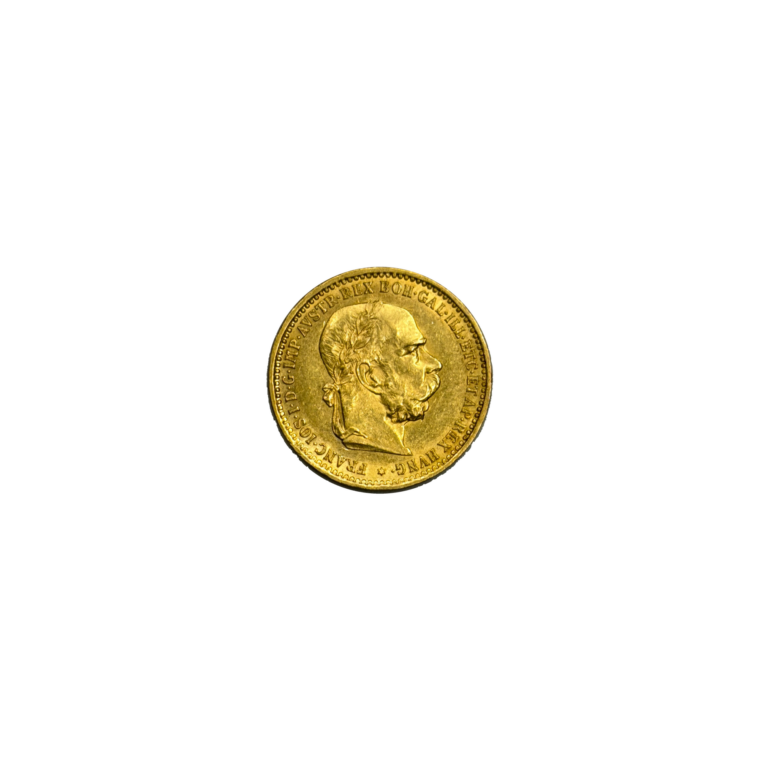
XF, AU, UNC
1896, 1897, 1905, 1906
.098 troy ounce
Austria


