

You must have an order with a minimum of $1,000.00 to place your order, your current order total is $0.00.
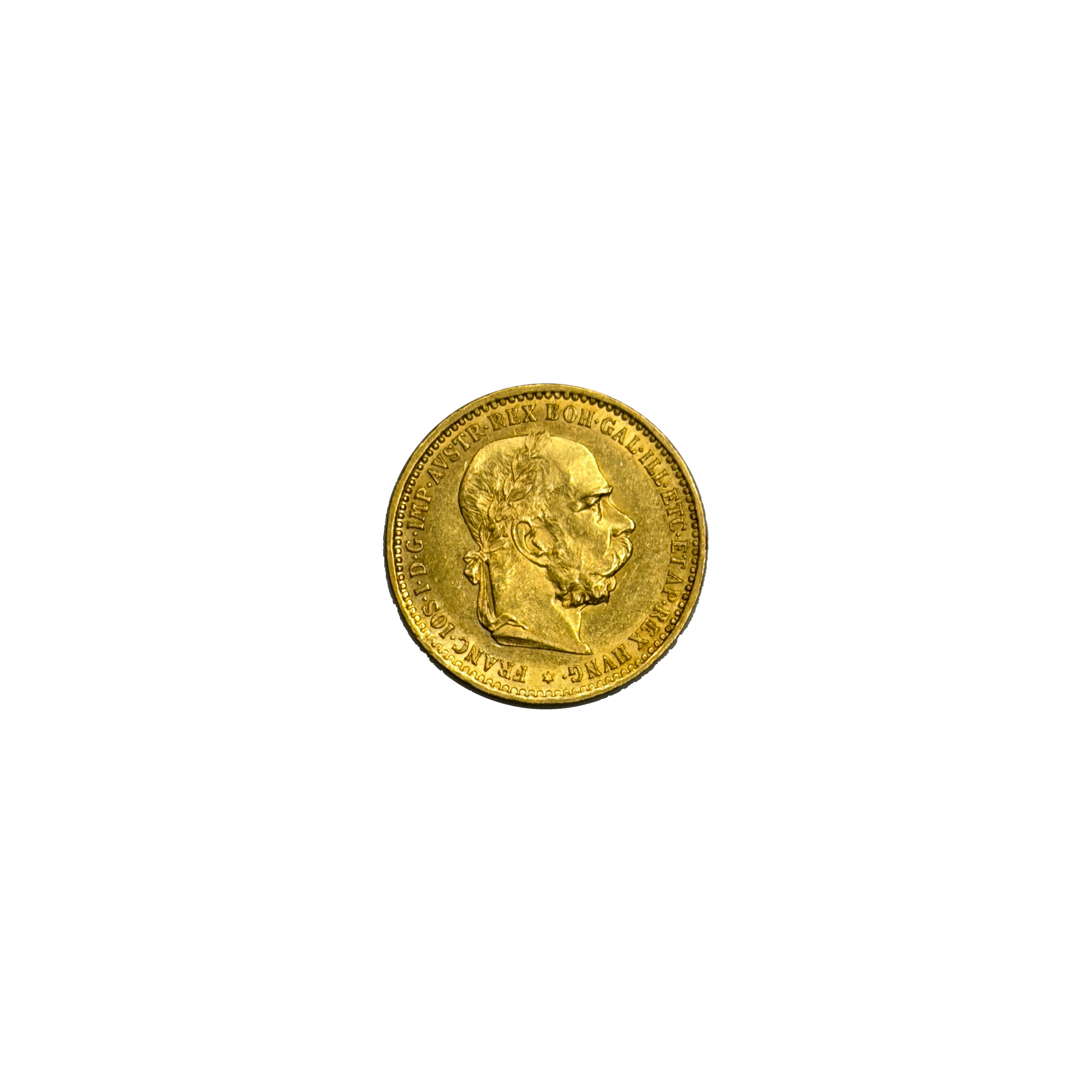
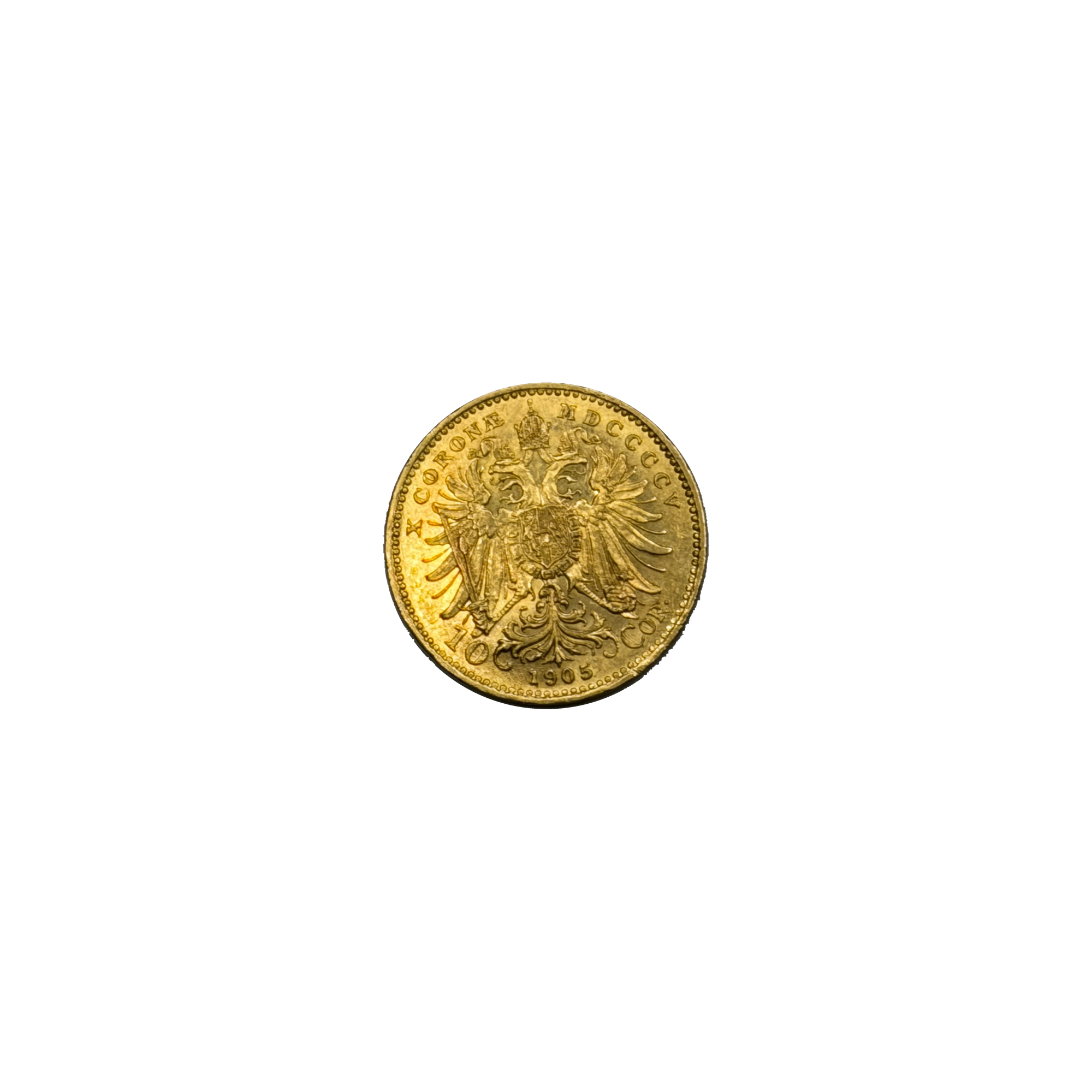
Franz Joseph came to the Habsburg throne in 1848, at eighteen, amid the revolutions that shook every capital in Europe—and he was still emperor sixty-eight years later, one of the longest reigns in European history. The gold 10 Corona, struck in Vienna from 1896 to 1912, belongs to the final act of that reign: the introduction of the corona placed Austria-Hungary on the gold standard and gave the empire its last and most widely distributed gold coinage. The 10 Corona was its smallest gold denomination—the coin an empire of fifty million people actually used when gold changed hands in ordinary amounts.
For the modern investor, that small size is the point. At 0.0980 troy ounces—just under a tenth of an ounce—the 10 Corona is among the smallest historic gold coins available at near-bullion acquisition costs, delivering divisible negotiability in its most practical form: affording its owner the flexibility to liquidate positions in increments as modest as the moment requires — a flexibility that no one-ounce instrument can replicate. Classified instructively as “historical bullion,” it trades at per ounce acquisition costs comparable to modern fractional bullion, tracks the spot price of gold over time, and carries the pre-1933 designation and the associated insulation against possible future government intervention. For investors whose priorities are one of the smallest practical units of divisible negotiability, low cost per ounce, a supply limited to four original dates, and a standardized and widely recognized gold content—all for near-bullion pricing—the Austrian 10 Corona is among the most efficient instruments in the fractional gold market today.
The series carries two obverse portraits of Franz Joseph across its twenty-year run. The earlier issues bear his laureate head—crowned with a laurel wreath in the Roman imperial manner, with the full beard and side-whiskers of his middle age. The later issues replaced it with the celebrated bare-head portrait by the sculptor Stefan Schwartz: the aged emperor unadorned, bald, his features rendered with unsentimental realism. Both carry the Latin legend of his titles—FRANC IOS I D G IMP AVSTR REX BOH GAL ILL ET AP REX HVNG—Emperor of Austria, King of Bohemia, Galicia, and Illyria, and Apostolic King of Hungary. The reverse presents the crowned double-headed imperial eagle with the Habsburg shield at its breast, the denomination 10 COR, and the date.
Each coin weighs 3.39 grams, is struck in .900 fine gold, and contains 0.0980 troy ounces of pure gold. Grade range: AU/UNC/XF. Minted 1896, 1897, 1905, and 1906.
No European sovereign presided over more history than Franz Joseph. His reign began with revolution and ended in the middle of the First World War—sixty-eight years in which the map of Europe was redrawn around him. The Compromise of 1867 split his realm into the dual monarchy of Austria-Hungary, an arrangement that produced parallel coinages: Austrian corona struck in Vienna, Hungarian korona struck in Kremnica, two national faces of a single monetary system. The corona coinage of 1892 was the empire’s modernization—a decimal gold-standard currency for a state that would not survive its creator by more than two years. Franz Joseph died in 1916; the empire dissolved in 1918. The 10 Corona, struck through 1912, is the small change of that twilight—working gold from the last years Europe’s oldest ruling house governed as if the nineteenth century would never end.
Few coin series document a single life the way the 10 Corona does. The laureate portrait presents the emperor as institution—formal, classical, timeless by intention. The Schwartz bare-head portrait presents the man—old, unadorned, and rendered honestly. Owning both types is owning the arc of one of the longest reigns in modern continental history, in gold. The Vienna Mint, in continuous operation since the twelfth century, struck both with the die work and surface quality that made its coinage a standard across Central Europe.
The 10 Corona’s surviving supply exists because corona gold was hoarded across Central Europe as savings through two world wars—coins set aside precisely because they were trusted. They trade on their gold content first and their history second, which keeps acquisition costs at the bullion end of the historic coin market and makes the 10 Corona one of the lowest-cost entry points into pre-1933 European gold. The tenth-ounce size compounds the advantage: it is the denomination that lets an investor scale a position—building it, gifting it, or liquidating it—in increments as small as any the historic gold market commonly offers.
The corona family is one of the standard, universally documented historic gold types in the dealer market on both sides of the Atlantic. Specifications are fixed and familiar, trading history is deep, and the coins convert to cash readily wherever gold trades. The 10 Corona’s liquidity profile rests on the corona family’s universally documented standard, with the added practical dimension that small coins meet modest needs without disturbing the rest of a holding.
In 1933, FDR issued Executive Order 6102, requiring Americans to surrender their gold coin and bullion to the Treasury—but the order and the regulations that followed it exempted gold coins of recognized special value to collectors of rare and unusual coins. Subsequent clarifications by the Treasury identified pre-1933 gold coins—a classification that includes the Austrian 10 Corona, struck between 1896 and 1912—as falling within that collector classification as historical items.
Under current constitutional law, a government intervention in the gold market would be executed through the power of eminent domain—the government’s right to take private property for public use provided it pays the owner just compensation. Historic coins complicate the government’s ability to broadly establish “just compensation” or “fair value,” which was precisely the reasoning behind the original “recognized special value” exemption in 1933. That complexity, and the precedent surrounding pre-1933 gold coins, creates a notable impediment to the government’s ability to restrict them broadly—particularly compared to modern bullion, which can be valued easily and consistently at a single price. In essence, it is a bureaucratic question of whether the government would undertake the enormous task of valuing the diversity and complexity of the historic-coin genre—every coin, every date, every condition, every personal holding—and that difficulty is what insulates the owner’s legal liquidity rights in the event of capital controls.
Whether a future government intervention in private gold markets is a risk an investor assigns significant weight to is a personal judgment. The factual point is narrower: the pre-1933 status represents a layer of portfolio differentiation that this coin carries at minimal added per-ounce cost over comparable modern bullion, along with a measure of insulation for the legal liquidity rights of its owner.
For a more in-depth study, we invite you to read our comprehensive memorandum on this subject: Preparing for a Potential Gold Confiscation
The Austrian 10 Corona is among the smallest gold coins of one of Europe’s longest reigns—a tenth of an ounce of Habsburg history that trades at near-bullion acquisition costs, converts to cash anywhere gold is dealt, and reaches the market in just four original dates. For the investor who values divisible negotiability above all, no other historic gold coin delivers this combination of small size, low cost per ounce, and standardized gold content so completely.
| Year | Mintage |
|---|---|
| 1896 | 211,000 |
| 1897 | 1,803,000 |
| 1905 | 1,933,230 |
| 1906 | 1,081,161 |
| Total | 5,028,391 |
Mintage figures per the Standard Catalog of World Coins, via the NGC World Price Guide. Figures are the laurel-head type (KM-2805) in USAGOLD’s four listed dates; later bare-head issues of 1909–1912 (KM-2815/2816) exist beyond this range.
XF, AU, UNC
1896, 1897, 1905, 1906
.098 troy ounce
Austria
| Quantity | Wire | Card |
|---|---|---|
| 1–51 | $467.65 | $487.14 |
| 52–102 | $462.97 | $482.27 |
| 103+ | $458.30 | $477.40 |
Quantity tiers reflect the historic & fractional gold order discount (1% at $25,000+ · 2% at $50,000+ in qualifying coins). Any mix of qualifying historic coins counts toward the same order total.
Prices shown under Wire include a 4% cash discount. Card prices are the full list price. ACH bank transfer is available to established clients only. First-time orders can be paid by wire transfer or card.
Interested in gold but struggling to find the right firm?

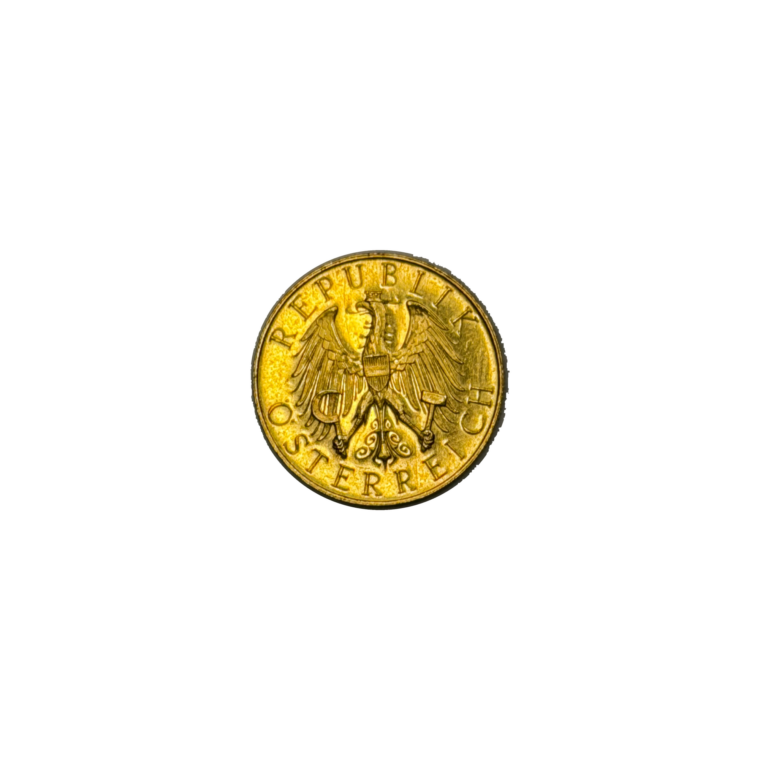
BU, PL
1926-1934
.1702 troy ounce
Austria


