

You must have an order with a minimum of $1,000.00 to place your order, your current order total is $0.00.
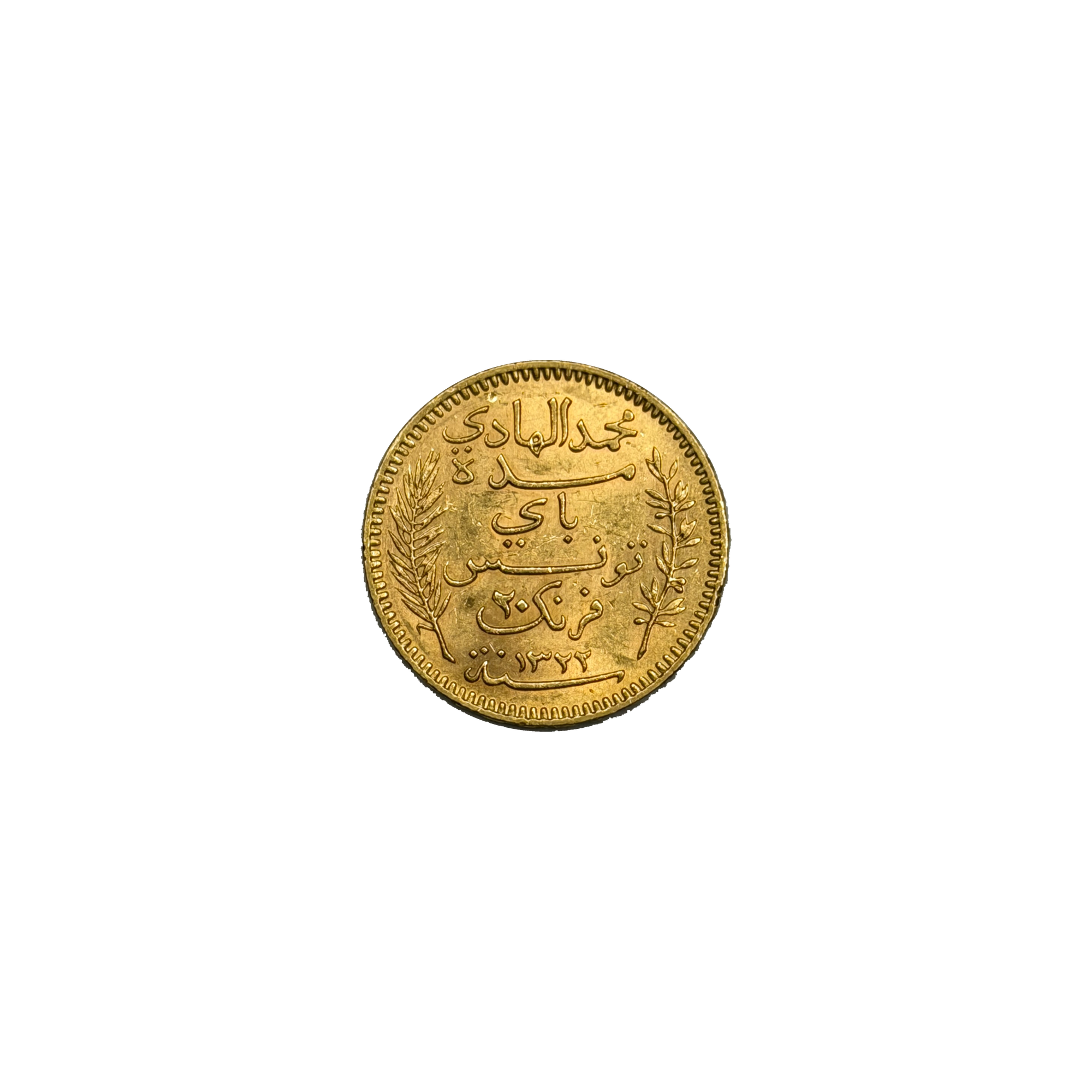
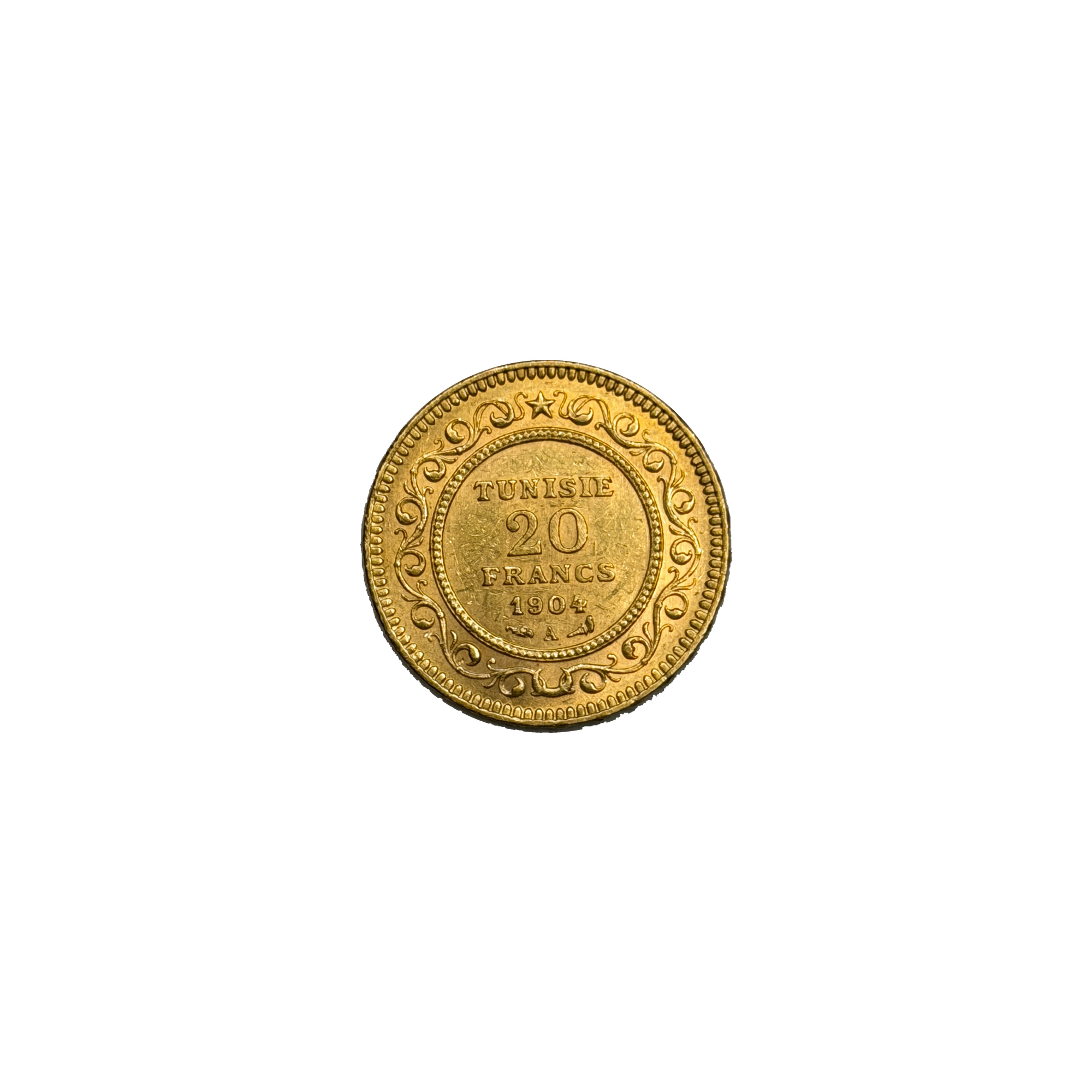
Few gold coins carry two worlds on their two faces as literally as the Tunisian 20 Franc. The obverse is entirely Arabic — the name and titles of the reigning Bey of Tunis in flowing calligraphy, dated by the Islamic calendar, framed by palm and olive branches. The reverse is entirely French — TUNISIE, 20 FRANCS, the Gregorian date, and the privy marks of the Paris Mint, set within an ornate Moorish arabesque. Struck at Paris from 1891 to 1904 during the French protectorate, it is the coin of a crossroads: North African sovereignty and European finance sharing a single 21-millimeter disk of gold.
For the investor, what matters is the standard underneath the artistry. The Tunisian 20 Franc was struck to the same specification as the French 20 Franc and Swiss 20 Franc Helvetia — 6.45 grams of .900 fine gold, 0.1867 troy ounces — the most widely produced and universally documented fractional gold standard in history. It is classified instructively as “historical bullion”: it trades at per ounce acquisition costs comparable to modern bullion coins and tracks the spot price of gold over time, while carrying the historic (pre-1933) designation and the associated insulation against the possibility of future government intervention. At roughly one-fifth of a troy ounce, it offers divisible negotiability — affording its owner the flexibility to liquidate positions incrementally, in amounts proportionate to the specific needs of the moment and across a variety of circumstances. For investors whose priorities are a standardized and widely recognized gold content, divisible negotiability, and one of the lowest costs per coin in historic gold—all for near-bullion pricing—the Tunisian 20 Franc is among the most accessible entry points in the market, and the only coin in the 20 franc family joining Arabic and French on a single piece of gold.
The obverse presents the Arabic inscription naming the reigning Bey of Tunis — the example pictured names Muhammad al-Hadi Bey — with the Hijri date below, flanked by a palm frond and an olive branch. Because the series spans nearly four decades, coins are encountered naming the several beys who reigned across the period. The reverse places TUNISIE, the denomination 20 FRANCS, and the date within a beaded circle, surrounded by an intricate arabesque cartouche with a star at its crown — one of the more ornamental reverses in the francophone gold series. The A mintmark of the Paris Mint appears below the date.
Each coin measures 21 millimeters in diameter, weighs 6.45 grams, and is struck from .900 fine gold, containing 0.1867 troy ounces of pure gold — identical in specification to the French and Swiss 20 franc coins. Grade range: AU/BU/UNC. Minted 1891–1904.
France established its protectorate over Tunisia in 1881, and the arrangement produced a distinctive monetary compromise: the beys of Tunis remained the nominal sovereigns — their names and titles on the money — while the coinage itself was integrated into the French financial system, struck at the Paris Mint to the French franc standard. The result is a coin that documents the age of empire more candidly than most: local sovereignty on one side, the machinery of European finance on the other.
That French standard was itself the closest thing the nineteenth century had to a global currency. The 20 franc specification — 6.45 grams, .900 fine — circulated across France, Switzerland, Belgium, Italy, and beyond, settling accounts from Paris to Beirut. A Tunisian 20 Franc was interchangeable with all of it: gold that moved without translation across the Mediterranean world. Regular production ended in 1904; later dates were token presentation strikings of a few dozen pieces, fixing the population permanently.
The Tunisian 20 Franc trades in the slipstream of the most liquid fractional gold family in the world. Its specifications are identical to the French 20 Franc and Swiss 20 Franc Helvetia — universally documented, instantly verifiable — so any dealer who handles European fractional gold can value it on sight, and bid-ask behavior tracks the broader 20 franc market. Within that family, the Tunisian issue adds character the mass-market coins cannot: Arabic calligraphy, a Paris Mint pedigree, and protectorate-era history, typically at pricing in the same near-bullion class. For clients building a fractional gold position, it functions as a 20 franc with a story — readily absorbed by the market that already knows its weight and fineness by heart.
In 1933, FDR issued Executive Order 6102, requiring Americans to surrender their gold coin and bullion to the Treasury — but the order and the regulations that followed it exempted gold coins of recognized special value to collectors of rare and unusual coins. Subsequent clarifications by the Treasury identified pre-1933 gold coins — a classification that includes the Tunisian 20 Franc, struck between 1891 and 1904 — as falling within that collector classification as historical items.
Under current constitutional law, a government intervention in the gold market would be executed through the power of eminent domain — the government’s right to take private property for public use provided it pays the owner just compensation. Historic coins complicate the government’s ability to broadly establish “just compensation” or “fair value,” which was precisely the reasoning behind the original “recognized special value” exemption in 1933. That complexity, and the precedent surrounding pre-1933 gold coins, creates a notable impediment to the government’s ability to restrict them broadly — particularly compared to modern bullion, which can be valued easily and consistently at a single price. In essence, it is a bureaucratic question of whether the government would undertake the enormous task of valuing the diversity and complexity of the historic-coin genre — every coin, every date, every condition, every personal holding — and that difficulty is what insulates the owner’s legal liquidity rights in the event of capital controls.
Whether a future government intervention in private gold markets is a risk an investor assigns significant weight to is a personal judgment. The factual point is narrower: the pre-1933 status represents a layer of portfolio differentiation that this coin carries at minimal added per-ounce cost over comparable modern bullion, along with a measure of insulation for the legal liquidity rights of its owner.
For a more in-depth study, we invite you to read our comprehensive memorandum on this subject: Preparing for a Potential Gold Confiscation
The Tunisian 20 Franc is the rare coin that adds genuine character to a gold position without asking the investor to give anything up for it: the exact specification of the world’s most recognizable fractional gold standard, struck at the Paris Mint, carrying the calligraphy of the beys of Tunis and the history of the Mediterranean crossroads — all at near-bullion-class pricing. No other coin in the 20 franc family combines this much history with this much practicality for gold investors.
| Year | Mintage |
|---|---|
| 1891 (AH 1308) | 400,000 |
| 1892 (AH 1309) | 937,000 |
| 1893 (AH 1310) | 35,000 |
| 1894 (AH 1311) | 20 |
| 1895 (AH 1313) | 20 |
| 1896 (AH 1314) | 20 |
| 1897 (AH 1315) | 164,000 |
| 1898 (AH 1316) | 150,000 |
| 1899 (AH 1316) | 150,000 |
| 1900 (AH 1318) | 150,000 |
| 1901 (AH 1319) | 150,000 |
| 1902 (AH 1320) | 20 |
| 1903 (AH 1321) | 300,000 |
| 1904 (AH 1321) | 600,000 |
| Total (1891–1904) | 3,036,080 |
Mintage figures per the Standard Catalog of World Coins, via the NGC World Price Guide. Paris Mint (A). The 20-piece dates (1894–1896, 1902) and the 23-piece 1905 and 1906 issues were presentation strikings; the 1905–1906 dates are excluded from the reference range above per USAGOLD’s mintage methodology.
AU, UNC, BU
1891-1904
.1867 troy ounce
Tunisia
| Quantity | Wire | Card |
|---|---|---|
| 1–26 | $906.01 | $943.76 |
| 27–52 | $896.95 | $934.32 |
| 53+ | $887.89 | $924.88 |
Quantity tiers reflect the historic & fractional gold order discount (1% at $25,000+ · 2% at $50,000+ in qualifying coins). Any mix of qualifying historic coins counts toward the same order total.
Prices shown under Wire include a 4% cash discount. Card prices are the full list price. ACH bank transfer is available to established clients only. First-time orders can be paid by wire transfer or card.
Interested in gold but struggling to find the right firm?


