

You must have an order with a minimum of $1,000.00 to place your order, your current order total is $0.00.
The Romanov dynasty ruled Russia for 304 years, from Michael Romanov’s accession in 1613 to the abdication of Nicholas II in 1917, and built one of the wealthiest and most powerful ruling houses the world has known. The gold 10 Rouble of Nicholas II, struck from 1898 to 1911, is the final chapter of that dynasty’s coinage—minted under the gold-standard reform that briefly made the rouble one of the hardest currencies in Europe, and ended forever by war and revolution. Like the German 20 Mark of Wilhelm II, it belongs to the small class of coins that constitute the last gold of an empire: no successor issue exists, and none ever will.
The investment case rests on what happened afterward. Following the original mintage, huge swaths of the type were melted down or lost over the past century, and Russian gold coins today rank among the most sought-after of all historic European issues—yet the 10 Rouble remains among the rarest Russian coins still obtainable at reasonable premiums. It trades on its gold content first and its finite, shrinking supply second—which means the scarcity, in effect, comes at no added cost. At 0.2489 troy ounces—almost exactly a quarter ounce—the coin also offers divisible negotiability: affording its owner the flexibility to liquidate positions incrementally, in amounts proportionate to the specific needs of the moment and across a variety of circumstances. For investors whose priorities are a highly coveted coin steeped in the history of a vanished empire, comparative scarcity from a supply fixed by revolution and thinned by a century of melting, an internationally sought-after standing among collectors of Russian gold, and the divisible negotiability of its quarter-ounce size, the Nicholas II 10 Rouble is among the most historically consequential coins available anywhere near bullion-level acquisition costs.
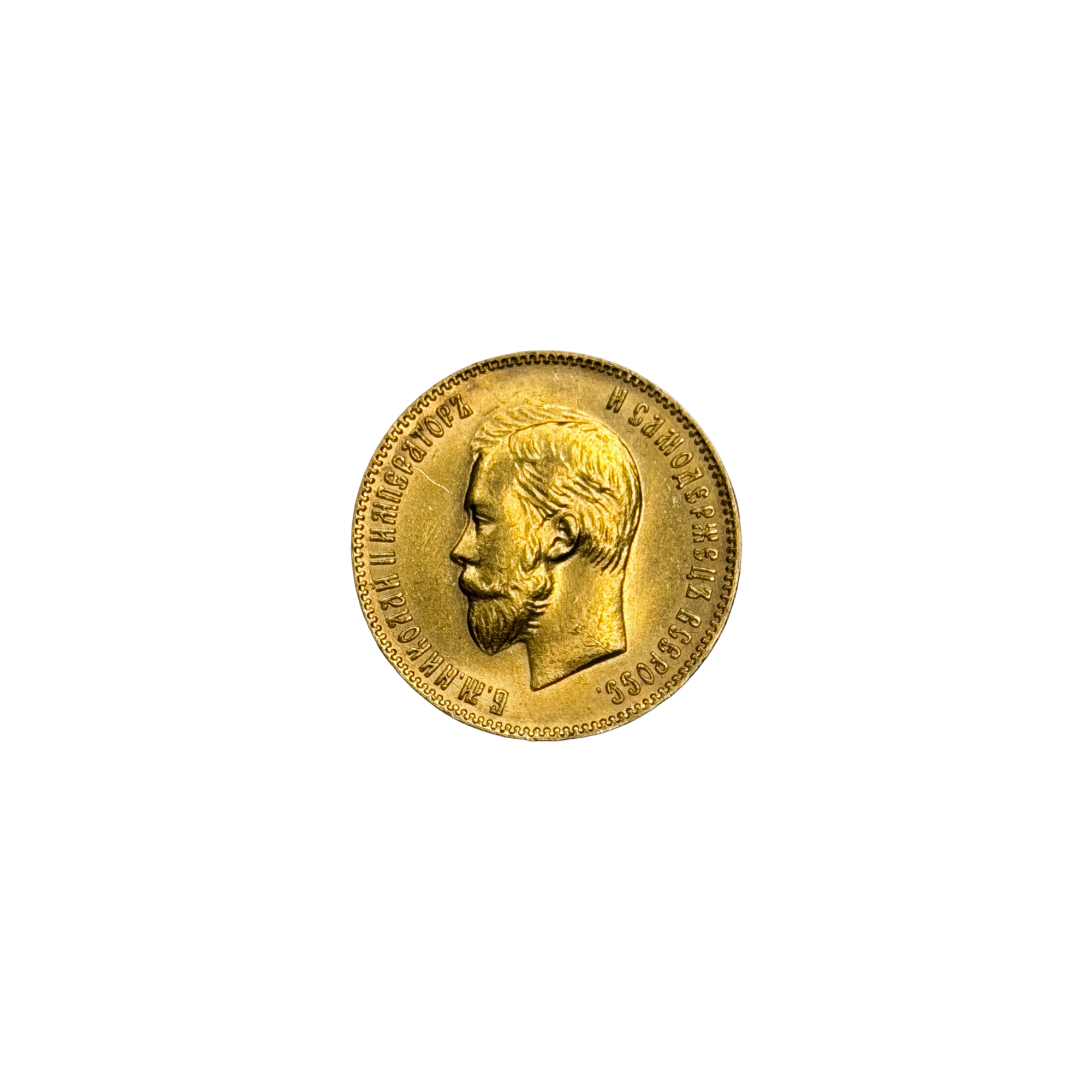
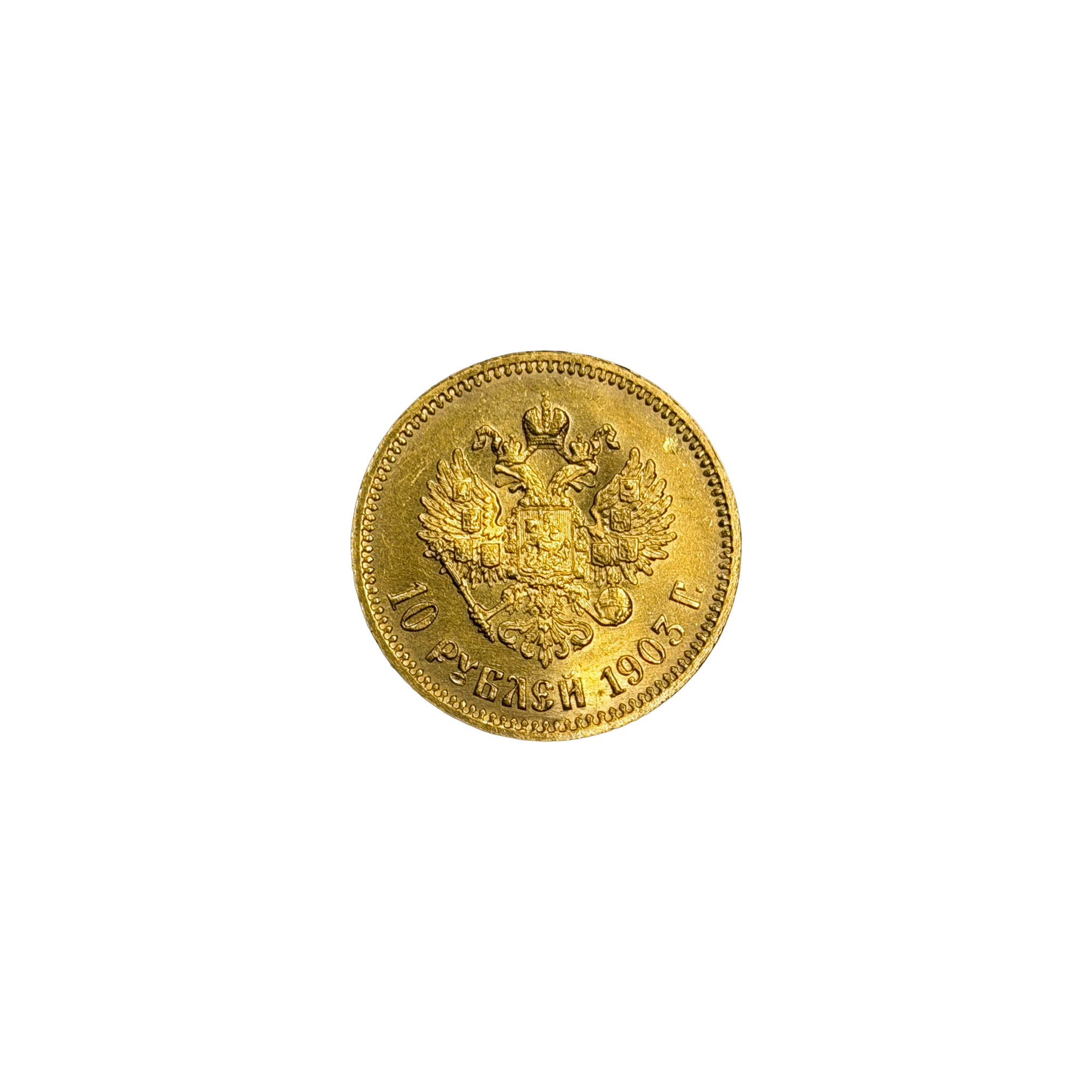
The obverse bears the left-facing portrait of Nicholas II—bearded, bare-headed, rendered with quiet formality—surrounded by the Cyrillic legend of his titles: “By the Grace of God, Nicholas II, Emperor and Autocrat of All the Russias.” The reverse presents the imperial coat of arms and seal of His Tsarist Majesty: the double-headed eagle first adopted as a Russian state symbol under Ivan III in the late fifteenth century, crowned three times for the realms of Kazan, Astrakhan, and Russia, with scepter and orb in its talons and the arms of the empire’s territories spread across its wings. On the eagle’s breast hangs a shield depicting a horseman slaying a dragon—St. George, an image European coin enthusiasts will recognize from the British sovereign. The denomination and date complete the design.
Each coin weighs 8.6 grams, is struck in .900 fine gold, and contains 0.2489 troy ounces of pure gold. Grade range: AU. Minted 1898–1911.
Nicholas II never wanted the throne. Shy in his youth, he once told a foreign ambassador he would have preferred the life of a sailor. History gave him instead the final act of the Romanov dynasty: an autocrat who—misguided in part by his mystical wife and the influence of the monk Rasputin—resisted democratic reform until the pressures of war and revolution swept the monarchy away. He abdicated in March 1917 as the Bolsheviks rose toward power; the following year, he and his family—his wife, four daughters, and young heir—were murdered at Bolshevik hands, and Russia descended into the still darker regimes of Lenin and Stalin.
The coins bearing his portrait reflect the happier moment before the fall. The monetary reform of 1897 placed the rouble on the gold standard, and for the seventeen years that followed, Imperial Russia’s gold coinage circulated on par with the great currencies of Europe. The 10 Rouble is that era’s principal gold coin—the money of a vast empire at its material peak, struck in the final years such a thing was possible.
The 10 Rouble’s scarcity argument is not about original mintage—it is about survival. The original record was substantial—more than 42.2 million pieces struck across 1898–1911—but the revolution, Soviet-era seizures and melts, and a century of dispersal consumed enormous portions of the type, and no mint can ever strike another — attrition on a scale that leaves Russian gold genuinely scarce in the market today, whatever the ledgers once recorded. What remains trades actively but thinly relative to the great Western European types: Russian gold is a market where supply is fixed, demand is international, and the coins remain obtainable at premiums anchored to gold content rather than to their standing among collectors of historic European gold—standing the buyer acquires at no added cost. Higher-grade survivors such as the AU examples offered here represent a further-diminished slice of that fixed supply.
Nicholas II roubles are universally documented, instantly identifiable—no other coinage carries the Romanov eagle beneath that portrait—and traded by historic gold dealers across North America and Europe. The type’s deep auction and dealer history keeps pricing transparent, and the quarter-ounce size places it in the most practical segment of the historic gold market for incremental liquidation. For investors who need to convert holdings to cash, the 10 Rouble performs that function reliably wherever gold trades.
In 1933, FDR issued Executive Order 6102, requiring Americans to surrender their gold coin and bullion to the Treasury—but the order and the regulations that followed it exempted gold coins of recognized special value to collectors of rare and unusual coins. Subsequent clarifications by the Treasury identified pre-1933 gold coins—a classification that includes the Nicholas II 10 Rouble, struck between 1898 and 1911—as falling within that collector classification as historical items.
Under current constitutional law, a government intervention in the gold market would be executed through the power of eminent domain—the government’s right to take private property for public use provided it pays the owner just compensation. Historic coins complicate the government’s ability to broadly establish “just compensation” or “fair value,” which was precisely the reasoning behind the original “recognized special value” exemption in 1933. That complexity, and the precedent surrounding pre-1933 gold coins, creates a notable impediment to the government’s ability to restrict them broadly—particularly compared to modern bullion, which can be valued easily and consistently at a single price. In essence, it is a bureaucratic question of whether the government would undertake the enormous task of valuing the diversity and complexity of the historic-coin genre—every coin, every date, every condition, every personal holding—and that difficulty is what insulates the owner’s legal liquidity rights in the event of capital controls.
Whether a future government intervention in private gold markets is a risk an investor assigns significant weight to is a personal judgment. The factual point is narrower: the pre-1933 status represents a layer of portfolio differentiation that this coin carries at minimal added per-ounce cost over comparable modern bullion, along with a measure of insulation for the legal liquidity rights of its owner.
For a more in-depth study, we invite you to read our comprehensive memorandum on this subject: Preparing for a Potential Gold Confiscation
The Nicholas II 10 Rouble is the last gold coin of a 304-year dynasty and a vanished empire—a quarter ounce of .900 fine gold whose supply was fixed by revolution, thinned by a century of melting, and can never be expanded. Available in AU condition at acquisition costs still anchored to its gold content—though an issue this sought-after reaches the market irregularly and is rarely available in quantity—it offers a combination of historical finality, comparative scarcity, and international standing among collectors of Russian gold that no other coin near bullion pricing can match for gold investors.
| Year | Mintage |
|---|---|
| 1898 | 200,000 |
| 1899 | 27,600,013 |
| 1900 | 6,021,013 |
| 1901 | 2,377,021 |
| 1902 | 2,019,009 |
| 1903 | 2,817,019 |
| 1904 | 1,024,510 |
| 1906 | 10 |
| 1909 | 50,000 |
| 1910 | 100,018 |
| 1911 | 50,011 |
| Total | 42,258,624 |
Each Nicholas II 10 Rouble weighs 8.6 grams, is struck in .900 fine gold, and contains 0.2489 troy ounces of pure gold - almost exactly a quarter ounce.
The gold 10 Rouble of Nicholas II was struck from 1898 to 1911, under the monetary reform of 1897 that placed the rouble on the gold standard. It is the final gold coinage of Imperial Russia - no successor issue exists.
The obverse bears the left-facing portrait of Nicholas II surrounded by the Cyrillic legend of his titles. The reverse presents the crowned imperial double-headed eagle with scepter and orb, bearing on its breast a shield of St. George slaying the dragon.
More than 42.2 million pieces were struck across 1898-1911, but the revolution, Soviet-era seizures and melts, and a century of dispersal consumed enormous portions of the type - and no mint can ever strike another. The surviving supply is finite and shrinking.
The grade range is AU (About Uncirculated).
AU
1898 – 1911
.2489 troy ounce
Russia
| Quantity | Wire | Card |
|---|---|---|
| 1–17 | $1,347.97 | $1,404.14 |
| 18–35 | $1,334.49 | $1,390.10 |
| 36+ | $1,321.01 | $1,376.06 |
Quantity tiers reflect the historic & fractional gold order discount (1% at $25,000+ · 2% at $50,000+ in qualifying coins). Any mix of qualifying historic coins counts toward the same order total.
Prices shown under Wire include a 4% cash discount. Card prices are the full list price. ACH bank transfer is available to established clients only. First-time orders can be paid by wire transfer or card.
Interested in gold but struggling to find the right firm?

AU
1897-1911
.1245 troy ounce
Russia


