

You must have an order with a minimum of $1,000.00 to place your order, your current order total is $0.00.
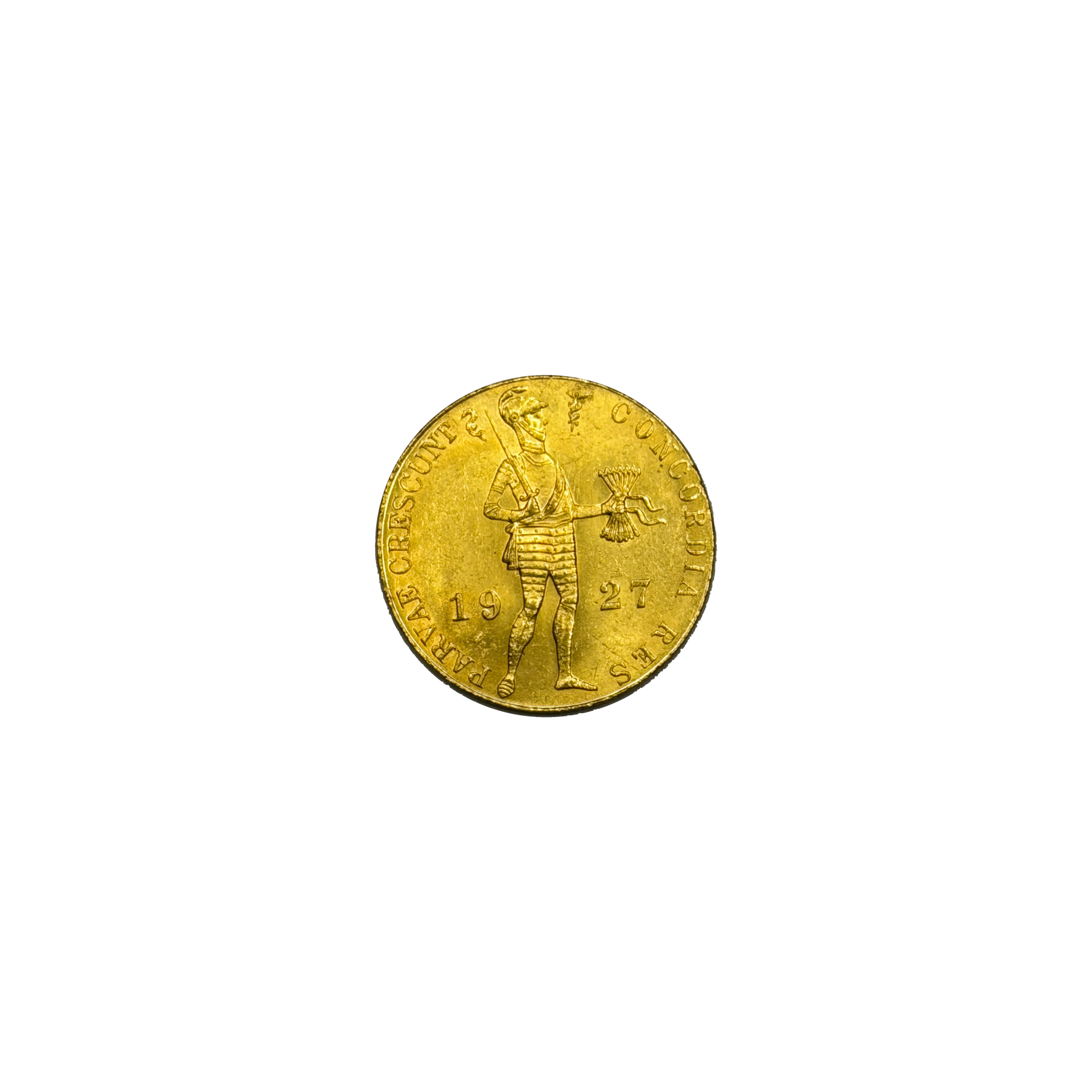
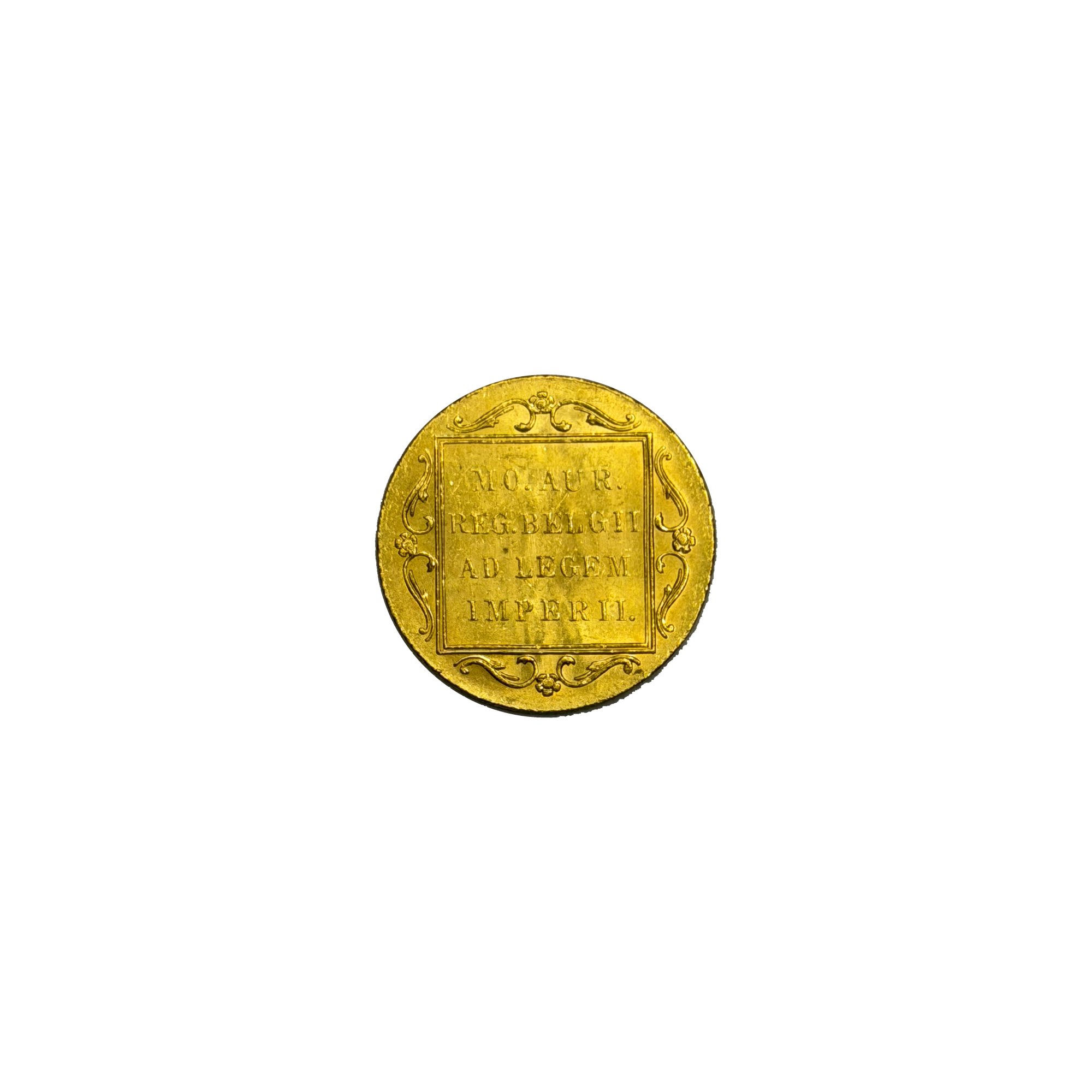
Before the sovereign, before the double eagle, before any modern bullion coin existed, there was the Dutch trade ducat. The Netherlands began striking gold ducats to a fixed standard in 1586, during the Dutch Republic’s rise to command of world commerce, and the design has remained essentially unchanged for more than four centuries — an armored knight standing with sword and a bundle of arrows, circled by the motto CONCORDIA RES PARVAE CRESCUNT: “through concord, small things grow.” It is among the longest-running coin designs in the history of money. When Amsterdam was the financial capital of the world — home of the first publicly traded corporation and the prototype of central banking — the ducat was the coin that moved Dutch trade from the Baltic to the East Indies.
For investors, the ducat pairs that pedigree with practical credentials. At 0.1106 troy ounces of exceptionally fine .983 gold, it trades at per ounce acquisition costs comparable to modern fractional bullion coins and tracks directly with the spot price of gold over time. Its small size provides genuine divisible negotiability — affording its owner the flexibility to liquidate positions incrementally, in amounts proportionate to the specific needs of the moment and across a variety of circumstances. And in pre-1933 dated form, as specified by USAGOLD, it carries the historic designation and the associated insulation against the possibility of future government intervention. For investors whose priorities are a highly coveted coin steeped in four centuries of historical significance, the highest fineness in the historic fractional genre, and a gold standard recognized on sight since the age of sail—all for near-bullion pricing—no coin in the gold market carries a longer track record than the Netherlands trade ducat.
The obverse presents the standing knight — armored, sword raised over his shoulder, gripping a bundle of seven arrows representing the seven provinces of the original Dutch union — with the date divided at either side of the figure and the CONCORDIA motto encircling. The reverse carries an ornamented square tablet inscribed MO. AUR. REG. BELGII AD LEGEM IMPERII: “gold money of the Kingdom of the Netherlands according to the law of the empire.” Both design and inscription descend directly from the sixteenth century, and their survival into the modern era is itself the coin’s statement: an instrument so trusted in world trade that no ruler dared change it.
Each ducat contains 0.1106 troy ounces of gold at 3.494 grams total weight, struck in .983 fine gold — among the highest-purity coins of the classical era, a legacy of trade coinage that had to be accepted on sight in ports where no assayer was available. Grade range: PL/UNC. Minted 1814–1932. USAGOLD supplies pre-1933 dated examples.
The ducat is the coin of the Dutch Golden Age. In the seventeenth century, the Netherlands essentially invented the modern financial system — the joint-stock corporation, the stock exchange, and central banking all trace to Amsterdam — and the trade ducat was that system’s hard-money instrument, minted to a standard deliberately held constant so that merchants from Danzig to Batavia could accept it without weighing or assay. The Dutch East India Company carried ducats east by the chest; Russian tsars and other European states paid the Dutch coin the highest compliment available in the era of hard money, imitating it for their own trade payments. The ducats USAGOLD offers belong to the modern chapters of that continuous tradition — struck at Utrecht to the same standard, the same design, and the same fineness the trading world had trusted for centuries.
Recognizability is the ducat’s founding purpose. The standing-knight design was engineered to be known on sight in foreign ports, and four centuries later it still is: dealers across Europe and North America identify the type immediately, its specifications are universally documented, and its .983 fineness is a fixture of the standard references. The ducat trades actively in both the American and European markets, and its unusually high purity makes its gold content one of the simplest calculations in the historic coin market. For investors who prioritize the ability to convert a holding to cash quickly, the ducat performs that function as it has since the age of sail.
A note on dates, offered in the spirit of transparency that governs everything USAGOLD publishes: because the ducat has been struck across so many eras — including issues after 1933 — the date on the coin matters. USAGOLD specifies pre-1933 dated ducats, and that specification is what places the coin within the legal classification described below. It is the same reason we specify pre-1933 dates on the Swiss 20 Franc Helvetia, where post-1933 issues fall outside the exemption entirely.
In 1933, FDR issued Executive Order 6102, requiring Americans to surrender their gold coin and bullion to the Treasury — but the order and the regulations that followed it exempted gold coins of recognized special value to collectors of rare and unusual coins. Subsequent clarifications by the Treasury identified pre-1933 gold coins — a classification that includes the Netherlands trade ducat as specified by USAGOLD in pre-1933 dated form — as falling within that collector classification as historical items.
Under current constitutional law, a government intervention in the gold market would be executed through the power of eminent domain — the government’s right to take private property for public use provided it pays the owner just compensation. Historic coins complicate the government’s ability to broadly establish “just compensation” or “fair value,” which was precisely the reasoning behind the original “recognized special value” exemption in 1933. That complexity, and the precedent surrounding pre-1933 gold coins, creates a notable impediment to the government’s ability to restrict them broadly — particularly compared to modern bullion, which can be valued easily and consistently at a single price. In essence, it is a bureaucratic question of whether the government would undertake the enormous task of valuing the diversity and complexity of the historic-coin genre — every coin, every date, every condition, every personal holding — and that difficulty is what insulates the owner’s legal liquidity rights in the event of capital controls.
Whether a future government intervention in private gold markets is a risk an investor assigns significant weight to is a personal judgment. The factual point is narrower: the pre-1933 status represents a layer of portfolio differentiation that this coin carries at minimal added per-ounce cost over comparable modern bullion, along with a measure of insulation for the legal liquidity rights of its owner.
For a more in-depth study, we invite you to read our comprehensive memorandum on this subject: Preparing for a Potential Gold Confiscation
The Netherlands trade ducat is the oldest continuously trusted gold coin design an investor can own — the instrument that financed the first modern economy, struck in .983 fine gold to a standard held constant for more than four centuries precisely so that it would be accepted anywhere, by anyone, on sight. That unmatched pedigree trades at per ounce acquisition costs comparable to modern fractional bullion — though, like most centuries-old gold, the ducat is rarely available in quantity, and allotments are quickly subscribed when they appear. No other gold coin can boast this combination of antiquity, purity, and enduring liquidity for gold investors.
| Year | Mintage |
|---|---|
| 1814 | 2,930,270 |
| 1815 | 1,286,530 |
| 1816 | 220,570 |
| 1817 | 498,013 |
| 1818 | 1,561,407 |
| 1819 | 111,301 |
| 1820 | 10,419 |
| 1821 | 15,073 |
| 1822 | 11,971 |
| 1824 | — |
| 1825 | 167,279 |
| 1827 | 165,142 |
| 1828 | 1,085,914 |
| 1829 | 1,400,100 |
| 1830 | 11,186 |
| 1831 | 1,410,915 |
| 1833 | — |
| 1835 | — |
| 1836 | — |
| 1839 | — |
| 1840 | 103,321 |
| 1849 | 14,344 |
| 1872 | 30,095 |
| 1873 | 40,041 |
| 1874 | 44,005 |
| 1876 | 44,409 |
| 1877 | 14,875 |
| 1878 | 87,310 |
| 1879 | 20,103 |
| 1880 | 25,372 |
| 1885 | 81,205 |
| 1894 | 30,407 |
| 1895 | 58,444 |
| 1899 | 60,686 |
| 1901 | 29,284 |
| 1903 | 90,824 |
| 1905 | 87,995 |
| 1906 | 29,379 |
| 1908 | 91,006 |
| 1909 | 106,021 |
| 1910 | 421,447 |
| 1912 | 147,860 |
| 1913 | 205,464 |
| 1914 | 246,560 |
| 1916 | 116,997 |
| 1917 | 216,892 |
| 1920 | 293,389 |
| 1921 | 409,001 |
| 1922 | 49,837 |
| 1923 | 106,674 |
| 1924 | 84,206 |
| 1925 | 573,071 |
| 1926 | 191,311 |
| 1927 | 654,424 |
| 1928 | 571,881 |
| 1932 | 88,268 |
| Total (listed figures) | 16,352,498 |
Mintage figures per the Standard Catalog of World Coins, via the NGC World Price Guide. Dates NGC lists without figures are shown with a dash. Netherlands (Utrecht) strikes; the 1815 figure combines the plain and clover-leaf varieties, the 1825–1829 figures combine Utrecht and Brussels (B) strikings, and overdate figures are credited to their years. Russian-made imitation trade ducats of 1818–1849 (struck at St Petersburg, several million pieces) are excluded. NGC lists a second 1909 entry of 30,182 not included in the total.
UNC, PL
1814-1932
.1106 troy ounce
Netherlands
| Quantity | Wire / ACH | Card |
|---|---|---|
| 1–46 | $518.05 | $539.64 |
| 47–92 | $512.87 | $534.24 |
| 93+ | $507.69 | $528.85 |
Quantity tiers reflect the historic & fractional gold order discount (1% at $25,000+ · 2% at $50,000+ in qualifying coins). Any mix of qualifying historic coins counts toward the same order total.
Prices shown under Wire/ACH include a 4% cash discount. Card prices are the full list price.
Interested in gold but struggling to find the right firm?


