

You must have an order with a minimum of $1,000.00 to place your order, your current order total is $0.00.
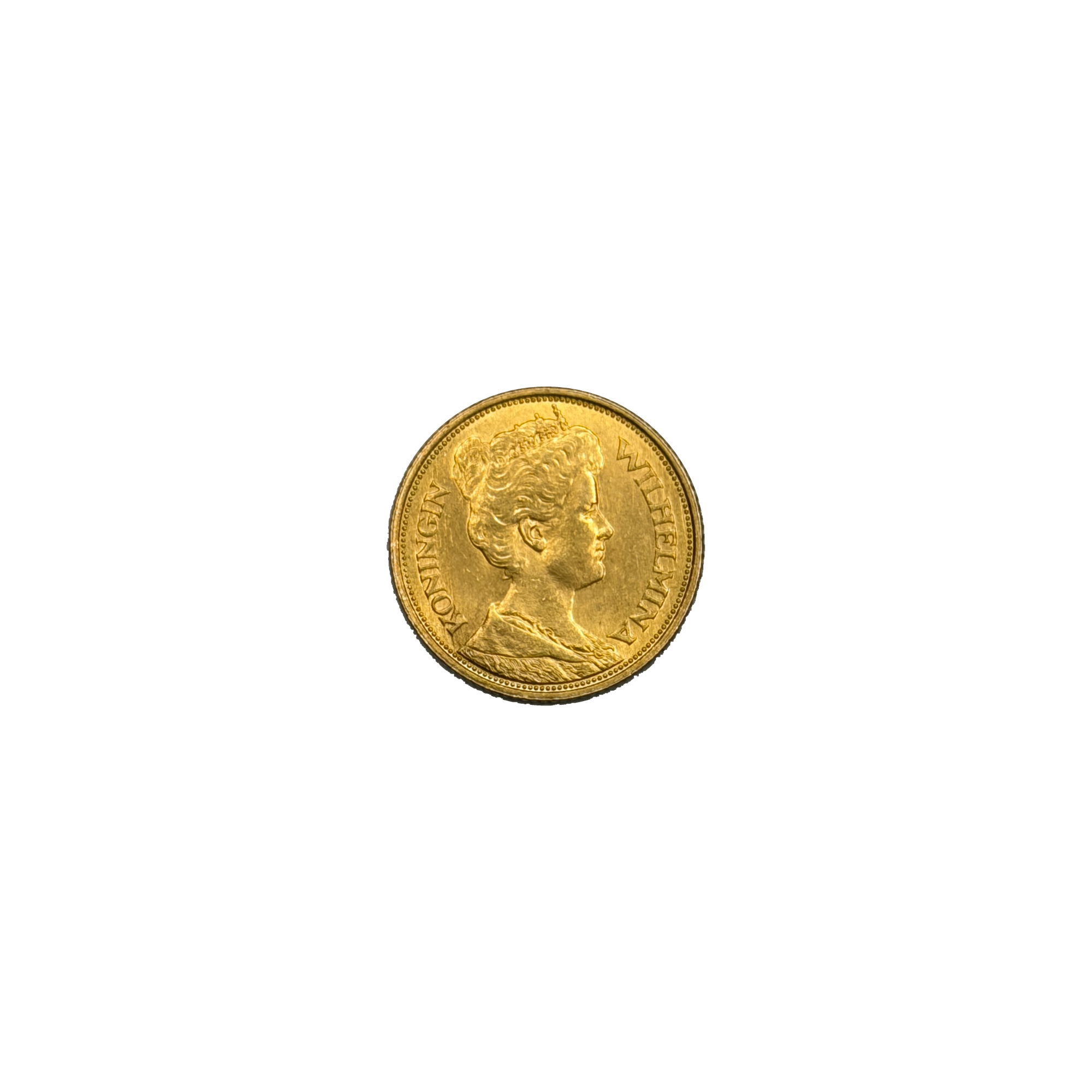
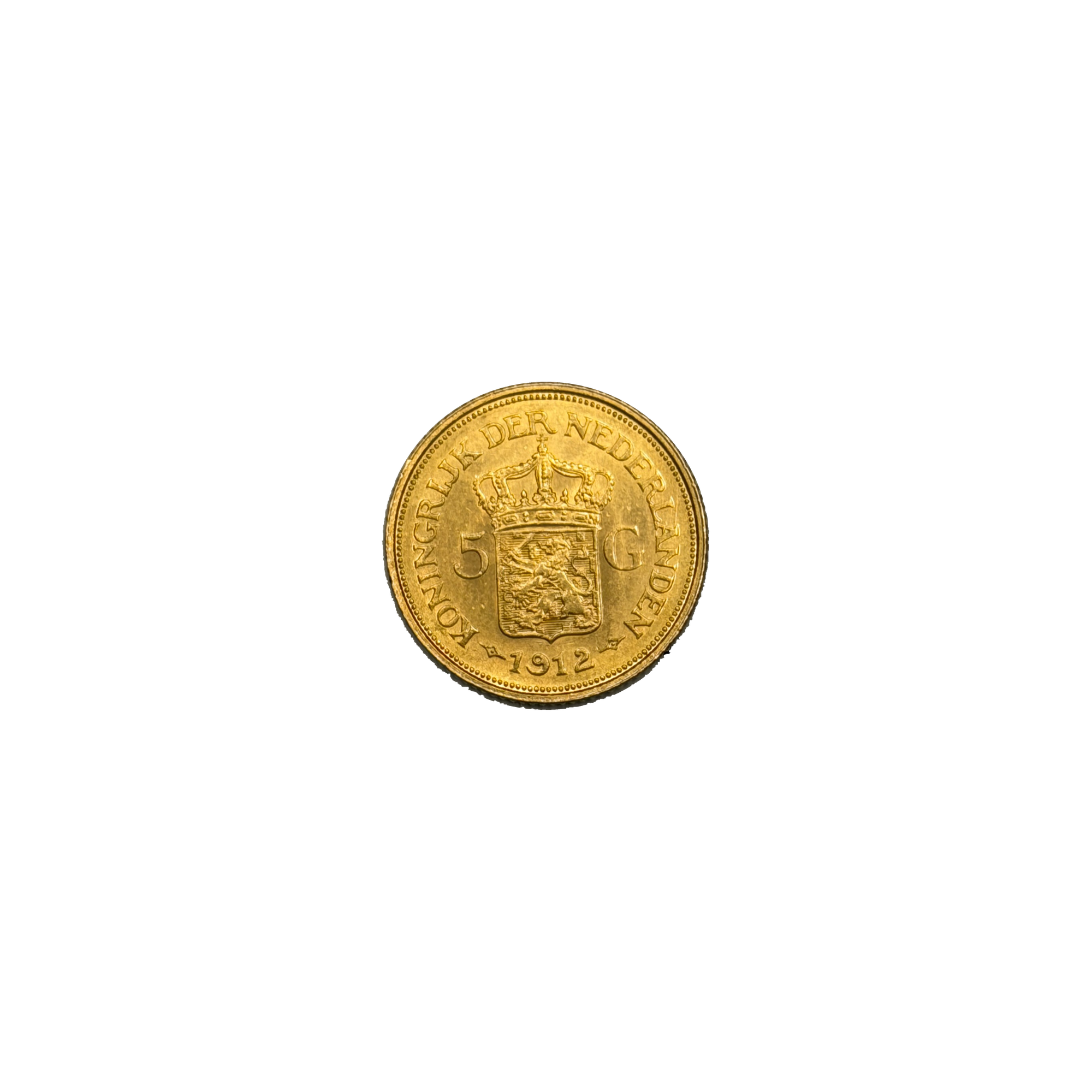
The Netherlands struck its twentieth-century gold 5 Gulden exactly once. In 1912, the Utrecht mint produced one million pieces bearing the mature portrait of Queen Wilhelmina, and then the denomination was never issued again. One million coins, one year — against the roughly 21.2 million mature-portrait 10 Guilders struck across nine dates, and against British sovereign production that exceeded 30 million coins in single peak years. Survival from that original mintage is unknown, but assuredly lower. By the comparative standard that matters, the 5 Gulden is among the scarcest pre-1933 European gold coins available to investors, and it trades nowhere near a price that reflects it.
The coin’s second argument is its size. At 0.09735 troy ounces — just under one-tenth of an ounce — the 5 Gulden is the smallest unit in the Dutch family, and with that comes divisible negotiability: a position can be liquidated in small increments, in amounts proportionate to the specific needs of the moment and across a variety of circumstances. It trades at per ounce acquisition costs competitive with modern one-tenth-ounce bullion coins, tracks directly with the spot price of gold over time, and carries the historic (pre-1933) designation and the associated insulation against the possibility of future government intervention. For investors whose priorities are a highly coveted coin steeped in historical significance, notable scarcity due to a limited single-year mintage, a high state of preservation, and a standardized and widely recognized gold content—all for near-bullion pricing—the 5 Gulden is both the smallest and scarcest coin of the Dutch gold series.
The obverse bears the mature portrait of Queen Wilhelmina facing right, a diadem in her upswept hair, with the legend KONINGIN WILHELMINA — the same composed, authoritative likeness that anchors the 10 Guilder issues of the era. The reverse displays the crowned Dutch coat of arms, the rampant lion of the House of Nassau, flanked by the denomination 5 G, with KONINGRIJK DER NEDERLANDEN encircling and the date 1912 below.
Each coin contains 0.09735 troy ounces of pure gold in a .900 fine alloy at 3.36 grams total weight. Minted 1912 only. Grade range is AU/UNC — the highest “raw” grade, meaning coins that have not been encapsulated and independently graded — with the majority uncirculated specimens exhibiting strong luster and original coin detail.
Smaller European denominations were working money in the fullest sense — their practical value related more directly to everyday goods and services, so they circulated harder and longer than the larger gold coins that sat in savings. Most surviving small European gold shows that wear. The 5 Gulden group USAGOLD offers is the exception: firmly AU/UNC, with the majority of pieces uncirculated, their original design detail and luster intact. A single-year, million-mintage coin from 1912 in that state of preservation is a combination the historic fractional market rarely extends.
The 5 Gulden bears the portrait of one of the most remarkable monarchs of the modern era. Wilhelmina ascended the Dutch throne at age ten, amassed a personal fortune that made her the first female billionaire in recorded history, called Adolf Hitler “the archenemy of mankind” while leading the Dutch government-in-exile from London, and reigned for fifty-eight years. Her full story — including her famous reply to Kaiser Wilhelm II about the Dutch dikes — is told on our companion page for the Wilhelmina 10 Guilder. The 5 Gulden captures her at mid-reign, two years before the First World War would test the Netherlands’ neutrality and her own resolve.
The 5 Gulden belongs to the Dutch guilder family — one of the most consistently recognized and traded pre-1933 European gold types in both the American and European markets. Dealers identify the Wilhelmina portrait and Nassau arms on sight, the coin’s specifications are standardized and well-documented, and the family’s trading history is deep on both sides of the Atlantic. The 5 Gulden adds to that liquidity profile the practical advantage of the smallest increment in the family: the coin most suited to converting exactly as much gold to cash as a circumstance requires, and no more.
In 1933, FDR issued Executive Order 6102, requiring Americans to surrender their gold coin and bullion to the Treasury — but the order and the regulations that followed it exempted gold coins of recognized special value to collectors of rare and unusual coins. Subsequent clarifications by the Treasury identified pre-1933 gold coins — a classification that includes the Netherlands 5 Gulden, struck in 1912 — as falling within that collector classification as historical items.
Under current constitutional law, a government intervention in the gold market would be executed through the power of eminent domain — the government’s right to take private property for public use provided it pays the owner just compensation. Historic coins complicate the government’s ability to broadly establish “just compensation” or “fair value,” which was precisely the reasoning behind the original “recognized special value” exemption in 1933. That complexity, and the precedent surrounding pre-1933 gold coins, creates a notable impediment to the government’s ability to restrict them broadly — particularly compared to modern bullion, which can be valued easily and consistently at a single price. In essence, it is a bureaucratic question of whether the government would undertake the enormous task of valuing the diversity and complexity of the historic-coin genre — every coin, every date, every condition, every personal holding — and that difficulty is what insulates the owner’s legal liquidity rights in the event of capital controls.
Whether a future government intervention in private gold markets is a risk an investor assigns significant weight to is a personal judgment. The factual point is narrower: the pre-1933 status represents a layer of portfolio differentiation that this coin carries at minimal added per-ounce cost over comparable modern bullion, along with a measure of insulation for the legal liquidity rights of its owner.
For a more in-depth study, we invite you to read our comprehensive memorandum on this subject: Preparing for a Potential Gold Confiscation
The Netherlands 5 Gulden is a one-year coin from one of Europe’s most liquid gold families — one million pieces struck in 1912, never issued again, surviving in AU/UNC condition, and priced competitively on a per ounce basis with modern tenth-ounce bullion. Highly coveted and rarely available in quantity, it is both the smallest coin in the Dutch series and one of its scarcest — the kind of coin that is quickly subscribed when small groups reach the market, and one that tends to settle into heirloom positions once acquired. No other fractional European gold coin delivers this combination of single-year scarcity, condition, and small-increment flexibility at so accessible a cost per ounce.
| Year | Mintage |
|---|---|
| 1912 | 1,000,000 |
| Total | 1,000,000 |
Each coin contains 0.09735 troy ounces of pure gold in a .900 fine alloy at 3.36 grams total weight - just under one-tenth of an ounce, and the smallest unit in the Dutch gold family.
Exactly once. In 1912 the Utrecht mint struck one million pieces, and the denomination was never issued again - a single-year, one-million-coin issue.
The obverse bears the mature portrait of Queen Wilhelmina facing right with the legend KONINGIN WILHELMINA. The reverse displays the crowned Dutch coat of arms with the rampant lion of the House of Nassau, the denomination 5 G, KONINGRIJK DER NEDERLANDEN encircling, and the date 1912 below.
One million coins from a single year of production - against roughly 21.2 million mature-portrait 10 Guilders struck across nine dates - places it, by that comparative standard, among the scarcest pre-1933 European gold coins available to investors.
The grade range is AU/UNC, with the majority uncirculated specimens exhibiting strong luster and original coin detail.
Queen Wilhelmina
1912
AU, UNC
.09735 troy ounce
Netherlands
| Quantity | Wire | Card |
|---|---|---|
| 1–52 | $453.91 | $472.82 |
| 53–105 | $449.37 | $468.09 |
| 106+ | $444.83 | $463.36 |
Quantity tiers reflect the historic & fractional gold order discount (1% at $25,000+ · 2% at $50,000+ in qualifying coins). Any mix of qualifying historic coins counts toward the same order total.
Prices shown under Wire include a 4% cash discount. Card prices are the full list price. ACH bank transfer is available to established clients only. First-time orders can be paid by wire transfer or card.
Interested in gold but struggling to find the right firm?


