

You must have an order with a minimum of $1,000.00 to place your order, your current order total is $0.00.
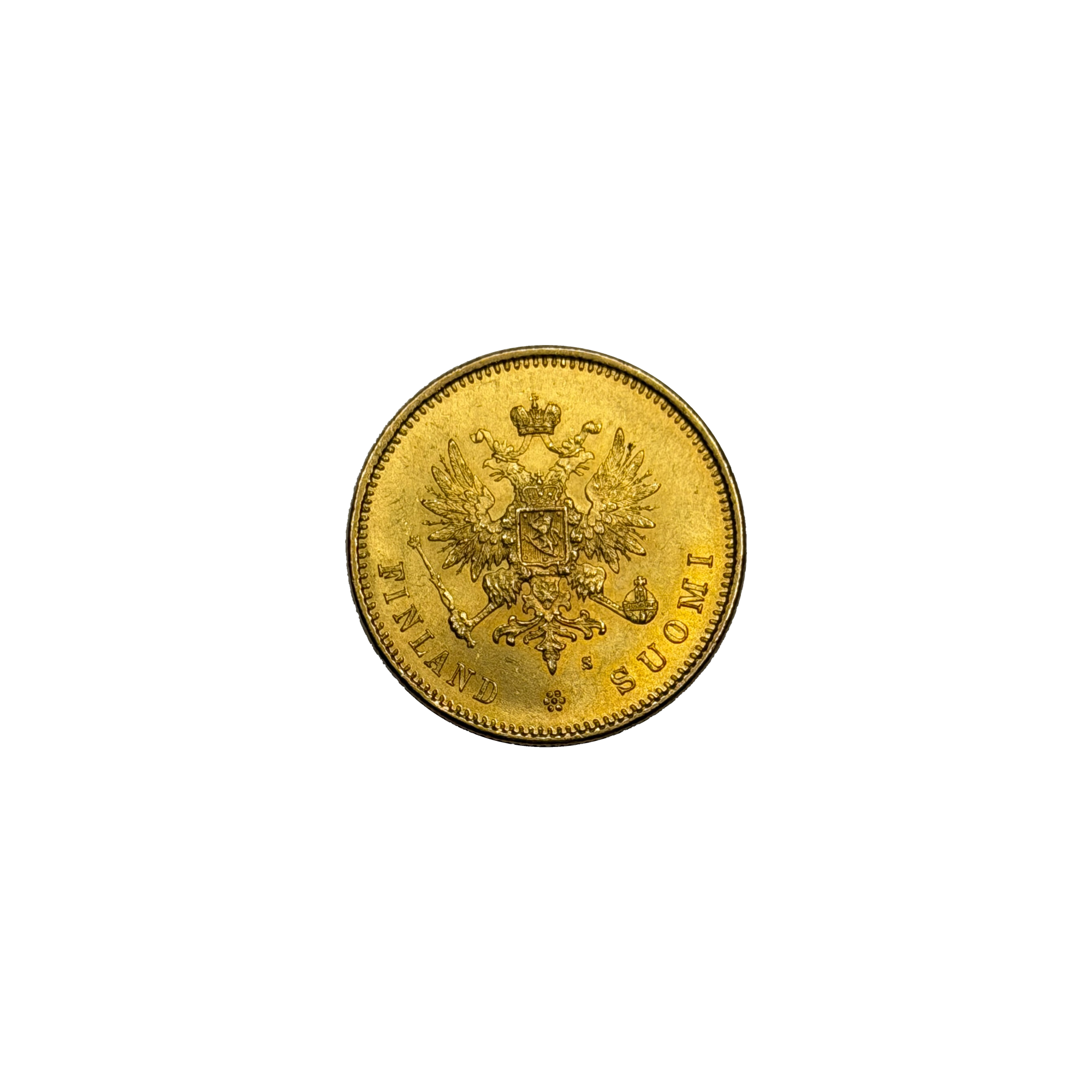
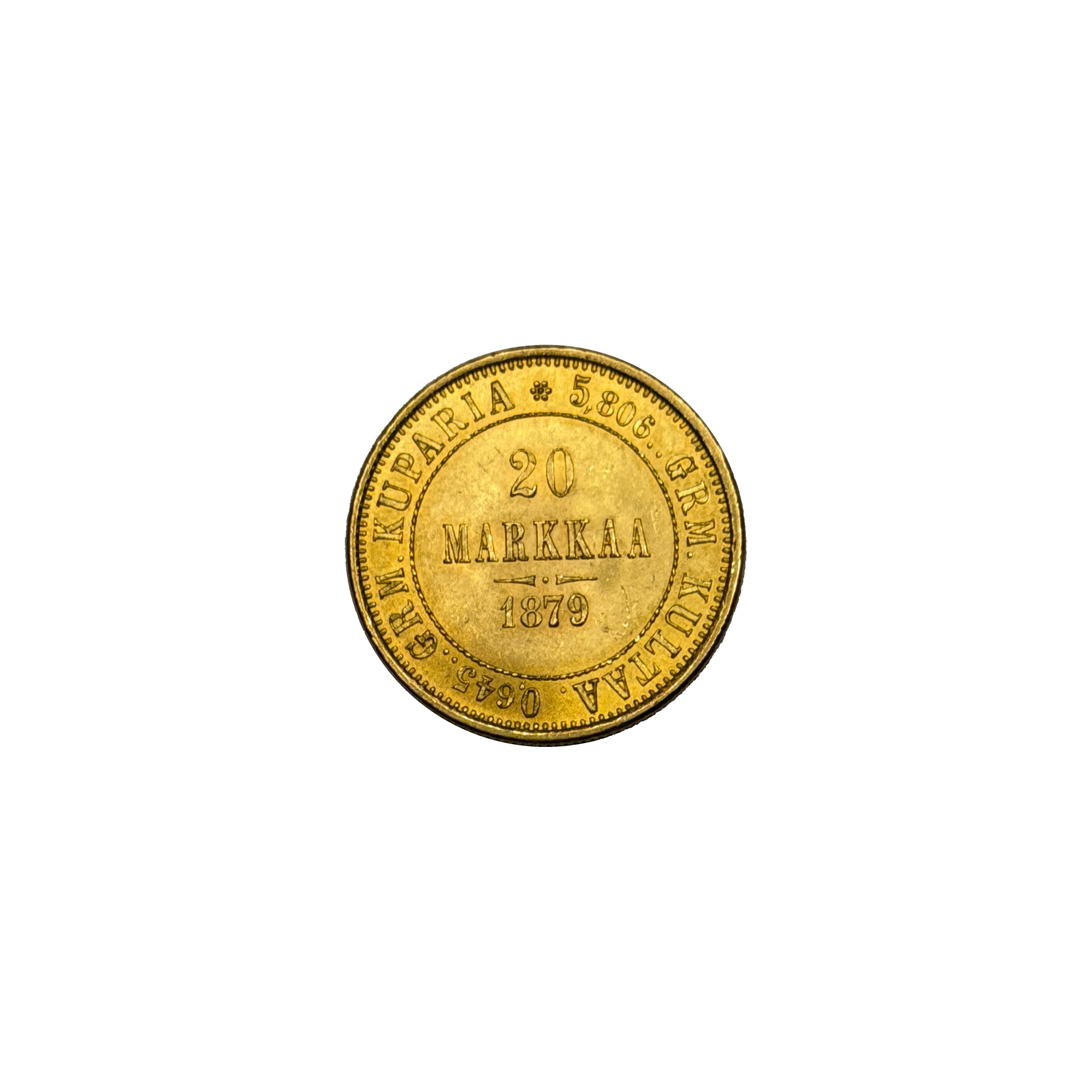
The Finland 20 Markkaa is one of the more historically improbable coins in the pre-1933 European gold canon: the gold coinage of a country that did not yet formally exist. Struck in Helsinki between 1878 and 1913, while Finland was a Grand Duchy of the Russian Empire, the 20 Markkaa carried the double-headed eagle of the tsars on its face — but with the Finnish lion set at the eagle’s heart, the legends rendered in Finland’s own languages, and the coin minted to a Western European standard rather than a Russian one. It is the money of a people asserting a national identity within an empire, four decades before independence arrived in 1917.
For investors, the 20 Markkaa combines that story with unusually practical credentials. Its 0.1867 troy ounces of .900 fine gold place it on the Latin Monetary Union franc standard — the same gold content as the French 20 Franc and Swiss 20 Franc Helvetia, two of the most heavily traded fractional gold coins in the world — so its value is understood instantly wherever European gold trades. It trades at per ounce acquisition costs comparable to modern fractional bullion, tracks directly with the spot price of gold over time, and carries the historic (pre-1933) designation and the associated insulation against the possibility of future government intervention. Its production window was also narrow: 36 years, under a single coinage system, against the British sovereign’s continuous multi-decade output of 30-plus million coins in peak years. For investors whose priorities are a coin steeped in the historical significance of a nation minting its identity ahead of its independence, a narrow 36-year production history, uncirculated preservation, and a standardized and widely recognized gold content shared with the French 20 Franc and Swiss Helvetia—all for near-bullion pricing—the Finland 20 Markkaa is among the most distinctive coins in the fractional gold market.
The obverse presents the crowned double-headed imperial eagle of Russia, sceptre and orb in its talons — but at the center of its breast sits the crowned rampant lion of Finland’s own coat of arms, and the flanking legends read FINLAND and SUOMI, the country’s name in Swedish and Finnish. No Russian appears on the coin. The reverse is a model of gold standard-era candor: within a beaded circle, the denomination 20 MARKKAA and the date; around it, an inscription stating the coin’s exact metal content — 5.806 grams of gold and 0.645 grams of copper. The coin declares its own intrinsic value on its face, a practice from an era when money was expected to prove itself.
Each 20 Markkaa contains 0.1867 troy ounces of pure gold at 6.45 grams total weight, struck in .900 fine gold to the Latin Monetary Union franc standard — matching the French 20 Franc and Swiss 20 Franc Helvetia. Grade range: UNC. Struck 1878–1913 at the Helsinki mint.
Finland’s money is a study in how a nation can exist before it appears on a map. Under Russian rule from 1809, Finland retained its own senate, its own laws, and — after 1860 — its own currency, the markka. When Finland placed the markka on gold in 1878, it deliberately chose the Western European franc standard rather than the Russian rouble system: 20 markkaa equaled 20 French francs, not any round number of roubles. The choice tied Finland’s economy to Paris, Brussels, and Geneva rather than St. Petersburg, and it meant Finnish gold spent seamlessly across gold standard Europe. The 20 Markkaa is that declaration in physical form — struck under the tsar’s eagle, denominated in Finland’s own language, and weighted to Europe’s money rather than Russia’s. When independence came in 1917, the markka was already, in every monetary sense, a national currency. It remained one until Finland adopted the euro in 2002.
The 20 Markkaa’s greatest practical asset is the standard it was built on. Because it carries exactly the gold content of the French 20 Franc and Swiss 20 Franc Helvetia — the benchmark fractional coins of the European gold market — dealers price and trade it with the same fluency, and its specifications are universally documented in the standard references. The Finnish issues add a distinctive design and a far narrower production history to a gold weight the entire market already knows by heart. For investors who prioritize the ability to convert a holding to cash quickly, the 20 Markkaa trades in both the American and European markets with the full liquidity of the franc-standard family, while offering a coin most other portfolios will not hold.
In 1933, FDR issued Executive Order 6102, requiring Americans to surrender their gold coin and bullion to the Treasury — but the order and the regulations that followed it exempted gold coins of recognized special value to collectors of rare and unusual coins. Subsequent clarifications by the Treasury identified pre-1933 gold coins — a classification that includes the Finland 20 Markkaa, struck between 1878 and 1913 — as falling within that collector classification as historical items.
Under current constitutional law, a government intervention in the gold market would be executed through the power of eminent domain — the government’s right to take private property for public use provided it pays the owner just compensation. Historic coins complicate the government’s ability to broadly establish “just compensation” or “fair value,” which was precisely the reasoning behind the original “recognized special value” exemption in 1933. That complexity, and the precedent surrounding pre-1933 gold coins, creates a notable impediment to the government’s ability to restrict them broadly — particularly compared to modern bullion, which can be valued easily and consistently at a single price. In essence, it is a bureaucratic question of whether the government would undertake the enormous task of valuing the diversity and complexity of the historic-coin genre — every coin, every date, every condition, every personal holding — and that difficulty is what insulates the owner’s legal liquidity rights in the event of capital controls.
Whether a future government intervention in private gold markets is a risk an investor assigns significant weight to is a personal judgment. The factual point is narrower: the pre-1933 status represents a layer of portfolio differentiation that this coin carries at minimal added per-ounce cost over comparable modern bullion, along with a measure of insulation for the legal liquidity rights of its owner.
For a more in-depth study, we invite you to read our comprehensive memorandum on this subject: Preparing for a Potential Gold Confiscation
The Finland 20 Markkaa is the gold coin of a nation that minted its independence before it could declare it — the tsar’s eagle carrying Finland’s lion, struck for just 36 years to the same franc standard that makes the French 20 Franc and Swiss Helvetia the most fluently traded fractional gold in Europe. It pairs that benchmark liquidity with a narrow production history, uncirculated preservation, and divisible negotiability, all at per ounce acquisition costs comparable to modern fractional bullion. No other franc-standard gold coin carries a national story this distinctive at so accessible a cost per ounce.
| Year | Mintage |
|---|---|
| 1878 | — |
| 1879 | 300,000 |
| 1880 | 90,000 |
| 1891 | 91,000 |
| 1903 | 112,000 |
| 1904 | 188,000 |
| 1910 | 201,000 |
| 1911 | 161,000 |
| 1912 | 881,000 |
| 1913 | 214,000 |
| Total (listed figures) | 2,238,000 |
Mintage figures per the Standard Catalog of World Coins, via the NGC World Price Guide. Dates NGC lists without figures are shown with a dash.
UNC
1878-1913
.1867 troy ounce
Finland
| Quantity | Wire | Card |
|---|---|---|
| 1–20 | $1,166.51 | $1,215.11 |
| 21–41 | $1,154.84 | $1,202.96 |
| 42+ | $1,143.18 | $1,190.81 |
Quantity tiers reflect the historic & fractional gold order discount (1% at $25,000+ · 2% at $50,000+ in qualifying coins). Any mix of qualifying historic coins counts toward the same order total.
Prices shown under Wire include a 4% cash discount. Card prices are the full list price. ACH bank transfer is available to established clients only. First-time orders can be paid by wire transfer or card.
Interested in gold but struggling to find the right firm?


