

You must have an order with a minimum of $1,000.00 to place your order, your current order total is $0.00.
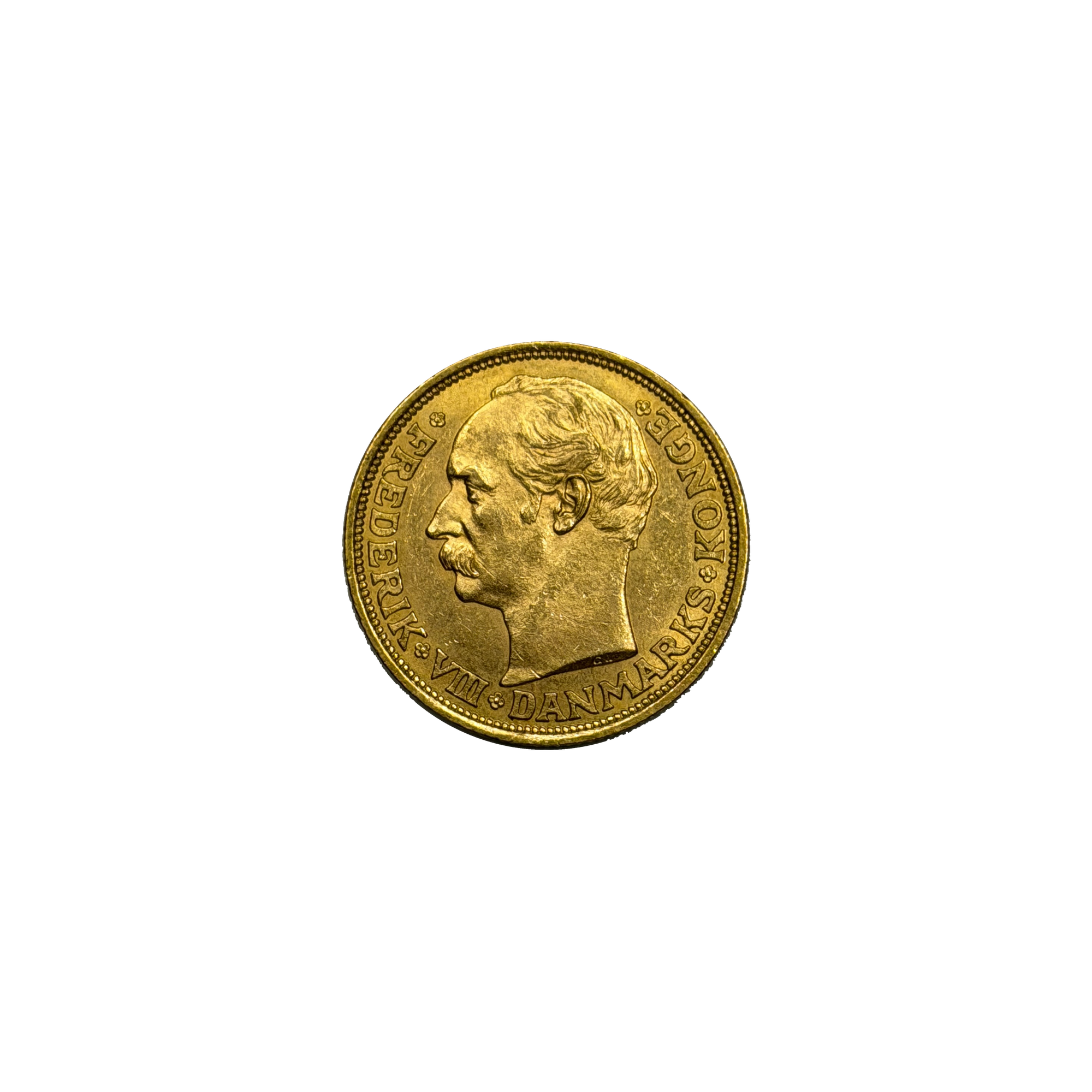
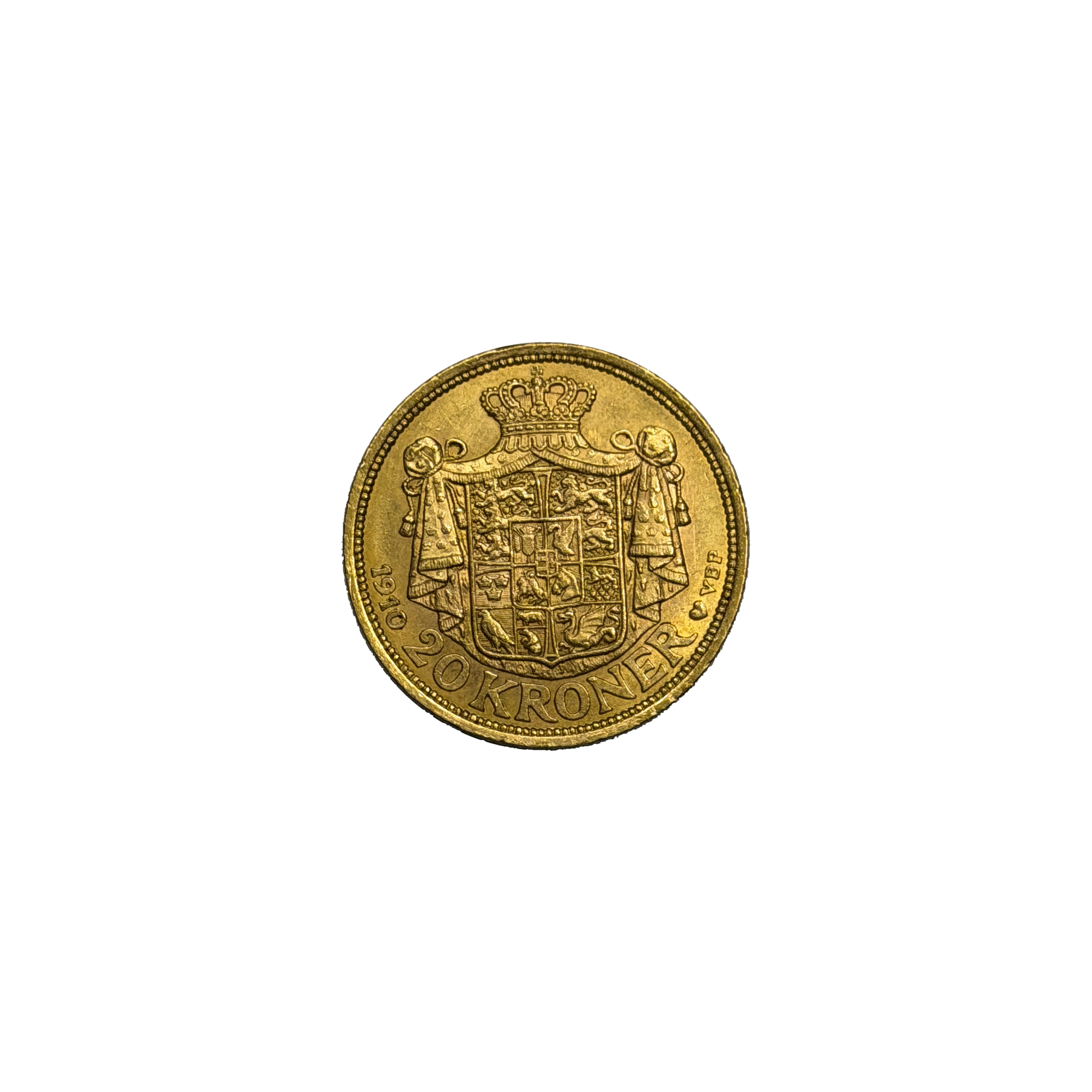
Frederik VIII reigned for only six years — 1906 to 1912, the brief interval between his father Christian IX, the “father-in-law of Europe,” and his son Christian X, who would carry the Danish crown through two world wars. The gold 20 Kroner of his reign, struck from 1908 to 1912, is the compact middle chapter of the Scandinavian Monetary Union’s flagship denomination: a five-year issue window against the 28-year run of the Christian IX Mermaid, in a coin of identical weight, fineness, and legal standing across three kingdoms.
For investors, that combination — the union’s principal gold coin, from its narrowest 20 Kroner issue window — is the appeal. At 0.2592 troy ounces of .900 fine gold, a slightly larger gold content than the British sovereign’s 0.2354 oz, the Frederik VIII 20 Kroner trades at per ounce acquisition costs comparable to modern bullion coins and tracks directly with the spot price of gold over time, while carrying the historic (pre-1933) designation and the associated insulation against the possibility of future government intervention. At roughly one-quarter of a troy ounce, it also offers divisible negotiability: affording its owner the flexibility to liquidate positions incrementally, in amounts proportionate to the specific needs of the moment and across a variety of circumstances. For investors whose priorities are notable scarcity due to the narrowest 20 Kroner issue window in the Danish family, brilliant uncirculated preservation, quarter-ounce divisible negotiability, and a standardized and widely recognized gold content slightly richer than the British sovereign’s—all for near-bullion pricing—the Frederik VIII 20 Kroner is a distinctive holding within the fractional European gold market.
The obverse presents the bare-headed portrait of King Frederik VIII. The reverse carries the crowned royal arms of Denmark within an ermine mantle — the heraldic format that succeeded the seated Dania “Mermaid” of the Christian IX era and continued under Christian X.
Each 20 Kroner contains 0.2592 troy ounces of pure gold at 8.96 grams total weight, struck in .900 fine gold to the Scandinavian Monetary Union standard — identical in specification to the Swedish 20 Kronor, and interchangeable with it across Scandinavia during the gold standard era. Minted 1908–1912 at the Copenhagen Mint. Grade range: BU — coins that entered savings rather than circulation, showing the original mint brilliance and design detail as struck.
Frederik VIII spent more than half a century as crown prince under his long-reigning father before taking the throne at age sixty-three. Thoroughly prepared and briefly served, he ruled from 1906 until his death in 1912 — a reign short enough that his coinage forms a complete, self-contained royal issue, opened and closed within a single decade. He was the son of the father-in-law of Europe and the father of two kings: Christian X of Denmark and Haakon VII, elected King of newly independent Norway in 1905. The dynasty’s reach across Scandinavia mirrored the monetary union its coins served.
The Scandinavian Monetary Union — the treaty of 1873–75 that placed Denmark, Sweden, and Norway on a single gold krone standard — was one of the most successful currency unions in monetary history: a working single currency area a century and a quarter before the euro, built not on a central bureaucracy but on a fixed weight of gold. Twenty kroner equaled 8.96 grams of .900 fine gold whether struck in Copenhagen or Stockholm, and the coins circulated interchangeably across every Scandinavian border. The Frederik VIII issues of 1908–1912 belong to the union’s final untroubled chapter — struck in the last confident years before the First World War drove its members off gold and ended the system. Within two years of the final Frederik VIII strikes, the classical gold standard itself was gone.
The comparative frame is simple. The Christian IX 20 Kroner accumulated across 28 years of production; the Christian X issues span dates from 1913 to 1931; the Frederik VIII 20 Kroner was struck in five — the narrowest issue window among the Danish 20 Kroner types USAGOLD offers. That supply is fixed in the strictest sense, and no demand event can enlarge it. Because the coin trades at per ounce acquisition costs broadly in line with its long-running siblings, the investor acquires the family’s thinnest 20 Kroner supply at little added cost — which is the value: the scarcity comes at essentially the price of the common dates. When flight-to-safety episodes have taxed the supplies of historic European gold — 2008 remains the reference case — premiums have risen modestly across the whole genre, rare and common issues alike, a behavior same-price modern bullion never exhibits.
The Scandinavian 20 Kroner type — Danish and Swedish together — is a fixture of the international pre-1933 gold market. Dealers across North America and Europe recognize the Danish royal portraits and crowned-arms reverse on sight, the union standard’s specifications are universally documented, and the type trades actively wherever European gold trades. Because the Danish and Swedish issues share one specification, they form a single deep pool of interchangeable quarter-ounce-class gold — a liquidity advantage few single-country types can match. The Frederik VIII issues participate fully in that liquidity while adding an issue-window scarcity their siblings lack.
In 1933, FDR issued Executive Order 6102, requiring Americans to surrender their gold coin and bullion to the Treasury — but the order and the regulations that followed it exempted gold coins of recognized special value to collectors of rare and unusual coins. Subsequent clarifications by the Treasury identified pre-1933 gold coins — a classification that includes the Frederik VIII 20 Kroner, struck between 1908 and 1912 — as falling within that collector classification as historical items.
Under current constitutional law, a government intervention in the gold market would be executed through the power of eminent domain — the government’s right to take private property for public use provided it pays the owner just compensation. Historic coins complicate the government’s ability to broadly establish “just compensation” or “fair value,” which was precisely the reasoning behind the original “recognized special value” exemption in 1933. That complexity, and the precedent surrounding pre-1933 gold coins, creates a notable impediment to the government’s ability to restrict them broadly — particularly compared to modern bullion, which can be valued easily and consistently at a single price. In essence, it is a bureaucratic question of whether the government would undertake the enormous task of valuing the diversity and complexity of the historic-coin genre — every coin, every date, every condition, every personal holding — and that difficulty is what insulates the owner’s legal liquidity rights in the event of capital controls.
Whether a future government intervention in private gold markets is a risk an investor assigns significant weight to is a personal judgment. The factual point is narrower: the pre-1933 status represents a layer of portfolio differentiation that this coin carries at minimal added per-ounce cost over comparable modern bullion, along with a measure of insulation for the legal liquidity rights of its owner.
For a more in-depth study, we invite you to read our comprehensive memorandum on this subject: Preparing for a Potential Gold Confiscation
The Frederik VIII 20 Kroner is the compact middle chapter of Denmark’s gold story — a five-year issue from a six-year reign, slightly richer in gold than a British sovereign, struck in the last confident years of a currency union that gold alone held together, and preserved in brilliant uncirculated condition. It pairs the narrowest 20 Kroner issue window in the Danish family with quarter-ounce-class divisible negotiability and two-continent liquidity at per ounce acquisition costs comparable to modern bullion — a fixed, finite supply less often available than its long-running siblings, and quickly subscribed when it appears. No other Danish 20 Kroner combines this degree of comparative scarcity with the full liquidity of the Scandinavian union standard.
| Year | Mintage |
|---|---|
| 1908 | 243,000 |
| 1909 | 365,000 |
| 1910 | 200,000 |
| 1911 | 183,000 |
| 1912 | 184,000 |
| Total | 1,175,000 |
Mintage figures per the Standard Catalog of World Coins, via the NGC World Price Guide. Dates NGC lists without figures are shown with a dash.
BU
1908-1912
.2592 troy ounce
Denmark
| Quantity | Wire | Card |
|---|---|---|
| 1–19 | $1,262.24 | $1,314.83 |
| 20–38 | $1,249.62 | $1,301.68 |
| 39+ | $1,237.00 | $1,288.53 |
Quantity tiers reflect the historic & fractional gold order discount (1% at $25,000+ · 2% at $50,000+ in qualifying coins). Any mix of qualifying historic coins counts toward the same order total.
Prices shown under Wire include a 4% cash discount. Card prices are the full list price. ACH bank transfer is available to established clients only. First-time orders can be paid by wire transfer or card.
Interested in gold but struggling to find the right firm?

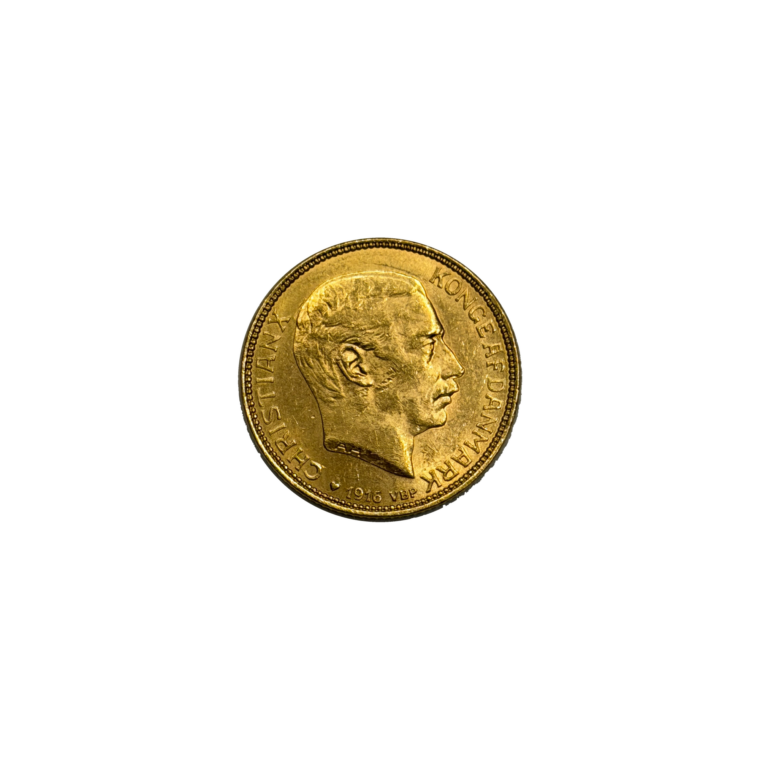
BU
1913-1931
.2592 troy ounce
Denmark
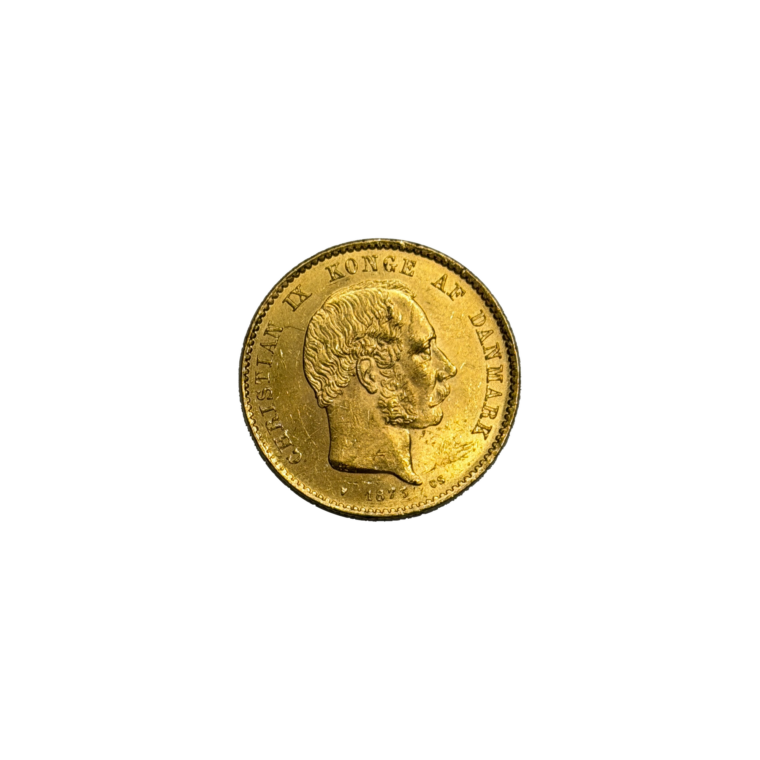
BU
1873-1900
.2592 troy ounce
Denmark


