
You must have an order with a minimum of $1,000.00 to place your order, your current order total is $0.00.
The Danish 10 Kroner is the fractional workhorse of the Scandinavian Monetary Union — the treaty of 1873–75 that placed Denmark, Sweden, and Norway on a single gold krone standard and let their coins circulate interchangeably across three kingdoms for four decades. Where the 20 Kroner sat in bank reserves and settled large accounts, the 10 Kroner was the gold that moved through daily commerce: half the size, the same .900 fine standard, legal tender from Copenhagen to Stockholm to Christiania. The Christian IX issues, struck from 1873 to 1900, are the founding coins of that system — the union’s small denomination under the king who launched it.
That smaller size is precisely its appeal to the modern investor. At 0.1296 troy ounces of gold, the 10 Kroner offers one of the strongest cases for divisible negotiability in pre-1933 European gold: a position built from coins of roughly one-eighth ounce can be liquidated in fine increments, in amounts proportionate to the specific needs of the moment and across a variety of circumstances. The coin trades at per ounce acquisition costs comparable to modern fractional bullion, tracks directly with the spot price of gold over time, and carries the historic (pre-1933) designation and the associated insulation against the possibility of future government intervention. For investors whose priorities are fine-grained divisible negotiability, the longest production run in Denmark’s small gold denomination, and ready liquidity through a standardized and widely recognized gold content—all for near-bullion pricing—the Christian IX 10 Kroner is among the most practical instruments in the fractional gold market today.
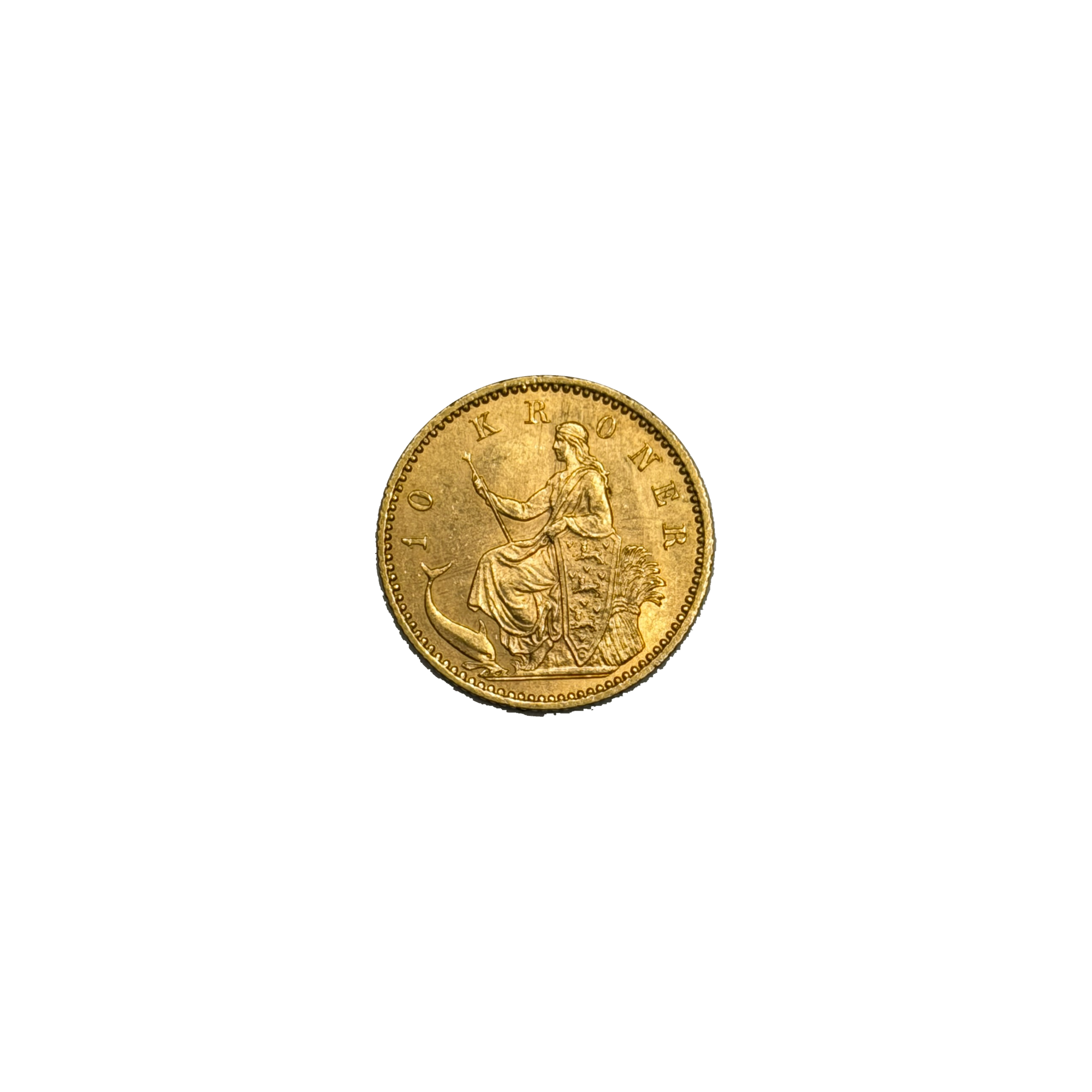
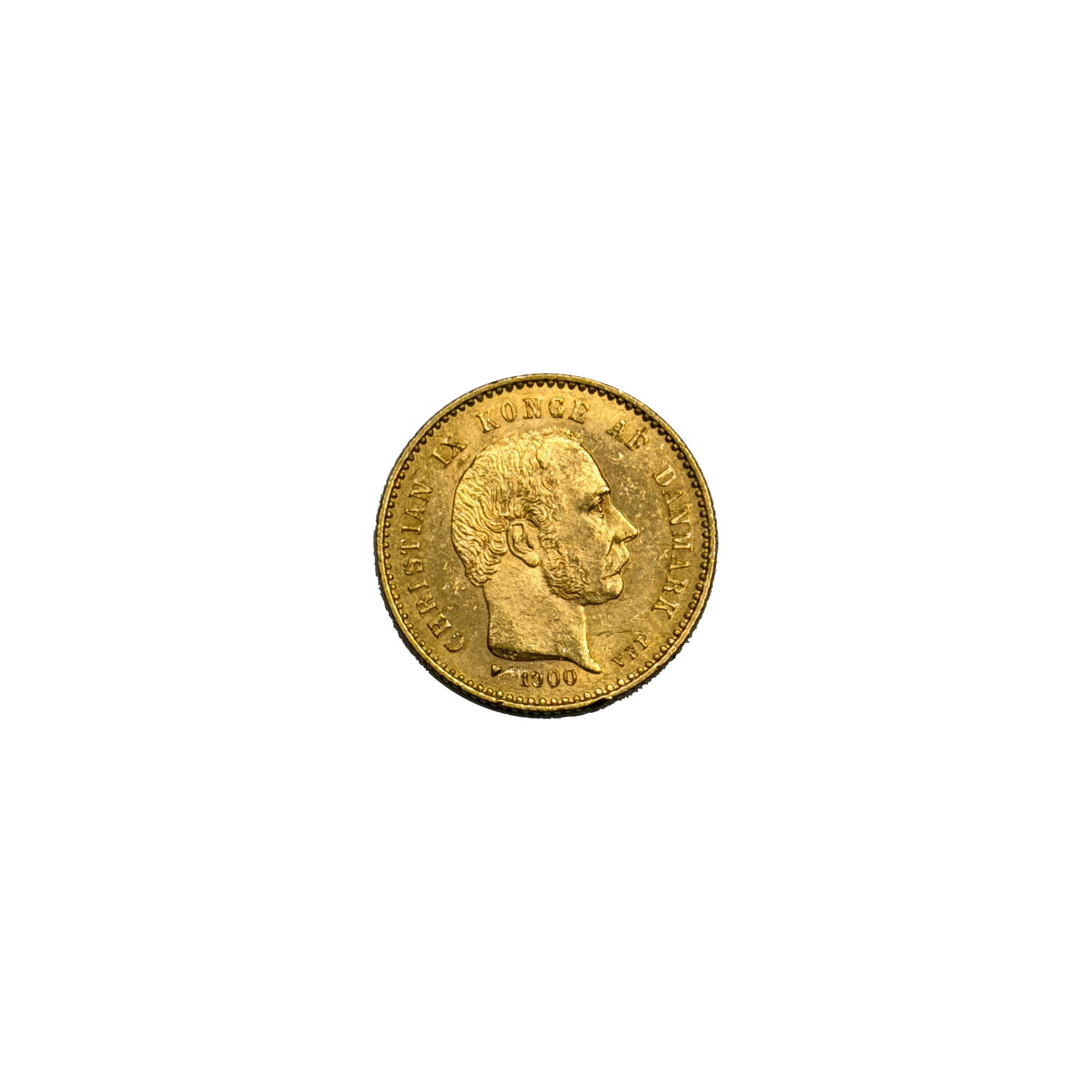
The obverse carries the bearded portrait of King Christian IX. The reverse bears one of the most admired designs in Scandinavian coinage — the seated figure of Dania, the personification of Denmark, with her shield of three lions, a sheaf of grain for the land, and a dolphin at her feet for the sea. The design is popularly known as the “Mermaid” — Denmark’s maritime symbol attached to its national gold coinage.
Each 10 Kroner contains 0.1296 troy ounces of pure gold at 4.48 grams total weight, struck in .900 fine gold — exactly half the 20 Kroner on the Scandinavian Monetary Union standard, and identical in specification to the Swedish 10 Kronor. Minted 1873–1900 at the Copenhagen Mint. Grade range: BU/UNC — coins that entered savings rather than circulation, showing the original mint brilliance and design detail as struck.
The king on the obverse earned one of the great nicknames in royal history. Christian IX’s children married so strategically that by the end of his reign his descendants sat on or stood beside the thrones of Britain, Russia, Greece, and Norway — his daughter Alexandra married King Edward VII of Britain, his daughter Dagmar became Empress of Russia as wife of Alexander III, and his son George became King of the Hellenes. European royalty gathered at his palace in Copenhagen for family reunions that doubled as diplomatic summits, and the press called him “the father-in-law of Europe.” The 10 Kroner coins bearing his portrait are the small change, in gold, of that extraordinary dynasty — struck at the height of its influence.
The Scandinavian Monetary Union deserves more attention than it gets from students of monetary history. It was a functioning multi-national single currency — a century and a quarter before the euro — built on nothing more elaborate than a treaty commitment to a fixed weight of gold. Because a krone was 0.4032 grams of fine gold whether struck in Denmark, Sweden, or Norway, the three kingdoms needed no shared central bank and no political integration; the coins themselves enforced the standard. The union operated smoothly from 1873–75 until the First World War pushed its members onto paper, and it never truly functioned again. The Christian IX 10 Kroner is that experiment’s founding everyday denomination — a physical record of what a currency union looks like when gold, rather than policy, holds it together.
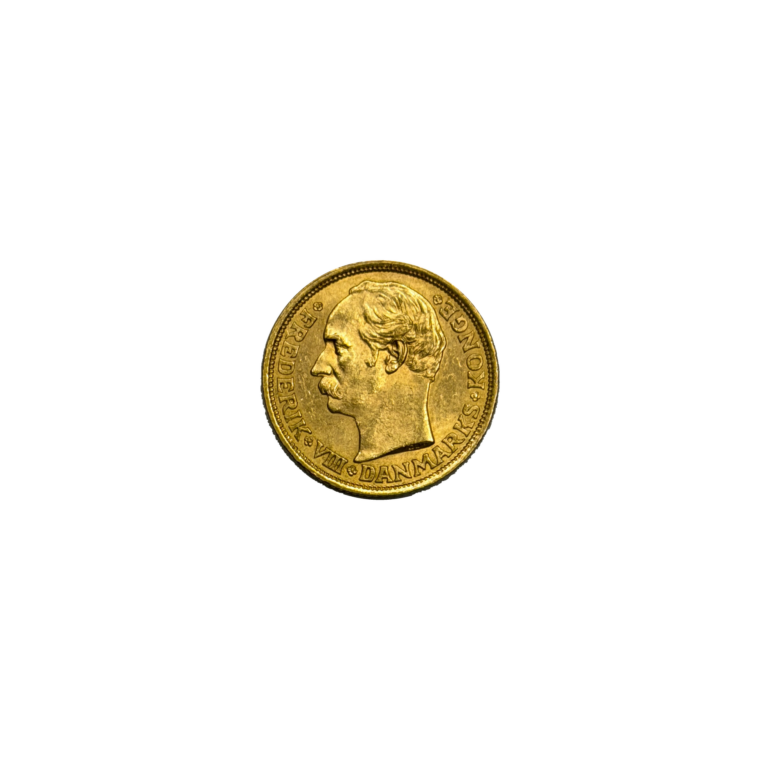
At roughly one-eighth of a troy ounce, the 10 Kroner sits among the lower absolute price points in pre-1933 European gold — an accessible entry into the genre and a fine-grained unit of liquidation for an established holding. Gold’s utility as a reserve asset depends partly on the ability to convert exactly as much as circumstances require and no more, and a holding that includes 10 Kroner pieces can be drawn down in steps roughly half the size the 20 Kroner or the European 20 franc class permits. Within the Danish family, the Christian IX issues offer the longest production run and the signature Dania design; the Frederik VIII 10 Kroner offers the same specification from a two-year issue window for investors who prioritize comparative scarcity.
The Scandinavian krone-standard coins form one of the recognized families of the international pre-1933 gold market. Dealers across North America and Europe identify the Dania “Mermaid” design and the Danish royal portraits on sight, the union standard is universally documented, and the Danish and Swedish issues’ shared specification gives the type an unusually deep pool of interchangeable coins. The 10 Kroner adds the practical advantage of the family’s smallest increment — the coin best suited to converting exactly as much gold to cash as a circumstance requires. For investors who prioritize quick, clean convertibility, the 10 Kroner performs reliably in both the American and European markets.
In 1933, FDR issued Executive Order 6102, requiring Americans to surrender their gold coin and bullion to the Treasury — but the order and the regulations that followed it exempted gold coins of recognized special value to collectors of rare and unusual coins. Subsequent clarifications by the Treasury identified pre-1933 gold coins — a classification that includes the Christian IX 10 Kroner, struck between 1873 and 1900 — as falling within that collector classification as historical items.
Under current constitutional law, a government intervention in the gold market would be executed through the power of eminent domain — the government’s right to take private property for public use provided it pays the owner just compensation. Historic coins complicate the government’s ability to broadly establish “just compensation” or “fair value,” which was precisely the reasoning behind the original “recognized special value” exemption in 1933. That complexity, and the precedent surrounding pre-1933 gold coins, creates a notable impediment to the government’s ability to restrict them broadly — particularly compared to modern bullion, which can be valued easily and consistently at a single price. In essence, it is a bureaucratic question of whether the government would undertake the enormous task of valuing the diversity and complexity of the historic-coin genre — every coin, every date, every condition, every personal holding — and that difficulty is what insulates the owner’s legal liquidity rights in the event of capital controls.
Whether a future government intervention in private gold markets is a risk an investor assigns significant weight to is a personal judgment. The factual point is narrower: the pre-1933 status represents a layer of portfolio differentiation that this coin carries at minimal added per-ounce cost over comparable modern bullion, along with a measure of insulation for the legal liquidity rights of its owner.
For a more in-depth study, we invite you to read our comprehensive memorandum on this subject: Preparing for a Potential Gold Confiscation
The Christian IX 10 Kroner is the everyday gold of a currency union that worked — the founding small denomination of the Scandinavian Monetary Union, struck under the father-in-law of Europe, in brilliant uncirculated condition and half the size of its flagship sibling. It pairs one of the smallest increments in fractional European gold with the recognizability of the union standard, all at per ounce acquisition costs comparable to modern fractional bullion. No other small European gold coin combines this flexibility, dynastic history, and liquidity so completely for gold investors.
| Year | Mintage |
|---|---|
| 1873 | 369,000 |
| 1874 | — |
| 1877 | 98,000 |
| 1890 | 151,000 |
| 1898 | 100,000 |
| 1900 | 204,000 |
| Total (listed figures) | 922,000 |
Mintage figures per the Standard Catalog of World Coins, via the NGC World Price Guide. Dates NGC lists without figures are shown with a dash.
UNC, BU
1873-1900
.1296 troy ounce
Denmark
| Quantity | Wire | Card |
|---|---|---|
| 1–38 | $629.17 | $655.39 |
| 39–76 | $622.88 | $648.84 |
| 77+ | $616.59 | $642.28 |
Quantity tiers reflect the historic & fractional gold order discount (1% at $25,000+ · 2% at $50,000+ in qualifying coins). Any mix of qualifying historic coins counts toward the same order total.
Prices shown under Wire include a 4% cash discount. Card prices are the full list price. ACH bank transfer is available to established clients only. First-time orders can be paid by wire transfer or card.
Interested in gold but struggling to find the right firm?

UNC, BU
1908-1909
.1296 troy ounce
Denmark


