

You must have an order with a minimum of $1,000.00 to place your order, your current order total is $0.00.
In the early 1900s, the phrase “rich as an Argentine” was popular shorthand for a person of substantial wealth. By 1914, only Great Britain was more urbanized than Argentina, and by 1929 only Great Britain had more cars per capita. Argentina ranked among the ten wealthiest nations in the world in per capita income. The 5 Pesos gold coin — known simply as the “Argentino” — was the monetary instrument of that golden age, struck in Buenos Aires between 1881 and 1896 under the monetary reform that put the young republic on a gold footing.
For investors, the Argentino belongs to the category classified instructively as “historical bullion.” It trades at per ounce acquisition costs comparable to modern bullion coins and tracks the spot price of gold over time, while carrying the historic (pre-1933) designation and the associated insulation against the possibility of future government intervention. At roughly one-quarter of a troy ounce, it also offers practical divisible negotiability: affording its owner the flexibility to liquidate positions incrementally, in amounts proportionate to the specific needs of the moment and across a variety of circumstances. For investors whose priorities are divisible negotiability, notable scarcity from a fixed sixteen-year series, a coin steeped in the history of a nation’s golden age, and a standardized and widely recognized gold content—all for near-bullion pricing—the Argentino is one of the most historically instructive coins in the Latin American gold series.
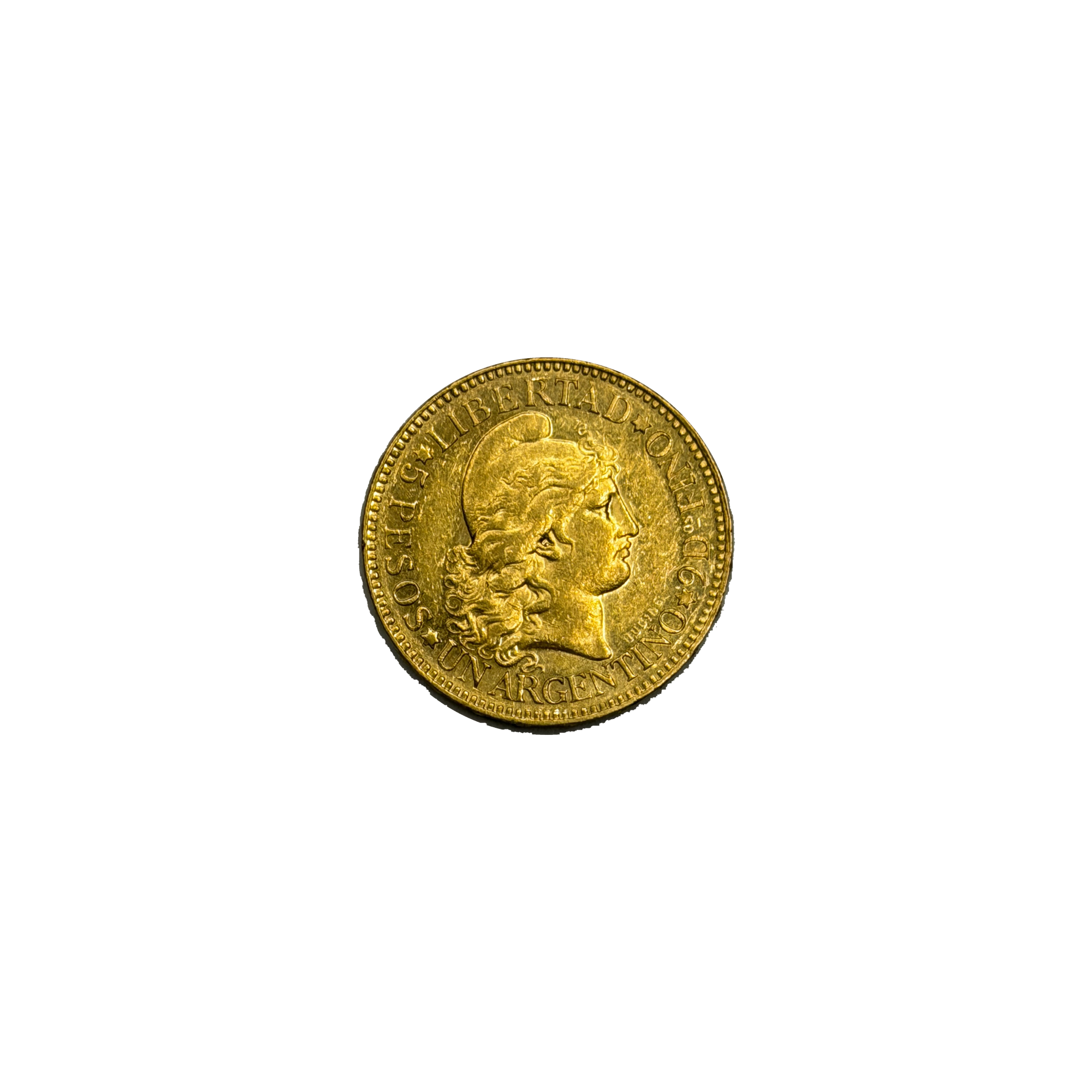
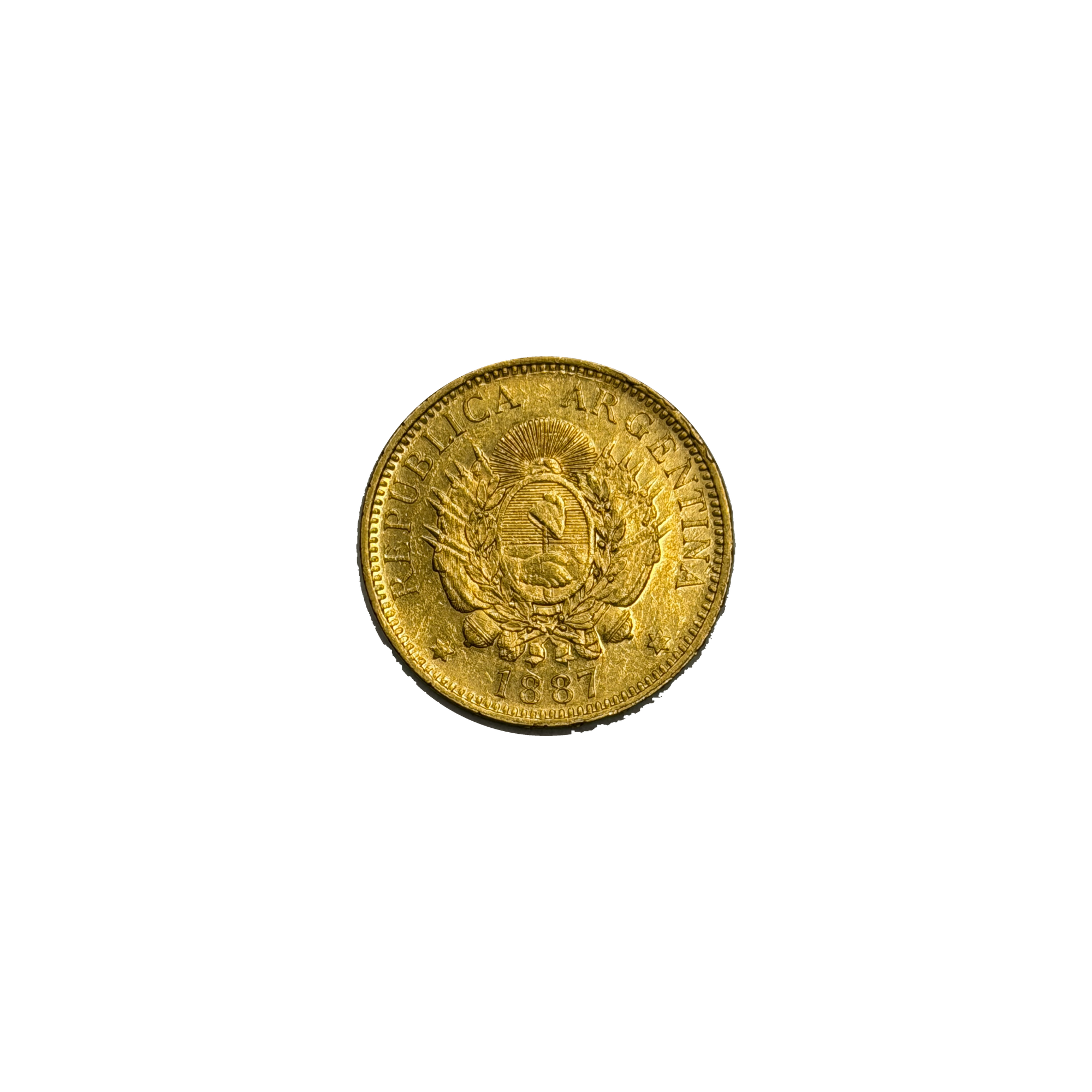
The obverse presents a right-facing head of Liberty wearing the Phrygian cap, her hair flowing loosely beneath it — a design reminiscent of early United States coinage, and one of the reasons the coin has long been popular with American buyers. The surrounding legend reads LIBERTAD with the denomination 5 PESOS • UN ARGENTINO. The reverse carries Argentina’s national coat of arms: an oval shield with clasped hands beneath a liberty cap on a pike, crowned by a rising sun and framed by draped national flags, with REPUBLICA ARGENTINA around and the date below.
Each coin contains 0.2334 troy ounces of pure gold, struck in .900 fine gold at a gross weight of 8.0645 grams — the continental European gold standard of the era. Grade range: AU/UNC. The series was minted from 1881 through 1896. The source description notes the coin is difficult to obtain in uncirculated condition; most surviving examples circulated as working money.
The Argentino documents both halves of Argentina’s monetary story. The first half is prosperity: a gold-backed peso, an export economy that drew millions of European immigrants, and a standard of living that rivaled the great powers. The second half is the unwinding. Beginning primarily under the administration of Juan Perón not more than two decades after that 1929 peak, the nationalization of industries, expansion of state services, and substantial overseas borrowing began to undermine the country’s economic position. Unable to finance its spending, the government opted to inflate its way out of debt — producing, between 1976 and 1991, a wage and price inflation factor of roughly 2.1 billion times original prices. Once an example of prosperity, Argentina’s currency failure set the stage for one of the most dramatic economic breakdowns of the late 20th and early 21st centuries.
The gold coin was untouched by any of it. A 5 Pesos Argentino contains today exactly the gold it contained in 1896, and commands whatever that gold commands — while the paper peso it once anchored has been redenominated repeatedly out of recognition. Like the Uruguay 5 Pesos across the Río de la Plata, the Argentino is a one-coin illustration of the difference between gold and government-issued money, from a country that experienced that difference as sharply as any nation in the hemisphere.
Scarcity here is comparative, and the numbers are documented. The entire Argentino series comprises 6,343,022 coins across ten dates struck between 1881 and 1896 — less than a quarter of what the British Royal Mint system produced in sovereigns in a single peak year, when output exceeded 30 million coins. Several dates are genuinely small: 37,152 pieces in 1881 and 196,543 in the final 1896 issue. Production ended in 1896 and never resumed, so the population is fixed, and more than a century of circulation and melting has only reduced it. Combined with the source-noted difficulty of finding uncirculated examples, the supply picture is meaningfully tighter than the mass-market European fractionals it trades alongside — while its pricing remains driven primarily by gold content.
The Argentino’s gold content is standardized and universally documented, its .900 fineness matches the familiar European coinage standard of its era, and its Liberty-head design is immediately identifiable to dealers who handle historic world gold. Investors should understand the trade-off plainly: this is not a sovereign or 20 franc — the coins that serve as primary liquidity instruments in the fractional gold market. The Argentino trades on scarcity and character within a diversified holding, and demand has historically absorbed the quantities that surface. Clients who want maximum on-sight liquidity should anchor a position with the high-volume fractionals and add coins like the Argentino, the Colombia 5 Pesos, and the Uruguay 5 Pesos for differentiation, scarcity, and character.
In 1933, FDR issued Executive Order 6102, requiring Americans to surrender their gold coin and bullion to the Treasury — but the order and the regulations that followed it exempted gold coins of recognized special value to collectors of rare and unusual coins. Subsequent clarifications by the Treasury identified pre-1933 gold coins — a classification that includes the Argentina 5 Pesos, struck between 1881 and 1896 — as falling within that collector classification as historical items.
Under current constitutional law, a government intervention in the gold market would be executed through the power of eminent domain — the government’s right to take private property for public use provided it pays the owner just compensation. Historic coins complicate the government’s ability to broadly establish “just compensation” or “fair value,” which was precisely the reasoning behind the original “recognized special value” exemption in 1933. That complexity, and the precedent surrounding pre-1933 gold coins, creates a notable impediment to the government’s ability to restrict them broadly — particularly compared to modern bullion, which can be valued easily and consistently at a single price. In essence, it is a bureaucratic question of whether the government would undertake the enormous task of valuing the diversity and complexity of the historic-coin genre — every coin, every date, every condition, every personal holding — and that difficulty is what insulates the owner’s legal liquidity rights in the event of capital controls.
Whether a future government intervention in private gold markets is a risk an investor assigns significant weight to is a personal judgment. The factual point is narrower: the pre-1933 status represents a layer of portfolio differentiation that this coin carries at minimal added per-ounce cost over comparable modern bullion, along with a measure of insulation for the legal liquidity rights of its owner.
For a more in-depth study, we invite you to read our comprehensive memorandum on this subject: Preparing for a Potential Gold Confiscation
The Argentina 5 Pesos is a quarter ounce of gold from the moment a nation stood among the wealthiest on earth — struck in a fixed sixteen-year series of barely six million coins, finished before the twentieth century began, and untouched by the currency collapse that followed. It pairs the flexibility of fractional size with documented comparative scarcity and a Liberty design that echoes early American coinage — and because uncirculated survivors are genuinely difficult to source, offerings are irregular and rarely large. No other Latin American gold coin tells the case for gold ownership as vividly while still trading on its gold content first.
| Year | Mintage |
|---|---|
| 1881 | 37,152 |
| 1882 | 252,092 |
| 1883 | 906,042 |
| 1884 | 447,900 |
| 1885 | 203,908 |
| 1886 | 397,734 |
| 1887 | 1,834,674 |
| 1888 | 1,663,265 |
| 1889 | 403,712 |
| 1896 | 196,543 |
| Total | 6,343,022 |
AU, UNC
1881 – 1896
.2334 troy ounce
Argentina
| Quantity | Wire | Card |
|---|---|---|
| 1–21 | $1,113.95 | $1,160.36 |
| 22–43 | $1,102.81 | $1,148.76 |
| 44+ | $1,091.67 | $1,137.15 |
Quantity tiers reflect the historic & fractional gold order discount (1% at $25,000+ · 2% at $50,000+ in qualifying coins). Any mix of qualifying historic coins counts toward the same order total.
Prices shown under Wire include a 4% cash discount. Card prices are the full list price. ACH bank transfer is available to established clients only. First-time orders can be paid by wire transfer or card.
Interested in gold but struggling to find the right firm?


