

You must have an order with a minimum of $1,000.00 to place your order, your current order total is $0.00.
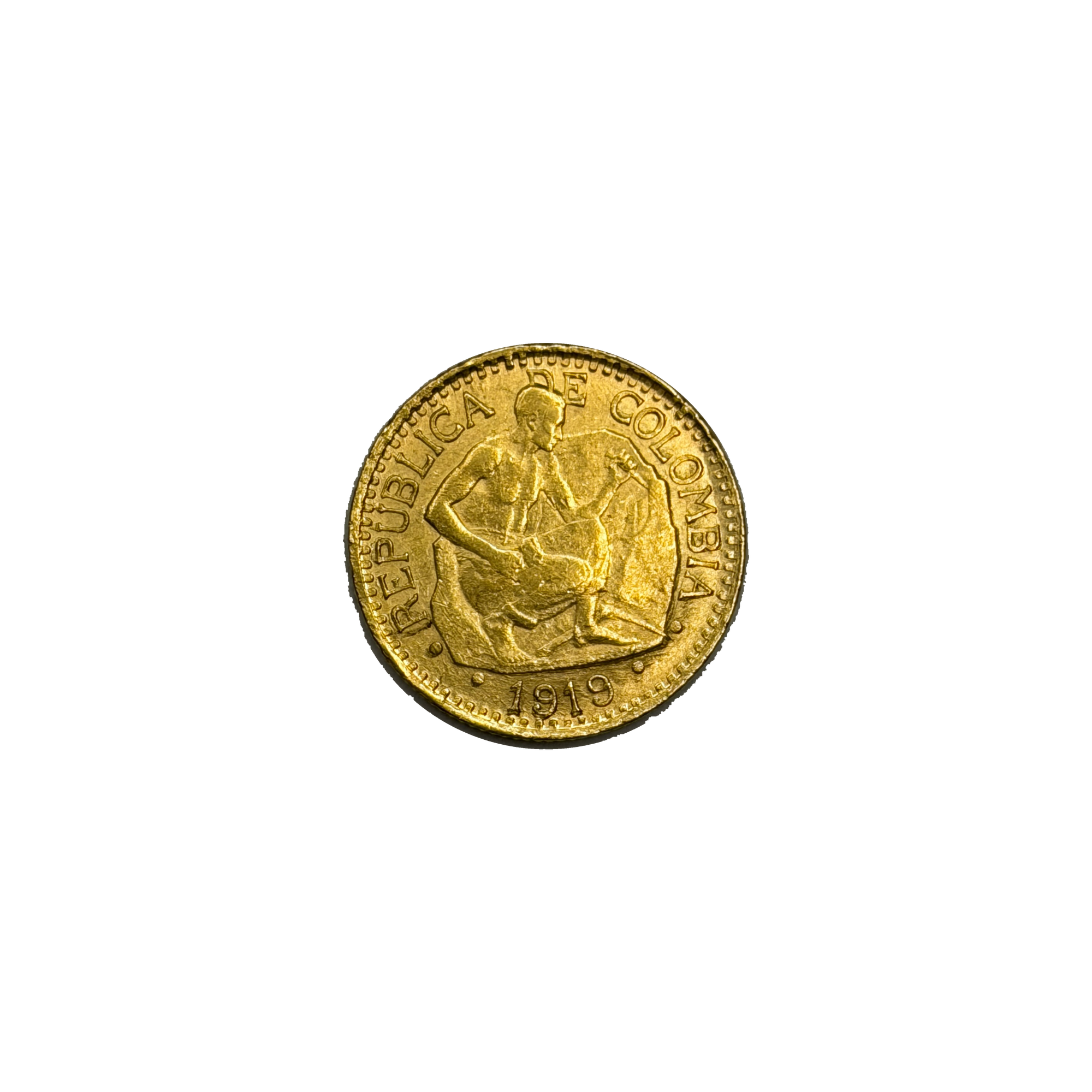
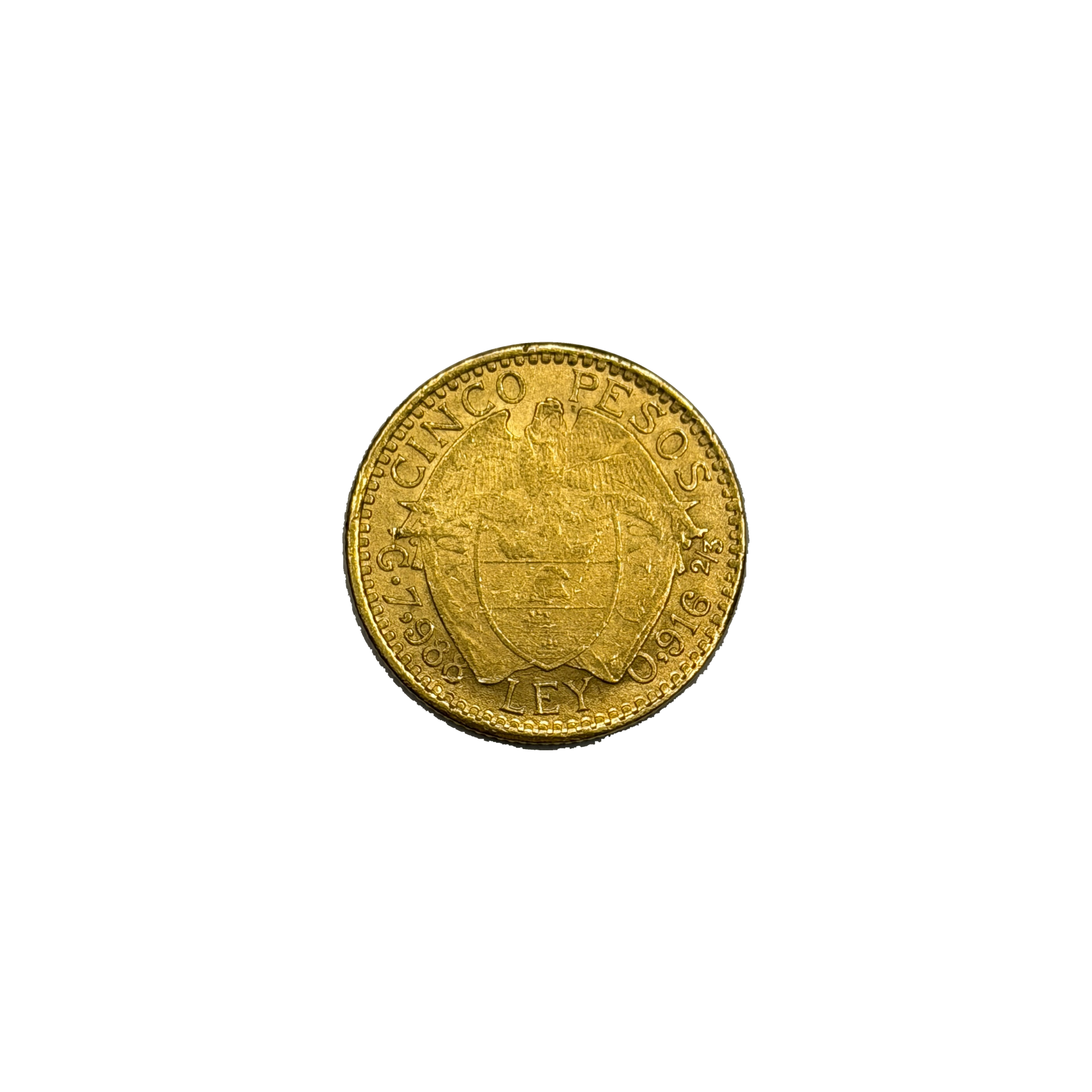
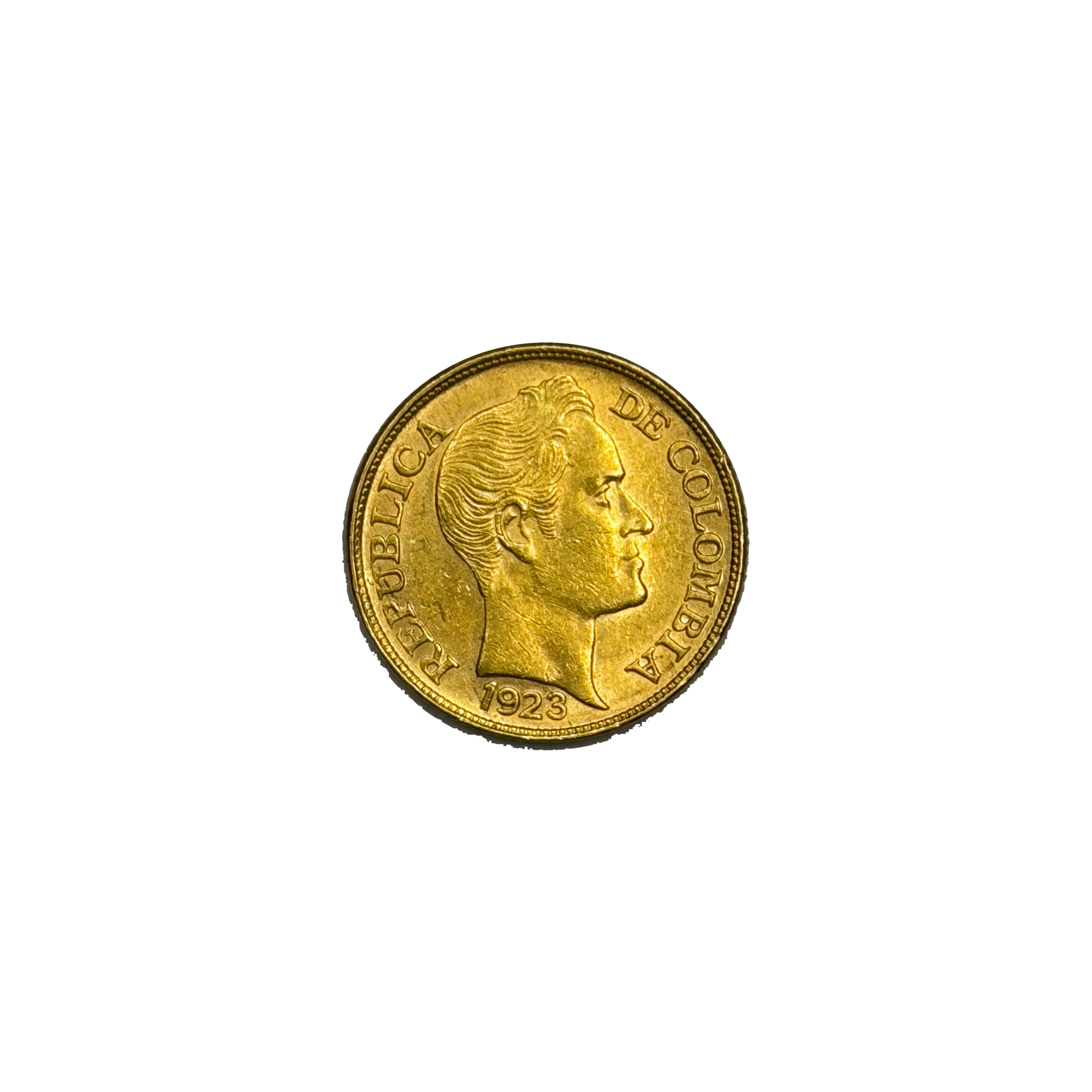
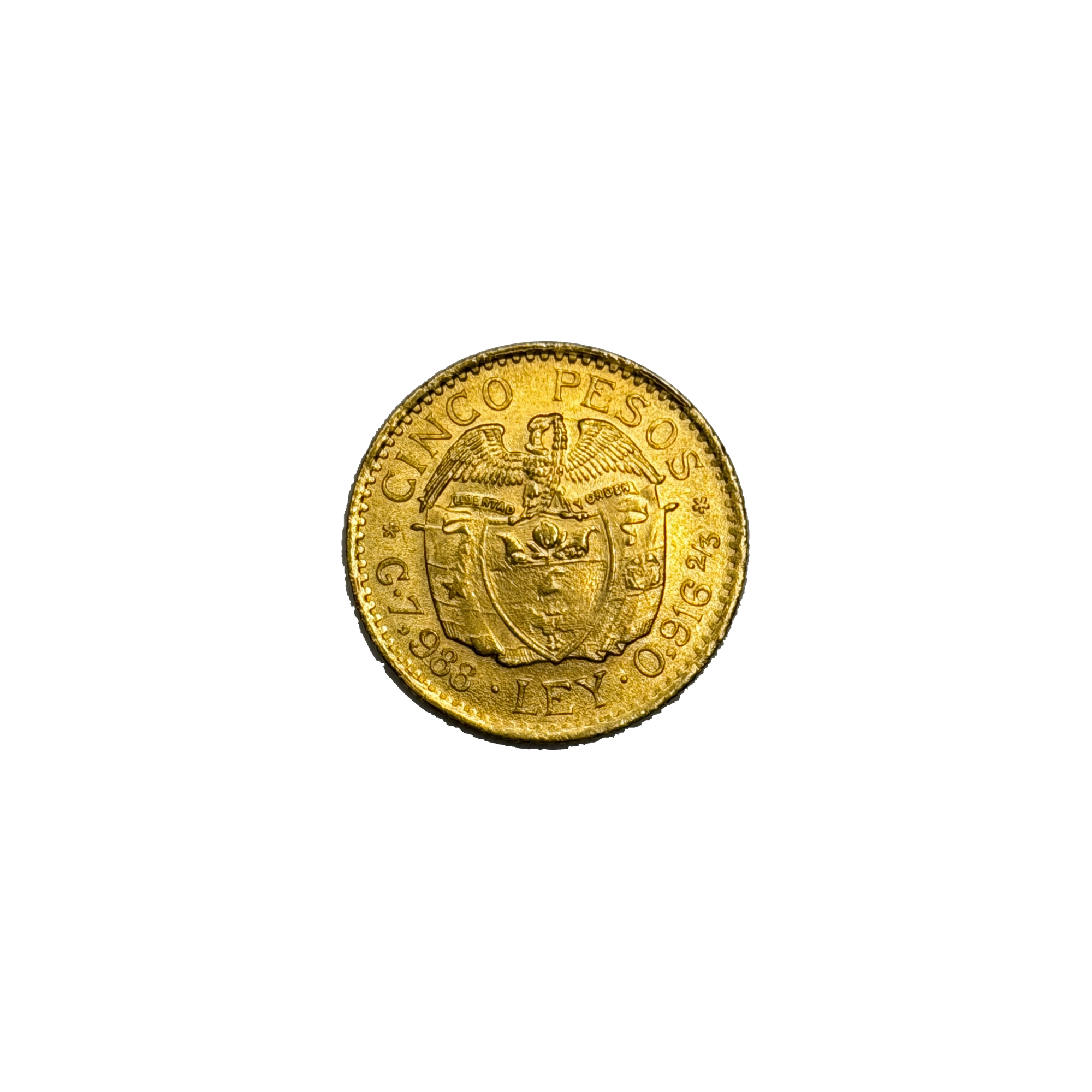
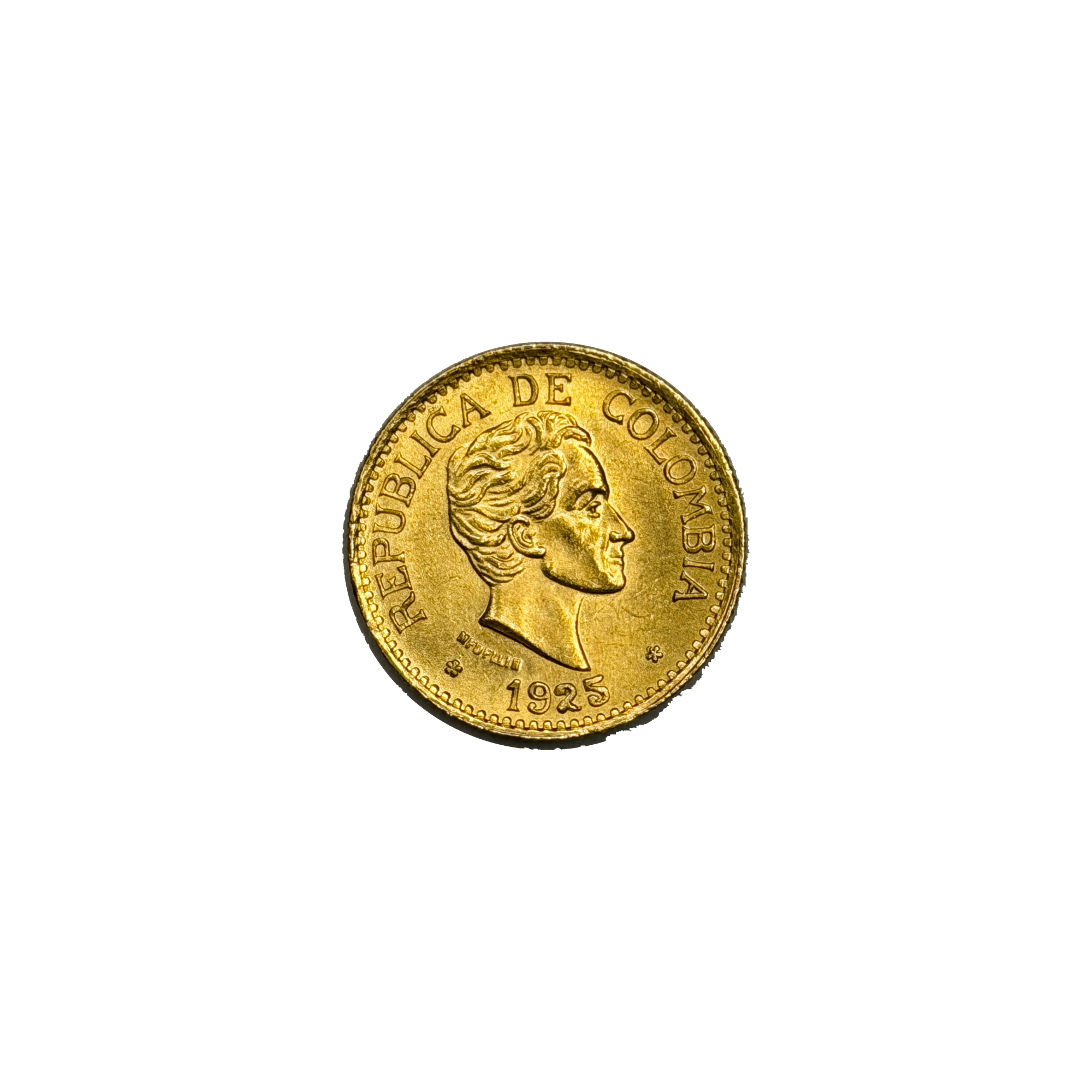
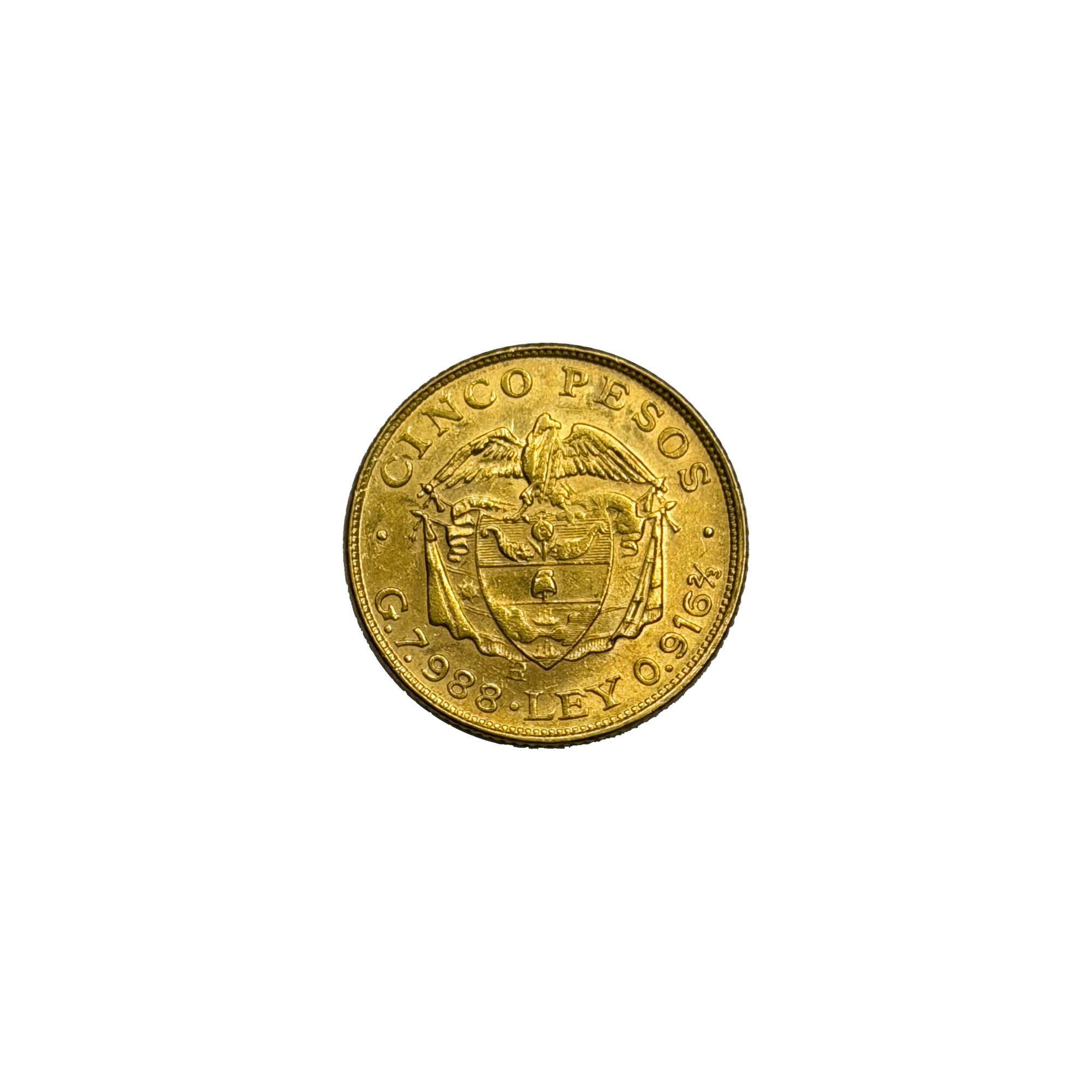
When Colombia returned to gold coinage in the early twentieth century, it struck its 5 Pesos to a standard any banker in London would have recognized on sight: 7.988 grams of .916⅔ fine gold — 0.2355 troy ounces, for all practical purposes the exact gold content of a British sovereign. For most of the series, the coin carried the portrait of Simón Bolívar, the Liberator of six South American republics and the most consequential figure in the continent’s history.
For investors, the Colombia 5 Pesos is classified instructively as “historical bullion.” It trades at per ounce acquisition costs comparable to modern bullion coins and tracks the spot price of gold over time, while carrying the historic (pre-1933) designation and the associated insulation against the possibility of future government intervention. At roughly one-quarter of a troy ounce, it provides divisible negotiability — affording its owner the flexibility to liquidate positions incrementally, in amounts proportionate to the specific needs of the moment and across a variety of circumstances. And it is comparatively scarce: the entire 1913–1930 series comprises 7,123,000 coins, less than a quarter of what the British mint system produced in sovereigns in a single peak year. For investors whose priorities are divisible negotiability, comparative scarcity, and a standardized gold content that matches the British sovereign’s almost exactly—all for near-bullion pricing—the Colombia 5 Pesos is one of the most efficient instruments in the Latin American gold series.
The series includes three distinct types, all sharing the same weight and fineness. The earliest issues carry one of the more unusual designs in gold coinage: a laborer cutting stone, sleeves rolled, within a rough pentagonal border — a working-country image from the years when Colombian gold coinage was tied to the mining economy. In 1919 the design changed to a large bare-headed portrait of Simón Bolívar facing right, and in the mid-1920s to a refined smaller Bolívar head. On all types the legend reads REPUBLICA DE COLOMBIA with the date, and the reverse displays the Colombian coat of arms — the condor with wings spread above a draped shield bearing the pomegranate, cornucopias, liberty cap, ship, and isthmus — with the denomination CINCO PESOS above and the coin’s own specifications, G. 7.988 • LEY 0.916⅔, struck into the design below.
Each coin contains 0.2355 troy ounces of pure gold at 7.988 grams gross weight, .916⅔ fine. Grade range: AU/UNC/XF. The series was struck from 1913 through 1930; examples from the Bogotá mint carry a small B beneath the arms.
No figure in the Western Hemisphere is memorialized on more coinage than Simón Bolívar, and the reason is scale: between 1813 and 1825 he led the campaigns that freed present-day Colombia, Venezuela, Ecuador, Peru, Panama, and Bolivia — a territory larger than Europe — from three centuries of Spanish rule. He was the first president of Gran Colombia, the republic whose partition produced modern Colombia, and Bolivia carries his name. For Colombian gold coinage to bear his portrait was a statement of national identity in the same way Washington’s portrait functions on American money. For the investor, the Bolívar portrait is what makes the coin instantly attributable: a face recognized across an entire continent, on a coin whose weight and purity are stamped into its own reverse.
The 5 Pesos series spans Colombia’s early-twentieth-century emergence — the coffee boom, the expansion of mining, and the republic’s effort to maintain a gold-backed peso in the years when most of Latin America still settled its trade in metal. The series ended in 1930, as the Depression pushed nation after nation off the gold standard, making the Colombia 5 Pesos one of the last quarter-ounce-class gold coins struck for circulation anywhere in the Americas. What survives is a fixed, dated record of the gold-standard era — a coin that has held its 0.2355 ounces of gold through every peso devaluation since.
The comparative numbers are documented and instructive. Across eighteen years and three design types, Colombia struck 7,123,000 5 Pesos coins in total — against more than 30 million sovereigns per year from the British mint system at its peak. Within the series, several dates are genuinely small: 17,000 pieces in 1913, 29,000 in 1922, and 43,000 in 1917. Production ceased in 1930 and never resumed, so the population is fixed and diminishes with time. The coin trades on its gold content first and its scarcity second — which is exactly the value for patient holders: a fixed, diminishing supply acquired at little more than the price of its gold.
The Colombia 5 Pesos benefits from a practical advantage few coins share: its specifications are engraved on the coin itself, and its gold content matches the British sovereign — the most widely documented benchmark in the fractional gold market — almost exactly, which makes it easy for any dealer to value. That said, investors should understand the trade-off plainly: the Colombia 5 Pesos trades on scarcity and character rather than the high-volume dealer flow that moves sovereigns and 20 franc coins. It is a coin acquired for differentiation within a diversified fractional gold holding, not as a primary liquidity instrument — and demand has historically absorbed the quantities that surface.
In 1933, FDR issued Executive Order 6102, requiring Americans to surrender their gold coin and bullion to the Treasury — but the order and the regulations that followed it exempted gold coins of recognized special value to collectors of rare and unusual coins. Subsequent clarifications by the Treasury identified pre-1933 gold coins — a classification that includes the Colombia 5 Pesos, struck between 1913 and 1930 — as falling within that collector classification as historical items.
Under current constitutional law, a government intervention in the gold market would be executed through the power of eminent domain — the government’s right to take private property for public use provided it pays the owner just compensation. Historic coins complicate the government’s ability to broadly establish “just compensation” or “fair value,” which was precisely the reasoning behind the original “recognized special value” exemption in 1933. That complexity, and the precedent surrounding pre-1933 gold coins, creates a notable impediment to the government’s ability to restrict them broadly — particularly compared to modern bullion, which can be valued easily and consistently at a single price. In essence, it is a bureaucratic question of whether the government would undertake the enormous task of valuing the diversity and complexity of the historic-coin genre — every coin, every date, every condition, every personal holding — and that difficulty is what insulates the owner’s legal liquidity rights in the event of capital controls.
Whether a future government intervention in private gold markets is a risk an investor assigns significant weight to is a personal judgment. The factual point is narrower: the pre-1933 status represents a layer of portfolio differentiation that this coin carries at minimal added per-ounce cost over comparable modern bullion, along with a measure of insulation for the legal liquidity rights of its owner.
For a more in-depth study, we invite you to read our comprehensive memorandum on this subject: Preparing for a Potential Gold Confiscation
The Colombia 5 Pesos puts the most famous face in South American history on a sovereign’s worth of gold — 0.2355 troy ounces, specifications stamped into the coin itself, from a fixed eighteen-year series smaller than a single peak year of sovereign production. It combines fractional flexibility, documented comparative scarcity, and a standardized, sovereign-equivalent gold content at pricing driven primarily by the metal itself — and it surfaces in modest quantities that demand has historically absorbed quickly. No other coin pairs Bolívar’s portrait with this combination of practical advantages for gold investors.
| Year | Mintage |
|---|---|
| 1913 | 17,000 |
| 1917 | 43,000 |
| 1918 | 423,000 |
| 1919 | 2,181,000 |
| 1920 | 978,000 |
| 1922 | 29,000 |
| 1923 | 74,000 |
| 1924 | 825,000 |
| 1925 | 668,000 |
| 1926 | 383,000 |
| 1927 | 365,000 |
| 1928 | 314,000 |
| 1929 | 321,000 |
| 1930 | 502,000 |
| Total | 7,123,000 |
XF, AU, UNC
1913-1930
.2355 troy ounce
Colombia
| Quantity | Wire | Card |
|---|---|---|
| 1–21 | $1,111.88 | $1,158.21 |
| 22–43 | $1,100.76 | $1,146.63 |
| 44+ | $1,089.64 | $1,135.05 |
Quantity tiers reflect the historic & fractional gold order discount (1% at $25,000+ · 2% at $50,000+ in qualifying coins). Any mix of qualifying historic coins counts toward the same order total.
Prices shown under Wire include a 4% cash discount. Card prices are the full list price. ACH bank transfer is available to established clients only. First-time orders can be paid by wire transfer or card.
Interested in gold but struggling to find the right firm?


