

You must have an order with a minimum of $1,000.00 to place your order, your current order total is $0.00.
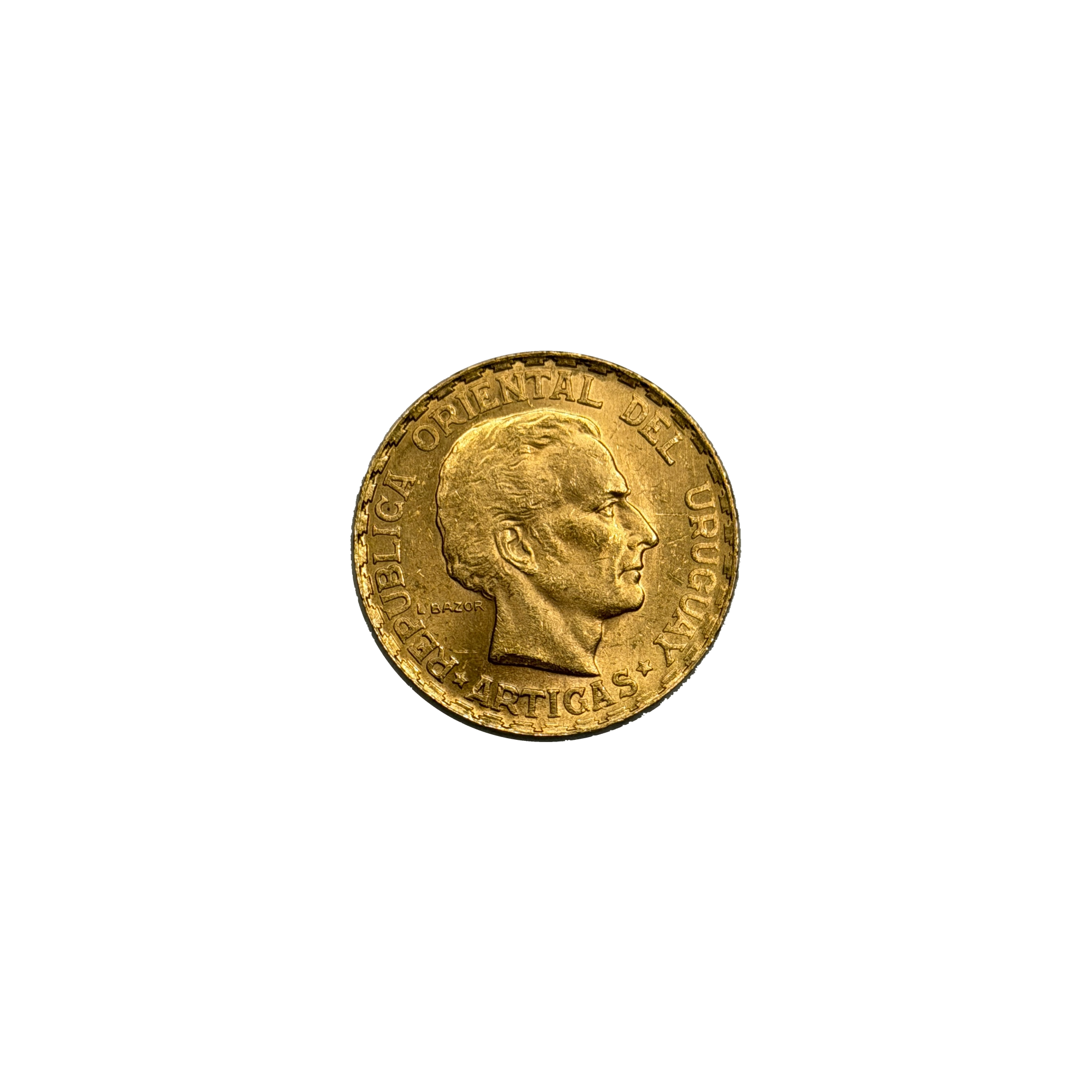
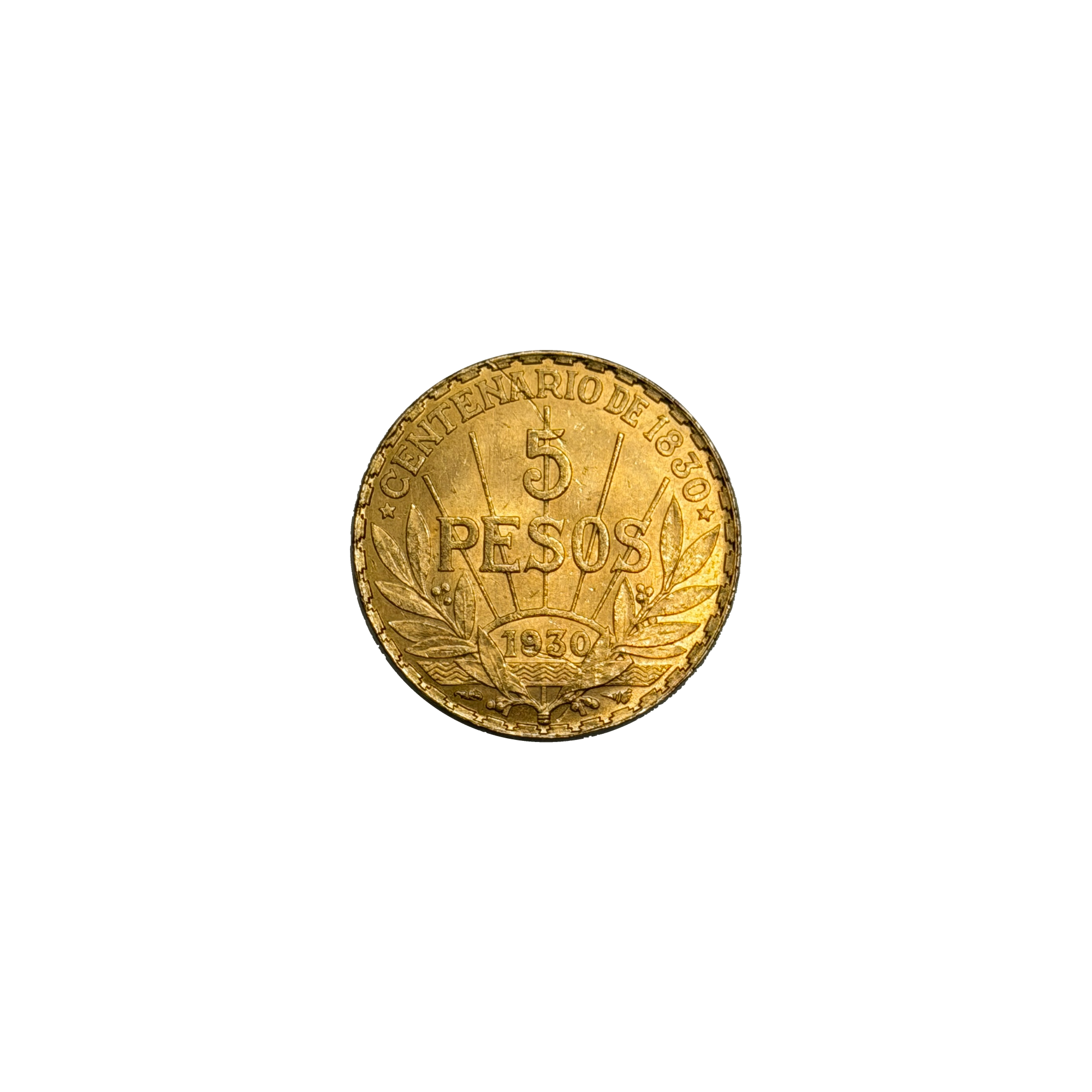
Most coins USAGOLD offers are scarce in the comparative sense — meaningfully harder to find than the sovereigns and francs they trade alongside. The Uruguay 5 Pesos is a different proposition. Struck in 1930 only, as a single-year commemorative of the centenary of Uruguay’s first constitution, it is listed in the Standard Catalog of World Gold Coins as the only coin of its design type — and the catalog records that just 14,415 pieces were released, with the remainder of the mintage withheld. A hoard of roughly 80,000 coins, comprising most of that withheld remainder, reached the market in 1998 — released, by longstanding market account, from Argentine central bank holdings — and was quickly placed with private investors and collectors. Add it up: fewer than 100,000 Uruguay 5 Pesos are known to exist, anywhere.
For perspective, British sovereign production exceeded 30 million pieces in single peak years — several hundred times the Uruguay 5 Pesos’ entire existence — yet the Uruguay trades at essentially the price of a sovereign. Coins of genuinely fixed, five-figure-to-low-six-figure populations ordinarily trade at collector multiples. This one does not. For investors whose priorities are a highly coveted coin steeped in historical significance, notable scarcity due to a limited single-year mintage, a high state of preservation, and a standardized and widely recognized gold content—all for near-bullion pricing—the Uruguay 5 Pesos is among the most affordable true rarities in the gold market, surfacing only occasionally and in small quantities, typically as early holders of the 1998 hoard pare down their positions.
The obverse bears the portrait of José Gervasio Artigas — the father of Uruguayan independence and the national hero whose name rings the coin alongside REPUBLICA ORIENTAL DEL URUGUAY. The reverse displays the denomination over a rising sun with the legend CENTENARIO DE 1830, marking one hundred years of the Uruguayan constitution, framed in laurel with the 1930 date below. The “Oriental” in Uruguay’s official name refers to the country’s position on the eastern bank of the Uruguay River — Uruguayans sometimes still call themselves “Orientals.”
Each coin is struck from .917 fine gold and contains 0.2501 troy ounces of actual gold content — almost exactly one-quarter ounce; four coins contain 1.0004 troy ounces. Grade range: UNC. Minted 1930 only.
In 1930, the Uruguayan peso was worth slightly more than the U.S. dollar: twenty U.S. dollars were pegged to the 0.9675 troy ounces of gold in a $20 Double Eagle, while twenty Uruguayan pesos were pegged to the 1.0004 troy ounces of gold contained in four of these 5 Pesos coins. What followed is the familiar and sad legacy of many twentieth-century Latin American currencies. Chronic inflation consumed the original peso, which was replaced in 1975 by the New Peso at a rate of one for 1,000 — and the New Peso was itself replaced in 1993, again at one for 1,000. Measured against its 1930 gold parity, the paper peso lost effectively all of its value across two currency reforms.
The gold coin lost none. A physical 5 Pesos piece contains today exactly the quarter ounce of gold it contained in 1930, and commands whatever that gold commands — while the paper currency it once stood beside has been redenominated out of existence twice. Few coins anywhere illustrate the difference between gold and government-issued money so cleanly, in a single object, from a single year.
The Uruguay 5 Pesos’ supply picture is unusually precise for a historic coin: 14,415 released at issue, a documented hoard of roughly 80,000 released in 1998, and no other source — the design was never struck again. Fewer than 100,000 pieces exist, the population is fully distributed into private hands, and no demand event can enlarge it. The coin appears in the market rarely and in small lots; availability, when it comes, tends to be brief. Within USAGOLD’s offerings, it is the closest thing to a true rarity that can still be acquired at pricing driven primarily by its gold content.
The Artigas portrait is one of the stronger republican designs of the gold-standard era — a national hero rendered with the directness of the period’s best coinage, on a coin struck for a constitutional centenary rather than for commerce. Because the bulk of the population sat withheld for nearly seven decades before the 1998 release, surviving examples are typically encountered in uncirculated condition, with original luster intact — a conditional profile far above what a 1930 issue would ordinarily present.
The Uruguay 5 Pesos trades on a different basis than the mass-market European fractionals: its market is made by its scarcity and by the collectors and investors who know the coin, rather than by high-volume dealer flow. Its gold content is standardized and documented, its single-year, single-type identity makes it easy to authenticate and value, and demand has historically absorbed the small quantities that surface. Investors should understand the trade-off plainly: this is a coin acquired for scarcity and character within a diversified holding, not as a primary liquidity instrument — the sovereigns and 20 franc coins serve that role.
In 1933, FDR issued Executive Order 6102, requiring Americans to surrender their gold coin and bullion to the Treasury — but the order and the regulations that followed it exempted gold coins of recognized special value to collectors of rare and unusual coins. Subsequent clarifications by the Treasury identified pre-1933 gold coins — a classification the 1930-dated Uruguay 5 Pesos falls squarely within — as falling within that collector classification as historical items. A single-year issue with a known population under 100,000 is, if anything, the archetype of the “recognized special value” the original exemption described.
Under current constitutional law, a government intervention in the gold market would be executed through the power of eminent domain — the government’s right to take private property for public use provided it pays the owner just compensation. Historic coins complicate the government’s ability to broadly establish “just compensation” or “fair value,” which was precisely the reasoning behind the original “recognized special value” exemption in 1933. That complexity, and the precedent surrounding pre-1933 gold coins, creates a notable impediment to the government’s ability to restrict them broadly — particularly compared to modern bullion, which can be valued easily and consistently at a single price. In essence, it is a bureaucratic question of whether the government would undertake the enormous task of valuing the diversity and complexity of the historic-coin genre — every coin, every date, every condition, every personal holding — and that difficulty is what insulates the owner’s legal liquidity rights in the event of capital controls.
Whether a future government intervention in private gold markets is a risk an investor assigns significant weight to is a personal judgment. The factual point is narrower: the pre-1933 status represents a layer of portfolio differentiation that this coin carries at minimal added per-ounce cost over comparable modern bullion, along with a measure of insulation for the legal liquidity rights of its owner.
For a more in-depth study, we invite you to read our comprehensive memorandum on this subject: Preparing for a Potential Gold Confiscation
The Uruguay 5 Pesos is a genuine rarity priced like a gold coin: a single-year 1930 constitutional centenary issue with fewer than 100,000 pieces known to exist, typically preserved in uncirculated condition, containing a quarter ounce of gold that has outlived two redenominations of the currency it was struck to anchor. It will never be a volume holding — the supply does not permit it — and that is precisely its appeal: highly coveted, rarely available in quantity, and quickly subscribed when small lots surface, it is the kind of coin clients acquire as an heirloom position within a diversified gold holding. No other coin in the market offers this degree of documented scarcity at pricing still driven primarily by its gold content.
UNC
1930
.2501 troy ounce
Uruguay
| Quantity | Wire / ACH | Card |
|---|---|---|
| 1–20 | $1,166.27 | $1,214.86 |
| 21–41 | $1,154.61 | $1,202.71 |
| 42+ | $1,142.94 | $1,190.56 |
Quantity tiers reflect the historic & fractional gold order discount (1% at $25,000+ · 2% at $50,000+ in qualifying coins). Any mix of qualifying historic coins counts toward the same order total.
Prices shown under Wire/ACH include a 4% cash discount. Card prices are the full list price.
Interested in gold but struggling to find the right firm?


