
You must have an order with a minimum of $1,000.00 to place your order, your current order total is $0.00.
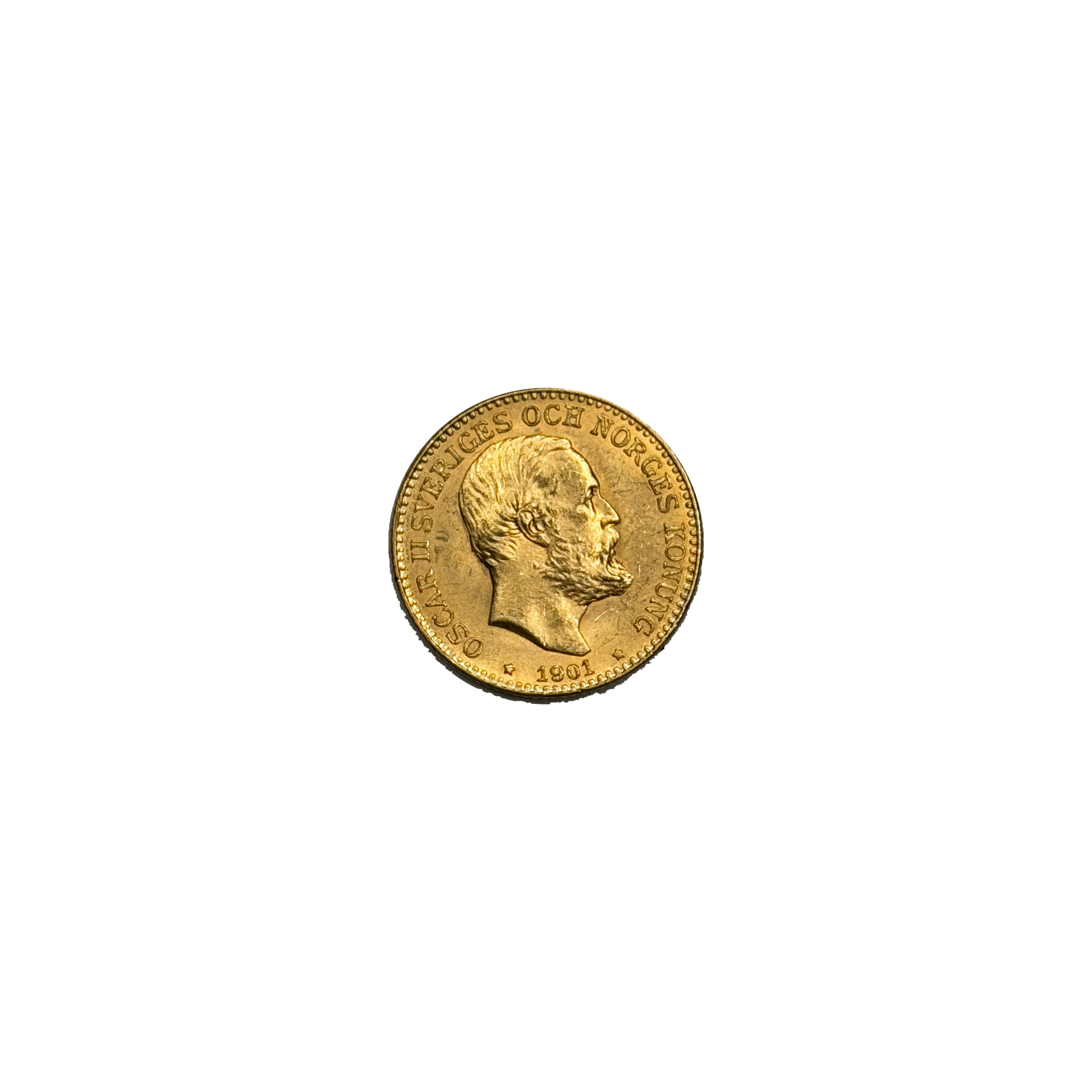
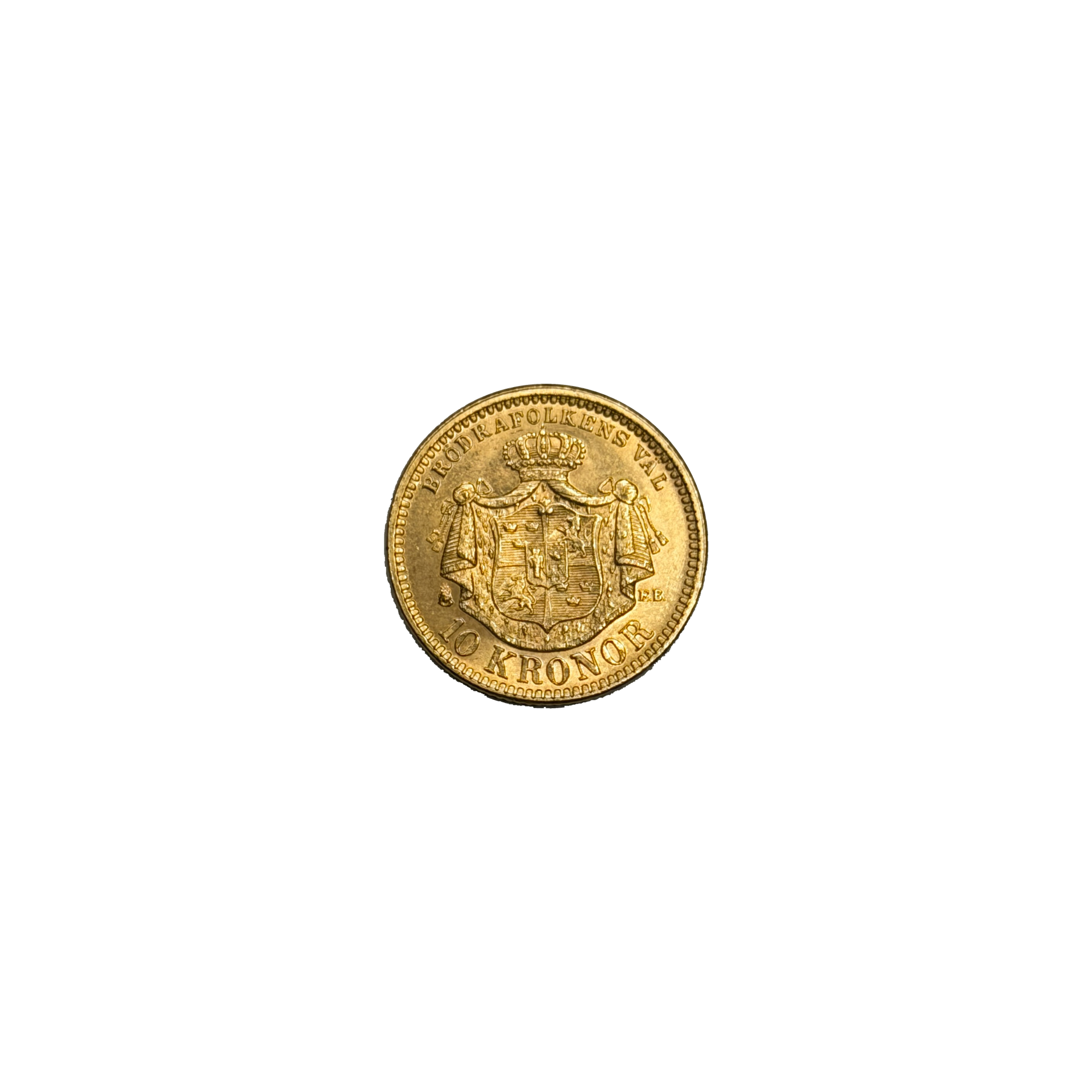
The Swedish 10 Kroner is the half-size companion to the founding coin of the Scandinavian Monetary Union — the 1873–75 treaty system that placed Denmark, Sweden, and Norway on a single gold krone standard and let their coins circulate interchangeably across three kingdoms for four decades. Struck in Stockholm under King Oscar II, the 10 Kroner carried the union standard into everyday commerce: half the gold of the 20 Kronor, the same .900 fineness, the same legal-tender standing from Stockholm to Copenhagen to Christiania.
For the modern investor, that half size is the point. At 0.1296 troy ounces of gold — roughly one-eighth of an ounce — the 10 Kroner offers divisible negotiability in one of the smallest increments in pre-1933 European gold: a position can be liquidated in small increments, in amounts proportionate to the specific needs of the moment and across a variety of circumstances. The coin trades at per ounce acquisition costs comparable to modern fractional bullion, tracks directly with the spot price of gold over time, and carries the historic (pre-1933) designation and the associated insulation against the possibility of future government intervention. For investors whose priorities are the smallest increment in the Scandinavian gold family, uncirculated preservation, and the ready liquidity of a standardized and widely recognized gold content—all for near-bullion pricing—the Swedish 10 Kroner is among the most practical instruments in the fractional gold market today.
The obverse bears the right-facing portrait of Oscar II, full-bearded in the classical bare-headed style, with the legend OSCAR II SVERIGES OCH NORGES KONUNG — “Oscar II, King of Sweden and Norway.” The reverse displays the crowned royal arms of Sweden draped within an ermine mantle above the denomination 10 KRONOR, encircled by the motto of the reign: BRÖDRAFOLKENS VÄL — “the welfare of the brother peoples,” Oscar’s pledge to his twin realms, struck into every coin of the series.
Each 10 Kroner contains 0.1296 troy ounces of pure gold at 4.48 grams total weight, struck in .900 fine gold — exactly half the 20 Kronor on the Scandinavian Monetary Union standard, and identical in specification to the Danish 10 Kroner. Grade range: UNC. Minted 1876–1895 and 1901.
Oscar II reigned from 1872 to 1907 as king of both Sweden and Norway — poet, translator, patron of science, and the monarch other nations repeatedly asked to arbitrate their disputes. His reign carried Sweden through its industrial transformation, and its most delicate hour — the 1905 dissolution of the union with Norway — ended peacefully, without a shot fired, under a king whose coinage had promised “the welfare of the brother peoples” all along. His fuller story appears on our companion page for the Swedish 20 Kronor. The 10 Kroner is his coinage at its most practical: the denomination sized for the commerce of ordinary Swedes rather than the reserves of banks.
The Scandinavian Monetary Union succeeded at what later currency projects have struggled to do, and it did so with no shared institutions at all. Three kingdoms fixed their kroner to one weight of gold — 0.4032 grams of fine gold per krone — and for forty years a coin struck in any of the three spent freely in the others. The system asked nothing of its members except that they keep their gold promise, and it lasted precisely as long as they did: the First World War pushed Scandinavia onto paper money, and the union never truly functioned again. The 10 Kroner is the denomination that carried that experiment into daily life, and its survivors are the everyday record of a currency union that actually worked.
The Scandinavian krone-standard coins form one of the recognized families of the international pre-1933 gold market. Dealers across North America and Europe identify the Oscar II portrait and mantled arms on sight, the union standard is universally documented, and the Swedish and Danish issues’ shared specification gives the type a deep pool of interchangeable coins on two continents. The 10 Kroner adds the family’s smallest increment — the coin best suited to converting exactly as much gold to cash as a circumstance requires, and no more. For investors who prioritize quick, clean convertibility in small amounts, it performs that function reliably wherever European gold trades.
In 1933, FDR issued Executive Order 6102, requiring Americans to surrender their gold coin and bullion to the Treasury — but the order and the regulations that followed it exempted gold coins of recognized special value to collectors of rare and unusual coins. Subsequent clarifications by the Treasury identified pre-1933 gold coins — a classification that includes the Swedish 10 Kroner, struck between 1876 and 1901 — as falling within that collector classification as historical items.
Under current constitutional law, a government intervention in the gold market would be executed through the power of eminent domain — the government’s right to take private property for public use provided it pays the owner just compensation. Historic coins complicate the government’s ability to broadly establish “just compensation” or “fair value,” which was precisely the reasoning behind the original “recognized special value” exemption in 1933. That complexity, and the precedent surrounding pre-1933 gold coins, creates a notable impediment to the government’s ability to restrict them broadly — particularly compared to modern bullion, which can be valued easily and consistently at a single price. In essence, it is a bureaucratic question of whether the government would undertake the enormous task of valuing the diversity and complexity of the historic-coin genre — every coin, every date, every condition, every personal holding — and that difficulty is what insulates the owner’s legal liquidity rights in the event of capital controls.
Whether a future government intervention in private gold markets is a risk an investor assigns significant weight to is a personal judgment. The factual point is narrower: the pre-1933 status represents a layer of portfolio differentiation that this coin carries at minimal added per-ounce cost over comparable modern bullion, along with a measure of insulation for the legal liquidity rights of its owner.
For a more in-depth study, we invite you to read our comprehensive memorandum on this subject: Preparing for a Potential Gold Confiscation
The Swedish 10 Kroner is the everyday denomination of the gold standard that held three kingdoms together — struck under the renaissance king of the North, half the size of its flagship sibling, and correspondingly more flexible in an investor’s hands. It combines both one of the smallest increments in fractional European gold and uncirculated preservation with the recognizability of the Scandinavian union standard, at per ounce acquisition costs comparable to modern fractional bullion. No other small European gold coin delivers this combination of flexibility, history, and liquidity so completely for gold investors.
| Year | Mintage |
|---|---|
| 1876 | 37,000 |
| 1877 | 55,000 |
| 1880 | 27,000 |
| 1883 | 149,000 |
| 1894 | 36,000 |
| 1895 | 65,000 |
| 1901 | 213,286 |
| Total | 582,286 |
Mintage figures per the Standard Catalog of World Coins, via the NGC World Price Guide. Dates NGC lists without figures are shown with a dash. Figures are the Oscar II type of 1876–1895 (KM-743) and the 1901 issue (KM-767; the coin pictured is dated 1901); the earlier 1873–1876 type (KM-732) falls outside the listed range.
Oscar II
UNC
1876-1901
.1296 troy ounce
Sweden
| Quantity | Wire | Card |
|---|---|---|
| 1–36 | $658.75 | $686.20 |
| 37–72 | $652.16 | $679.34 |
| 73+ | $645.58 | $672.48 |
Quantity tiers reflect the historic & fractional gold order discount (1% at $25,000+ · 2% at $50,000+ in qualifying coins). Any mix of qualifying historic coins counts toward the same order total.
Prices shown under Wire include a 4% cash discount. Card prices are the full list price. ACH bank transfer is available to established clients only. First-time orders can be paid by wire transfer or card.
Interested in gold but struggling to find the right firm?


