

You must have an order with a minimum of $1,000.00 to place your order, your current order total is $0.00.
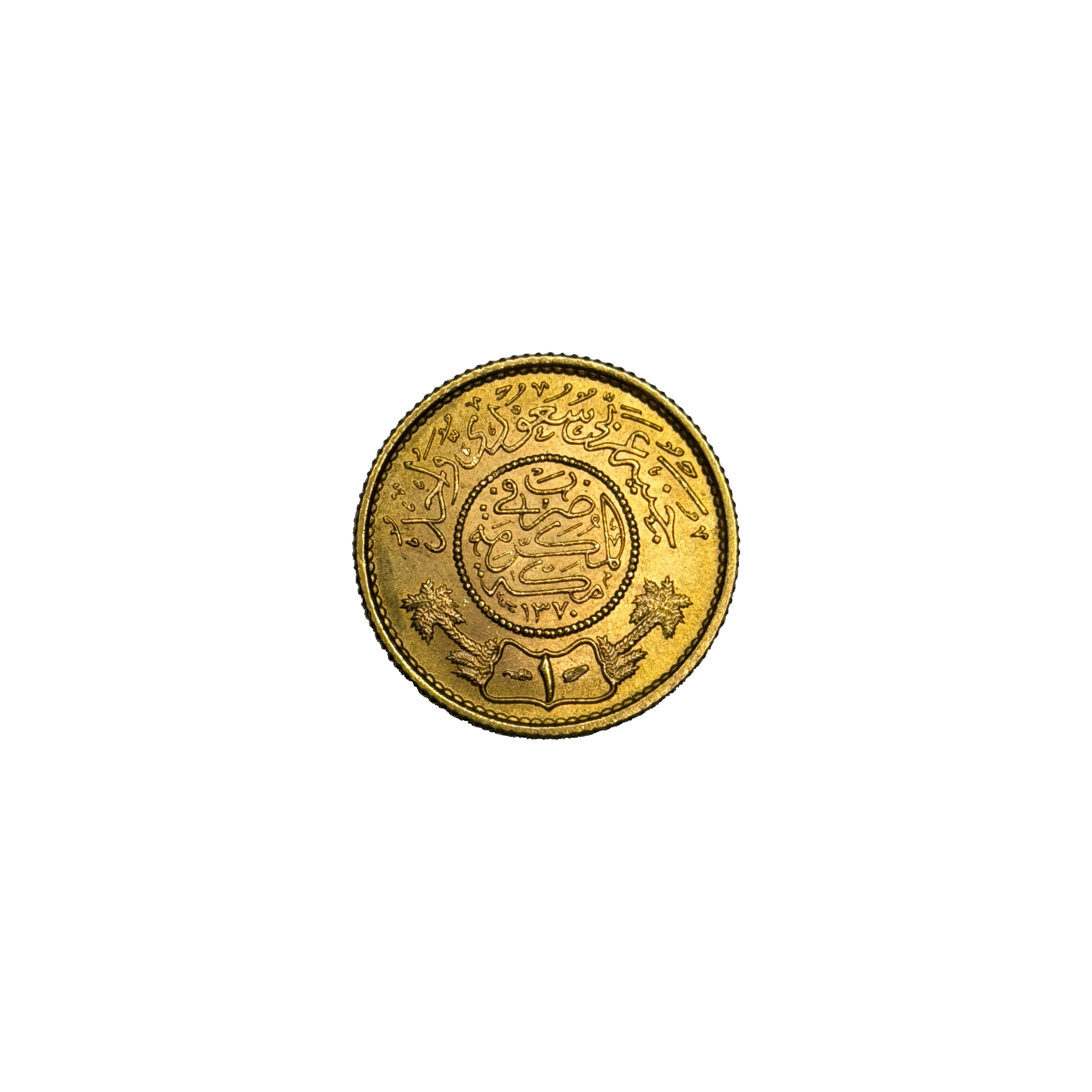
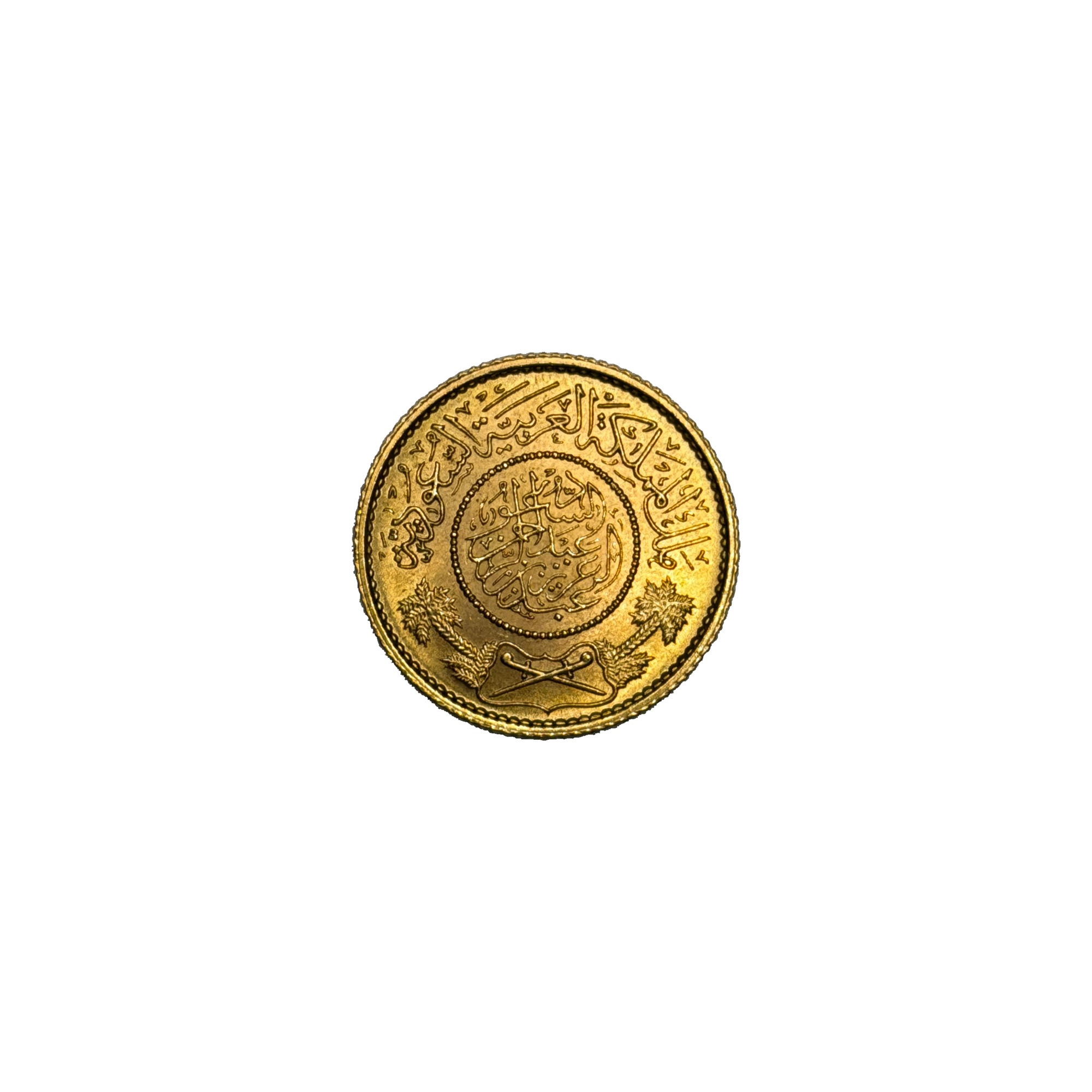
In the middle of the twentieth century, as oil revenue began transforming the Arabian Peninsula, the young Kingdom of Saudi Arabia struck its own gold coin — the guinea, issued in the early 1950s under the kingdom’s founder, King Abdulaziz Al Saud. The choice of standard tells the story: the Saudi guinea was minted to the gold specification the region’s merchants already trusted above all others, that of the British sovereign — approximately 0.2354 troy ounces of pure gold in a .917 fine, 7.99-gram coin. In the gold markets of Jeddah and the wider Middle East, where sovereigns had long served as the money of trade and pilgrimage, the guinea took its place as the kingdom’s own entry in that same familiar format.
For investors, the guinea’s case rests on practical merits. It is classified instructively as historical bullion — trading at per ounce acquisition costs comparable to modern bullion coins and tracking directly with the spot price of gold over time. Its sovereign-matched content means the market prices it off a specification every gold dealer knows, and at roughly one-quarter of a troy ounce it offers divisible negotiability: affording its owner the flexibility to liquidate positions incrementally, in amounts proportionate to the specific needs of the moment and across a variety of circumstances. It is also a genuine artifact of a pivotal moment — the founding era of the modern Middle East, rendered in gold. One important distinction from the other historic coins in this catalog: because the guinea was struck after 1933, it does not carry the pre-1933 classification, and investors seeking that specific layer of legal differentiation should look to the sovereign, libra, and other pre-1933 types we offer. For investors whose priorities are a highly coveted coin steeped in the founding history of the modern Middle East, notable scarcity due to a single-date issue, and a standardized and widely recognized gold content—all for near-bullion pricing—the guinea stands apart from every other coin in the catalog.
The guinea is struck entirely in Arabic calligraphy — no portrait appears on either side, in keeping with tradition. Both sides carry legends in elegant script around a beaded central circle, naming King Abdulaziz bin Abdulrahman Al Saud and the Kingdom of Saudi Arabia, and both are framed by date palms; one side places the date and the denomination in a cartouche below, the other the crossed swords — the symbols of strength and vitality that still anchor the Saudi coat of arms. The example pictured is dated AH 1370, corresponding to 1950–51.
Specifications follow the British sovereign standard: approximately 7.99 grams total weight, .917 fine (22-carat) gold, and 0.2354 troy ounces of pure gold, at a diameter comparable to the sovereign’s 22mm. Grade range: AU. Minted 1950–1951.
King Abdulaziz — known in the West as Ibn Saud — unified the Arabian Peninsula’s regions through three decades of campaigning and proclaimed the Kingdom of Saudi Arabia in 1932. Six years later, commercial quantities of oil were discovered at Dammam, and by the late 1940s the kingdom sat atop the revenue stream that would remake the global economy. The guinea belongs to precisely this hinge moment: a kingdom born of the desert economy — where wealth moved as gold, livestock, and pilgrimage trade — beginning its transformation into an oil power, and marking that sovereignty with a gold coin of its own.
The coin’s monetary context is equally distinctive. Mid-century Arabia ran on hard money longer than nearly anywhere else on earth. Silver riyals and gold coins — above all the British sovereign — served the great pilgrimage economy of Mecca and the region’s merchant trade. The guinea was the kingdom’s answer in that environment: national gold, on the standard the bazaar already knew. It stands as one of the last gold coins anywhere struck for a genuinely gold-using economy rather than for collectors.
At roughly one-quarter of a troy ounce, the guinea occupies the same practical niche that has made the sovereign format the workhorse of fractional gold: a unit small enough to liquidate in measured steps, large enough to avoid the premium inefficiency of the smallest fractional sizes, and priced at per ounce acquisition costs comparable to modern bullion. Gold’s utility as a reserve asset depends partly on the ability to convert exactly as much as circumstances require and no more — and a holding built from quarter-ounce coins can be drawn down coin by coin, in amounts proportionate to the actual need. The guinea delivers that flexibility with a historical identity that modern fractional bullion cannot supply, at a cost of ownership in the same near-bullion neighborhood.
The supply context is also worth understanding. The guinea was struck for a brief window in the early 1950s — a production life measured in years, compared with the sovereign’s continuous striking across more than a century and over 600 million St. George pieces. The kingdom soon after moved toward modern monetary arrangements — its monetary agency was established in 1952, and paper currency followed within the decade — which closed the era of Saudi circulating gold almost as soon as it had begun. The guinea is therefore the product of a short, self-contained moment: the first and effectively the only circulating gold coinage of the Saudi state.
The guinea’s liquidity rests on its standard. Because its gold content matches the British sovereign — the most widely recognized gold coin in the world — dealers price the guinea off a specification that requires no introduction, and the coin trades readily wherever world gold coins change hands. In the Middle East and the Gulf, where the memory of trade gold runs deepest, the Saudi guinea enjoys particular recognition. Its calligraphic design is immediately identifiable, its specifications are documented in all standard references, and its fractional size gives it the same incremental-liquidation flexibility that makes sovereign-format coins the practical backbone of a liquid gold holding.
The Saudi guinea is the founding era of the modern Middle East struck in 22-carat gold — the sovereign’s trusted fractional standard, issued by the kingdom at the very moment oil began remaking the world economy, in a calligraphic design unlike anything else in the gold coin market. It trades at near-bullion acquisition costs, prices off a specification every dealer knows, and adds a historical dimension no modern bullion coin can offer — though as a single-date issue it reaches the market irregularly and is rarely available in quantity. No other gold coin ties the world’s most recognized fractional gold standard to the birth of the oil age — and that combination is the guinea’s distinct advantage for gold investors.
| Year | Mintage |
|---|---|
| AH 1370 (1950) | 2,000,000 |
| Total | 2,000,000 |
Mintage figures per the Standard Catalog of World Coins, via the NGC World Price Guide. Dates NGC lists without figures are shown with a dash. NGC’s price guide lists no figure for any later Saudi guinea issue.
AU
1950-1951
.2354 troy ounce
Saudi Arabia
| Quantity | Wire | Card |
|---|---|---|
| 1–20 | $1,157.03 | $1,205.24 |
| 21–41 | $1,145.46 | $1,193.19 |
| 42+ | $1,133.89 | $1,181.14 |
Quantity tiers reflect the historic & fractional gold order discount (1% at $25,000+ · 2% at $50,000+ in qualifying coins). Any mix of qualifying historic coins counts toward the same order total.
Prices shown under Wire include a 4% cash discount. Card prices are the full list price. ACH bank transfer is available to established clients only. First-time orders can be paid by wire transfer or card.
Interested in gold but struggling to find the right firm?


