

You must have an order with a minimum of $1,000.00 to place your order, your current order total is $0.00.
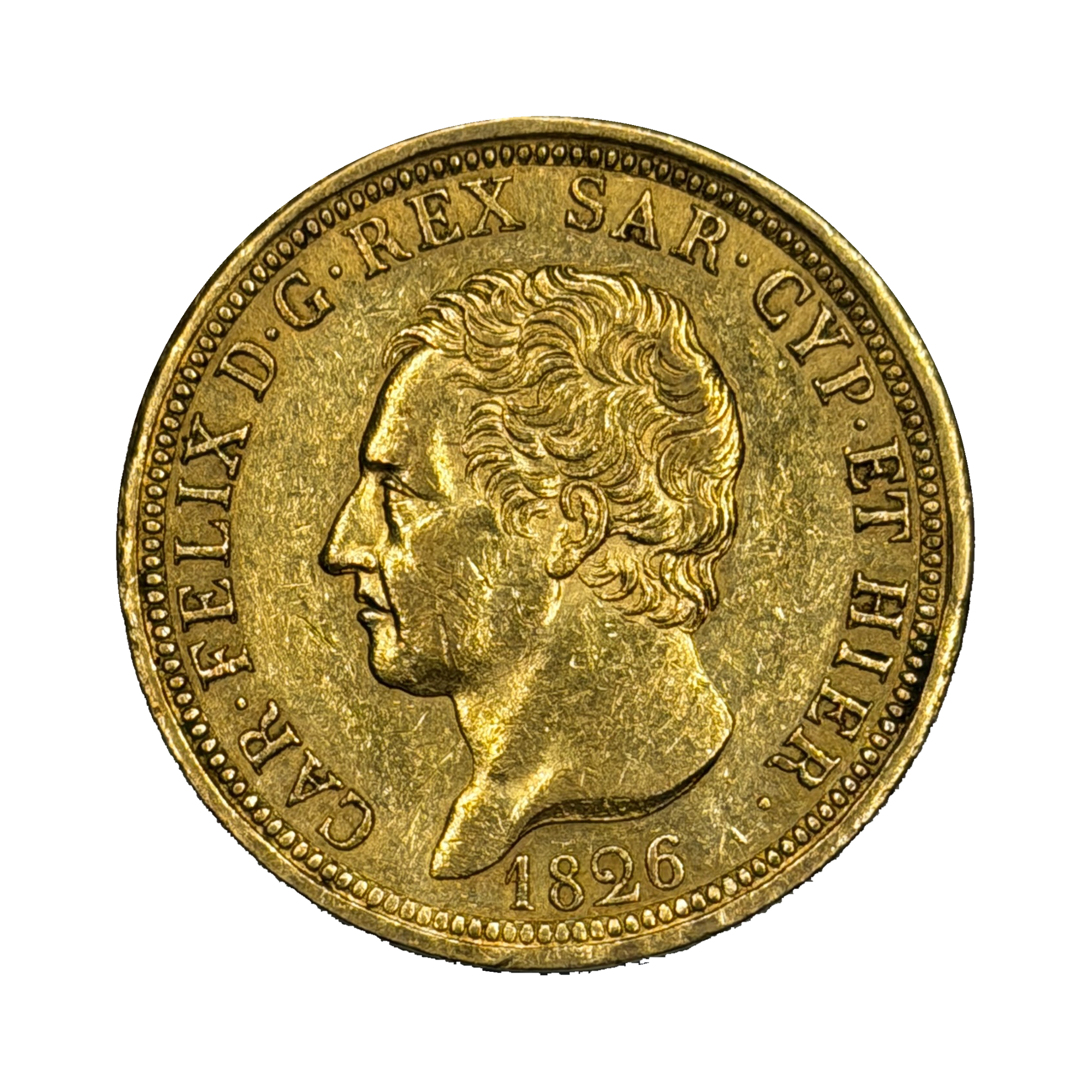
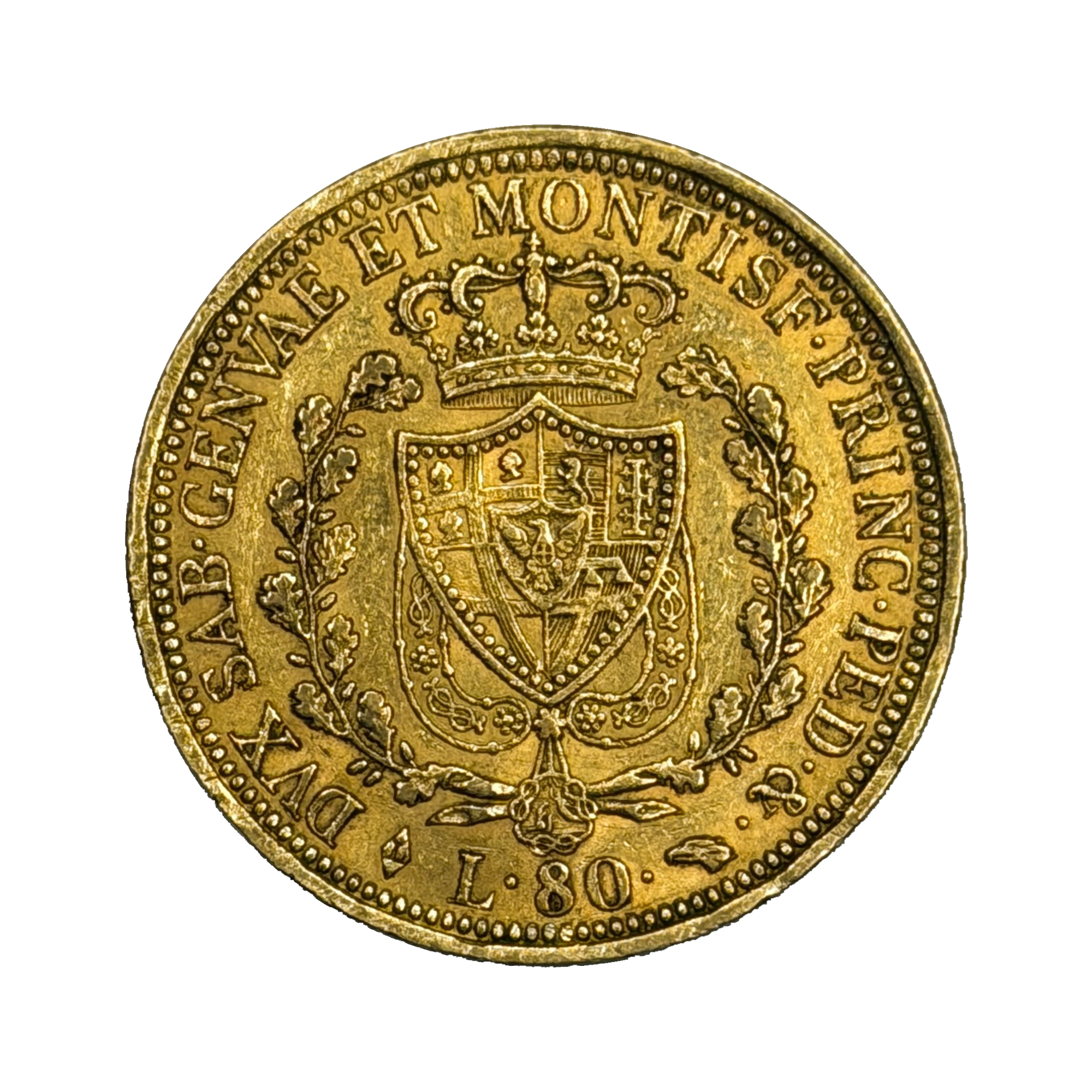
In the 1820s, the Kingdom of Sardinia — the Savoy monarchy ruled from Turin that would, a generation later, engineer the unification of Italy — struck the largest gold coin of its monetary system: the 80 Lire. At roughly three-quarters of a troy ounce of pure gold, it was a sum of genuine consequence in its day, the equivalent of four 20 Lira pieces in a single coin. Denominations of that size were never everyday money. They settled large accounts, moved between banks and merchant houses, and sat in strongboxes as stored wealth — which is precisely why large gold coins of this era were struck in far smaller numbers than the fractional workhorses that circulated hand to hand.
For investors, that history translates into a straightforward profile. The 80 Lire trades on its gold content first — roughly 0.7468 troy ounces, tracking the spot price of gold over time — while carrying the pre-1933 designation and the associated insulation against the possibility of future government intervention. And it inverts the usual scarcity logic of the historic gold market: where fractional coins earn their place through divisible negotiability, the great gold coins earn theirs through the arithmetic of their original purpose. Coins too valuable for daily commerce were minted in far smaller quantities, and fewer still survived the meltings and recoinages of the following two centuries. For investors whose priorities are a highly coveted coin steeped in the history of pre-unification Italy, comparative scarcity of the kind only the great gold coins possess, and nearly three-quarters of an ounce of standardized and widely recognized gold, the Sardinia 80 Lire occupies a place very few coins at any price point can match — an heirloom position, rarely available and almost never in quantity.
The obverse bears a left-facing bare-head portrait of King Carlo Felice, his hair curled in the neoclassical style of the Restoration era, surrounded by the Latin legend CAR·FELIX D·G·REX SAR·CYP·ET HIER — “Charles Felix, by the Grace of God, King of Sardinia, Cyprus, and Jerusalem” — with the date below. The reverse displays the full crowned arms of the House of Savoy on an ornamented shield, framed by branches of oak beneath the continuing legend DVX SAB·GENVAE ET MONTISF·PRINC·PED — “Duke of Savoy, Genoa, and Montferrat, Prince of Piedmont” — with the denomination L·80 at the base flanked by mint marks. The heraldry is deliberately elaborate: on a coin of this size, the engravers had room to render the dynasty’s full quartered arms rather than the simple cross shield of the smaller denominations.
Each coin weighs approximately 25.8 grams, is struck from .900 fine gold, and contains approximately 0.7468 troy ounces of actual gold content — the 80 Lire specification of the French germinal-franc standard on which Sardinia coined. Grade range: AU/XF. Minted 1823–1831. The type was struck only under Carlo Felice, from 1823 to 1831; his successor Carlo Alberto replaced it with a 100 Lire piece in 1832.
Carlo Felice, who reigned from 1821 to 1831, was the last of the old absolutist line of the House of Savoy — a conservative monarch of the post-Napoleonic Restoration, more comfortable with the dynastic Europe of the Congress of Vienna than with the national movements stirring beneath it. His successor Carlo Alberto, who reigned from 1831 to 1849, straddled both worlds: he granted the constitution — the Statuto Albertino — that made Sardinia-Piedmont the only Italian state with representative government, and he led the kingdom into the first war of Italian independence against Austria. When that war ended in defeat at Novara in 1849, Carlo Alberto abdicated in favor of his son — Vittorio Emanuele II, the king who would complete the Risorgimento and be crowned the first King of Italy in 1861.
The 80 Lire thus belongs to the two reigns immediately preceding unification: gold struck by the fathers of the kingdom’s constitutional turn, in the decades when Turin was quietly becoming the capital of the Italian national idea.
The early nineteenth century ran on coin. Paper money existed, but the wars and inflations of the Napoleonic era had taught European merchants to trust gold, and large-value settlement required large gold coins. The 80 Lire served that function within the Sardinian system — a banker’s and merchant’s coin, four times the value of the 20 Lira a professional might earn and spend. That original role is the source of its standing today. Fractional gold circulated by the tens of millions across Europe; the great denominations were struck in far smaller numbers because commerce simply needed fewer of them, and their high face value made them the first coins pulled back into the melting pot when monetary systems changed. A surviving 80 Lire is a coin that escaped two centuries of consolidation — issued by a kingdom that itself disappeared into the new Italian state in 1861.
The 80 Lire trades within the broader family of large historic European gold — alongside pieces like the 100 Franc and 100 Lira denominations of the later Latin Monetary Union era — and its specifications are documented in every standard world reference. Struck to the French germinal standard, its weight and fineness are immediately intelligible to any dealer who handles European gold: .900 fine, on the same system as the most familiar coins in the market. Its substantial gold content means a small number of coins can carry a meaningful gold position, and each coin liquidates as a single, easily verified three-quarter-ounce instrument wherever gold trades.
In 1933, FDR issued Executive Order 6102, requiring Americans to surrender their gold coin and bullion to the Treasury — but the order and the regulations that followed it exempted gold coins of recognized special value to collectors of rare and unusual coins. Subsequent clarifications by the Treasury identified pre-1933 gold coins — a classification that includes the Sardinia 80 Lire, struck in the 1820s through the 1840s — as falling within that collector classification as historical items.
Under current constitutional law, a government intervention in the gold market would be executed through the power of eminent domain — the government’s right to take private property for public use provided it pays the owner just compensation. Historic coins complicate the government’s ability to broadly establish “just compensation” or “fair value,” which was precisely the reasoning behind the original “recognized special value” exemption in 1933. That complexity, and the precedent surrounding pre-1933 gold coins, creates a notable impediment to the government’s ability to restrict them broadly — particularly compared to modern bullion, which can be valued easily and consistently at a single price. In essence, it is a bureaucratic question of whether the government would undertake the enormous task of valuing the diversity and complexity of the historic-coin genre — every coin, every date, every condition, every personal holding — and that difficulty is what insulates the owner’s legal liquidity rights in the event of capital controls.
Whether a future government intervention in private gold markets is a risk an investor assigns significant weight to is a personal judgment. The factual point is narrower: the pre-1933 status represents a layer of portfolio differentiation that this coin carries at minimal added per-ounce cost over comparable modern bullion, along with a measure of insulation for the legal liquidity rights of its owner.
For a more in-depth study, we invite you to read our comprehensive memorandum on this subject: Preparing for a Potential Gold Confiscation
The Sardinia 80 Lire is the great gold coin of the kingdom that made Italy — nearly three-quarters of an ounce of gold in a single pre-unification instrument, struck under the Savoy kings whose dynasty would unify the peninsula a generation later. It combines the substantial gold content of a near-ounce holding with the structural scarcity of a denomination too valuable for daily commerce and the fixed supply of a state that vanished in 1861 — a highly coveted coin that surfaces so seldom that acquisitions are best treated as heirloom positions. No other large gold coin available to investors today unites this much gold, this much history, and this much comparative scarcity in a single piece.
| Year | Mintage |
|---|---|
| 1824 (T) | 5,919 |
| 1824 (G) | 3,904 |
| 1825 (T) | 13,728 |
| 1825 (G) | 8,465 |
| 1826 (T) | 75,957 |
| 1827 (T) | 38,473 |
| 1827 (G) | 14,733 |
| 1828 (T) | 22,504 |
| 1828 (G) | 8,961 |
| 1829 (G) | 7,436 |
| 1830 (T) | 5,972 |
| 1830 (G) | 25,942 |
| 1831 (T) | 740 |
| Total | 232,734 |
Mintage figures per the Standard Catalog of World Coins, via the NGC World Price Guide. Dates NGC lists without figures are shown with a dash. T = Turin, G = Genoa. The 1821 first-year type (KM-119, 965 struck) precedes the listed range.
XF, AU
1823 – 1831
.7468 troy ounce
Sardinia
| Quantity | Wire | Card |
|---|---|---|
| 1–6 | $3,651.86 | $3,804.02 |
| 7–13 | $3,615.34 | $3,765.98 |
| 14+ | $3,578.82 | $3,727.94 |
Quantity tiers reflect the historic & fractional gold order discount (1% at $25,000+ · 2% at $50,000+ in qualifying coins). Any mix of qualifying historic coins counts toward the same order total.
Prices shown under Wire include a 4% cash discount. Card prices are the full list price. ACH bank transfer is available to established clients only. First-time orders can be paid by wire transfer or card.
Interested in gold but struggling to find the right firm?


